

Record ID: 7834
Description
Throughput-Matched Extrusion Lines — every station from the mixer to the packing scale is calculated against your grain formulation, not a generic machine rating, so a bottleneck at the flake press or oven never dictates your actual daily output.
Technical Specifications
| Parameter | Value |
|---|---|
| Product Type | Corn Flakes Production Line |
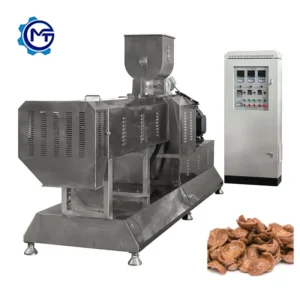
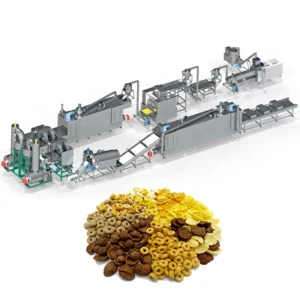
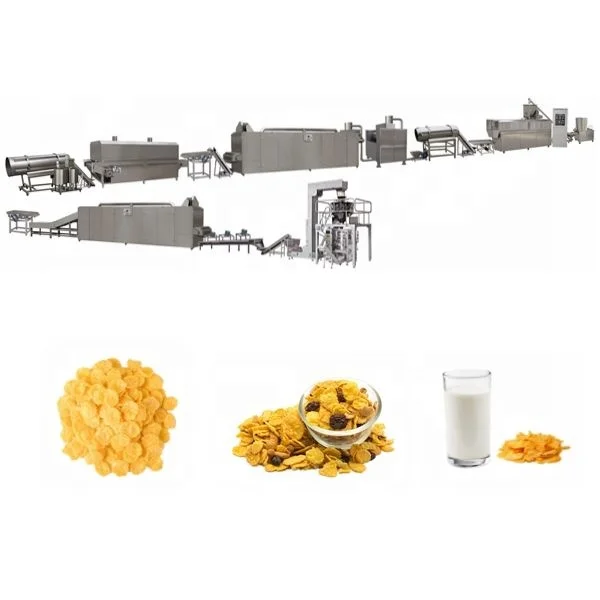
| Line Configuration | Mixer → Screw Conveyor → Twin Screw Extruder → Corn Flakes Press Machine → High-temperature Oven → Sugar Spraying System → Cooling Conveyor → Sifter → Packing Machine |
| Extruder Models Available | MT65, MT70, MT85 |
| Screw Type | Twin screw, co-rotating, sectional modules |
| Screw Material | Alloy (38CrMoAL), nitriding process |
| Barrel Design | Self-cleaning, no discharge required for material changeover |
| Motor | SIEMENS (China) |
| Inverter | Delta inverters |
| Control System | PLC and MCC control, separate control box for dryer |
| Feeding System | Speed-adjusted converter, food-grade stainless steel twin screw |
| Gearbox | Automatic lubrication function |
| Cutting System | Knife fixed in die head seat, rotary cutting by V-belt drive |
| Corn Flakes Press Roller | 510×310×1050 mm, adjustable roller distance, integrated cooling system |
| High-temperature Oven | Gas baking, both-side baking system, 0-200°C range |
| Dryer Options | 3-layer 5m / 5-layer 5m / 5-layer 7m / 5-layer 8m / 7-layer 8m / 5-layer 11m (steam dryer) |
| Sugar Spraying System | Roller Ø600×2700 mm |
| Contact Material | Food-grade stainless steel |
| MT65 Installed Power / Real Power | 70 kW / 40 kW |
| MT65 Output | 100-150 kg/h (basis not stated in source — confirm raw material formulation and moisture content) |
| MT65 Dimension | 20000×1200×2200 mm |
| MT70 Installed Power / Real Power | 100 kW / 70 kW |
| MT70 Output | 200-240 kg/h (basis not stated in source — confirm raw material formulation and moisture content) |
| MT70 Dimension | 25000×1500×2200 mm |
| MT85 Installed Power / Real Power | 200 kW / 150 kW |
| MT85 Output | 300-400 kg/h (basis not stated in source — confirm raw material formulation and moisture content) |
| MT85 Dimension | 30000×3500×4300 mm |
| Mixer Power / Tank Size | 4 kW / φ600×500 mm |
| Standards | CE, ISO |
Application Suitability
| Application | Material or Output |
|---|---|
| Corn flakes production | Maize, corn grits, standard and white corn varieties |
| Breakfast cereal production | Rice, wheat, oat, rye and multi-grain blends |
| Flavoured corn flakes | Sugar-coated, salt-coated, honey-coated cereal flakes |
| Fortified cereal lines | Vitamin- and mineral-enriched breakfast cereal formulations |
| Institutional nutrition programmes | Consistent-density flakes for large-scale food distribution |
What "300 kg per Hour" Leaves Out on a Corn Flakes Line
Nominal capacity ratings assume a standard formulation that almost never matches what arrives at your factory dock.
I spent years doing after-sales calls across Latin America before moving into order delivery, and the pattern was always the same: a line ran perfectly on the supplier’s test floor with calibrated corn grits, then choked on the buyer’s local grain. One Chilean project stands out — the crusher screen blinded within hours because the local white corn had a finer particle size than the trial material. The whole line sat idle while workers waited two days for a replacement screen. That is why every corn flakes production line turnkey we ship now goes through a trial run on your exact raw material before it leaves the workshop. A capacity number without a formulation basis is just marketing [NEED_CITE: grain particle size distribution and its effect on extruder feeding stability].
Screw Geometry and Barrel Profile for Grain Extrusion
The twin-screw, co-rotating configuration on MT65, MT70, and MT85 is designed for the specific shear and residence-time requirements of cereal doughs. The sectional screw modules can be rearranged so that the compression ratio and kneading block sequence match your grain blend — whether you are running pure corn or a wheat-oat mixture that gelatinises at a different temperature window. The barrel maintains a self-cleaning ability, which means you do not need to disassemble and manually purge when switching between formulations. A corn flakes production line turnkey that cannot adapt its screw profile to your recipe will produce inconsistent flake density from batch to batch.
Press Roller Gap and Thermal Uniformity
The flake press machine uses a 510×310×1050 mm roller set with adjustable gap spacing, giving you direct control over final flake thickness. An integrated cooling system on the roller prevents dough adhesion and maintains surface consistency through long production runs. Downstream, the high-temperature oven applies gas-fired heat from both sides, so flakes in the centre of the belt receive the same thermal exposure as those at the edges. This matters because uneven baking creates a mix of crisp and leathery flakes in the same batch, and downstream sugar coating will not adhere uniformly to a surface that still holds residual moisture [NEED_CITE: moisture gradient effects on sugar coating adhesion in breakfast cereal production].
What the Power and Inverter Specs Mean at Floor Level
Each extruder model pairs a SIEMENS motor with Delta inverters on the feeding and cutting systems. The inverter-controlled twin-screw feeder synchronises raw material input to screw speed, preventing surges that cause pressure spikes at the die. The gearbox has automatic lubrication, which reduces the chance of bearing failure during extended runs. The PLC and MCC control architecture gives operators a single interface to monitor barrel temperature zones, screw RPM, feeder rate, and oven temperature simultaneously. On a corn flakes production line turnkey, losing synchronisation between any two of these variables shifts flake bulk density outside your packing specification.
When Stations Are Sized by Spreadsheet Instead of Reality
A common procurement mistake is matching line stations to the extruder nameplate rather than to your actual product target. If the sugar spraying system drum is undersized relative to extruder output, flakes accumulate on the cooling conveyor and absorb ambient moisture before coating. If the oven is too short for your target moisture reduction, you either slow the line or ship flakes that stale within weeks. The cost is not the equipment itself — it is the weeks of lost production while you identify which station is the constraint [NEED_CITE: throughput bottleneck analysis in food extrusion lines].
How This Line Gets Built and Verified
The line layout and capacity calculation document maps throughput at every station — mixer batch cycle, extruder kg/h, press roller surface speed, oven dwell time, and sugar drum residence — against your specific grain formulation. Screw and die configuration records are generated after a trial run on your raw material in the in-house testing workshop, not copied from a generic build. Electrical schematics and voltage confirmation are locked before production starts, so there are no surprises when the control cabinet meets your local power supply. The MT65, MT70, and MT85 models share the same modular station philosophy, so whether your target is 100-150 kg/h (basis to be confirmed) or a higher throughput, every downstream component is scaled proportionally.
Documentation & Verification
- Line layout and capacity calculation matched to your grain formulation and target flake density
- Screw and die configuration record generated after trial run on your raw material
- Electrical schematic with voltage and frequency confirmation for your local supply
- Trial run report covering extruder pressure, flake thickness, and oven moisture reduction data
- CE declaration of conformity and ISO certificate for customs and regulatory clearance
- Wear parts list with screw module and die specifications for reorder planning
Installation, Commissioning & Support
- Floor plan based on MT85’s 30000×3500×4300 mm footprint with utility connection points marked
- Dedicated circuit sizing confirmed against the selected model’s installed power rating (70-200 kW range)
- Modular station delivery allows phased assembly in facilities with limited overhead clearance
- First-run parameter logging for barrel temperature zones, roller gap, and oven profile by commissioning engineer
- Operator training on PLC and MCC interface covering formulation changeover and fault diagnostics
- Initial spare set of 38CrMoAL screw modules and die plates included for first replacement cycle
What to Prepare Before Requesting a Quotation
A corn flakes production line turnkey proposal needs more than a target capacity number. Send us your grain type, particle size distribution, and moisture content so the extruder screw profile can be specified correctly. Confirm your local voltage, frequency, and preferred control language to avoid rewiring on site. Let us know your workshop ceiling height and available floor length — the MT85 configuration requires significant linear space, and the oven and sugar spraying system need clearance above the conveyor path. If you are replacing or extending an existing line, share details of upstream storage and downstream packing equipment so throughput matching covers the full process.
Frequently Asked Questions
Q: How is output capacity verified on my actual grain formulation rather than nominal machine ratings?
A: Before shipment, your raw material is run through the extruder, flake press, and oven in the in-house testing workshop. The trial run report records actual kg/h throughput, flake thickness, moisture reduction, and bulk density. The capacity figures quoted in your proposal are based on these trial results, not on generic nameplate ratings.
Q: What voltage, frequency, and control language options are confirmed before production begins?
A: Electrical schematics and voltage confirmation are completed during the design phase. You specify your local supply voltage and frequency, and the control panel is built accordingly. PLC interface language is set to your operator preference before the control cabinet leaves the factory, preventing commissioning delays on site.
Q: How are the flake press roller gap and oven temperature profile matched to achieve target flake thickness and crispness?
A: The press roller gap is adjustable on the 510×310×1050 mm roller set, and the initial setting is determined during the trial run based on your target flake specification. The gas-fired oven temperature profile across both heating sides is then tuned to achieve the required final moisture content without over-browning.
Q: Can a trial run be performed on my raw material before shipment, and what does the trial report cover?
A: Yes, the testing workshop runs your formulation through the complete station sequence. The report documents extruder barrel pressure, screw RPM, flake dimensions after pressing, oven exit moisture, and sugar coating adhesion. You receive the report before authorising shipment.
Q: What is the phased installation, commissioning schedule, and operator training scope for a complete line?
A: Stations arrive as modular units and are assembled in sequence from mixer to packer. Commissioning covers individual station checks, then full-line synchronisation with your formulation. Operator training covers the PLC and MCC interface, roller gap adjustment, oven temperature control, and routine screw and die changeover procedures.
Related products
-
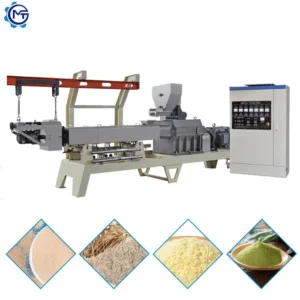
New Technical Automatic Cereal Nutritional Powder Instant Porridge Baby Food Making Machine
¥10,000.00 Select options This product has multiple variants. The options may be chosen on the product page -
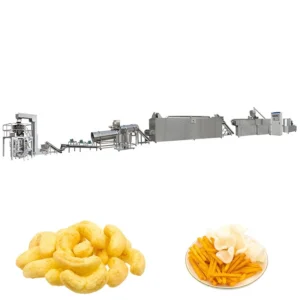
Corn Flake Making Machine Corn Puffs Making Machine Snack Food Production Line
Price range: ¥500.00 through ¥1,200.00 Select options This product has multiple variants. The options may be chosen on the product page -
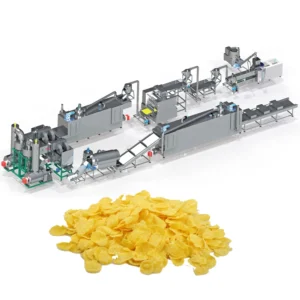
Intelligent Corn Flakes Production Line Twin Screw Extruder to Make Corn Flakes amd Morning Cereals
¥30.00 Select options This product has multiple variants. The options may be chosen on the product page -
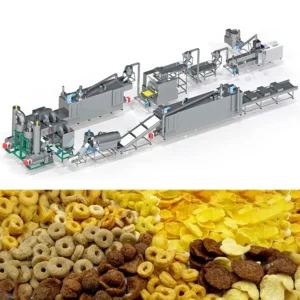
Corn Flakes Breakfast Cereal Production Line Making Machine Automatic
¥8,000.00 Select options This product has multiple variants. The options may be chosen on the product page