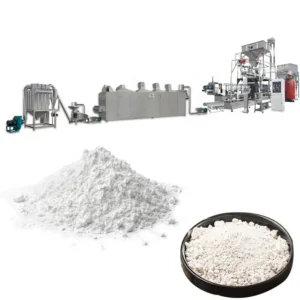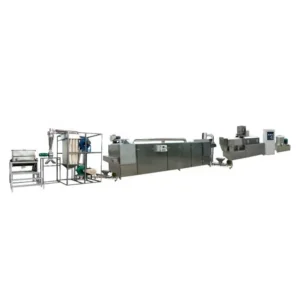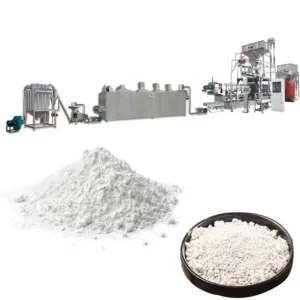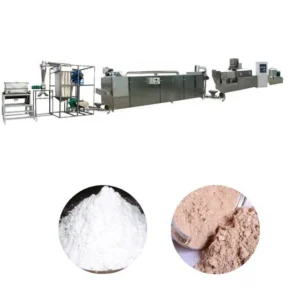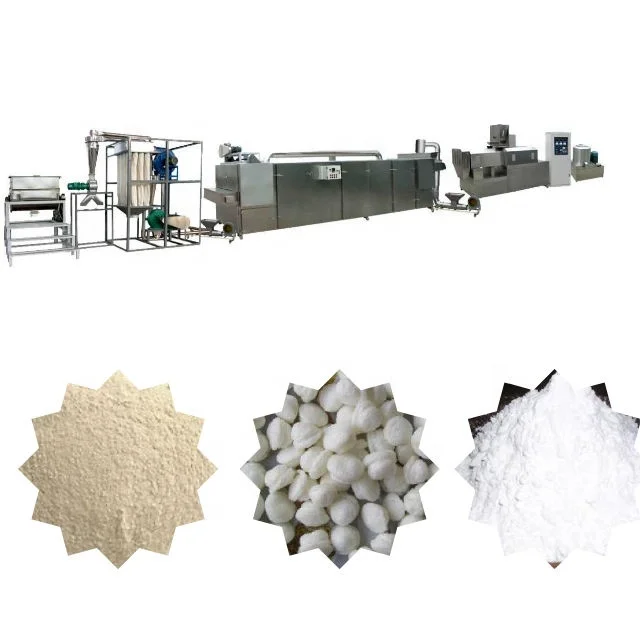


MT70 / MT85 / MT75 Modified Starch Production Line, Twin-Screw Extrusion, PLC & MCC Control — engineered as a complete turnkey project from batching through extrusion, drying and grinding to packing. Every station is throughput-matched to eliminate bottlenecks, with screw configuration and die design specified to your starch source and target modification degree. Line layout, utility planning and phased commissioning are delivered under one supplier responsibility.
- 3 capacity tiers with multi-fuel 5-layer dryer options
- Integrated barrel cooling with 7 heating zones for precise gelatinisation control
- Factory trial runs on your raw material before shipment
Description
Line throughput matched to your starch source — Every MT70, MT85 and MT75 modified starch production line turnkey project we deliver is configured after in-house trial runs on the buyer’s actual raw material, not a generic catalog build.
Technical Specifications
| Parameter | Value |
|---|---|
| Product Type | Modified Starch Production Line (Twin-Screw Extrusion) |
| Model Options | MT70, MT85, MT75 |
| Screw Type | Twin-screw |
| MT70 Installed Power | 160 kW |
| MT70 Power Consumption | 120 kW |
| MT70 Output Capacity | 150–200 kg/h (basis not stated in source — confirm raw material / moisture content / starch type) |
| MT70 Overall Dimensions | 41000 × 1500 × 2200 mm |
| MT85 Installed Power | 190 kW |
| MT85 Power Consumption | 140 kW |
| MT85 Output Capacity | 300–400 kg/h (basis not stated in source — confirm raw material / moisture content / starch type) |
| MT85 Overall Dimensions | 43000 × 1500 × 3200 mm |
| MT75 Installed Power | 210 kW |
| MT75 Power Consumption | 150 kW |
| MT75 Output Capacity | 300–500 kg/h (basis not stated in source — confirm raw material / moisture content / starch type) |
| MT75 Overall Dimensions | 45000 × 1500 × 3500 mm |
| Voltage & Frequency | 380V 50Hz Three Phase (configurable: 380V 60Hz, 415V 60Hz, 220V 60Hz) |
| Control System | PLC and MCC control |
| Extruder Screw Material | 38CrMoAl |
| Extruder Screw Diameter (MT70) | 70 mm |
| Extruder Screw Length (MT70) | 1510 mm |
| Barrel Heating | 7 zones × 2 kW with integrated cooling system |
| Dryer Type | 5-layer baking oven |
| Dryer Fuel Options | Gas / Diesel / Electricity / Steam |
| Dryer Dimensions | 5000 × 1200 × 2300 mm |
| Dryer Drive Power | 3 kW with inverter speed control |
| Grinding System | Pulse grinder with cyclone discharge and dust collector |
| Mixer Contact Material | 201SS or 304SS stainless steel |
| Certifications | CE, ISO |
Application Suitability
| Application | Material or Output |
|---|---|
| Pregelatinised starch for food industry | Corn starch, tapioca starch, wheat starch |
| Modified starch for paper and textile sizing | Cassava starch, potato starch |
| Expanded corn starch for packaging filler | Corn starch with controlled moisture feed |
| Industrial starch modification | Various starch sources for pharmaceutical and food-grade applications |
Why "300 kg/h" Means Nothing Without Your Raw Material on the Table
Capacity figures quoted on generic starch will not hold on your production floor unless the entire line is tuned to what you actually feed it.
A modified starch production line turnkey project looks simple on paper until the raw material changes. I watched a line built for tapioca starch deliver consistent gelatinisation in our testing workshop, then struggle when the buyer switched to corn starch for pregelatinised output after installation. The expansion index dropped, and the dryer could not keep up with the altered moisture profile. Three weeks of screw reconfiguration followed before the line held steady output [NEED_CITE: raw material variability in starch extrusion processing]. This is why every project we take on starts with your actual starch source running through our extruder before anything ships.
Engineering the Line as One Continuous System
When we plan a modified starch production line turnkey layout, the mixer batch cycle, extruder feed rate, dryer residence time and pulse grinder throughput are all calculated together. A mixer that batches too slowly starves the extruder; a dryer that cannot match extruder output creates a bottleneck that forces the entire line to throttle back. Each station is sized so material flows continuously without accumulation or starvation at any point.
How Phased Installation Reduces Commissioning Risk
For new plant builds, we stage installation in phases — extruder and dryer first, then upstream mixing and downstream grinding and packing. This lets the electrical team verify the 380V three-phase supply and PLC communication on the core extrusion section before the full line is energised. Utility routing for steam or gas to the dryer is planned alongside the floor layout so that pipework does not conflict with maintenance access around the extruder barrel [NEED_CITE: industrial utility planning standards for food processing facilities]. Operator training runs parallel to each phase so your team understands one section before the next comes online.
Reading the Specs That Actually Matter for Starch Modification
The twin-screw configuration is central to this line because starch gelatinisation demands controlled shear and residence time that single-screw machines cannot deliver consistently across varying feed compositions. The 7-zone barrel heating with integrated cooling lets operators set a temperature gradient along the 1510 mm screw length — higher heat near the feed zone to initiate gelatinisation, then cooling toward the die to control expansion and prevent over-cooking. The 38CrMoAl screw material resists the abrasive wear that starch causes over thousands of operating hours. On the drying side, the 5-layer oven with inverter-controlled belt speed gives operators the ability to adjust residence time by altering belt speed rather than changing temperature, which protects heat-sensitive modifications already achieved in the extruder. The pulse grinder downstream uses cyclone discharge to separate fine powder from oversize particles, and the dust collector keeps the grinding area clean — important when producing food-grade or pharmaceutical-grade starch where cross-contamination must be eliminated.
What Happens When Stations Are Sourced Separately
I have seen buyers assemble a modified starch line from different vendors — one for the extruder, another for the dryer, a third for grinding. The extruder output exceeds what the dryer can handle, moisture leaves the dryer too high, and the grinder chokes on material that should have been dried further. The buyer then blames the extruder supplier, who blames the dryer, and production stalls while everyone argues [NEED_CITE: throughput mismatch risks in multi-vendor processing lines]. With a single-supplier turnkey project, every station is spec’d against the same capacity target and raw material profile, and one team owns the result.
Why Buyers Place This Project With Us
Our testing workshop runs your starch through the actual extruder configuration before shipment, producing a trial run report that confirms gelatinisation degree, expansion behaviour and dryer performance on your material. Screw and die combinations are documented specifically for your project, not pulled from a generic build sheet. The line layout we provide accounts for your workshop dimensions and utility entry points. We assign a project engineer who follows the build from factory test through on-site commissioning, and that same engineer handles post-installation support calls. PLC and MCC programming is completed in our facility with the control language and voltage set to your site specification before the cabinets are wired to the machines.
Documentation & Verification
- Line layout drawing with throughput calculation matched to your starch type
- Screw and die configuration record specifying your raw material and target modification
- Trial run report from our testing workshop on your supplied starch sample
- Electrical schematic confirming voltage, frequency and control language for your site
- Factory test record with operating parameters logged before dispatch
- CE declaration of conformity and ISO certificate documentation
Installation, Commissioning & Support
- Floor plan marking for extruder and dryer placement within your 41–45 m line length envelope
- Dedicated circuit planning for 160–210 kW installed power depending on model selected
- PLC and MCC commissioning with I/O verification against your site voltage and frequency
- Barrel temperature profile tuning across 7 heating zones during first production run
- Operator training covering screw speed, feeder rate and dryer belt speed adjustment
- Wear parts list covering 38CrMoAl screws, dies and grinder blades with stocking guidance
What We Need to Start Your Project Layout
Send us the starch type you plan to process, your target modification or pregelatinisation specification, and the daily output you need to hit. Include your workshop floor dimensions and ceiling height so we can draft a line layout that fits, along with your local voltage and frequency so the electrical package is built correctly from the start.
Frequently Asked Questions
Q: How do you verify the line will meet capacity on our specific starch raw material?
A: We run your starch sample through the extruder in our testing workshop before the line ships. The trial run confirms screw configuration, barrel temperature profile and dryer settings against your target modification degree. We document every parameter and include the report with your shipment so production starts from a known baseline.
Q: What utility connections does the modified starch production line turnkey project require?
A: The line needs a three-phase power supply matching your local voltage and frequency, configurable from 220V to 415V. The 5-layer dryer can be set up for gas, diesel, electricity or steam depending on your site availability. Compressed air is needed for pneumatic controls and the pulse grinder dust collection system.
Q: How is the workshop layout planned for different capacity tiers?
A: The MT70 requires approximately 41 m in length, the MT85 about 43 m and the MT75 around 45 m, each with roughly 1.5 m width plus maintenance clearance. We draft a layout drawing based on your workshop dimensions that includes utility routing and operator access paths before production begins.
Q: What does commissioning and training include on site?
A: Our engineer supervises mechanical assembly, electrical connection and first production runs. Training covers PLC operation, barrel temperature adjustment, screw speed and feeder rate tuning, dryer belt speed control and routine maintenance on the 38CrMoAl screws and grinder blades.
Q: How are spare wear parts managed for ongoing production?
A: We provide a wear parts list covering screws, dies and grinder blades with recommended stocking quantities. Parts are manufactured to the same 38CrMoAl specification as the original configuration and can be ordered against your project record so replacement sets match your screw and die setup exactly.
Related products
-
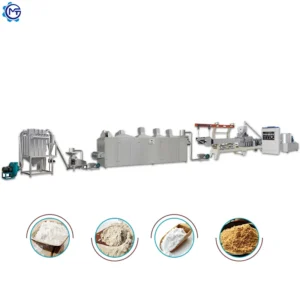
Twin-Screw Extrusion Line for Modified Starch. Producing Pregelatinized Adhesive & Food Grade Powder
¥65.00 Select options This product has multiple variants. The options may be chosen on the product page -
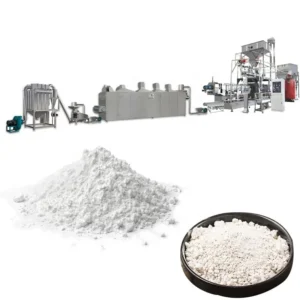
Corn Cassava Modified Starch Powder Production Line Electric-powered Motor Automatic 400kg/h Processing Equipment New Condition
¥65.00 Select options This product has multiple variants. The options may be chosen on the product page -
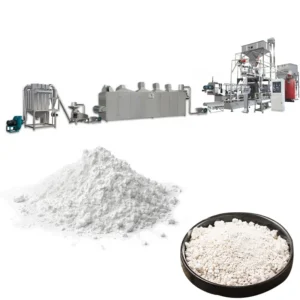
High-Efficiency Customizable Modified Starch Production Line – Automatic Corn Pellet Adhesive Making Equipment
¥65.00 Select options This product has multiple variants. The options may be chosen on the product page -
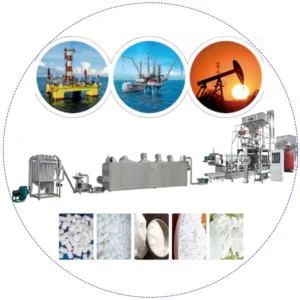
Cassava & Pregelatinized Corn Starch Extrusion Equipment – CE Certified Industrial Twin-Screw Modified Starch Line
¥65.00 Select options This product has multiple variants. The options may be chosen on the product page