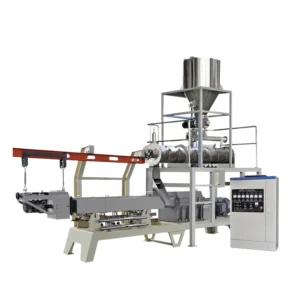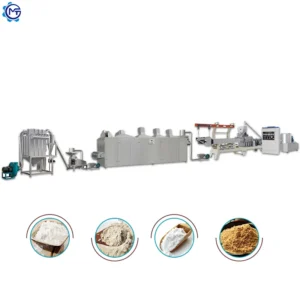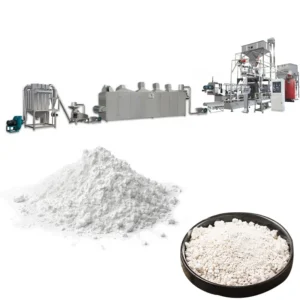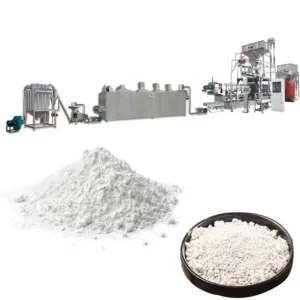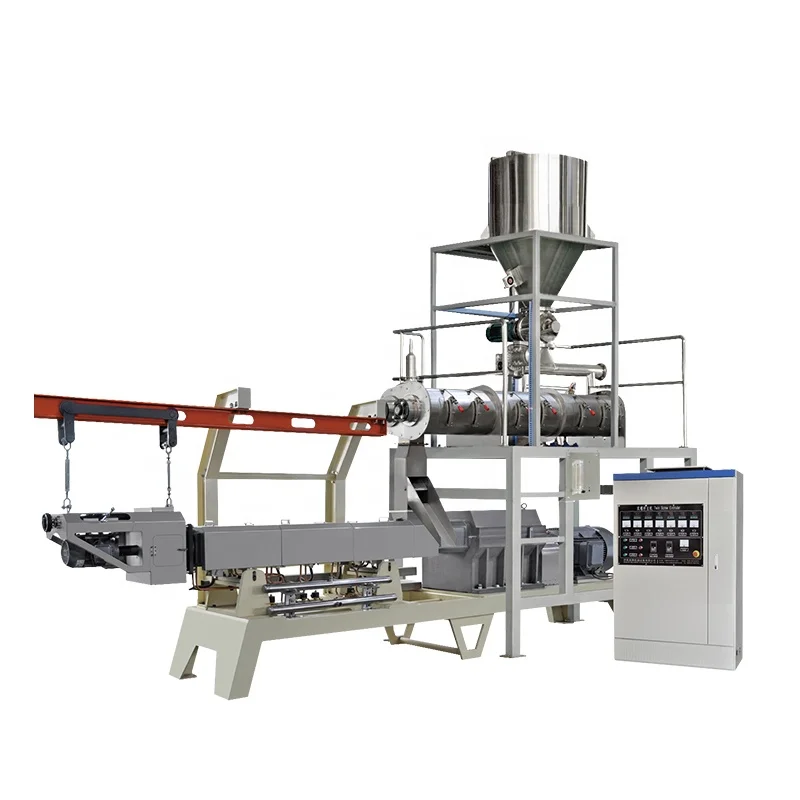


MT65 / MT70 / MT75 Modified Starch Production Line, Twin Screw Extruder, PLC Control — designed for corn, rice, cassava and bean starch processing.
- Customizable screw and barrel configuration matched to raw material and target denatured starch grade
- Complete turnkey layout from flour mixer through extruder, multi-layer roasting oven to pulse grinder
Every station throughput is calculated so dryer and grinding capacity align with extruder output, preventing downstream bottlenecks. Trial runs on your raw material are completed in our testing workshop before shipment.
Description
Complete line throughput matching — Every station from the flour mixer to the pulse grinder is calculated against the extruder’s real output on your starch type, preventing downstream bottlenecks that cap the entire Modified Starch Production Line turnkey below its rated capacity.
Technical Specifications
| Parameter | Value |
|---|---|
| Model | MT65 / MT70 / MT75 |
| Product Type | Modified Starch Twin Screw Extrusion Production Line |
| Screw Type | Twin screw |
| Installed Power | 110 kW (MT65); 160 kW (MT70); 190 kW (MT75) |
| Power Consumption | 90 kW (MT65); 140 kW (MT70); 150 kW (MT75) |
| Output Capacity | 100–150 kg/h (MT65, basis to be confirmed); 150–200 kg/h (MT70, basis to be confirmed); 300–350 kg/h (MT75, basis to be confirmed) |
| Overall Dimensions (L×W×H) | 40,000×1,500×2,200 mm (MT65); 41,000×1,500×2,200 mm (MT70); 43,000×1,500×3,200 mm (MT75) |
| Voltage & Frequency | 380 V, 50 Hz, three-phase (full line voltage configurable per market) |
| Control System | PLC with frequency conversion control across feeding, rotary cutting, and spindle |
| Barrel & Screw Configuration | Customizable for modified and denatured starch processing |
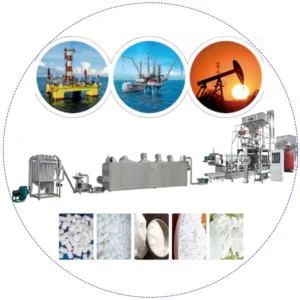
| Line Stations | Flour mixer → Screw conveyor → Twin screw extruder → Air conveyor → Roasting oven → Air conveyor → Pulse grinder |
| Mixer Power Options | 4 kW / 7.5 kW / 15 kW |
| Mixer Batch Capacity | 20–30 kg; 70–80 kg; 170–180 kg per batch |
| Mixer Material | Stainless steel (201 S.S. or 304 S.S.) |
| Dryer Type | Multi-layer roasting oven with round-trip drying, adjustable temperature and time, multiple heating fuel options |
| Pulse Grinder Motor | 15 kW drive, 1.5 kW air circulation, 1.1 kW impeller fan |
| Pulse Grinder Mesh | 100–120 mesh |
| Pulse Grinder Contact Material | Stainless steel (hopper and product-touch parts) |
| Raw Materials | Corn, rice, cassava, beans, and other grains |
| Warranty | 1 year complete guarantee with lifetime maintenance |
| Certification | CE; ISO |
Application Suitability
| Application | Material or Output |
|---|---|
| Modified starch for textile sizing | Corn or cassava starch processed to target viscosity and solubility |
| Denatured starch for paper coating | Rice or corn starch with controlled gelatinisation degree |
| Modified starch for oil drilling fluids | Cassava or corn starch extruded for thermal stability |
| Denatured starch for construction additives | Corn or bean starch processed to target water retention |
| Nutritional fortified powder | Multi-grain blends including rice, corn, and bean flours |
| Pre-gelatinised starch for food ingredients | Corn or cassava starch with adjustable expansion and moisture |
Why Quoted Capacity Rarely Survives Contact with Your Raw Material
A Modified Starch Production Line turnkey rated at a nominal throughput on corn starch may deliver considerably less when your actual feedstock is cassava or waxy maize, because gelatinisation temperature, amylose ratio, and moisture absorption all shift the extruder’s real output.
The capacity number on a quotation only holds when the screw configuration, barrel temperature profile, and die geometry have been matched to your specific starch source and target modification grade.
I learned this the hard way years ago. A customer ordered a line that ran beautifully on corn starch during our workshop trial. When the machines arrived at their facility, we discovered their production feedstock was cassava starch. The gelatinisation window was completely different. The screw combination and barrel heating zones had to be rebuilt from scratch, and I spent half a month on-site re-commissioning the line. That is why I now insist on receiving the buyer’s actual raw material for a trial run before signing off on any shipment [NEED_CITE: starch gelatinisation temperature ranges by botanical source]. Without that step, the capacity figure in the contract is little more than a hope.
Barrel Zones and Screw Elements Built Around Your Starch
Twin screw extrusion gives operators precise control over shear, residence time, and temperature at each barrel zone, which is critical when processing starches with different amylose-to-amylopectin ratios. The barrel and screw configuration on this line is designed specifically for modified and denatured starch processing rather than borrowed from a generic snack or feed build. Each screw element section — conveying, kneading, and reverse-flight — is selected based on the buyer’s target degree of gelatinisation and the thermal sensitivity of the raw material. This level of configuration is what separates a Modified Starch Production Line turnkey that hits its specification from one that produces unevenly cooked output with variable solubility.
Matching Dryer and Grinder to Extruder Output
The multi-layer roasting oven uses round-trip drying with a double pitch roller chain drive, allowing adjustable temperature profiles and drying times to suit different starch moisture levels exiting the extruder. Downstream, the pulse grinder reduces dried extrudate to 100–120 mesh powder with stainless steel contact surfaces. If the dryer cannot handle the moisture load from the extruder, or if the grinder chokes on feed rates above its design point, the entire line slows to the pace of its weakest station. Throughput matching across every piece of equipment is verified during the line layout stage, not discovered during commissioning [NEED_CITE: industrial starch drying load calculation methods].
What the Specifications Mean for Your Production
The installed power range from 110 kW to 190 kW across the three models reflects the motor capacity needed to maintain consistent screw speed under the viscous load of gelatinising starch. Twin screw extruders generate shear heating internally, and the barrel zones supplement this with external heating — the balance between the two determines whether starch granules swell uniformly or rupture unevenly. The PLC and frequency conversion control allows operators to tune feeding rate, screw speed, and cutting speed independently, which is essential when switching between starch sources or target modification grades. The pulse grinder’s 15 kW drive motor paired with dedicated air circulation and impeller fan motors ensures stable powder classification at the target mesh size, preventing the oversize fraction from recycling back and overloading the grinding chamber.
The Cost of Skipping Configuration Verification
When a line ships with a generic screw and die setup that was never tested against the buyer’s raw material, the consequences cascade through the entire facility. The extruder may run, but the starch gelatinisation will be incomplete or uneven, producing powder that fails the buyer’s own downstream quality checks. The dryer then has to work harder to remove residual moisture from under-processed material, consuming more energy while still delivering off-spec product. Operators end up running the line well below its nameplate capacity just to maintain acceptable quality, and the investment in a full Modified Starch Production Line turnkey delivers a fraction of the planned output [NEED_CITE: consequences of incorrect screw configuration in starch extrusion].
Why Procurement from One Responsible Supplier Matters
Every station on this line — mixer, conveyor, extruder, dryer, grinder — is specified and supplied by a single source, so throughput calculations are done once and honoured across every machine. The screw and die configuration is recorded against your raw material and target starch grade, not copied from another application. An in-house testing workshop allows trial runs on your actual feedstock before the line is packed for shipment. Voltage, frequency, and control language are confirmed against your facility’s electrical infrastructure before production begins, not discovered as a mismatch during installation. Documentation covering the full line — from electrical schematics through trial run reports — ships with the equipment, giving your maintenance team a single reference point.
Documentation & Verification
- Line layout drawing with capacity calculation matched across all stations
- Screw and die configuration record specific to your starch type and modification target
- Electrical schematic with confirmed voltage, frequency, and control language
- Trial run report generated on your raw material in the testing workshop
- CE declaration of conformity and ISO certificate for the complete line
- Operation and maintenance manual covering every station from mixer to grinder
Installation, Commissioning & Support
- Foundation planning accounts for the 40–43 metre line length and dryer height up to 3,200 mm
- Dedicated electrical circuit sized for the 110–190 kW installed power depending on model selected
- Frequency conversion drives on feeding, cutting, and spindle tuned to your starch during commissioning
- Multi-layer dryer temperature zones calibrated to your material’s drying curve on site
- Pulse grinder mesh screen and air flow balanced against your target particle size distribution
- Wear parts list with screw elements, die plates, and grinder screens identified for first reorder
What We Need to Move Your Project Forward
To configure a line that delivers on its capacity promise, share your starch source and grade specifications, your target daily output in finished powder, and your facility’s available floor area and ceiling height. Confirm your local voltage and frequency standard, the preferred control panel language, and whether you can send a representative batch of raw material for a pre-shipment trial run. If you have existing upstream milling or downstream packing equipment, provide the interface specifications so the line can be integrated without gap or bottleneck.
Frequently Asked Questions
Q: How is line throughput verified so extruder output matches dryer and grinder capacity?
A: Each station’s capacity is calculated against the extruder’s real output on your specific starch, accounting for moisture addition and expansion ratio. A trial run in our testing workshop confirms the numbers before the line ships, and the layout drawing documents the matched throughput for every station.
Q: Can the screw and barrel configuration be specified to our raw material and target starch grade?
A: Yes. The screw element sequence and barrel temperature zones are designed around your starch source — corn, cassava, rice, or blends — and the degree of gelatinisation or modification your end product requires. The configuration is recorded and shipped with your documentation package.
Q: What voltage, frequency, and control language options are available for our market?
A: The standard mixer runs on 380 V, 50 Hz three-phase, but the full line voltage and frequency are confirmed during the specification stage to match your facility’s supply. Control panel language and PLC interface are set to your operators’ preference before factory testing.
Q: Is a trial run on our raw material performed before shipment?
A: We require a sample of your actual production feedstock for a trial run in our testing workshop. The results — including output rate, gelatinisation degree, and powder characteristics — are documented in a report that you review before authorising shipment.
Q: What does turnkey installation include for this line?
A: Installation covers layout planning, foundation guidance, equipment positioning, utility connection supervision, and full commissioning with parameter tuning on your material. Operator training covers PLC operation, screw speed adjustment, dryer temperature management, and daily maintenance routines for every station.
Related products
-
Pregelatinized Low-Cost Modified Starch Line – High-Efficiency Automated Starch Processing Machine
¥65.00 Select options This product has multiple variants. The options may be chosen on the product page -
Cassava Corn Potato Flour Starch Production Line – Industrial Pregelatinized & Modified Extrusion Machinery
¥65.00 Select options This product has multiple variants. The options may be chosen on the product page -
Automatic Modified Corn Starch Making Machine 304 Stainless Steel Gearbox High Efficiency Starch Processing Production Line
¥30.00 Select options This product has multiple variants. The options may be chosen on the product page -
Cassava & Pregelatinized Corn Starch Extrusion Equipment – CE Certified Industrial Twin-Screw Modified Starch Line
¥65.00 Select options This product has multiple variants. The options may be chosen on the product page