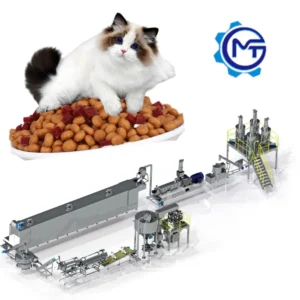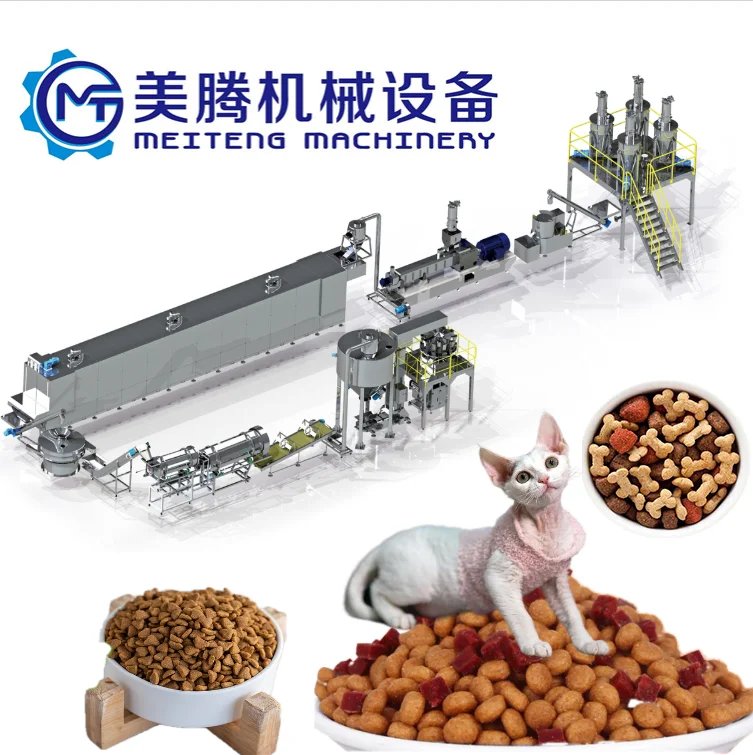


MT70 Pet Food Processing Line, 100-200 kg/h, Twin-Screw Extruder, PLC & MCC Control — engineered for dry kibble, semi-moist, and treat formats with screw configuration and die design matched to your raw material and target density.
- Fully integrated from mixing through extrusion, drying, and packaging with throughput balanced across every station
- In-house trial runs on your specific formulation before shipment, with layout and capacity calculated to your factory footprint
Trusted by producers in 60+ countries for turnkey pet food projects backed by single-supplier accountability from design through commissioning.
Description
Turnkey throughput matching — the MT70 pet food processing line is engineered so extruder output, dryer residence time, and packing speed stay synchronized under one supplier’s accountability rather than assembled from separate vendors.
Technical Specifications
| Parameter | Value |
|---|---|
| Model | MT70 |
| Product Type | Pet Food Processing Line |
| Extruder Type | Twin-screw |
| Output Capacity | 100–200 kg/h (basis not stated in source — confirm raw material formulation, moisture content, and kibble size) |
| Voltage & Frequency | 380V 50Hz Three Phase |
| Control System | PLC and MCC |
| Automation Level | Fully automated from mixing through extrusion, drying, to packaging |
| Line Stations | Mixing, extrusion, drying, flavouring, packaging |
| Recipe Adaptability | Dry kibble, semi-moist pet food, treats |
| Assembly State | Modular components |
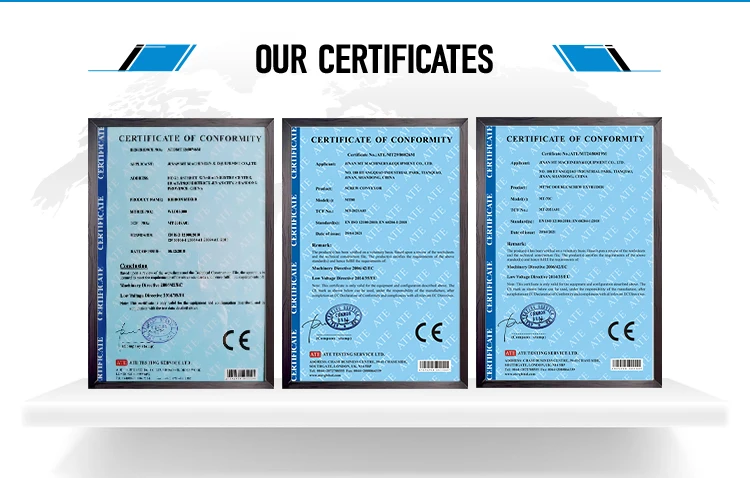
| Certification | CE, ISO |
Application Suitability
| Application | Material or Output |
|---|---|
| Dry kibble production for dogs and cats | Corn, meat meal, poultry by-product, fish meal blends |
| Semi-moist pet food formulation | High-moisture meat slurry with starch binders |
| Functional pet treats | Protein concentrates, vitamin premixes, fibre supplements |
| Aquatic-adjacent companion animal diets | Mixed grain and animal protein with adjusted density targets |
What "100–200 kg/h" Actually Depends On
Capacity is only meaningful when tied to the buyer’s specific raw material formulation and target kibble density.
I have watched lines rated at a nominal throughput lose half their output the moment the buyer switches from a standard corn base to a fresh chicken slurry recipe. The starch gelatinisation window shifts, expansion collapses, and the dryer cannot keep up with the altered moisture load. That gap between quoted capacity and real-world output is where most pet food processing line turnkey projects stall during commissioning [NEED_CITE: raw material variability impact on extrusion throughput].
From Batching to Packing Under One Engineering Responsibility
When a single supplier designs the entire pet food processing line turnkey layout, every station is sized against the same formulation data. The mixer batch cycle is timed to feed the extruder hopper without starvation or overflow. The dryer belt length and air temperature zones are calculated from the actual moisture removal load leaving the die face, not from a generic catalogue assumption.
This matters because throughput mismatch between independently sourced machines is the most common cause of commissioning delays. A dryer undersized for the extruder’s real output forces the entire line to run below nameplate capacity, while an oversized packing station sits idle and wastes floor space.
Recipe Changeover Without Rebuilding the Line
The MT70 platform supports dry kibble, semi-moist, and treat formats on the same mechanical footprint by adjusting screw configuration, die geometry, and dryer temperature profile rather than swapping major assemblies. For manufacturers entering multiple product segments, this reduces the capital outlay compared to dedicating separate lines per SKU.
The PLC control stores recipe parameters — barrel temperature zones, screw speed, feeder rate, dryer dwell time — so operators can call up a saved formulation and run within specification from the first kilogram [NEED_CITE: PLC recipe management in food extrusion systems]. Semi-moist recipes that demand higher moisture at the die face require coordinated dryer adjustment, and having both stations under one control architecture prevents the lag that manual coordination introduces.
Screw Configuration, Die Design, and What They Mean for Kibble Quality
Twin-screw extrusion gives the MT70 a wider processing window than single-screw designs when handling high-fat or high-protein recipes that tend to slip in the barrel. The screw elements are selected and sequenced based on the buyer’s raw material — more kneading blocks for difficult-to-gelatinise starches, tighter pitch for density control in sinking-style kibble.
Die hole diameter and land length determine kibble shape and expansion ratio at the cut face. A shorter land produces rapid expansion and lower density, suitable for floating aquatic feed or light cat kibble. A longer land restricts expansion, yielding denser dog kibble that holds its shape through coating and packing. Moisture content at the die, typically between 22% and 28% depending on formulation, governs how aggressively the product expands when pressure drops — and this must be matched to dryer capacity to avoid surface case-hardening.
The PLC-controlled barrel temperature zones allow operators to hold a precise thermal profile from feed end to die plate, which is critical for batch-to-batch consistency in texture and nutritional retention.
The Hidden Cost of Generic Screw and Die Builds
When a supplier copies a standard screw configuration without testing the buyer’s actual raw material, the first production run often delivers kibble that is either too dense or too fragile. Too-dense product sinks when the market expects floating feed; too-fragile kibble shatters in the coating drum and generates excessive fines that the packing station cannot handle.
Correcting this after installation means weeks of trial-and-error on the factory floor, consuming raw material and producing off-spec product that must be discarded or sold at a steep discount [NEED_CITE: extrusion screw configuration impact on product density]. The cost is not the screw set itself — it is the lost production time, the wasted ingredients, and the delayed market entry.
Why Sourcing the Complete Line Matters
Throughput calculations are documented station by station, showing the mixer batch weight, extruder actual output on the buyer’s formulation, dryer evaporation rate, and packing speed — not just a single headline number.
Screw and die configurations are specified after reviewing the buyer’s raw material data sheet and target product specification, then recorded in the configuration document supplied with the line.
An in-house testing workshop runs the buyer’s actual raw material through the MT70 before shipment, generating a trial run report that confirms expansion, density, and texture targets are achievable.
Electrical schematics are issued with voltage and frequency confirmed against the buyer’s facility supply, preventing commissioning delays caused by mismatched power infrastructure.
On-site installation covers mechanical assembly, utility connection, control system commissioning, and operator training as a single coordinated scope rather than fragmented contractor visits.
Documentation & Verification
- Line layout drawing showing station spacing, utility drop points, and material flow for the MT70 footprint
- Capacity calculation sheet matching mixer batch cycle to extruder feed rate and dryer evaporation load
- Screw element sequence and die plate specification recorded for the buyer’s confirmed formulation
- Trial run report from in-house testing workshop on customer-supplied raw material
- Electrical schematic with confirmed voltage, frequency, and control language for destination facility
- CE declaration of conformity and ISO certificate for the complete line assembly
Installation, Commissioning & Support
- Foundation plan showing load points and leveling requirements for the modular MT70 station layout
- Dedicated circuit sizing for 380V 50Hz three-phase supply with MCC panel isolation and overload protection
- Modular component delivery allowing phased assembly in facilities with limited access or overhead clearance
- First-run commissioning with barrel temperature profiling and screw speed tuning on the buyer’s actual formulation
- Operator training covering PLC recipe recall, die changeover procedure, and dryer belt tension adjustment
- Wear parts inventory list specifying screw element, die plate, and cutter blade replacement intervals
- Scheduled maintenance checklist aligned to bearing lubrication, gearbox oil change, and sensor calibration cycles
What to Include in Your Inquiry
Provide your raw material formulation — including protein source, fat content, and starch type — along with the target kibble size, shape, and density range. Include your facility’s available floor area and ceiling height so the line layout can be configured to your space. Confirm local voltage and frequency, preferred control language, and whether you want a trial run on your actual raw material before the line ships.
Frequently Asked Questions
Q: How is the 100–200 kg/h capacity verified for my specific recipe?
A: The capacity range is a starting estimate that must be confirmed against your raw material formulation, moisture content, and target kibble size. We run a trial in our testing workshop using your actual ingredients, measuring real output, expansion ratio, and density. The results are documented in a trial run report that accompanies your quotation.
Q: How do you prevent bottlenecks between the extruder, dryer, and packing station?
A: Each station is sized based on the same formulation data. The dryer belt length and airflow are calculated from the moisture load leaving the extruder die, and the packing station speed is matched to the dryer output rate. The capacity calculation document shows throughput at every station, not just the extruder.
Q: Can the screw configuration be changed for different kibble densities?
A: Yes. The twin-screw assembly uses interchangeable elements — kneading blocks, conveying screws, and reverse elements — arranged in a sequence matched to your formulation. The die plate geometry is also specified per product. Both are recorded in the configuration document so future orders for replacement parts are exact.
Q: What does on-site commissioning involve for this turnkey line?
A: Our engineers handle mechanical assembly, utility connection, PLC parameter loading, and first-run production on your raw material. Operator training covers recipe changeover, daily maintenance, and troubleshooting. The commissioning period is scheduled in advance and included in the project scope.
Q: Are spare wear parts available when the first replacement is due?
A: A wear parts list is supplied with the line, identifying screw elements, die plates, and cutter blades by part number. Replacement sets can be ordered directly, and we recommend stocking the first set before initial production so downtime is avoided when wear reaches the replacement threshold.
Related products
-

MT135 Brand 2.5-3.0t/h PLC Controlled Multi-Species Cat Food Processing Line
¥55,000.00 Select options This product has multiple variants. The options may be chosen on the product page -
200-250kg/h Capacity PLC Controlled Multi-Species Dog Food Processing Line with MT-70 Extruder
¥35,000.00 Select options This product has multiple variants. The options may be chosen on the product page -
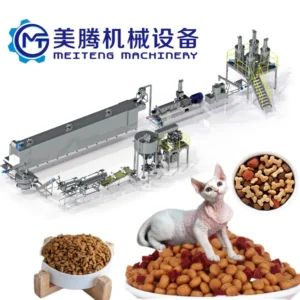
MT70 100-200kg/h Dog & Cat Pet Food Processing Line with 380V 50Hz Three Phase Power
¥35,000.00 Select options This product has multiple variants. The options may be chosen on the product page -
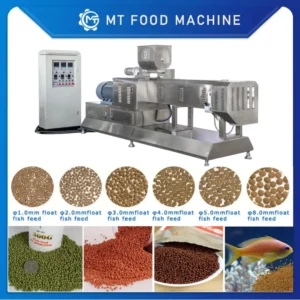
4-5t/h High Capacity Multi-Species Fish Feed Processing Line to Produce Fish Food
¥65,000.00 Select options This product has multiple variants. The options may be chosen on the product page