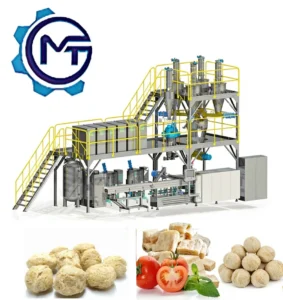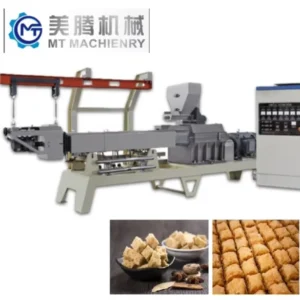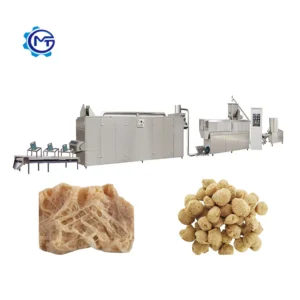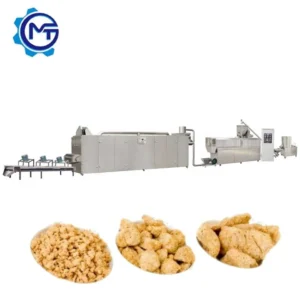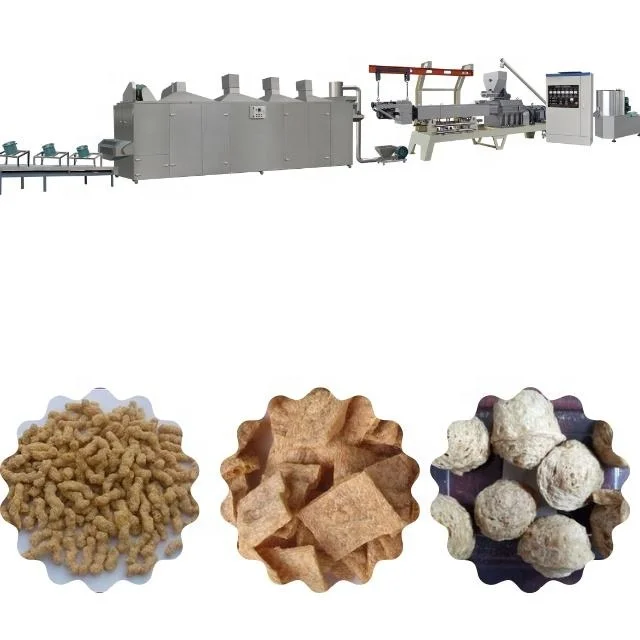


MT65 Twin-Screw TVP Extrusion Line, 85 kW Installed, Food-Grade Stainless Steel — engineered for textured vegetable protein and plant-based meat production from soybean or peanut meal.
Twin-screw extrusion applies high temperature, pressure and shear to restructure protein molecules into meat-like fibre textures, with screw and die configuration matched to your raw material formulation and target product density.
Trial runs on customer raw material in our in-house testing workshop validate output and texture before shipment.
- Three model tiers (MT65 / MT70 / MT85) for small to mid-volume production
- Complete line stations from mixing through drying, cooling and packing
- CE certified with full electrical schematic and voltage confirmation
Description
Matched Throughput Across Every Station — we specify extruder, dryer and cooler capacity to your soybean or peanut meal formulation so no single unit bottlenecks the line.
Technical Specifications
| Parameter | Value |
|---|---|
| Model | MT65 / MT70 / MT85 |
| Product Type | Textured Vegetable Protein (TVP) Extrusion Line |
| Screw Type | Twin-screw |
| Output Capacity (MT65) | 150–200 kg/h (basis not stated in source — confirm raw material formulation and moisture content) |
| Output Capacity (MT70) | 200–300 kg/h (basis not stated in source — confirm raw material formulation and moisture content) |
| Output Capacity (MT85) | 600–800 kg/h (basis not stated in source — confirm raw material formulation and moisture content) |
| Installed Power (MT65) | 85 kW |
| Real Power (MT65) | 65 kW |
| Installed Power (MT70) | 120 kW |
| Real Power (MT70) | 90 kW |
| Installed Power (MT85) | 195 kW |
| Real Power (MT85) | 165 kW |
| Overall Dimensions (MT65) | 18000 × 1300 × 2300 mm |
| Overall Dimensions (MT70) | 20000 × 1500 × 2400 mm |
| Overall Dimensions (MT85) | 24000 × 3500 × 4300 mm |
| Contact Material | Stainless steel (food-grade) |
| Line Configuration | Mixing → Conveying → Extrusion → Drying → Cooling → Packing |
| Mixer Tank Volume | 150 kg |
| Mixer Power | 4 kW |
| Mixer Rotary Speed | 385 rpm |
| Mixer Mixing Time | 10 min per batch |
| High-Temperature Roaster Belt Effective Length | 3.5 m |
| High-Temperature Roaster Far Infrared Heater Power | 3.9 kW × 24 |
| High-Temperature Roaster Dimension | 4500 × 1500 × 1600 mm |
| Cooling Machine Temperature Range | 0–260°C |
| Control System | PLC / MCC (configurable) |
| Voltage & Frequency | Configurable per site requirement |
| Standards | CE certified |
| Warranty | 1 year complete, life-time maintenance |
Application Suitability
| Application | Material or Output |
|---|---|
| Textured vegetable protein for vegetarian meat analogues | Low-temperature soybean meal, peanut meal |
| Plant-based ham and sausage ingredients | Soy protein concentrate blends |
| Canned and quick-frozen vegetarian food components | Defatted soy flour formulations |
| Fast-food plant-based patty and nugget bases | Pea protein and soy blends |
| Small to mid-volume TVP production | Continuous twin-screw extrusion at varying throughput tiers |
Why Nominal Capacity Figures Mislead Plant-Based Meat Buyers
A line rated at a certain kg/h on one protein blend may deliver half that on yours.
When a plant based meat processing line turnkey is quoted on a nominal throughput figure, that number usually comes from a test run on a reference material — often pure soy isolate at a specific moisture level. Switch to a pea protein blend or a peanut meal formulation with different fibre content and water absorption, and the extruder screw configuration that worked perfectly on the reference material can produce dense, under-expanded output with no fibrous pull. The dryer downstream then receives product at the wrong moisture level, the cooler cannot bring it to packing temperature on schedule, and the entire line runs below the nameplate rating while the buyer wonders where the capacity went [NEED_CITE: extrusion throughput variance by raw material composition]. I spent years flying to Latin America fixing exactly this problem — lines that ran fine on paper but stalled mid-commissioning because nobody matched the screw profile to the actual feedstock.
Barrel Zone Profiles That Determine Fibre Formation
The twin-screw extruder in this plant based meat processing line turnkey uses segmented barrel zones with independent temperature control to manage the thermal and shear history of the protein mass. Opening spherical protein molecules into aligned chain structures requires a precise sequence of hydration, shear and heat — too aggressive in the early zones and the material degrades before it reaches the die; too gentle and the protein never unfolds into the fibrous texture that consumers associate with meat. The screw configuration is specified to the buyer’s raw material and target product rather than copied from a generic build, because soybean meal and peanut meal respond very differently to the same screw element arrangement.
Die Geometry and Expansion Control for Consistent Texture
The die plate at the extruder discharge controls the pressure drop that drives expansion and sets the final product density. For TVP destined for rehydration in ham or sausage applications, the die openings must produce pieces that absorb water uniformly without collapsing into mush. This plant based meat processing line turnkey pairs the die design with the upstream screw configuration so the melt temperature and pressure at the die face are predictable and repeatable [NEED_CITE: die design influence on extrudate density in food extrusion]. Getting this wrong means the downstream dryer sees inconsistent moisture across the batch, and the cooled product varies in rehydration behaviour from one production run to the next.
Reading the Power and Dimension Data Against Your Facility
The three model tiers span different installed power envelopes — 85 kW for the MT65 up to 195 kW for the MT85 — but real running power is lower, at 65 kW, 90 kW and 165 kW respectively. That gap between installed and real power reflects motor sizing for start-up torque and peak load rather than continuous draw, and it matters when you are planning your transformer capacity and dedicated circuit breakers. The overall line footprint stretches from 18 m for the MT65 to 24 m for the MT85, with the larger model requiring 4.3 m ceiling clearance. Before committing to a model, verify that your facility floor length and electrical room can accommodate the full line from mixer to packing station, not just the extruder alone.
What Happens When Dryer Capacity Lags Behind the Extruder
A mismatched dryer is the most common hidden failure on extrusion lines assembled from separate vendors. The extruder pushes product at a rate the dryer belt cannot handle within the required residence time, so moisture content at the dryer exit stays above specification. The cooling machine then receives warm, moist product that clumps on the conveyor and blocks the packing weigh-head. This cascade does not show up as a single alarm — it surfaces as chronic quality rejects, unplanned line stops to clear the cooler belt, and a throughput figure that never reaches what was quoted. On a plant based meat processing line turnkey sourced from one supplier, the dryer belt length and heater bank are sized against the extruder’s verified output on the buyer’s actual formulation [NEED_CITE: throughput matching between extruder and dryer in continuous food processing lines].
Why Sourcing the Whole Line From One Supplier Reduces Commissioning Risk
Every station on this line — mixer, extruder, high-temperature roaster, cooling machine, packing — is specified under one project scope so throughput, utility connections and control logic are coordinated before the machines are built. The in-house testing workshop runs the buyer’s raw material through the extruder before shipment, producing a trial run report that documents the screw configuration, barrel temperatures and product texture achieved. CE certification covers the complete assembly rather than individual machines bolted together on site. Electrical schematics confirm voltage, frequency and control language before production begins, avoiding the commissioning delays that happen when a PLC screen arrives in Spanish or the motor contactors are wired for the wrong supply frequency. Stainless steel food-grade contact materials throughout the line meet hygiene requirements without the buyer having to audit each vendor’s material certificates separately.
Documentation & Verification
- Line layout drawing with throughput calculation for your soybean or peanut meal formulation
- Screw and die configuration record matched to your target TVP fibre texture
- Trial run report on your raw material from the in-house testing workshop
- Electrical schematic confirming site voltage, frequency and PLC language before build
- CE declaration of conformity covering the complete integrated line
- Wear parts list with part numbers for screws, dies and dryer belt sections
Installation, Commissioning & Support
- Floor plan and utility connection diagram provided for the selected MT65, MT70 or MT85 line footprint
- Dedicated power circuit sizing guidance based on the real running power of your chosen model
- Machines shipped in sectional assemblies for on-site joining and alignment
- Commissioning includes screw speed, barrel zone temperature and dryer belt speed tuning on your material
- Operator training covers PLC navigation, screw changeover and daily cleaning procedures
- Spare screws, dies and dryer belt segments identified with part numbers for first replacement orders
What to Prepare Before Requesting a Quotation
To move from a general enquiry to a specific line configuration, we need your raw material type and supplier data sheet, the target TVP piece size and rehydration specification, and your daily production target in kg. Share your facility floor dimensions, available ceiling height, local voltage and frequency, and preferred PLC language so the electrical and mechanical design can be confirmed before the build slot is reserved.
Frequently Asked Questions
Q: How is line output capacity verified against my specific soybean or peanut meal formulation?
A: We run your raw material through the extruder in our in-house testing workshop before shipment. The trial produces a documented report showing screw configuration, barrel temperatures, moisture content and the texture achieved, so you see the actual throughput on your formulation rather than a generic nameplate figure.
Q: How do you ensure dryer and cooler capacity matches extruder throughput to avoid line bottlenecks?
A: Every station is specified under one project scope. The dryer belt length, heater bank and cooler airflow are calculated against the extruder’s verified output on your material, so moisture reduction and temperature drop meet specification at the designed line speed without product backlog.
Q: What voltage, frequency and control language options are confirmed before shipment?
A: Your site electrical specifications are collected during the proposal stage. The electrical schematic confirms voltage, frequency, motor ratings and PLC interface language before production begins, so the line powers up correctly on arrival without rewiring or software reconfiguration.
Q: Can I send my raw material for a trial run in your testing workshop before placing the order?
A: Yes. Sending your soybean meal, peanut meal or protein blend allows us to test screw configurations and barrel profiles on the actual feedstock. The trial run report becomes part of the project documentation and confirms the line will produce your target TVP texture.
Q: What does on-site installation, commissioning and operator training include?
A: Our engineers oversee mechanical assembly, utility connection verification and first production runs on your material. Training covers PLC operation, screw and die changeover, daily cleaning and routine maintenance. A wear parts list with reorder numbers is handed over at commissioning completion.
Related products
-

Vegetarian Meat Floss Production Line with Twin Screw
¥9,500.00 Select options This product has multiple variants. The options may be chosen on the product page -
Small Multifunctional Textured Soy Protein Machine – Soy Protein Production Line – Vegetarian Meat Processing Equipment
¥65.00 Select options This product has multiple variants. The options may be chosen on the product page -

Customized Vegetarian Meat Production Line for Food Factory
¥9,500.00 Select options This product has multiple variants. The options may be chosen on the product page -
Textured Soybean Protein Extruder Plant Protein Processing Production Line TVP Making Machine
¥30.00 Select options This product has multiple variants. The options may be chosen on the product page