

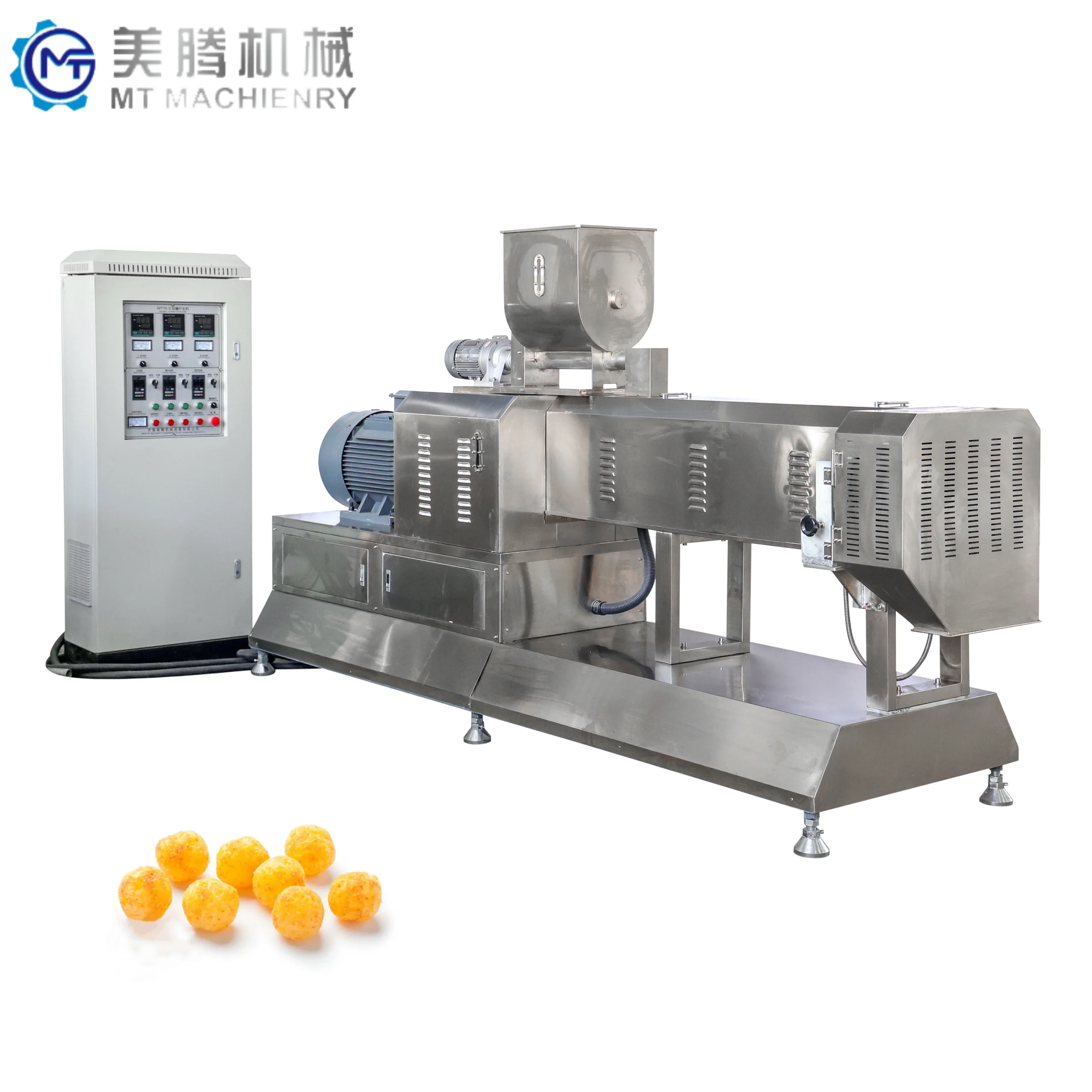
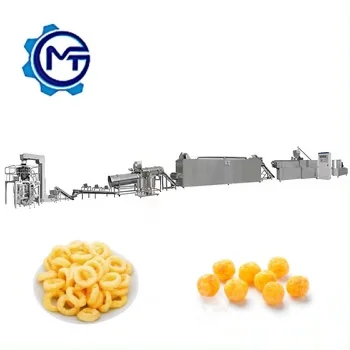
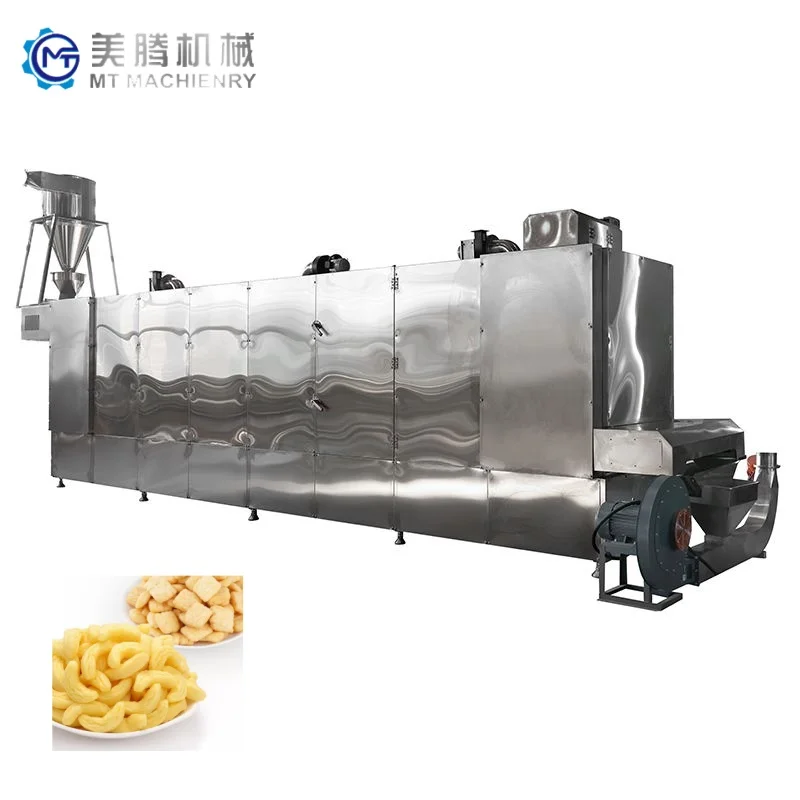
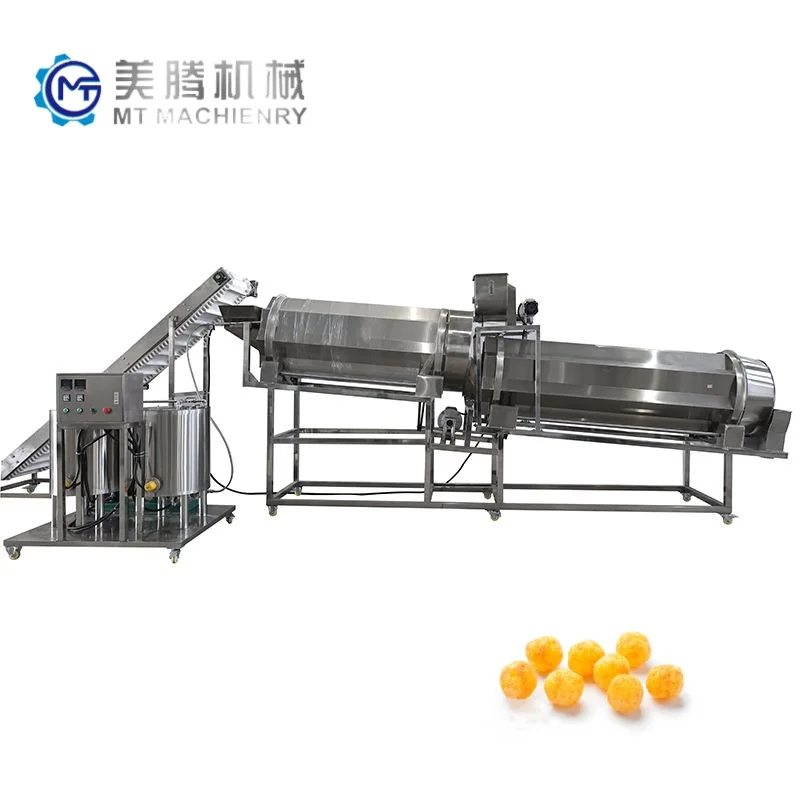
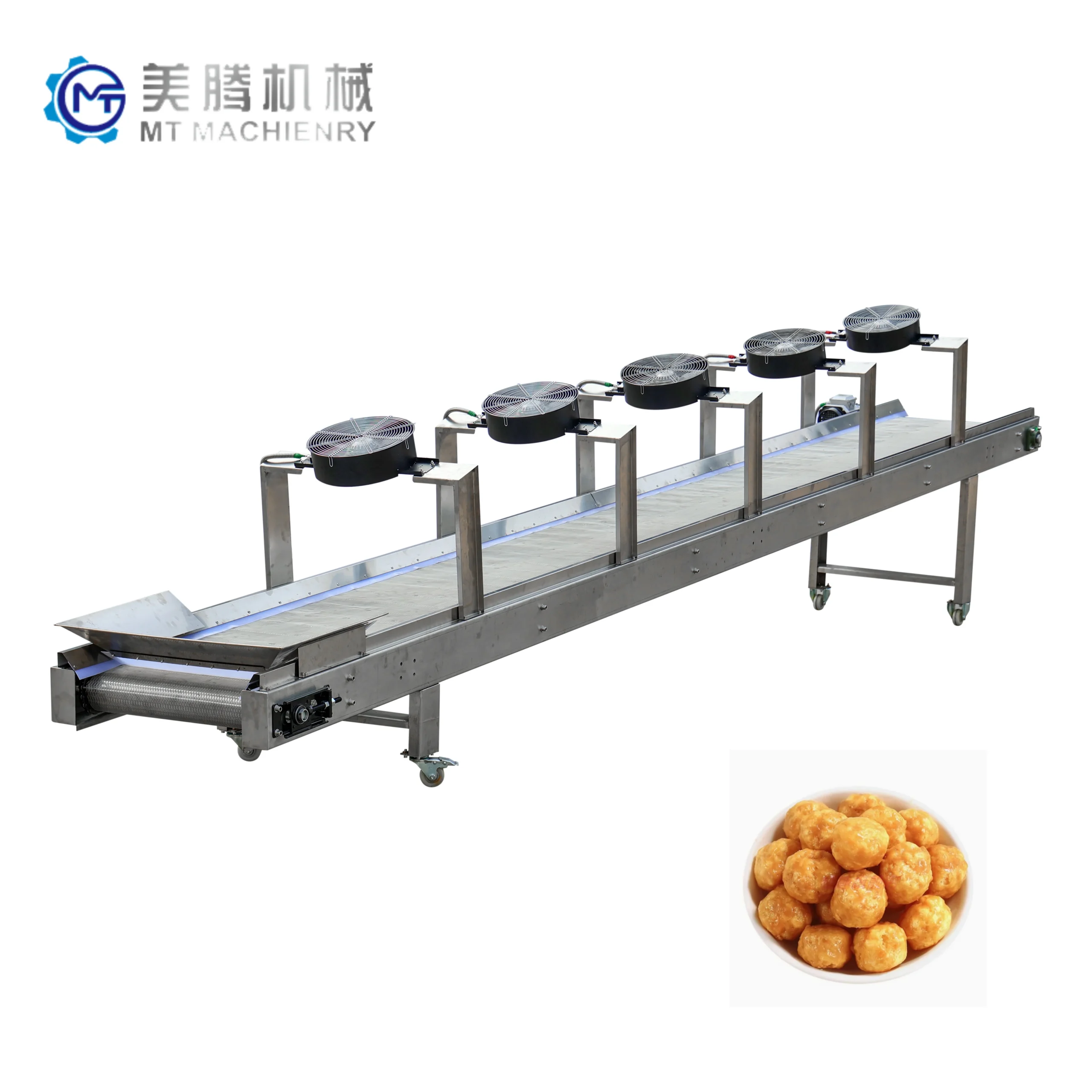
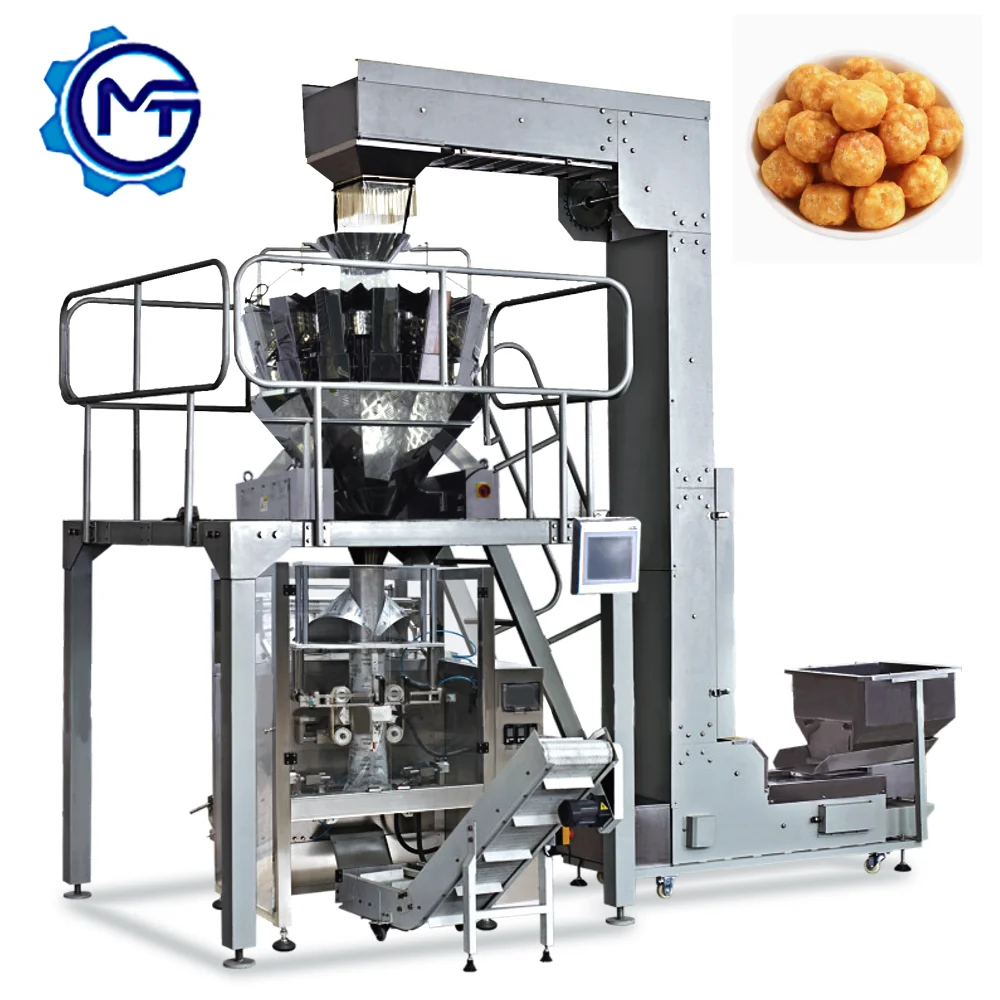
MT65 Twin Screw Extruder Corn Puff Snacks Production Line, 130 kW Installed, PLC Control — turnkey layout from batching through extrusion, drying, flavoring, cooling and packing.
- Screw configuration and die design are matched to your raw material and target snack shape, controlling expansion, density and texture at the die face.
- Every station is throughput-matched to eliminate bottlenecks, with in-house trial runs on your formula before shipment and full on-site commissioning included.
Description
Throughput-Matched Extrusion Lines — every station from batching to packing is calculated against your raw material behavior, not just the extruder’s nominal output, ensuring the corn puff snacks production line turnkey runs at steady state without bottleneck-induced downtime.
Technical Specifications
| Parameter | Value |
|---|---|
| Product Type | Twin Screw Extruder Corn Puff Snacks Production Line |
| Model Options | MT65 / MT70 / MT85 / MT100 |
| Screw Type | Twin Screw |
| Installed Power | 130 kW (MT65) / 180 kW (MT70) / 220 kW (MT85) / 240 kW (MT100) |
| Real Consumption | 95 kW (MT65) / 120 kW (MT70) / 130 kW (MT85) / 160 kW (MT100) |
| Output Capacity | 120–150 kg/h (MT65) / 200–300 kg/h (MT70) / 300–500 kg/h (MT85) / 600–800 kg/h (MT100) (basis not stated in source — confirm raw material type, moisture content and die configuration) |
| Control System | Frequency speed controlling system; PLC and MCC available |
| Raw Materials | Corn, rice, wheat, oat, barley flour, and similar grain bases |
| Die Configuration | Interchangeable dies for cheese ball, tube, stick, ring, fruit loop, star, wheel, flower, heart shapes |
| Core Filling Option | Available with added core filling and cutting module |
| Dryer Heating Source | Electric / Steam / Gas (configured to local utility conditions) |
| Flavoring System | Double drum flavoring line with sugar melting and spraying nozzle |
| Lubrication | Automatic lubricating and cooling system |
| Assembly State | Turnkey complete line |
| Standards | CE, ISO |
Application Suitability
| Application | Material or Output |
|---|---|
| Puffed corn snacks and cheese balls | Corn grits, corn flour, rice flour blends |
| Core-filled extruded snacks | Grain base with cream, chocolate, or fruit paste center |
| Ring, tube, and stick formats | Wheat, oat, and barley flour mixtures |
| Fortified breakfast cereal shapes | Multi-grain blends with added nutritional premix |
| 2D and 3D pellet snack intermediates | Starch-rich formulations for secondary puffing |
Why "Nominal Capacity" Is the Most Expensive Assumption in Snack Extrusion
A corn puff snacks production line turnkey quoted on nameplate output often fails to hold that number once your actual formula hits the barrel.
I learned this the hard way on a puffed rice ball project in Nigeria. The line was rated for a specific throughput on standard corn grits, but the customer sourced a coarser local grind with different moisture content. The screw combination was not adjusted, and the extruder spent three days producing dense, unexpanded product while the dryer and flavoring drums sat idle. The extruder was not the problem — the mismatch between raw material and screw configuration was [NEED_CITE: effect of particle size and moisture on extrusion expansion]. That experience changed how I approach every line proposal: capacity is not a catalog number, it is a result that must be proven on the buyer’s actual flour blend before the machine leaves the factory.
Screw Configuration as the Foundation of Product Density
Every shape in the die catalog — from fruit loops to star wheels — demands a specific relationship between screw pitch, barrel temperature, and residence time. The twin-screw design across all four models allows the screw elements to be rearranged for different shear profiles, which directly controls starch gelatinization and, ultimately, the expansion ratio of the final snack. A corn puff snacks production line turnkey that ships with a generic screw build will produce inconsistent density across product runs, forcing the operator to constantly adjust feed rate and moisture.
Matching Dryer and Flavoring Throughput to Extruder Output
The double drum flavoring line with integrated sugar melting and spraying is sized to coat at the same mass flow the extruder delivers. When a line is assembled from separate vendors, the extruder may run at full output while the coating drum can only handle a fraction of that volume, creating a pile-up of uncoated product between stations. Throughput matching means every station — drying, flavoring, cooling, packing — is calculated against the same hourly mass flow, so the corn puff snacks production line turnkey runs continuously without manual buffering.
Reading the Specs That Actually Matter
The installed power versus real consumption gap across all four models reveals how the line manages thermal load. The MT65, for example, carries 130 kW installed but draws roughly 95 kW in steady operation because the barrel heaters cycle and the main motor rarely runs at full torque. For factory electrical planning, the real consumption figure determines your transformer sizing and cable gauge, not the nameplate [NEED_CITE: electrical load calculation standards for food processing plants]. The interchangeable die system means a single extruder can shift between cheese balls and tube shapes by swapping the die plate and adjusting the cutter speed, rather than requiring a dedicated machine for each format. The automatic lubricating and cooling system reduces barrel wear and maintains consistent thermal zones, which is especially important when running high-sugar formulations that tend to carbonize on poorly cooled barrel surfaces.
The Hidden Cost of Skipping Pre-Shipment Trial Runs
When a line arrives on site and the first production run yields product outside the target density or shape specification, the cost extends beyond wasted raw material. Commissioning engineers stay longer, operator confidence drops, and the buyer’s market launch slips [NEED_CITE: cost of unplanned commissioning extensions in food processing projects]. The dryer heating source — whether electric, steam, or gas — must also be validated against the local utility supply before installation begins, because converting a steam-heated dryer to gas after arrival involves re-certifying pressure systems and can delay production start by weeks.
Why Procurement Through This Channel Works
Complete line responsibility sits with one supplier, so throughput calculations, utility planning, and station-to-station integration do not fracture across multiple vendors. Screw configuration and die design are specified to the buyer’s raw material and target shape, not copied from a generic build. An in-house testing workshop allows trial runs on the customer’s actual flour blend before shipment, catching density and expansion issues while changes are still inexpensive. The dryer heating source is configured to match local conditions — electric, steam, or gas — based on confirmed utility data rather than assumed. Pre-sales engineering, on-site installation, commissioning, operator training, and wear parts supply are delivered as a single project timeline rather than separate contracts.
Documentation & Verification
- Line layout and capacity calculation showing throughput at every station
- Screw and die configuration record matched to your target shape and density
- Trial run report on your raw material conducted before dispatch
- Electrical schematic with confirmed voltage, frequency, and control language
- CE declaration of conformity and ISO certificate for customs clearance
- Wear parts list with part numbers for screws, dies, and cutter blades
Installation, Commissioning & Support
- Foundation and utility layout provided based on MT65–MT100 footprint and real consumption values
- Dedicated electrical circuit sized to confirmed voltage, frequency, and 95–160 kW real load range
- Line arrives in modular sections for phased assembly matching your facility readiness
- First-run parameters set on your raw material during on-site commissioning
- Operator training covers die changes, screw element swaps, and PLC interface navigation
- Wear parts inventory recommended based on your planned production volume and material abrasiveness
What to Include in Your Inquiry
To configure a corn puff snacks production line turnkey that matches your facility, share your target product shapes and the specific grain flours you plan to run, including any local sourcing constraints. Confirm your available voltage and frequency, the control language your operators need, and whether your workshop requires a steam, gas, or electric dryer. If you have existing upstream mixing or downstream packing equipment, provide those specifications so the line can be integrated rather than duplicated.
Frequently Asked Questions
Q: How is line capacity verified on my specific raw material and formula before shipment?
A: Your raw material is tested in the in-house workshop using the screw configuration and die selected for your target shape. The trial run produces actual samples at measured throughput, and the results are documented in a report that confirms expansion ratio, density, and output rate on your formula before the line ships.
Q: How do you ensure throughput is matched between the extruder, dryer, flavoring, and packing stations?
A: Each station is calculated against the same hourly mass flow derived from your confirmed formula and target output. The dryer length, flavoring drum volume, cooling conveyor speed, and packing machine cycle rate are all set to handle the extruder’s verified output without buffering or idle time.
Q: What does the phased installation and commissioning schedule look like for a complete turnkey line?
A: Installation follows a station-by-station sequence — extruder and dryer first, then flavoring and cooling, with packing integrated last. Commissioning begins with dry runs, progresses to raw material trials, and concludes with sustained production runs where operators are trained on parameter adjustments and die changes.
Q: How are screw configuration and die design selected for my target snack shape and texture?
A: The screw element arrangement is designed around your raw material’s starch content, moisture level, and particle size to achieve the required gelatinization and shear. The die is selected from the interchangeable range to produce your target shape, and the cutter speed is matched to the extrusion rate for consistent piece length.
Q: What voltage, frequency, and control language options are confirmed before production begins?
A: Your facility’s electrical supply specifications and preferred operator language are confirmed during the engineering phase and documented in the electrical schematic. The PLC interface, MCC labeling, and variable frequency drive parameters are all set to your confirmed requirements before the control panels are built.
Related products
-

Automatic Rice Crispies Extruder Machine/Chocolate Corn Flakes Extrusion Plant/wheat Flaking Snacks Production Line
¥8,500.00 Select options This product has multiple variants. The options may be chosen on the product page -

Automatic High Productivity Puffed Corn Snacks Extruder Production Equipment New Condition Puff Snack Food Making Machine
¥11,050.00 Select options This product has multiple variants. The options may be chosen on the product page -

Puffed Snack Food Machine Snack Food Machine Puffed Snack Machine
¥11,050.00 Select options This product has multiple variants. The options may be chosen on the product page -

Puff Corn Snacks Food Line Puffed Rice Ball Production Making Equipment Machines
¥10,565.00 Select options This product has multiple variants. The options may be chosen on the product page


