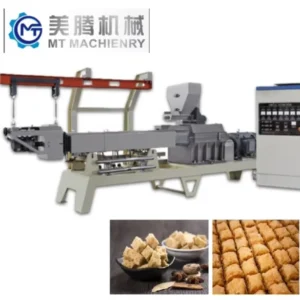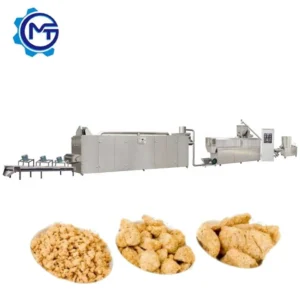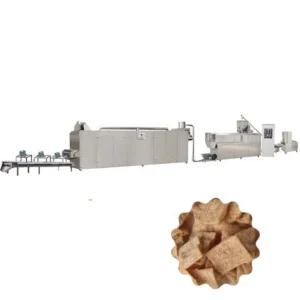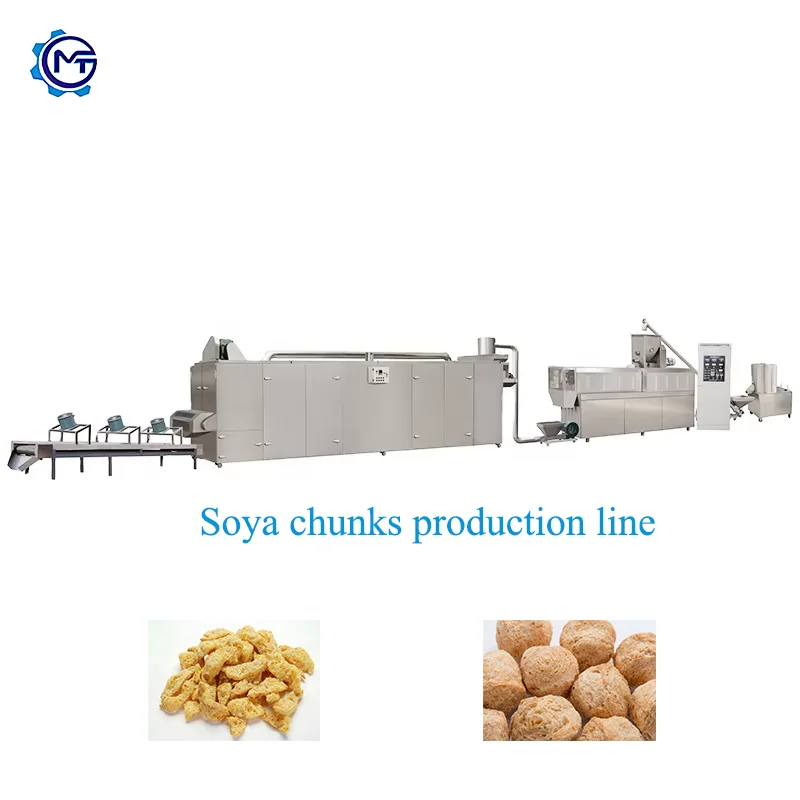

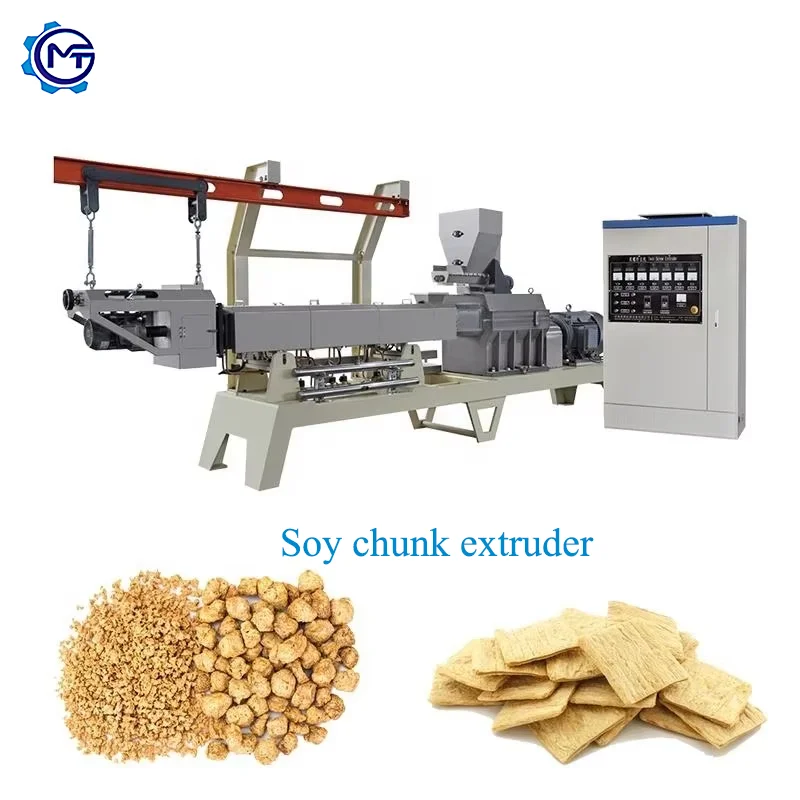
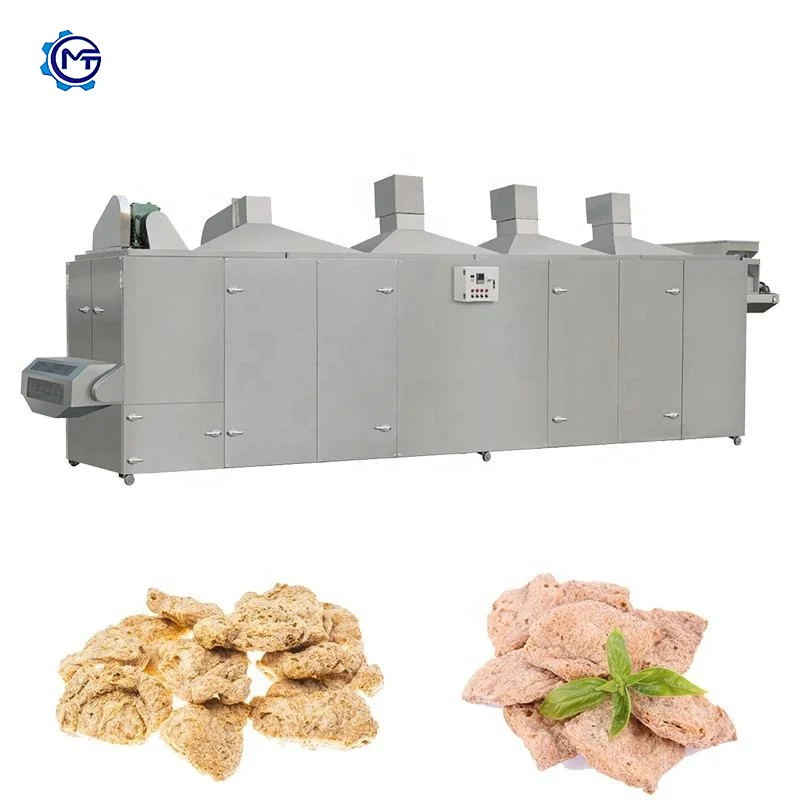


Textured Vegetable Protein Extrusion Line, Twin-Screw, PLC & MCC Control, CE Certified — engineered for continuous soy chunk and plant-based meat production with matched throughput across every station.
Screw configuration and die design are specified to your soy protein formulation, ensuring target fiber structure, density, and expansion. Barrel temperature profile and moisture injection are controlled via automated PLC for consistent output across shifts.
- Line stations integrated from batching through extrusion, drying, cooling, and packing
- Trial runs on your raw material performed in-house before shipment to validate texture and capacity
- Electrical schematics with voltage and control language confirmed for your market prior to production
Description
Soybean Protein Making Machine Automatic Soy Chunk Production Line – Turnkey Solution
Integrated Extrusion Engineering — Every station from batching to packing is sized against the same soy formulation throughput target, preventing the dryer or cooler from choking an extruder that was quoted on a different material basis.
Technical Specifications
| Parameter | Value |
|---|---|
| Product Type | Textured Vegetable Protein Extrusion Line |
| Screw Configuration | Twin-screw, profile matched to soy protein isolate or concentrate |
| Control System | Automated PLC and MCC control |
| Die Design | Configured for target chunk size, density, and fiber structure |
| Moisture Management | Steam or water injection (parameters to be confirmed per formulation) |
| Line Integration | Batching, mixing, extrusion, drying, cooling, packing |
| Assembly State | Complete turnkey production line |
| Certification | CE, ISO |
| Output Capacity | Rated capacity subject to raw material protein content, moisture, and die selection (basis to be confirmed) |
Application Suitability
| Application | Material or Output |
|---|---|
| Soy chunk and nugget production | Defatted soy flour, soy protein concentrate, soy protein isolate |
| Plant-based meat analogue base | Textured vegetable protein for further forming and seasoning |
| Fortified food ingredient processing | Blends incorporating pea protein, wheat gluten, or starch carriers |
| Meat extender manufacturing | TVP granules and flakes for ground meat replacement formulations |
Why Quoted Line Capacity Fails on Your Actual Soy Formulation
A Textured Vegetable Protein Extrusion Line turnkey only holds its rated output when every downstream station is engineered against your specific protein content and moisture profile, not a generic benchmark material.
I spent weeks in a Mexican plant recalibrating a line that was designed around a standard soy meal assumption. The buyer’s actual raw material had a protein content several points lower than the test sample. The extruder pushed product through, but the fiber structure collapsed, the dryer could not keep pace with the altered moisture load, and the whole line stalled. [NEED_CITE: protein content variation in commercial soy concentrate batches] Capacity numbers quoted without a raw material basis create false expectations that surface only after installation, when the cost of correction is measured in lost production weeks rather than engineering hours. A Textured Vegetable Protein Extrusion Line turnkey project must be validated on the buyer’s actual formulation before the equipment is built.
Matching Screw Geometry to Soy Protein Fiber Formation
The fiber structure that defines a quality soy chunk is created inside the barrel, where shear, temperature, and residence time converge. The screw configuration for a Textured Vegetable Protein Extrusion Line must be selected based on whether the feedstock is soy protein isolate, concentrate, or a blend, because each responds differently to mechanical shear and thermal input. Isolate formulations with higher protein density require a screw profile that builds sufficient shear without over-crosslinking the protein matrix, while concentrate blends with more carbohydrate content need adjusted pitch and kneading block placement to achieve the same fibrous pull-apart texture.
Balancing Throughput Across Extrusion, Drying, and Cooling
The extruder is only one station in the sequence, and its output means nothing if the dryer cannot remove moisture fast enough or the cooler cannot stabilize the chunks before packing. Each station on this Textured Vegetable Protein Extrusion Line turnkey system is sized so that the mass flow leaving the die matches the drying capacity and the cooling conveyor speed. When a line is assembled from separate vendors, the extruder may be rated for one throughput while the dryer is rated for another, and the gap only becomes visible during continuous production. [NEED_CITE: throughput balancing principles in multi-station food processing lines] Engineering the entire sequence as a single project eliminates that mismatch.
Reading the Specifications That Actually Matter
The twin-screw configuration is the core of the extrusion stage, and its length-to-diameter ratio determines how long the soy protein mass stays under heat and shear — a longer barrel allows more gradual protein alignment, which produces a more defined fiber structure in the final chunk. Die design controls the shape, density, and expansion ratio of the extrudate as it exits the barrel; a die specified for large nuggets will have different orifice geometry and land length than one designed for small granular TVP. The PLC and MCC control system maintains barrel temperature zones, screw speed, and moisture injection rates within tight bands across shifts, which is what keeps chunk texture consistent from the first hour of a run to the last. Automated control also records process parameters for each batch, giving producers traceability data that food safety audits increasingly require.
The Hidden Cost of Skipping the Trial Run
Lines that ship without a prior test on the buyer’s actual soy formulation carry a risk that only reveals itself during commissioning. Screw combinations that work on one protein source may produce dense, rubbery chunks on another, and correcting that on-site means pulling the screw elements, reconfiguring the barrel, and running test batches while the entire facility sits idle. [NEED_CITE: commissioning delays caused by unvalidated extrusion parameters] The dryer and cooler may also need adjustment if the actual extrudate carries a different moisture load than the design assumption. These corrections are routine in a testing workshop but expensive and disruptive on a factory floor where production schedules are already committed.
Why This Line Is Engineered as One Project
Every station on this Textured Vegetable Protein Extrusion Line turnkey system is specified under a single supplier scope, so throughput calculations account for the actual mass flow from batching through packing rather than relying on individual machine nameplates. Screw and die configurations are documented against your raw material formulation and target chunk dimensions, not copied from a generic build. An in-house testing workshop runs your soy protein concentrate or isolate before shipment, producing a trial report that confirms texture, expansion, and fiber structure. Electrical schematics are prepared with your local voltage and frequency confirmed before production begins, avoiding the delays that occur when a control cabinet arrives wired for the wrong supply. Pre-sales consultation extends through on-site installation, commissioning, operator training, and ongoing wear parts support.
Documentation & Verification
- Line layout drawing with throughput matched across extruder, dryer, and packing stations
- Screw and die configuration record specified to your soy protein formulation
- Trial run report on your raw material confirming chunk texture and fiber structure
- Electrical schematic with voltage and frequency confirmed for your facility
- CE declaration of conformity and ISO certificate for the complete line
- Operation and maintenance manual with wear parts list for twin-screw assembly
Installation, Commissioning & Support
- Foundation and utility layout provided based on the complete line footprint and PLC cabinet placement
- Dedicated power circuits specified for extruder main drive, dryer heating, and MCC control panel
- Equipment shipped in modular sections for sequential assembly along the production floor
- First-run commissioning includes barrel temperature profiling and screw speed calibration on your soy formulation
- Operator training covers PLC interface navigation, die changeover, and emergency stop procedures
- Wear parts list covers screw elements, die plates, and barrel liners with recommended replacement intervals
What We Need to Configure Your Line
To prepare an accurate layout and capacity calculation, share your soy protein source — isolate, concentrate, or a specific blend — along with the protein content and moisture level of your incoming raw material. Specify the target chunk dimensions, desired fiber texture, and daily production volume. Confirm your facility voltage, frequency, and preferred control language so the electrical design matches your site conditions from day one.
Frequently Asked Questions
Q: How is line capacity verified against my specific soy protein formulation?
A: Capacity is calculated based on your raw material’s protein content, moisture level, and the selected die configuration, not a generic benchmark. Before quotation, we review your formulation data. Before shipment, we run your actual material in our testing workshop and document the output rate, texture, and fiber structure in a trial report that accompanies the line.
Q: How do you match screw configuration to soy protein isolate versus concentrate?
A: Isolate and concentrate differ in protein density and carbohydrate content, which changes how the material responds to shear and heat inside the barrel. We select kneading block placement, screw pitch, and barrel zone temperatures based on your specific formulation to achieve the target fiber pull-apart texture rather than applying a standard screw build across all soy applications.
Q: What electrical configurations are available for different international markets?
A: Voltage, frequency, and control panel language are confirmed during the specification stage before production begins. The PLC and MCC system can be configured for your local supply standard, and the electrical schematic is reviewed with your engineering team to ensure the control cabinet, motor ratings, and heating elements all match your facility infrastructure.
Q: Is a trial run performed on my raw material before the line ships?
A: Yes. We conduct a trial run using your soy protein material in our testing workshop. The resulting report documents extrusion parameters, chunk dimensions, fiber structure assessment, and moisture content at each station. This allows us to finalize screw configuration and dryer settings before the equipment leaves the factory.
Q: How is throughput balanced between the extruder, dryer, and packing stations?
A: Each station is sized based on the mass flow calculated from your formulation and target output. The dryer capacity accounts for the moisture removal load from your specific extrudate, and the cooling conveyor is matched to the drying discharge rate. This prevents bottlenecks that occur when stations are sourced from separate vendors with mismatched ratings.
Related products
-
High-yield Soybean Protein Automated Production Line Single Screw Extruder for TVP
Price range: ¥20.00 through ¥30.00 Select options This product has multiple variants. The options may be chosen on the product page -
Soy Bean Meat Protein Production Line Machine Multi-functional Extruder for Soy Protein Food
¥8,650.00 Select options This product has multiple variants. The options may be chosen on the product page -
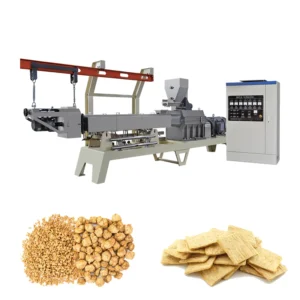
New Condition Soybean Protein Machine for Soy Chunks Production Textured Vegetable Protein Production Line
¥30.00 Select options This product has multiple variants. The options may be chosen on the product page -
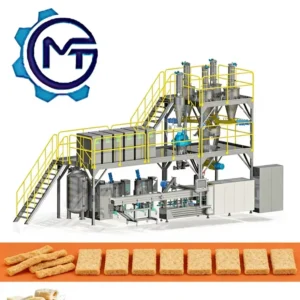
High Capacity Soy Protein Vegetarian Meat Processing Line
¥9,500.00 Select options This product has multiple variants. The options may be chosen on the product page