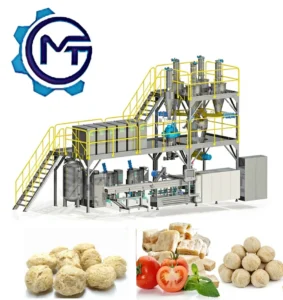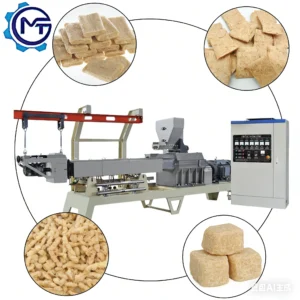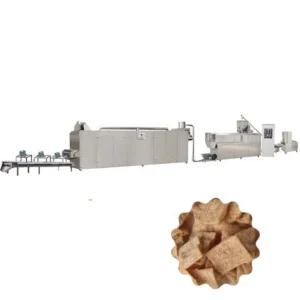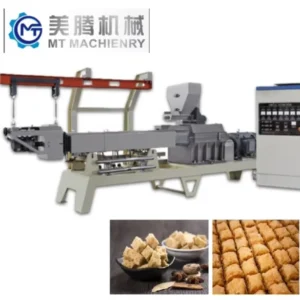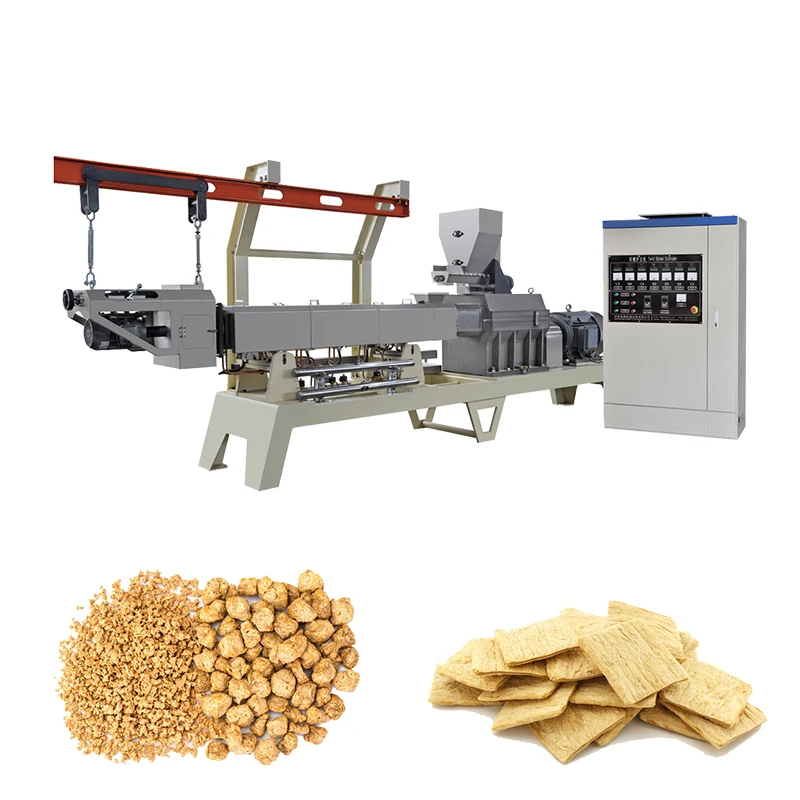


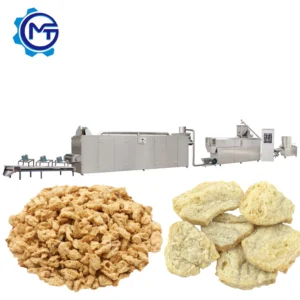
MT65 / MT70 / MT85 Textured Vegetable Protein Production Line, Twin-Screw Extruder, PLC/MCC Control — complete turnkey system from raw material mixing through extrusion, drying, cooling and packing.
- Screw configuration and die geometry specified to your soybean or peanut meal formulation, controlling fibre structure and expansion
- Line stations throughput-matched across mixer batch volume, extruder output, roaster belt capacity and cooler to prevent bottlenecks
- CE and ISO certified, with trial run on customer-supplied raw material in our testing workshop before shipment
Description
Matched Throughput Stations — the mixer batch volume, extruder output, roaster belt capacity and cooler range are sized against each other so no single unit holds back the textured vegetable protein production line turnkey.
Technical Specifications
| Parameter | Value |
|---|---|
| Product Type | Textured Vegetable Protein Production Line |
| Model | MT65 / MT70 / MT85 |
| Extruder Type | Twin-screw |
| Installed Power (MT65 / MT70 / MT85) | 85 kW / 120 kW / 195 kW |
| Real Power (MT65 / MT70 / MT85) | 65 kW / 90 kW / 165 kW |
| Output Capacity (MT65) | 150–200 kg/h (basis not stated in source — confirm raw material formulation / moisture content) |
| Output Capacity (MT70) | 200–300 kg/h (basis not stated in source — confirm raw material formulation / moisture content) |
| Output Capacity (MT85) | 600–800 kg/h (basis not stated in source — confirm raw material formulation / moisture content) |
| Overall Dimensions (MT65 / MT70 / MT85) | 18000 × 1300 × 2300 mm / 20000 × 1500 × 2400 mm / 24000 × 3500 × 4300 mm |
| Extruder Main Motor Power | 30 kW |
| Extruder Installed Power | 45.87 kW |
| Extruder Actual Power | 30–35 kW |
| Mixer Output | 300–600 kg/h |
| Mixer Rotary Speed | 385 rpm |
| Mixer Mixing Time | 10 min per batch |
| Mixer Tank Volume | 150 kg |
| Mixer Power | 4 kW |
| Mixer Dimensions | 1000 × 630 × 1100 mm |
| High-temperature Roaster Output | 300–400 kg/h |
| Roaster Effective Belt Length | 3.5 m |
| Roaster Belt Motor Power | 0.55 kW |
| Roaster Far Infrared Heater Power | 3.9 kW × 24 |
| Roaster Gas Consumption | 6.8 m³ (time basis not stated in source — confirm per hour or per batch) |
| Roaster Dimensions | 4500 × 1500 × 1600 mm |
| Cooling Machine Capacity | 200–300 kg/h |
| Line Stations | Raw material preparation → Mixing → Conveying → Extrusion → Conveying → Drying → Cooling → Packing |
| Control System | PLC / MCC (configurable) |
| Construction Material | Stainless steel (food-grade contact parts) |
| Voltage & Frequency | Configurable per destination market |
| Warranty | 1 year complete warranty, lifetime maintenance service |
| Standards | CE, ISO |
Application Suitability
| Application | Material or Output |
|---|---|
| Textured vegetable protein (TVP) and soy chunks | Low-temperature soybean meal, defatted soy flour |
| Vegetarian meat analogues and meat extenders | Peanut meal, soy-protein concentrate blends |
| Plant-based protein ingredients for ham and sausage processing | High-protein soy meal at controlled moisture |
| Soy meat chunks for canned food and quick-frozen meals | Formulated soy and cereal protein mixes |
| Fortified protein ingredients for institutional nutrition programmes | Custom legume and grain meal blends |
What Nominal Capacity Figures Leave Out About Protein Extrusion
Every kg/h rating on a textured vegetable protein production line turnkey must state which raw material formulation and moisture level it was measured on.
When a line is quoted at a round capacity number without that basis, the buyer often discovers during commissioning that their local soybean meal — different protein ratio, different fibre content, different residual oil — simply will not hold that throughput. The extruder barrel runs hotter than expected, the die back-pressure fluctuates, and the fibre structure collapses into dense, un-textured lumps. I have stood next to a machine rated for one output watching it struggle at a fraction of that figure because the screw configuration was copied from a standard build instead of being matched to the actual protein source [NEED_CITE: protein extrusion behaviour across soy and legume meal variants]. The fix always starts with the raw material, never with the motor.
Screw Element Arrangement and Protein Fibre Formation
The twin-screw extrusion process subjects soybean meal or peanut meal to high temperature, high pressure, and high shear inside the barrel. These combined forces open the spherical protein molecules into elongated chain structures that align in the direction of material flow. The screw element arrangement — the sequence of conveying, kneading, and reverse-screw sections — determines how much shear energy the protein absorbs before it reaches the die. A configuration that is too aggressive breaks the chains instead of aligning them, producing short, crumbly chunks rather than the long-fibre texture that downstream users expect in ham or sausage applications.
Barrel Temperature Profile and Moisture Management
Protein texturisation requires precise control across multiple barrel heating zones. The moisture content of the incoming meal, combined with any liquid injection at the feed port, sets the baseline for starch gelatinisation and protein denaturation. If the barrel profile is too flat, the material passes through without sufficient structural change. If it is too steep, surface scorching occurs before the core of the extrudate is fully texturised. The PLC control system on this line allows each zone to be set independently, giving operators the resolution to adjust when switching between soybean meal and peanut meal formulations [NEED_CITE: multi-zone barrel temperature control in twin-screw food extrusion].
Reading the Extruder and Line Station Specifications
The three extruder models — MT65, MT70, and MT85 — span output ranges from 150 kg/h to 800 kg/h, but these figures carry a basis-to-be-confirmed note because actual throughput depends entirely on the protein content and moisture of the raw material fed into the hopper. The mixer handles 300–600 kg/h with a 150 kg tank volume and 10-minute batch cycle, which means it can keep pace with the MT70 and MT85 extruders when batch timing is managed correctly. The high-temperature roaster provides a 3.5 m effective belt length and 300–400 kg/h capacity, with 24 far-infrared heaters rated at 3.9 kW each. The cooling machine covers 200–300 kg/h. When sizing a textured vegetable protein production line turnkey for your facility, compare these station capacities against each other rather than looking at the extruder number alone, because the roaster belt or cooler range can become the actual constraint.
The Cost of Skipping the Trial Run
Shipping an extruder without first testing the buyer’s actual raw material is the single most common reason commissioning stretches from days into weeks. The screw configuration that works perfectly on standard soybean meal in Shandong may produce gummy, under-texturised output on a European defatted soy flour with different water absorption characteristics. I spent half a month on one project re-tuning screw speed and five barrel zones because the local meal’s protein-to-moisture ratio was outside the range we had validated before shipment [NEED_CITE: raw material variability impact on extrusion commissioning timelines]. A trial run in the testing workshop eliminates that risk before the machine leaves the factory.
Why Procurement Through One Supplier Matters Here
The mixing station, twin-screw extruder, high-temperature roaster, cooling machine, and packing section are specified under a single supplier, which means throughput calculations across every station are verified before the layout is finalised rather than discovered during installation. Screw configuration and die geometry are documented against the buyer’s specific protein meal and target fibre structure, not pulled from a generic catalogue. The testing workshop allows a full trial run on customer-supplied raw material before shipment, so the commissioning team arrives on-site with parameters already established. PLC and MCC control integration across the line ensures that a recipe change at the mixer is reflected consistently through extrusion speed and dryer temperature. CE and ISO certification covers the complete assembly, which simplifies import clearance and local regulatory compliance [NEED_CITE: CE machinery directive requirements for complete food processing lines].
Documentation & Verification
- Line layout and capacity calculation showing throughput matching from mixer through cooler for your selected model
- Screw and die configuration record matched to your soybean meal or peanut meal formulation
- Trial run report produced on your supplied raw material before the line leaves the factory
- Electrical schematic with voltage, frequency, and control language confirmed for your destination market
- CE declaration of conformity and ISO certificate covering the complete line assembly
- Operation and maintenance manual with wear parts list specific to your screw and barrel configuration
Installation, Commissioning & Support
- Foundation and floor space planned against the line dimensions, up to 24000 × 3500 × 4300 mm for the MT85 configuration
- Dedicated electrical circuit sized to the installed power, up to 195 kW, with voltage confirmed before production
- Line shipped in station modules and reassembled on-site with mechanical and electrical alignment verified
- First production run supervised by an engineer who references the trial run report as the baseline
- Operator training covers PLC recipe management, barrel zone adjustment, and screw element replacement procedure
- Wear parts list provided at delivery with lead times for replacement screws, dies, and barrel liners
What We Need to Configure Your Line
To size the textured vegetable protein production line turnkey correctly, share the specific protein meal you will be processing — soybean, peanut, or a blend — along with its protein content and typical moisture level. Tell us your target daily output and whether the finished chunks are destined for retail packaging or bulk supply to a further-processing plant. Confirm the voltage and frequency at your facility and the control language your operators prefer, so the HMI and electrical documentation are prepared accordingly before production begins.
Frequently Asked Questions
Q: What raw material formulation and moisture content is each output capacity figure based on?
A: The published capacity ranges for the MT65, MT70, and MT85 models carry a basis-to-be-confirmed note because throughput on protein extrusion depends on the specific meal formulation, protein ratio, and moisture level. We validate actual output during a trial run on your raw material before the line ships, so the figure we commit to reflects your real production conditions rather than a generic benchmark.
Q: How are screw elements and die geometry selected for different protein sources?
A: Low-temperature soybean meal and peanut meal respond differently to shear and heat inside the barrel. We select the kneading block arrangement, reverse-screw sections, and die orifice geometry based on the protein content, fibre length target, and chunk density your market expects. The configuration is documented and can be adjusted if you introduce a new raw material blend later.
Q: How is throughput matched between the extruder, roaster, and cooler?
A: Each station is sized during the layout phase so that the mixer batch cycle, roaster belt capacity, and cooler range can absorb the extruder’s actual output without material backing up or sitting idle. The line layout and capacity calculation document shows these figures side by side for your selected model before production starts.
Q: What electrical standard and HMI language will be confirmed before production?
A: Voltage, frequency, plug type, and control panel language are confirmed during the specification stage and recorded on the electrical schematic. This covers both the PLC interface and the MCC panel labelling, so your operators and maintenance team can work in their preferred language from the first day of operation.
Q: Can we send our raw material for a trial run before the line ships?
A: Yes. Our in-house testing workshop runs the extruder on your supplied soybean meal or peanut meal at the target moisture level. The trial run report documents screw speed, barrel zone temperatures, die pressure, and the resulting fibre structure, giving you a verified baseline before the equipment is packed for dispatch.
Related products
-
Twin Screw Extruder for Textured Vegetable Protein (TVP)
¥9,500.00 Select options This product has multiple variants. The options may be chosen on the product page -
High Capacity Soy Protein Vegetarian Meat Processing Line
¥9,500.00 Select options This product has multiple variants. The options may be chosen on the product page -
New High Efficiency Protein Production Line Plant Protein Equipment for Artificial Vegetarian Meat Processing Food Grade
¥65.00 Select options This product has multiple variants. The options may be chosen on the product page -
Meat Taste Textured Soybean Protein Processing Machine Vegetable Protein Soy Meat Making Machine
¥8,650.00 Select options This product has multiple variants. The options may be chosen on the product page