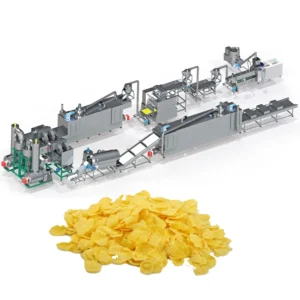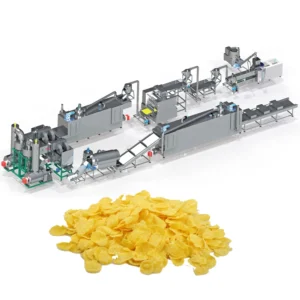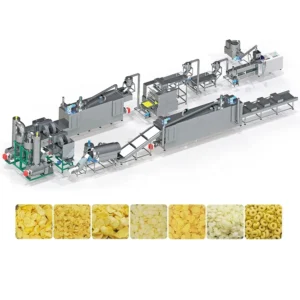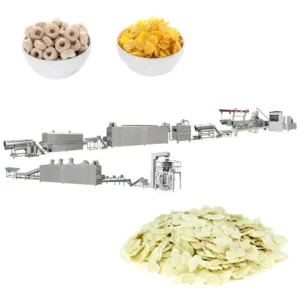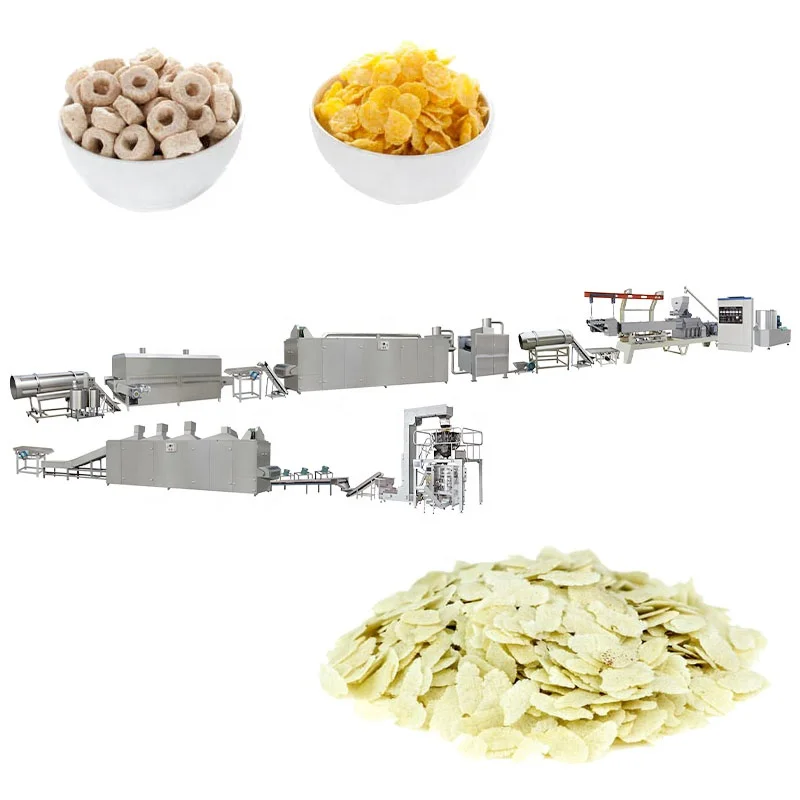
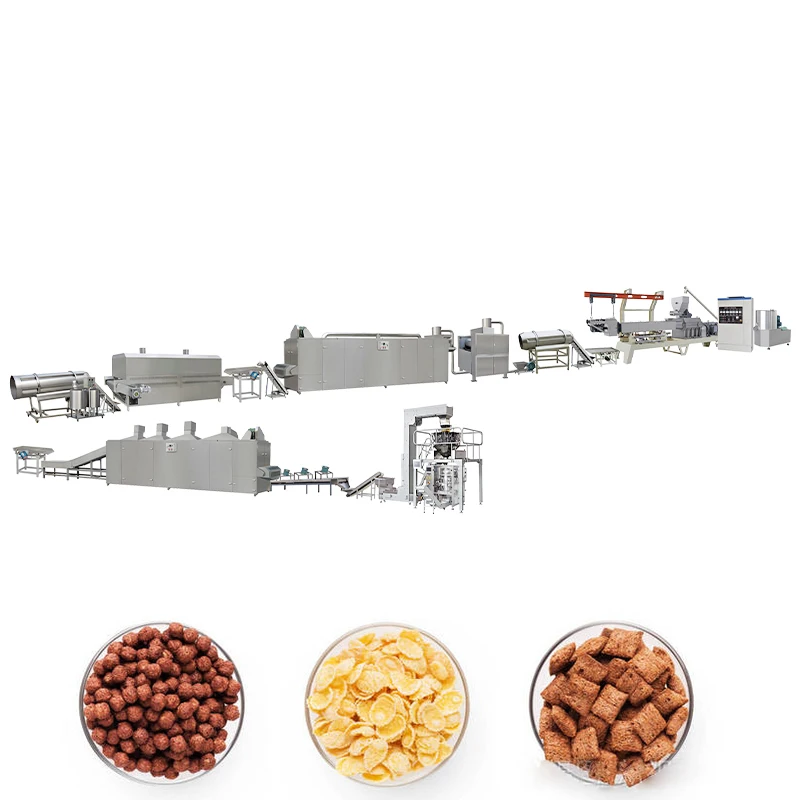

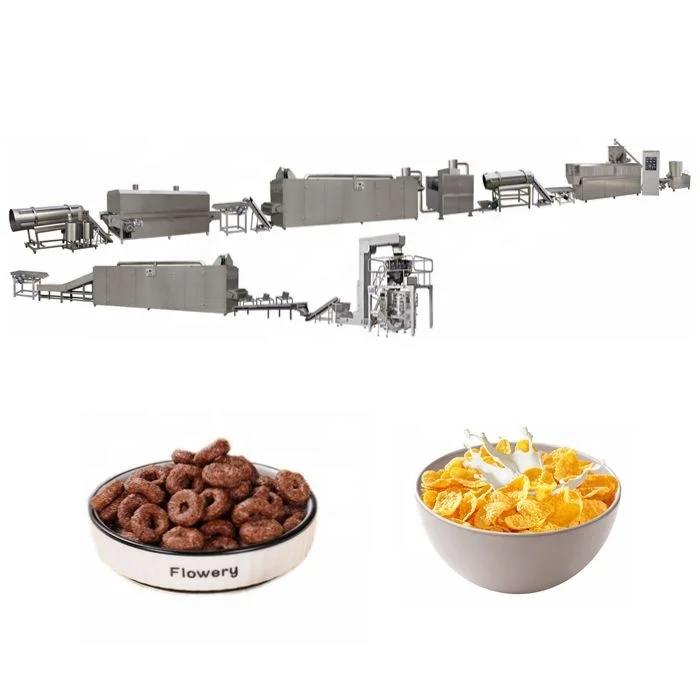

MT75 Twin Screw Corn Flakes Extrusion Production Line, 300-500 kg/h, 210kW Installed Power — engineered as a complete turnkey project with throughput matched across every station from mixing through extrusion, flaking, hot air roasting to packing. PLC-controlled hydraulic flaking system and twin-screw extruder with automatic lubrication ensure consistent flake thickness and stable long-run operation on corn, rice, wheat or oat-based recipes. Backed by in-house trial runs on your raw material before shipment, with full line layout and capacity documentation provided.
Description
Turnkey integration under one supplier — the MT75 corn flake line matches every station from batching to packing so throughput holds across the entire process.
Technical Specifications
| Parameter | Value |
|---|---|
| Model | MT75 |
| Product Type | Twin Screw Corn Flakes Extrusion Production Line |
| Screw Type | Twin-screw |
| Installed Power | 210 kW |
| Power Consumption | 150 kW |
| Output Capacity | 300–500 kg/h (basis not stated in source — confirm raw material, moisture content, product format) |
| Overall Dimensions | 45 × 1.5 × 3.5 m |
| Control System | PLC and MCC |
| Flaking Machine | Hydraulic double-roller, PLC-controlled, infrared sensor temperature monitoring |
| Dryer Heating Source | Gas or Electric (configurable) |
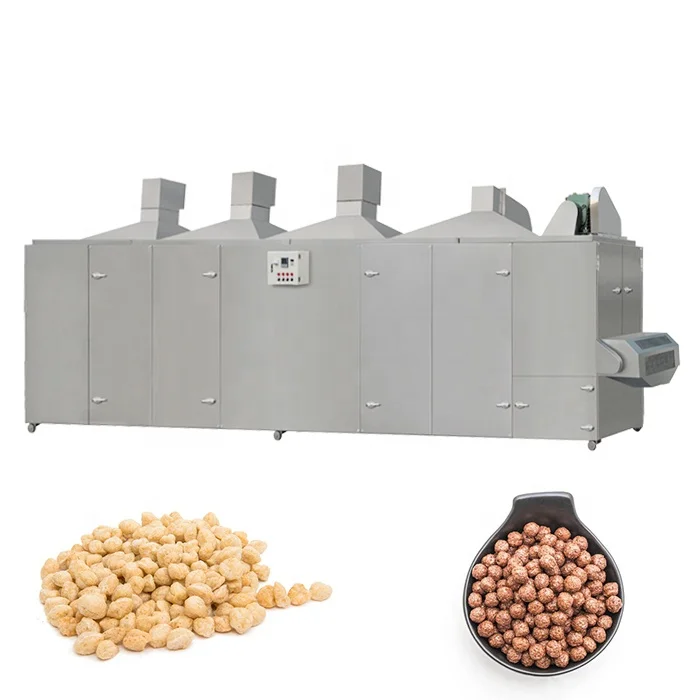
| Roasting Oven | Hot air with conciliation burner, dual circulating fans, cyclone dust removal |
| Coating System | Double tumble sugar melting, elevator, coating drum, spraying nozzle |
| Basic Raw Material | Corn, rice, wheat, oat, barley powder |
| Lubrication | Automatic lubricating and cooling |
| Standards | CE, ISO |
Application Suitability
| Application | Material or Output |
|---|---|
| Natural corn flake breakfast cereal | Corn grits or corn flour |
| Sugar-coated corn flakes | Corn base with sugar syrup coating |
| Multi-grain flaked cereal | Blends of rice, wheat, oat, barley with corn |
| Shaped cereal snacks | Ball, tube, ring, star, wheel, heart formats via interchangeable dies |
Why Quoted Output Rarely Survives First Contact With Your Raw Material
Actual line capacity depends on your grain source, moisture level, and flake thickness target — not on a catalog number.
I worked on a corn flakes project last year where the buyer ordered a line rated for a certain hourly output based on standard corn grits. When their local supplier delivered corn with higher moisture content, the extruder could not achieve proper gelatinisation, the flakes came off the roller press soft, and the roasting oven could not compensate. The real throughput dropped well below the quoted figure. A corn flakes production line turnkey only delivers its rated capacity when the screw profile, preconditioning, and drying curve are all set against the exact raw material you will actually feed it [NEED_CITE: effect of grain moisture on twin-screw extrusion gelatinisation].
Matching the Extruder to the Flaking and Roasting Stages
A corn flakes production line turnkey fails the moment one station runs faster than the next. On the MT75, the twin-screw extruder output is balanced against the hydraulic double-roller flaking machine and the hot air roasting oven capacity so material flow stays continuous. The PLC control coordinates the extruder screw speed with the flaking roller gap and the oven belt speed, preventing pile-ups or starved sections that would otherwise force operators to throttle the line back manually.
How Flake Thickness and Surface Blistering Define the Final Product
The flaking stage determines the mouthfeel, and the roasting stage defines the crispness. The hydraulic double-roller system on this line holds consistent pressure across the roller face, producing uniform flake thickness batch after batch. Downstream, the hot air roasting oven uses a conciliation burner with two separate circulating fans to create the surface blistering that consumers associate with quality corn flakes, while the cyclone dust removal pulls fines out of the airstream so they do not settle back onto the product [NEED_CITE: hot air roasting parameters for breakfast cereal blistering and moisture reduction].
Reading the Specs That Matter for Cereal Extrusion
The twin-screw configuration on the MT75 handles a wider moisture and fat range than a single-screw design, which matters when buyers switch between corn, oat, and multi-grain recipes. The automatic lubricating and cooling system keeps barrel temperatures stable during long production runs, reducing the thermal drift that causes inconsistent gelatinisation across a shift. With 210 kW installed power and 150 kW typical consumption, the electrical supply must be confirmed against local voltage and frequency before production begins — a 45-metre line footprint also demands careful utility planning in the facility layout. The PLC and MCC control gives operators recipe storage and repeatability, so a sugar-coated corn flake run and a natural corn flake run can be switched without manual guesswork on screw speed or barrel temperature zones.
The Hidden Cost of an Unmatched Coating Station
When the sugar coating drum is undersized relative to the extruder, coated flakes back up and cool before the syrup adheres properly, creating a dull, uneven finish that gets rejected at packing. On a corn flakes production line turnkey, the double tumble sugar melting system and spray nozzle must be matched to the upstream output so every flake receives a consistent coating layer [NEED_CITE: sugar coating adhesion failure in breakfast cereal production]. I have seen lines where the extruder and dryer were well matched but the coating drum could only handle half the throughput, forcing the whole line to idle at reduced speed.
Why Sourcing the Entire Line From One Supplier Matters
Every station on the MT75 line — mixing, extruding, flaking, drying, roasting, coating, cooling, packing — is configured together so no single unit becomes a bottleneck. Screw and die combinations are specified against your raw material rather than pulled from a generic build, and the in-house testing workshop runs trial batches before the equipment leaves the factory. Layout drawings, throughput calculations, and utility plans are produced as one package, which means the contractor installing the line works from a single coordinated set of documents rather than reconciling drawings from multiple vendors [NEED_CITE: turnkey project coordination for food processing lines].
Documentation & Verification
- Line layout and capacity calculation confirming station-by-station throughput match for the MT75
- Screw and die configuration record specified to your corn, oat, or multi-grain recipe
- Trial run report on your actual raw material produced in the testing workshop before dispatch
- Electrical schematic with voltage, frequency, and PLC language confirmed for your facility
- CE declaration of conformity and ISO certificate for export clearance
- Operation and maintenance manual with wear parts list for the flaking rollers and extruder screws
Installation, Commissioning & Support
- Foundation plan for the 45-metre line footprint with load points for the extruder and flaking machine
- Dedicated power circuit for the 210 kW installed load with voltage and frequency matched to your grid
- Phased assembly sequence for the roasting oven ductwork and cyclone dust removal system
- First-run parameter setting for screw speed, barrel temperatures, and roller gap on your raw material
- Operator training covering PLC recipe selection, sugar coating drum operation, and daily cleaning
- Wear parts supply for extruder screws, die plates, and flaking roller surfaces with lead time confirmed
Before You Send an Inquiry
To size a corn flakes production line turnkey correctly, we need to know the grain type and moisture content you plan to process, the flake thickness and shape you are targeting, and your facility voltage and frequency. Sharing your workshop dimensions and ceiling height lets us plan the dryer and roasting oven ductwork routing, and telling us whether you need sugar coating or natural flakes determines the downstream station configuration.
Frequently Asked Questions
Q: How is the real line output verified before shipment?
A: We run trial batches on your actual corn or multi-grain raw material in the testing workshop. The trial report documents extruder screw speed, barrel temperature profile, flake thickness, moisture after drying, and throughput achieved. This confirms whether the quoted capacity holds under your specific grain source and moisture conditions, and any screw or die adjustments are made before the line ships.
Q: How are the extruder, flaking machine, and coating drum matched?
A: Each station is sized against the extruder output so material flow stays balanced. The flaking roller width and speed match the extrudate ribbon, the dryer and roasting oven belt capacity matches flake volume, and the sugar coating drum diameter and residence time are calculated against the roasting oven discharge rate. The PLC coordinates speed across all stations.
Q: What does the turnkey project scope include?
A: The scope covers line layout design, throughput calculation for every station, utility planning for power, gas, and water, phased installation scheduling, and on-site commissioning. Operator training is included, along with electrical schematics and PLC language set to your local requirements. The contractor receives one coordinated document package rather than separate vendor drawings.
Q: Can you run a trial on our specific corn variety before we commit?
A: Yes. Send us a sample of your corn grits or flour and we run it through the twin-screw extruder, flaking machine, and roasting oven in the testing workshop. The trial report covers gelatinisation level, flake integrity, blistering quality, and achieved throughput so you can evaluate the line against your product specification before production begins.
Related products
-
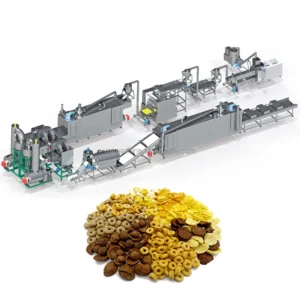
Stainless Steel Honey Small Corn Flake Breakfast Cereal Flakes Maker Making Machine Production Plant
¥30,000.00 Add to cart -
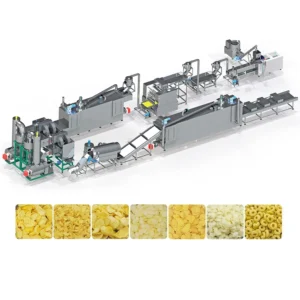
Automatic Commercial Breakfast Wheat Circle Corn Flake Production Line
¥65,000.00 Add to cart -
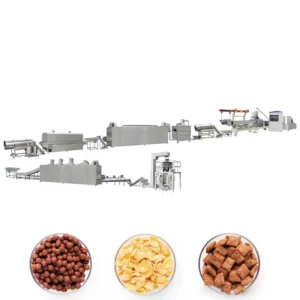
1000 Lbs Automatic Corn Flakes Production Line Mixer Breakfast Cereal Corn Flakes Production Line
¥45,000.00 Select options This product has multiple variants. The options may be chosen on the product page -
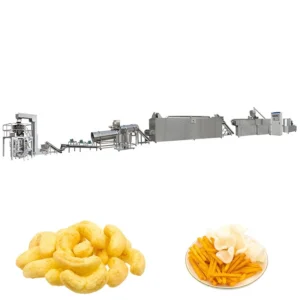
Corn Flake Making Machine Corn Puffs Making Machine Snack Food Production Line
Price range: ¥500.00 through ¥1,200.00 Select options This product has multiple variants. The options may be chosen on the product page