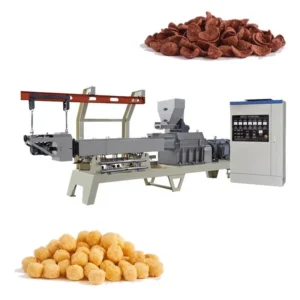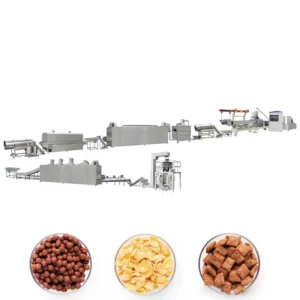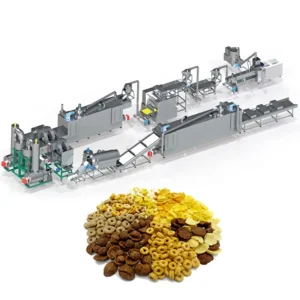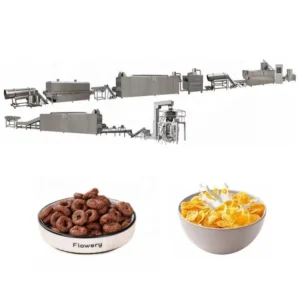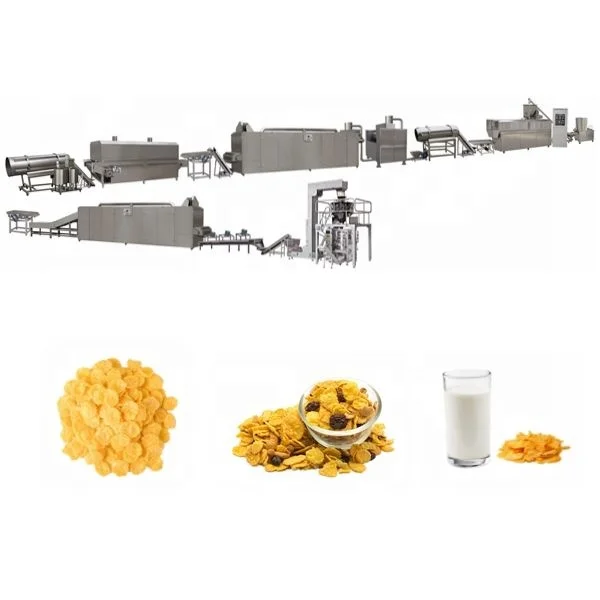


MT65 / MT70 / MT85 Breakfast Cereal Corn Flakes Production Line, Twin-screw Extrusion, Gas-fired Dual-side Baking — engineered as a complete turnkey layout from batching through extrusion, flaking, pressing, oven baking, sugar coating and packing. Each station’s throughput is matched to prevent bottlenecks, with screw configuration and die design specified to your grain formulation and target flake density.
- 38CrMoAL nitrided sectional screw modules for continuous gelatinisation and cooking
- Adjustable roller gap on flaking press with integrated cooling for precise thickness control
- Trial runs on your raw material in our testing workshop before shipment, with full documentation
Description
Turnkey Integration Under One Roof — Every station from batching through extrusion to packing is throughput-matched inside our facility, eliminating the hidden bottlenecks that occur when a corn flakes line is assembled from separate vendors.
Technical Specifications
| Parameter | Value |
|---|---|
| Product Type | Breakfast Cereal Corn Flakes Production Line |
| Model | MT65 / MT70 / MT85 |
| Installed Power | MT65 70kW / MT70 100kW / MT85 200kW |
| Real Power Consumption | MT65 40kW / MT70 70kW / MT85 150kW |
| Output Capacity | MT65 100–150 kg/h (basis not stated in source); MT70 200–240 kg/h (basis not stated in source); MT85 300–400 kg/h (basis not stated in source) |
| Overall Dimensions (L×W×H) | MT65 20000×1200×2200 mm / MT70 25000×1500×2200 mm / MT85 30000×3500×4300 mm |
| Extruder Type | Twin-screw, co-rotating, sectional modules (38CrMoAL alloy, nitrided) |
| Mixer Load | 10–30 kg/load, 4 kW |
| Corn Flakes Press Power | 16.12 kW (roller 510×310×1050 mm, adjustable gap, integrated cooling) |
| High-Temperature Oven | Gas-fired, dual-side baking, 3.75 kW drive, 4.5×1.4×1.8 m |
| Sugar Spraying System | 28.75 kW total, roller Ø600×2700 mm |
| Control System | Delta inverters, SIEMENS (China) motors, automatic gearbox lubrication, separate controller for flaking press |
| Warranty | 1 year from commissioning completion |
Application Suitability
| Application | Material or Output |
|---|---|
| Standard corn flakes | Maize grits, processed into flat toasted flakes for breakfast cereal |
| Multi-grain breakfast cereals | Rice, wheat, oat, and rye grain blends requiring controlled gelatinisation |
| Flavoured cereal variants | Sugar-coated, salt-seasoned, or vitamin-fortified flake formulations |
| Extruded pellet snacks (alternate line configuration) | Round, triangle, square, star, and flower shapes from grain-based dough |
Why Nominal Line Capacity Fails the Moment It Hits Your Grain
A breakfast cereal corn flakes production line turnkey should be quoted against your specific grain formulation, not a factory default.
I remember planning a line last year for a customer running a high-moisture oat blend. The extruder was rated for the output on paper, but the press roller could not keep pace once the dough reached it. Material backed up, cooled on the conveyor, and clumped before it entered the oven. We had to throttle the whole line down by a third just to get a stable run. That is the gap between a datasheet number and what your grain actually does. When the stations upstream and downstream are sized independently, the weakest link dictates your real throughput [NEED_CITE: throughput matching across food extrusion line stations].
How the Twin-Screw Stage Sets the Flake Foundation
The twin-screw extruder on this breakfast cereal corn flakes production line turnkey uses co-rotating sectional modules machined from 38CrMoAL alloy and nitrided for wear resistance. The sectional design allows the screw profile to be reconfigured for different grain blends, adjusting shear intensity and residence time. This is where starch gelatinisation must be completed uniformly — incomplete cooking here produces a raw centre that will never crisp properly in the oven, regardless of baking temperature or time.
Matching Stations So the Line Actually Holds Pace
A corn flakes line lives or dies on whether the flaking press and oven can absorb what the extruder puts out. The press here uses an adjustable roller gap with an integrated cooling system to set flake thickness while preventing sticking. Downstream, the gas-fired oven provides dual-side baking across a 4.5-metre belt. If the oven belt speed does not match the press output, flakes either pile up or space out too far, causing uneven moisture loss [NEED_CITE: oven belt speed and flake moisture uniformity].
Reading the Specs That Actually Matter
The difference between installed power and real power consumption is significant. The MT85 draws 150 kW under load against a 200 kW installed figure — this tells you the motor has thermal headroom rather than running at its ceiling. The mixer loads 10–30 kg per batch, which determines the batching rhythm feeding the extruder; if the mixer cycle is slower than the extruder consumption rate, the screw starves and pressure fluctuates. The sugar spraying system uses a 28.75 kW temperature-keeping roller at Ø600×2700 mm — roller diameter and heat retention directly affect how evenly the syrup coats the flakes. Delta inverters govern motor speed across the line, giving each station independent rate control so the operator can fine-tune the gap between extruder output and press intake.
The Hidden Cost of Mismatched Configuration
When the flaking press roller gap is set too wide for the target flake density, the oven cannot drive off enough moisture in its pass length, and the finished cereal arrives at the packaging station too soft to survive transport. If the sugar spraying roller runs faster than the cooling conveyor can carry product away, coated flakes stack up and fuse together. None of these problems show up in a factory test running on the supplier’s standard grit formulation. They appear on your first production day [NEED_CITE: corn flake density and moisture targets for retail packaging].
Why Sourcing the Whole Line Here
Our engineering team lays out the breakfast cereal corn flakes production line turnkey as a single project, calculating throughput at every hand-off point rather than quoting each machine on its own rating. The screw and die configuration is specified to the buyer’s grain blend and target flake density, not copied from a generic build. An in-house testing workshop runs your actual raw material through the line before it ships. Electrical schematics and voltage are confirmed against your local grid before the control panel is wired. CE and ISO documentation ships with the line, and operator training happens on your shop floor during commissioning.
Documentation & Verification
- Line layout and capacity calculation matched to your target output and grain blend
- Screw and die configuration record specified to your raw material and flake density target
- Trial run report on your grain formulation conducted before shipment
- Electrical schematic with voltage and frequency confirmed for your local grid
- CE declaration of conformity and ISO certificate with packing photographs
- Operation and maintenance manual with wear parts list
Installation, Commissioning & Support
- Floor space planning based on the MT85’s 30,000×3,500×4,300 mm footprint and oven length
- Power supply verified against real consumption figures of 40 kW to 150 kW depending on model
- Gas supply connection and ventilation specified for the dual-side high-temperature oven
- Press roller gap and extruder screw profile set during on-site commissioning
- Operator training on Delta inverter controls and separate flaking press controller
- Wear parts list covering 38CrMoAL screw modules and die plates for first replacement cycle
Before You Send the Inquiry
Tell us the grain formulation you intend to run — maize, wheat, oat, rye, or a blend — and the target flake thickness and density your market expects. Specify the voltage and frequency at your facility and the control language your operators need. Share the daily output target and available floor dimensions so we can match the dryer length and layer count to your throughput.
Frequently Asked Questions
Q: How is line capacity verified on my grain formulation before shipment?
A: We run a trial production in our in-house testing workshop using your actual grain blend and moisture content. The extruder screw profile, press roller gap, and oven temperature are all set and recorded during this run. You receive a trial run report documenting throughput, flake thickness, and moisture levels before the line is packed for shipment.
Q: How are extruder, press, and oven stations matched to avoid bottlenecks?
A: We calculate throughput at every hand-off point — mixer batch cycle, extruder output, press roller speed, oven belt speed, and cooling conveyor capacity — and specify each station so the downstream unit can absorb what the upstream unit produces. No station is quoted on its standalone maximum.
Q: What voltage and control options are confirmed before production starts?
A: We confirm your facility voltage, frequency, and preferred control language before the electrical panel is built. The line uses Delta inverters and SIEMENS motors, and the flaking press has a separate controller box. The electrical schematic and voltage confirmation document ship with the machine.
Q: What does on-site commissioning and operator training include?
A: Our engineers install the line, set the screw configuration and roller gap to your grain formulation, and run a production batch with your team present. Training covers inverter speed adjustment, press gap calibration, oven temperature zones, sugar spraying system operation, and the daily maintenance schedule for wear parts.
Related products
-
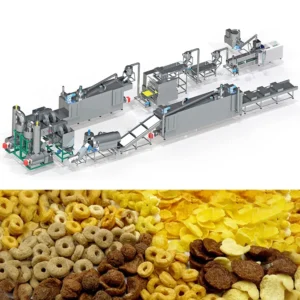
Automatic Instant Breakfast Cereals Snack Food Making Machine
¥10,000.00 Select options This product has multiple variants. The options may be chosen on the product page -
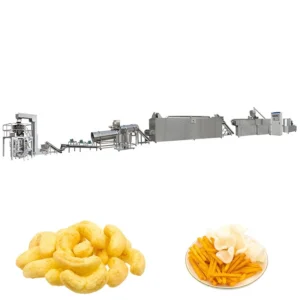
Corn Flake Making Machine Corn Puffs Making Machine Snack Food Production Line
Price range: ¥500.00 through ¥1,200.00 Select options This product has multiple variants. The options may be chosen on the product page -
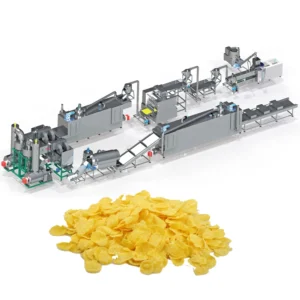
Intelligent Corn Flakes Production Line Twin Screw Extruder to Make Corn Flakes amd Morning Cereals
¥30.00 Select options This product has multiple variants. The options may be chosen on the product page -
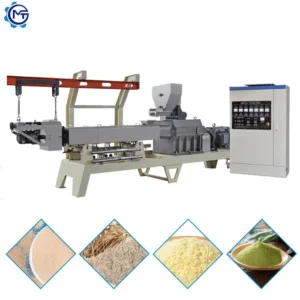
New Technical Automatic Cereal Nutritional Powder Instant Porridge Baby Food Making Machine
¥10,000.00 Select options This product has multiple variants. The options may be chosen on the product page