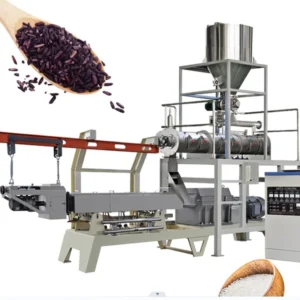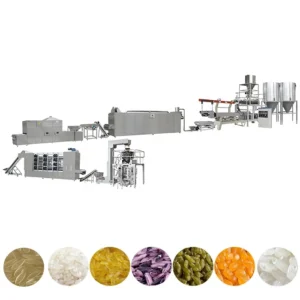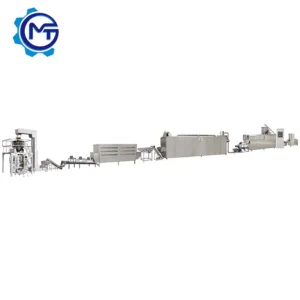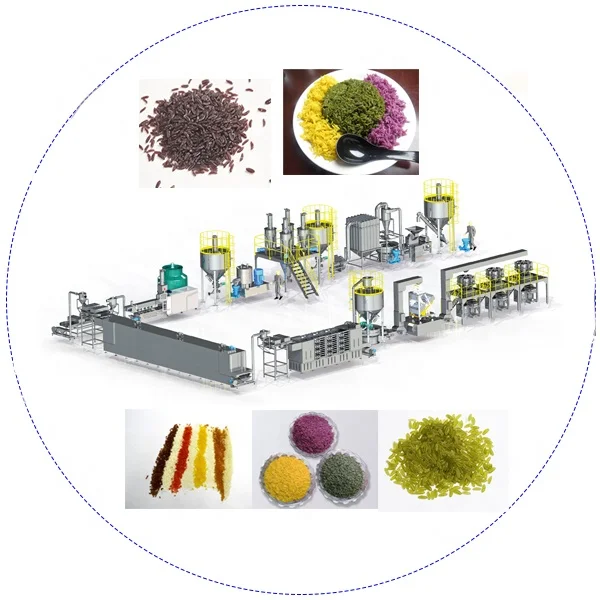
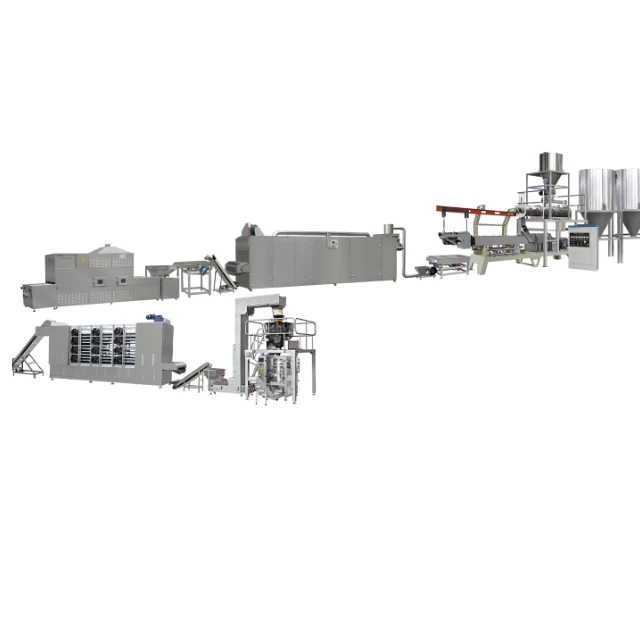

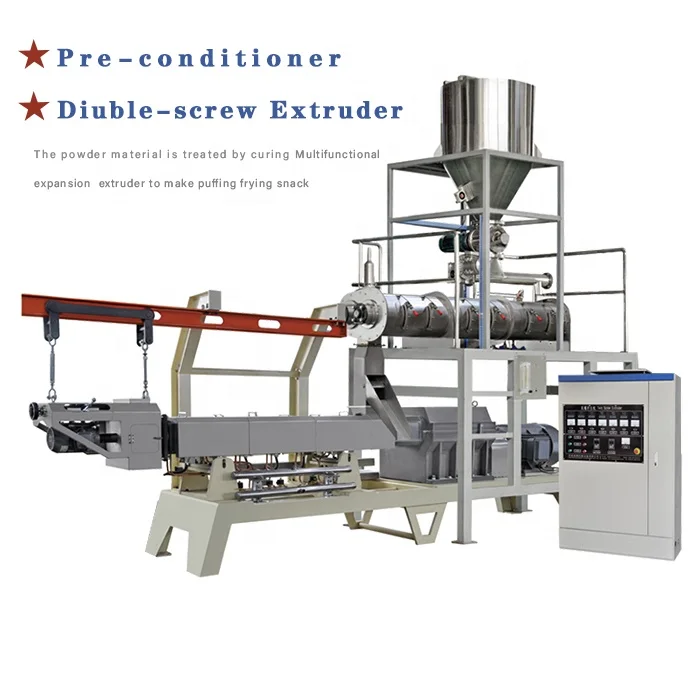

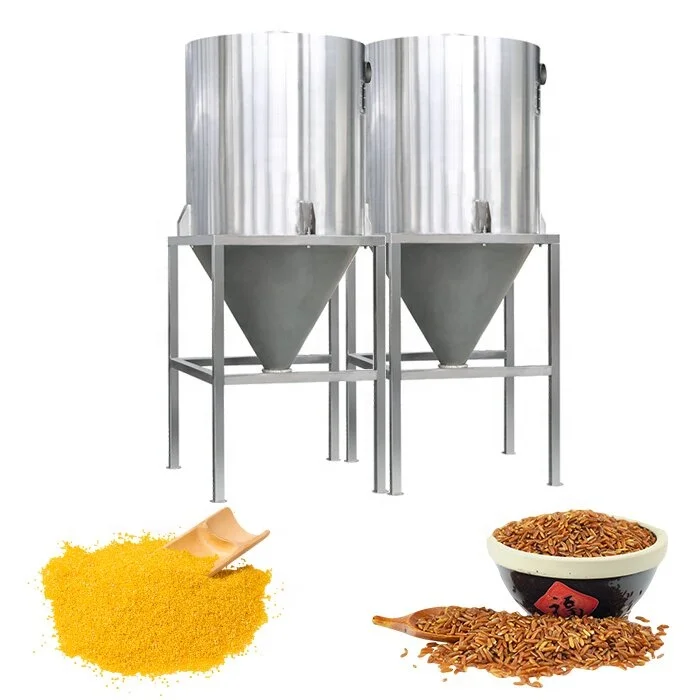
Nutritional Fortified Rice Kernel Extrusion Line, Twin-Screw, CE Certified — complete turnkey solution from mixing to packing for artificial and fortified rice production.
- Stations include mixing, extruding, vibrating, drying, cooling and packing
- Twin-screw extruder with frequency-controlled feeding system
- Circulation drying oven with adjustable mesh belt speed
Engineered as a complete line where every station is throughput-matched to your raw material formulation and target capacity, eliminating bottlenecks common when sourcing equipment from separate vendors. Backed by in-house testing workshop trials on your actual ingredients before shipment, plus full layout documentation and on-site commissioning support.
Description
Integrated Line Engineering — throughput matched across every station from mixing to packing, verified on your actual raw material before a single bolt is shipped.
Technical Specifications
| Parameter | Value |
|---|---|
| Product Type | Fortified Rice Kernel Extrusion Production Line |
| Model Options | MT65 / MT70 / MT85 / MT75 / MT95 |
| Screw Type | Twin-screw |
| MT65 Installed Power | 85 kW |
| MT65 Power Consumption | 60 kW |
| MT65 Capacity | 80–100 kg/hr (basis not stated in source — confirm raw material formulation and moisture content) |
| MT65 Overall Dimensions | 28 × 1.2 × 2.2 m |
| MT70 Installed Power | 120 kW |
| MT70 Power Consumption | 85 kW |
| MT70 Capacity | 100–120 kg/hr (basis not stated in source — confirm raw material formulation and moisture content) |
| MT70 Overall Dimensions | 30 × 1.5 × 2.2 m |
| MT85 Installed Power | 235 kW |
| MT85 Power Consumption | 165 kW |
| MT85 Capacity | 200–300 kg/hr (basis not stated in source — confirm raw material formulation and moisture content) |
| MT85 Overall Dimensions | 34 × 3.5 × 4.3 m |
| MT75 Installed Power | 180 kW |
| MT75 Power Consumption | 135 kW |
| MT75 Capacity | 300–500 kg/hr (basis not stated in source — confirm raw material formulation and moisture content) |
| MT75 Overall Dimensions | 32 × 3.5 × 4.3 m |
| MT95 Installed Power | 260 kW |
| MT95 Power Consumption | 195 kW |
| MT95 Capacity | 800–1000 kg/hr (basis not stated in source — confirm raw material formulation and moisture content) |
| MT95 Overall Dimensions | 36 × 3.5 × 4.3 m |
| Control System | Frequency speed controlling |
| Feeding System | Single or double screw feeding, matched to material characteristics |
| Dryer Heating Source | Electric or gas |
| Dryer Feature | Circulation drying with frequency-controlled mesh belt speed |
| Screw Construction | Wear-resistant alloy |
Application Suitability
| Application | Material or Output |
|---|---|
| Fortified rice kernel production for nutrition programmes | Broken rice, corn, millet, wheat, oats with vitamin and mineral premix |
| Artificial rice from grain by-products | Rice bran, buckwheat, bean flour, starch blends |
| Enriched breakfast cereal kernels | Oat and wheat base with micronutrient fortification |
| Specialty grain reconstitution | Cassava, sorghum, and local tuber or cereal flours |
Why Your Raw Material Blend Changes the Entire Line Layout
A Fortified Rice Kernel Extrusion Production Line turnkey must be built around the starch behaviour of your specific flour blend, not a generic catalogue recipe.
I spent two weeks in a West African plant reworking a nutritional rice line that had been tested on standard milled rice back at the factory. The buyer switched to a local cassava and sorghum mix, and the extrudate came out clumped with incomplete gelatinisation. We tore the screw configuration apart on the floor, rebuilt the barrel temperature profile zone by zone, and finally stabilised the output. [NEED_CITE: starch gelatinisation behaviour of cassava and sorghum in twin-screw extrusion] That is the kind of fire you avoid when line capacity is verified on your actual formulation before shipment.
Station Sequence and Moisture Control Architecture
The Fortified Rice Kernel Extrusion Production Line turnkey follows a deliberate station sequence: mixing, extruding, vibrating, low-temperature drying, cooling, high-temperature roasting, a second cooling stage, and packing. Each stage addresses a specific moisture and texture target. The vibrating station settles the kernel shape before drying begins. Low-temperature drying removes bulk moisture without case-hardening the surface, which would trap steam and crack the kernels during roasting. The high-temperature roasting pass then sets the final colour and bite, and the second cooling stage brings the product to ambient temperature before it reaches the packing station. Skipping or combining any of these stages risks uneven moisture profiles that shorten shelf life.
Feeding Stability and Extruder Screw Selection
Feeding consistency determines whether the extruder produces uniform kernels or a stream of misshapen fragments. The line offers single or double screw feeding, selected based on how freely your premix flows. Blends with fine vitamin-mineral powders or high-fat content tend to bridge in single-screw hoppers, so a twin-screw feeder provides the positive displacement needed to maintain a steady feed rate. Inside the barrel, the screw elements are configured to your target kernel density. More kneading blocks increase shear and gelatinisation, which suits dense wholegrain blends. Fewer kneading blocks preserve starch granule structure for lighter, more rice-like textures. [NEED_CITE: twin-screw element configuration for food extrusion applications]
Understanding Power and Capacity Across the Model Range
The installed power ranges from 85 kW on the MT65 to 260 kW on the MT95, reflecting the motor and heating requirements at each throughput tier. Power consumption under operating conditions is lower — for example, the MT75 draws 135 kW against its 180 kW installed capacity, leaving headroom for start-up surges. The circulation drying oven uses a frequency-controlled mesh belt, so residence time can be adjusted independently of extruder speed. This matters because a blend with higher initial moisture needs longer drying, and you do not want the extruder to idle while the dryer catches up. Frequency speed controlling across all stations keeps the line synchronised without manual throttle adjustments at each panel.
The Hidden Cost of Mismatched Station Throughput
When an extruder is quoted without its dryer and cooling capacity being matched, the bottleneck simply moves downstream. I have walked into plants where the extruder ran at full speed for twenty minutes, then operators had to shut it down because the dryer belt was overloaded and kernels were stacking up, sticking together in wet clumps. The packing station sat idle half the shift. The buyer ends up running the line well below the quoted extruder capacity, and the return on investment stretches far beyond the original projection. [NEED_CITE: production line bottleneck analysis in food processing] Every station on this line is sized to hold the same target output, so the constraint stays where you designed it to be.
What Makes This Line Procurement Different
The entire Fortified Rice Kernel Extrusion Production Line turnkey is supplied under one responsibility, meaning throughput is calculated across every station rather than assembled from separate vendor quotations that each assume the other can absorb peak output. Screw and die configurations are specified to your raw material formulation, not copied from a standard build. The in-house testing workshop runs your actual ingredients before the line ships, producing a trial report you can review before authorising dispatch. Electrical schematics confirm voltage and frequency against your site supply, avoiding the commissioning delays that happen when a 380 V motor arrives at a 415 V plant. CE certification has been maintained since 2014, supporting customs and regulatory clearance in import markets that require conformity documentation.
Documentation & Verification
- Line layout with capacity calculation for your specific grain blend and target kernel weight
- Screw and die configuration record matched to your formulation’s gelatinisation requirement
- Trial run report on your raw material from the in-house testing workshop before shipment
- Electrical schematic with site voltage, frequency, and control language confirmed
- CE declaration of conformity and ISO certificate for customs clearance
- Wear parts list identifying screw elements, dies, and dryer belt replacement intervals
Installation, Commissioning & Support
- Foundation requirements calculated from the overall dimensions of your selected model and total installed power
- Dedicated electrical circuit sizing based on the operating power consumption of the full line
- Arrives in sectional modules for assembly on site, aligned to the provided floor layout
- First-run commissioning includes barrel temperature profiling and dryer belt speed calibration
- Operator training covers screw configuration changes for different grain blends
- Wear parts kit supplied with initial screw elements and die plates for the first changeover
What We Need to Build Your Line Layout
Send the grain or flour blend you intend to run, including the ratio of base starch to fortification premix, and the target kernel size and weight per piece. Share your available floor space, ceiling height, and the voltage and frequency at the facility. If you have existing upstream milling or downstream packing equipment, let us know the model and throughput so the line interfaces correctly.
Frequently Asked Questions
Q: How is line capacity verified against my specific raw material blend and moisture level?
A: Your raw material is shipped to the in-house testing workshop where the selected extruder model runs a trial batch. Screw configuration, barrel temperature, and dryer settings are adjusted until the kernel density, colour, and moisture meet your specification. A trial run report is issued before the line is cleared for production and dispatch.
Q: How do you ensure throughput is matched between the extruder, dryer, and packing station?
A: Each station is sized during the layout phase using your formulation’s moisture content and the target kernel weight. The dryer belt width and length, cooling conveyor capacity, and packing head speed are all calculated to absorb the extruder’s output at full speed without accumulation or starvation at any transfer point.
Q: Can voltage, frequency, and control language be confirmed before production?
A: Yes. During the specification confirmation stage, we collect your site electrical data and issue an electrical schematic for your review. Motor ratings, heating element specifications, and control panel labels are set to your plant’s supply and operator language before any component is ordered for assembly.
Q: Is a trial run on my raw material performed before shipment?
A: Every line is tested on the buyer’s actual raw material in the testing workshop. The trial run replicates the full station sequence — extrusion through drying and roasting — and the resulting product samples and process parameters are documented in a report you approve before the line is packed for shipment.
Related products
-
CE Approved MT Brand Organic Baby Rice Nutrition Powder Extrusion Production Line with 500kg/h Capacity and Automatic Grade
¥9,500.00 Add to cart -

New Automatic Nutritional Powder Making Machine for Baby Food Production Line
¥20.00 Select options This product has multiple variants. The options may be chosen on the product page -
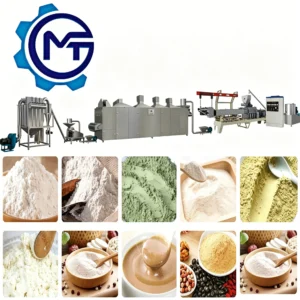
Organic Gluten Free Baby Rice Nutrition Powder Automatic 500kg/h Production Processing Line
¥8,238.27 Add to cart -
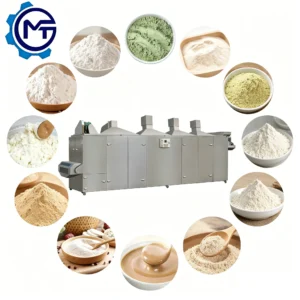
Small Scale MT Brand Automatic Baby Food Nutrition Powder Rice Flour Making Machine with 500kg/h Production Capacity PLC Control
¥9,500.00 Add to cart