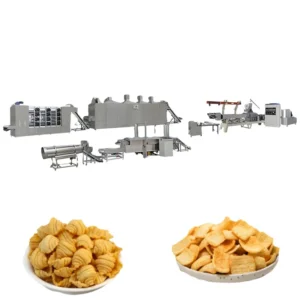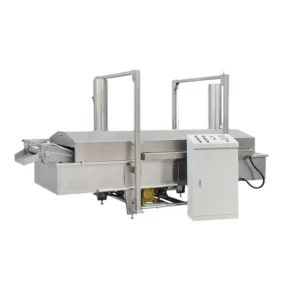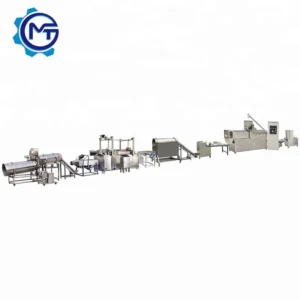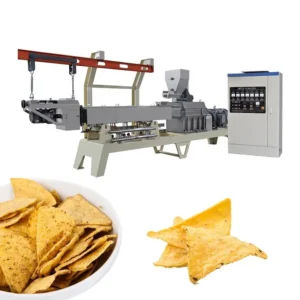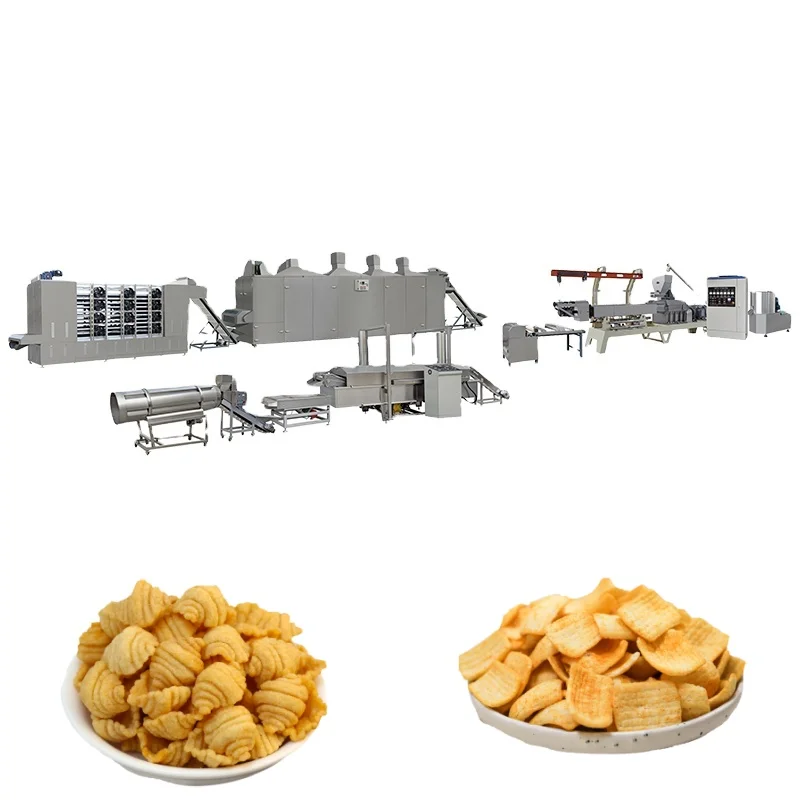
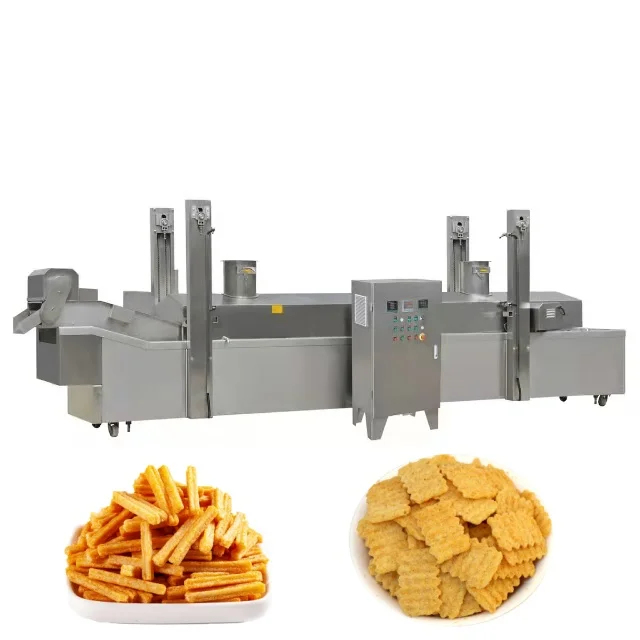


MT-65 Automatic Fried Corn Chips Making Line, 100 kW Main Motor, Twin-Screw Extrusion — a complete turnkey layout from mixing through frying with throughput matched across every station. Screw configuration and die design are specified to your raw material formulation and target chip shape, controlling expansion, density and texture through co-rotating sectional modules. Fryer features a 600 mm stainless steel belt with automatic temperature and speed control for uniform product finish.
- Line capacity calculation, screw and die record, and trial run on your raw material provided before shipment
- Voltage, frequency and control language confirmed to your destination market standard prior to production
- Full electrical schematic and CE documentation included with operator training during on-site commissioning
Description
Turnkey Line Matching — Throughput between extruder, cutter and fryer is calculated on your actual dough formulation before any station is sized.
Technical Specifications
| Parameter | Value |
|---|---|
| Model | MT-65 |
| Product Type | Automatic Fried Corn Chips Making Line |
| Screw Type | Twin screw, co-rotating sectional modules |
| Main Motor | 100 kW |
| Output Capacity | 120-150 kg/h (basis not stated in source — confirm raw material, moisture and product shape) |
| Cutter Power | 1.47 kW |
| Cutter Dimensions | 2500 × 600 × 1100 mm |
| Fryer Belt Width | 600 mm stainless steel mesh belt |
| Fryer Heating Options | Electricity or fuel gas |
| Drying / Heating Options | Gas, electric or diesel heating |
| Overall Dimensions | 22000 × 1200 × 2200 mm |
| Voltage & Frequency | Customizable (e.g. 3ph 380V 50Hz, 3ph 415V 60Hz, 3ph 220V 60Hz) |
| Contact Materials | Food-grade stainless steel on all product-contact parts |
| Control System | Available with PLC or MCC control (confirm requirement) |
| Standards | CE certified, ISO certified |
| Warranty | 1 year complete warranty with lifetime maintenance service |
Application Suitability
| Application | Material or Output |
|---|---|
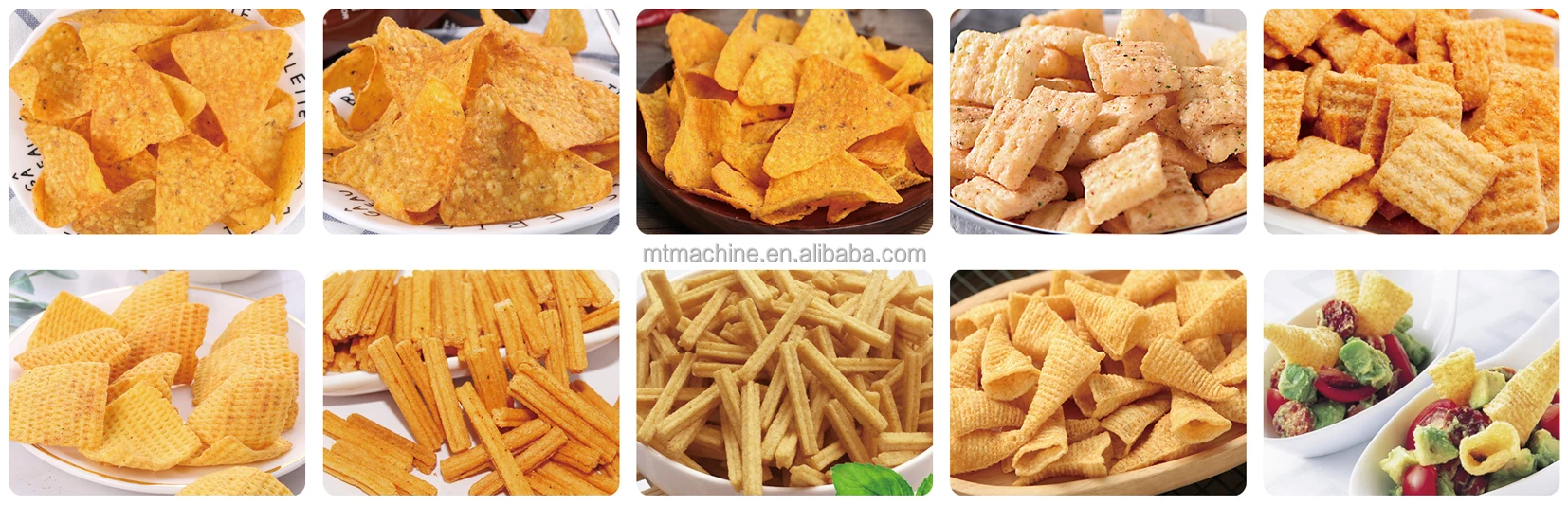
| Fried corn chips and tortilla chips | Corn powder, corn starch, wheat flour blends |
| Doritos-style triangular chips | Corn masa dough with seasoning-compatible surface texture |
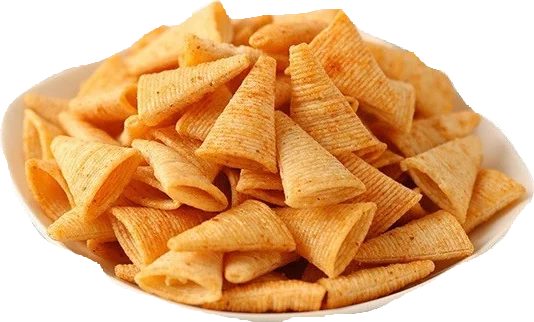
| Bugles and pillow-shaped snacks | Wheat flour and potato starch formulations via shaped die |
| Wavy and diamond-cut chips | Potato powder and corn starch blends with profiled cutting rollers |
| Square sheet rib chips and sticks | Corn and wheat composite dough, cut to sheet format before frying |
Why the Cutter-Fryer Handshake Decides Your Real Output
A fried corn chips making line turnkey only holds its quoted rate when every station is matched to the dough you actually run.
I once spent two weeks watching a corn chip line in a workshop where the extruder pushed out sheeted dough faster than the fryer belt could absorb it. The cutting machine was rated for the extruder’s peak, but the fryer oil recovery cycle lagged behind. Chips piled up on the transfer conveyor, cooled below the frying threshold and entered the oil at inconsistent temperatures. The result was uneven expansion and a belt that had to be stopped every twenty minutes to clear the backlog. That fried corn chips making line turnkey was rated for a certain capacity on paper, but the real number was dictated by the slowest thermal station. When a project contractor or snack producer sources individual machines from separate vendors, this mismatch is almost guaranteed because each supplier rates their own unit in isolation. [NEED_CITE: throughput matching between sequential thermal processing stations]
Screw Configuration Dictates What Your Dough Can Become
The MT-65 uses co-rotating twin-screw extrusion with sectional modules that can be rearranged along the barrel. Each module handles a different function — forward transport, backward mixing, de-gassing or high-shear cooking. For a corn chip dough that needs full starch gelatinisation without excessive moisture loss, the screw profile is set to extend residence time in the cooking zone while maintaining enough pressure to sheet cleanly at the die. A fried corn chips making line turnkey configured this way lets you adjust the screw arrangement when you switch from corn masa to a wheat-potato blend, rather than replacing the entire extruder.
Die Geometry and Cutter Timing Shape the Final Chip
The die opening determines sheet thickness, and the cutting roller profile determines the chip outline — triangle, diamond, wave or pillow. If the die gap is too wide for a low-moisture corn dough, the sheet tears at the cutter. If the cutter speed is not synchronised to the extruder output rate, you get overlapping chips that fuse together in the fryer. This synchronisation is not a fixed setting; it changes with every raw material formulation, which is why the in-house testing workshop runs your actual dough through the full sequence before the line ships. [NEED_CITE: die gap and cutter synchronisation for sheeted snack extrusion]
Reading the Specs That Actually Matter
The 100 kW main motor on the MT-65 twin-screw extruder provides the torque needed for high-viscosity corn masa, which demands significantly more shear energy than a puffed snack dough. The 600 mm fryer belt width sets the maximum sheet width that can pass through the oil in a single layer — a wider belt means more chips per linear metre of fryer travel, directly affecting oil residence time and moisture removal. Customisable voltage and frequency (3ph 380V 50Hz, 3ph 415V 60Hz, 3ph 220V 60Hz) mean the motor windings and heater elements are specified before production begins, avoiding the commissioning delays that occur when a machine arrives with the wrong electrical configuration. The 22-metre overall line length reflects the physical distance required for the extrusion, cooling, cutting and frying sequence to operate without material backlog at any transfer point.
The Hidden Cost of Undersized Frying Stations
When the fryer is specified by nominal capacity alone, without testing how your specific dough moisture content absorbs and releases oil, the thermal load calculation is incomplete. A corn dough with higher moisture demands more energy per kilogram to reach the target exit moisture, which slows the belt speed and backs material up to the cutter. Over time, operators compensate by running the oil hotter, degrading oil quality and shortening replacement intervals. The line runs, but the consumable cost climbs and the chip colour drifts outside specification. This is the most common failure mode I have seen on lines where the fryer was selected as a standalone unit. [NEED_CITE: oil degradation rate relative to dough moisture load in continuous frying]
Why Source This Line Here
The MT-65 fried corn chips making line turnkey is configured as a single-supplier project from mixing through frying, so throughput is calculated across every station rather than assembled from independent machine ratings. Screw configuration and die design are specified to the buyer’s raw material formulation and target chip shape, not copied from a generic build. Every line goes through a trial run in the in-house testing workshop using the customer’s actual raw material before it ships, so cutter-fryer synchronisation is verified under real conditions. Voltage, frequency and control language are confirmed before production begins, eliminating the commissioning delays that arise when electrical specifications are assumed. The line is backed by complete documentation including a trial run report and factory test record, not just a packing list.
Documentation & Verification
- Line layout drawing with throughput calculation across extruder, cutter and fryer stations
- Screw and die configuration record matched to your raw material and chip shape
- Trial run report on your corn or wheat dough conducted before shipment
- Electrical schematic with confirmed voltage, frequency and control language
- CE declaration of conformity and ISO certificate for export compliance
- Wear parts list covering screws, dies, cutting rollers and fryer belt segments
Installation, Commissioning & Support
- Foundation plan based on the 22000 × 1200 × 2200 mm line footprint and fryer load
- Dedicated electrical circuit sized for the 100 kW extruder motor plus fryer heating load
- Assembly sequence for sectional twin-screw barrel modules and fryer belt installation
- First-run parameter setting including screw speed, die gap and fryer belt speed calibration
- Operator training on cutter-fryer synchronisation adjustments for different dough formulations
- Spare screw elements, die inserts and fryer belt sections identified at time of shipment
What to Include in Your Inquiry
To configure a fried corn chips making line turnkey that matches your production target, we need your raw material formulation including corn flour type and moisture percentage, the chip shape and thickness you plan to run, and your destination market voltage and frequency standard. If you have an existing packaging line or seasoning drum, share the interface requirements so the fryer discharge can be matched to your downstream equipment.
Frequently Asked Questions
Q: How is throughput verified across the extruder, cutter and fryer to prevent bottlenecks?
A: Each station’s capacity is calculated against your specific dough formulation and moisture content, not a generic rating. The cutter speed and fryer belt speed are synchronised during a trial run on your raw material in the testing workshop, and the resulting throughput is documented in the trial run report before the line ships.
Q: Can I send my own raw material for a trial run before shipment?
A: Yes. The in-house testing workshop accepts your actual corn flour, wheat blend or potato starch formulation. The trial run tests extrusion behaviour, die sheeting quality, cutting synchronisation and frying response, and you receive a full report covering output rate, chip texture and oil absorption at your specific moisture level.
Q: How are screw configuration and die design selected for my chip shape?
A: The screw module arrangement is set based on the starch gelatinisation requirement of your raw material, and the die gap is matched to the target sheet thickness. Cutting roller profiles are selected for your chip outline — triangle, diamond, wave or pillow — and tested together during the pre-shipment trial run.
Q: What electrical options are confirmed before production begins?
A: Voltage, frequency and phase are confirmed to your destination standard, such as 3ph 380V 50Hz or 3ph 415V 60Hz. Motor windings, heater elements and control panel language are all specified to the confirmed values before manufacturing starts, so the line is ready for commissioning on arrival.
Q: What does the installation and commissioning schedule look like?
A: The 22-metre line arrives in sectional modules. Installation covers foundation, electrical connection, barrel assembly and fryer belt fitting. Commissioning includes parameter calibration on your raw material, cutter-fryer timing adjustment and operator training on formulation changes.
Related products
-
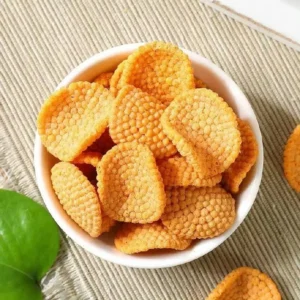
New Automatic Bugles Puff Snack Production Line Price Corn Chips Making Machine Fried Maize Machine High Productivity Large
¥8,570.00 Select options This product has multiple variants. The options may be chosen on the product page -
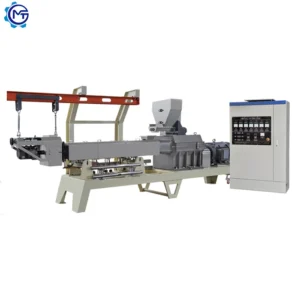
Industrial Wheat Flour Snacks Processing Equipment – Stainless Steel Fried Food Production Line
¥65.00 Select options This product has multiple variants. The options may be chosen on the product page -
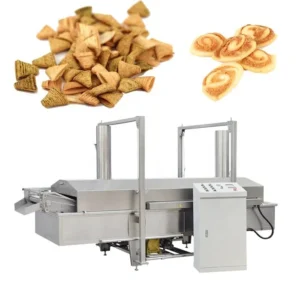
Double Screw Extruder Corn Flour Puffs Snack Nacho Chips Tortilla Doritos Making Machine Savory Snack Production Line
¥50.00 Select options This product has multiple variants. The options may be chosen on the product page -
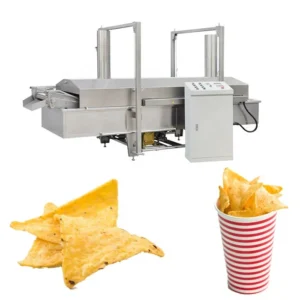
New Fully Automatic Large Capacity 304 Stainless Steel Savory Frying Snack Production Line Crisp Bugles Chips Processing Machine
¥30.00 Select options This product has multiple variants. The options may be chosen on the product page