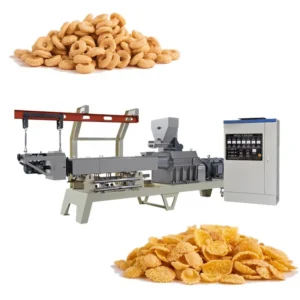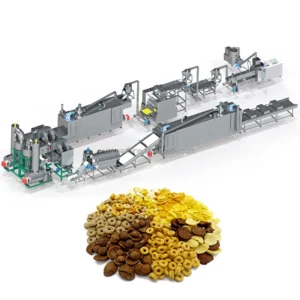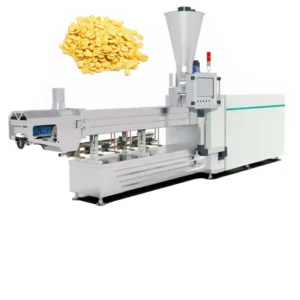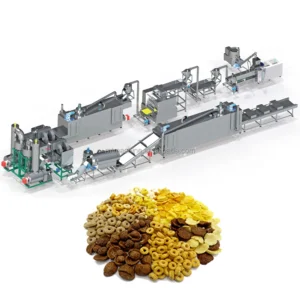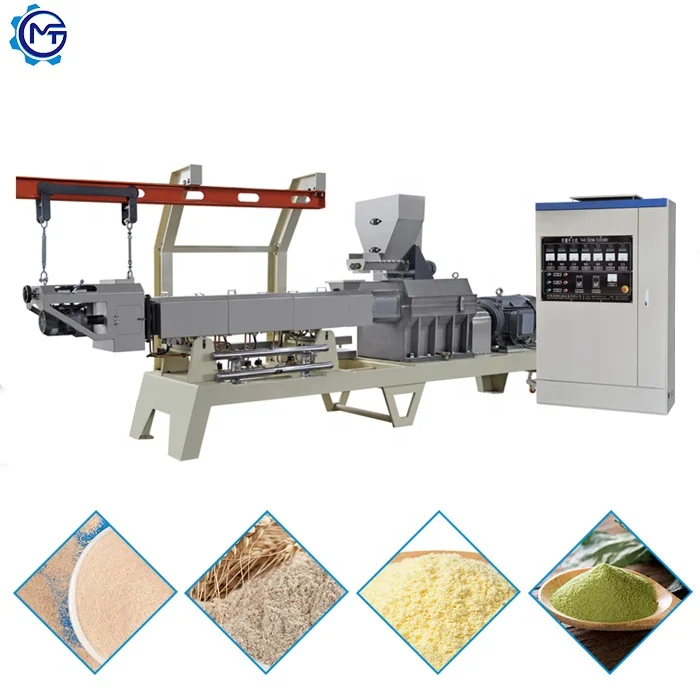
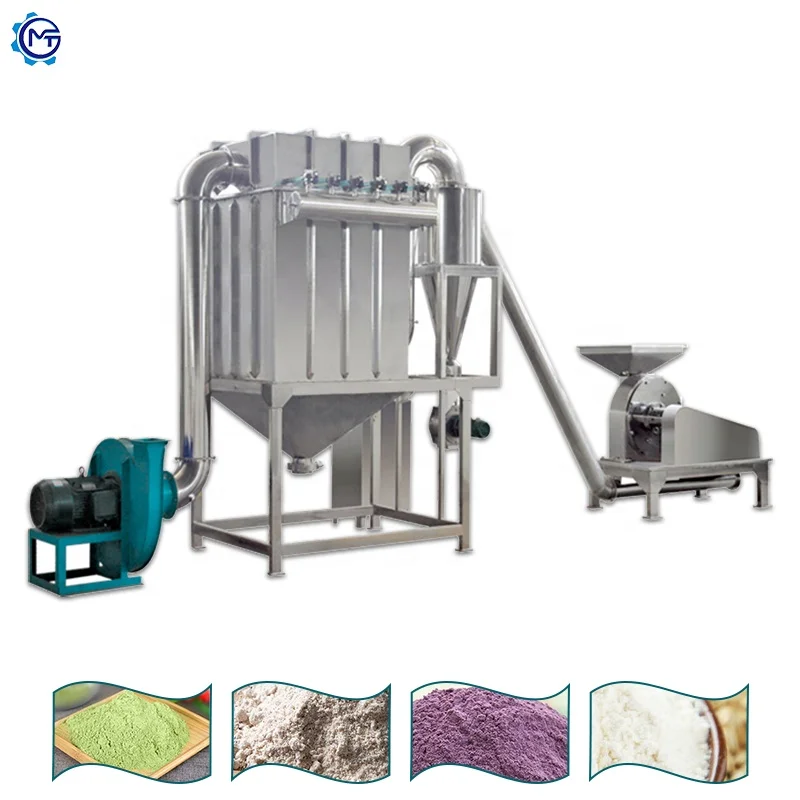
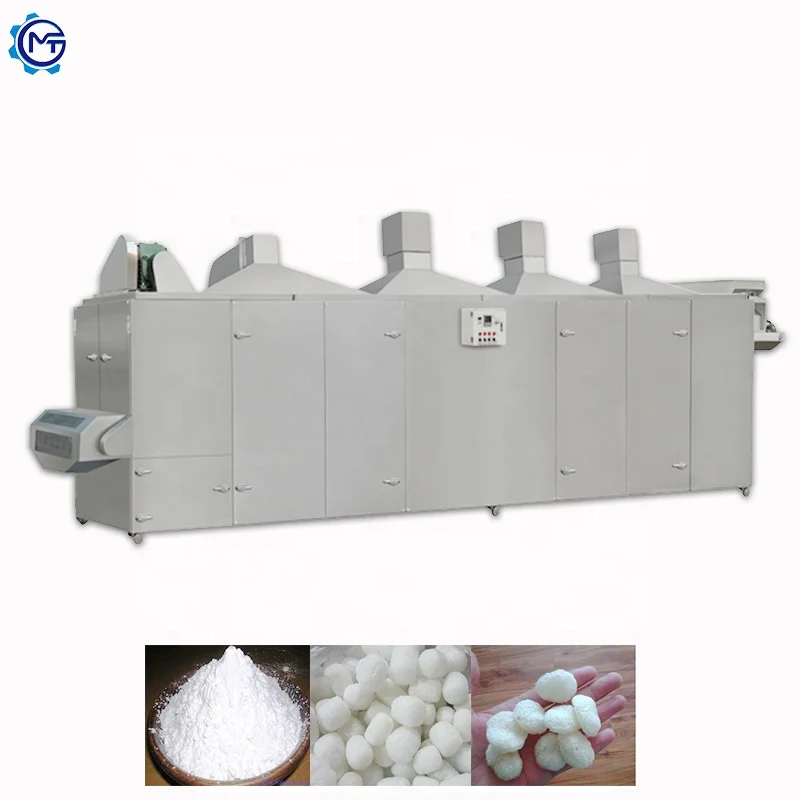
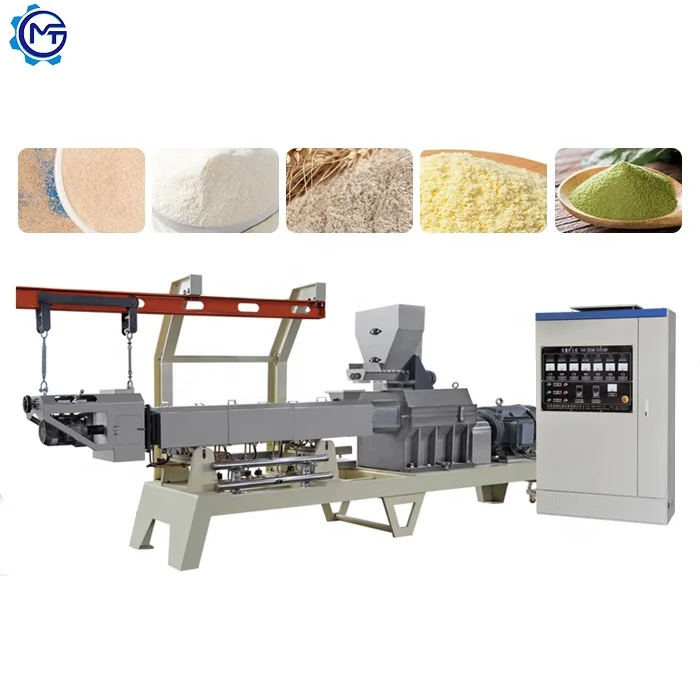
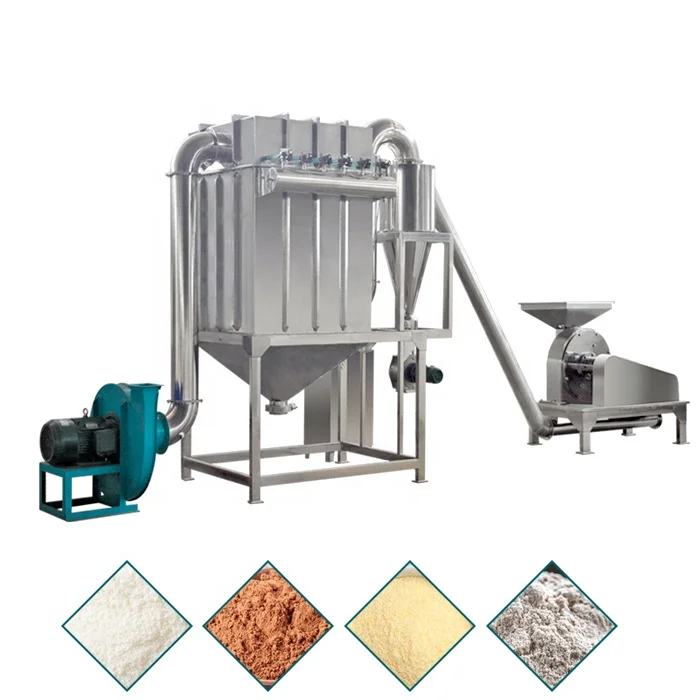
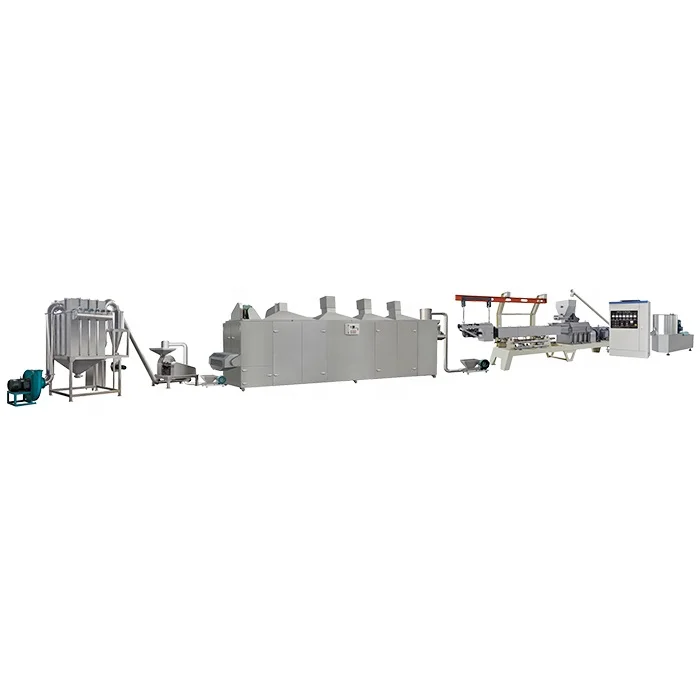
MT75 Corn Flakes Production Line, Twin Screw, 210 kW Installed Power — configured for complete breakfast cereal processing from mixing through flaking, roasting, and packing. PLC and MCC control ensure consistent starch gelatinisation across varying formulations, while the hydraulic double-roller flaking station with infrared temperature monitoring delivers uniform thickness. Screw and die geometry are matched to your specific grain blend and target crispness.
- Line throughput balanced across every station to eliminate bottlenecks between extrusion output and drying or coating capacity
Description
Throughput-Matched Engineering — Every station from mixing to packing is sized to the extruder’s actual output on your grain formulation, preventing the dryer or coating drum from becoming an unintended bottleneck.
Technical Specifications
| Parameter | Value |
|---|---|
| Product Type | Corn Flakes Production Line |
| Model | MT75 (also available: MT70, MT85) |
| Screw Type | Twin Screw |
| Installed Power | 210 kW (MT75); 160 kW (MT70); 190 kW (MT85) |
| Power Consumption | 150 kW (MT75); 120 kW (MT70); 140 kW (MT85) |
| Capacity | 300–500 kg/hr on standard cereal grains (basis to be confirmed for specific raw material and moisture) |
| Overall Dimensions | 45 × 1.5 × 3.5 m (MT75) |
| Control System | PLC and MCC control |
| Flaking System | Hydraulic double-roller, separate motor drive, infrared temperature control |
| Roasting Oven | Conciliation burner, dual circulating fans, cyclone dust removal |
| Dryer Heating Source | Gas or Electric |
| Coating System | Double tumble sugar melting, elevator, coating drum, spraying nozzle |
| Voltage Customization | Available (commonly 415V 50/60Hz, 440V 50/60Hz, 220V 60Hz) |
| Final Product Shapes | Ball, tube, stick, ring, fruit loop, star, wheel, flower, heart |
| Certifications | CE (since 2014), ISO |
Application Suitability
| Application | Material or Output |
|---|---|
| Natural corn flakes production | Corn grits, corn flour |
| Sugar-coated breakfast cereals | Corn, rice, wheat base with sugar or honey glaze |
| Multigrain cereal shapes | Rice, oat, and barley powder blends |
| Extruded cereal variants | Fruit loops, rings, stars, hearts via interchangeable moulds |
| Fortified breakfast cereals | Grain base with added vitamin and mineral premix |
Why Nominal Capacity Numbers Fail on Real Grain Formulations
A line rated at a theoretical output means nothing if it cannot hold that rate on your specific corn grits at your operating moisture.
I walked into a breakfast cereal plant last year where the extruder was rated for a certain throughput, but the buyer’s corn flour was coarser than the standard test medium. The actual output dropped significantly, and the downstream dryer was oversized for the reduced volume, wasting energy while the flaking station sat idle half the time. This mismatch is the single most common reason a corn flakes production line turnkey project disappoints in the first six months. The extruder, flaking rolls, dryer, and roasting oven must be sized not against a catalogue number but against the throughput your specific raw material will actually deliver [NEED_CITE: raw material particle size effects on extruder throughput].
How Screw Configuration Determines Flake Texture
The twin-screw extruder in this corn flakes production line turnkey system is not a generic build. The screw elements and barrel sections are arranged to match your grain blend’s starch gelatinisation profile. Corn requires a different shear and residence time pattern than a rice-wheat mix, and the screw configuration directly controls whether the extrudate exits with the correct moisture, temperature, and degree of cook to survive the flaking rolls without crumbling or sticking.
Matching Dryer and Roaster Capacity to the Extruder’s Real Output
A frequent failure in cereal lines is the dryer bottleneck. If the extruder delivers product faster than the dryer can reduce moisture to the target level, flakes enter the roasting oven too wet and emerge tough rather than crisp. The hot air roasting oven here uses a conciliation burner with two independent circulating fans and a cyclone dust removal device, giving precise temperature zones that can be adjusted to the actual throughput verified during the pre-shipment trial run [NEED_CITE: moisture reduction rates in multi-pass cereal dryers].
Reading the Power and Dimension Data Correctly
The MT75 draws 150 kW in operation and occupies 45 metres of line length. That footprint includes mixing, extruding, flaking, drying, hot air roasting, cooling, and packing stations. The installed power of 210 kW covers peak startup loads across all motors and heaters. Buyers comparing lines should look at power consumption rather than installed power, as the running figure determines electrical infrastructure cost. The hydraulic flaking station uses separate motors for each roller, which maintains uniform pressure across the full roller width and produces consistent flake thickness from edge to centre.
The Cost of Skipping Pre-Shipment Verification
When an extruder ships without a trial run on the buyer’s actual grain, the first production run becomes an expensive experiment. Screw elements may need rearranging, die apertures may need resizing, and the flaking gap may need adjustment — all on the factory floor, with raw material being wasted and delivery deadlines slipping [NEED_CITE: commissioning delays in food extrusion projects without factory trials]. The result is weeks of lost production that no specification sheet could have predicted.
What a Matched Line Looks Like in Practice
Every station on this line is sourced from the same supplier, which means throughput calculations, mechanical interfaces, and control integration are resolved before the equipment leaves the factory. The PLC and MCC control system coordinates motor speeds and temperature zones across extruding, flaking, drying, and roasting so that a change at one station propagates correctly to the next. The in-house testing workshop runs your raw material through the actual screw and die configuration before shipment, generating a trial report that documents product density, flake integrity, and coating adhesion against your market specification. Voltage and frequency are confirmed to your facility standard, and the control language is set before the machine is crated.
Documentation & Verification
- Line layout and capacity calculation showing station-by-station throughput match for your grain formulation
- Trial run report on your raw material documenting flake density and crispness before dispatch
- Screw and die configuration record specific to your corn flakes formulation
- Electrical schematic with voltage and frequency confirmed to your plant standard
- Operation and maintenance manual with wear parts list for screws, dies, and roller surfaces
Installation, Commissioning & Support
- Foundation plan accounts for the 45 × 1.5 × 3.5 m line footprint and dynamic loads from the hydraulic flaking station
- Dedicated circuit sized for 210 kW installed power with voltage matched to your facility before production
- Extruder barrel and screw assembly verified on-site against the pre-shipment configuration record
- PLC and MCC control system commissioned with operator language and alarm thresholds set to your standard
- Spare screw elements and die plates supplied with the initial shipment to cover the first replacement cycle
- Preventive maintenance schedule covers roller bearing lubrication, fan belt tension, and burner calibration intervals
What We Need to Build Your Line Quotation
To prepare an accurate line configuration, share your primary grain type and particle size distribution, target hourly output on that specific material, and the final product format — whether natural flakes, sugar-coated flakes, or a mix of extruded cereal shapes. We also need your facility voltage, frequency, and preferred control language, along with available floor space and ceiling height to confirm the line layout fits your building envelope.
Frequently Asked Questions
Q: How is line capacity verified on my specific raw material rather than a generic test medium?
A: Before shipment, your actual grain formulation runs through the extruder in our in-house testing workshop. The trial produces real corn flakes at production scale, and we measure output rate, flake density, crispness, and coating adhesion. You receive a formal trial run report documenting these results against your target specification, so capacity is confirmed on your material — not a catalogue average.
Q: How are extruder, dryer, flaking, and coating capacities matched to prevent bottlenecks?
A: Each station is sized based on the throughput verified during the pre-shipment trial. The dryer belt speed, roasting oven pass time, and coating drum volume are all calculated from the actual extruder output on your grain. Because the entire line comes from one supplier, the throughput balance is designed into the layout rather than assembled from mismatched vendors.
Q: Can voltage, frequency, and control language be configured to my target market before shipment?
A: Yes. The PLC and MCC control system is configured to your facility’s voltage and frequency — commonly 415V or 440V at 50/60Hz, or 220V at 60Hz — and the operator interface language is set before the machine ships. This is confirmed during the specification stage and documented in the electrical schematic you receive with the machine.
Q: How are screw configuration and die design selected for natural versus sugar-coated corn flakes?
A: Natural flakes require a specific degree of starch gelatinisation and a moisture level that allows clean flaking without tearing. Sugar-coated variants need a slightly different extrudate density so the coating adheres uniformly during tumbling. The screw element arrangement and die aperture are selected based on your target product during the pre-shipment trial, and the configuration is recorded for future reference and spare part ordering.
Q: What does the in-house trial run cover, and do I receive a formal report before the machine ships?
A: The trial covers the full process from mixing your raw material through extrusion, flaking, drying, and roasting. We document throughput rate, product texture, flake thickness uniformity, and roasting colour consistency. The trial run report is shared with you before dispatch, and any screw or die adjustments identified during the trial are made before the equipment is packed.
Related products
-
New Automatic Cornflakes Making Machine Oats Snack Food Chips Extruder Processing Line
¥30.00 Select options This product has multiple variants. The options may be chosen on the product page -
Corn Flakes Machine Breakfast Cereal Corn Flakes Production Line Cornflakes Making Machine
¥85,800.00 Select options This product has multiple variants. The options may be chosen on the product page -

200kg/h Breakfast Cereal Extruder Making Machine Hot Sale Corn Flake Production Line
¥30,000.00 Select options This product has multiple variants. The options may be chosen on the product page -

Small Scale Breakfast Cereal Manufacturing Machine for Corn Flakes Process Line
¥45,000.00 Select options This product has multiple variants. The options may be chosen on the product page