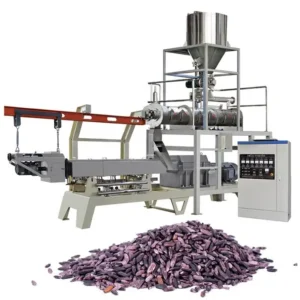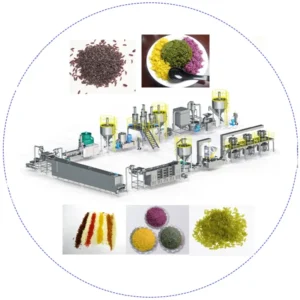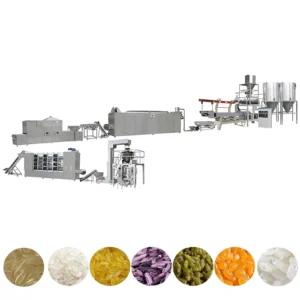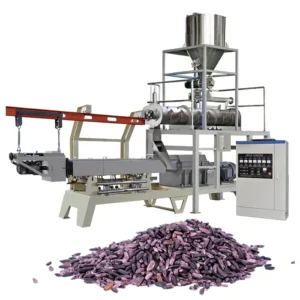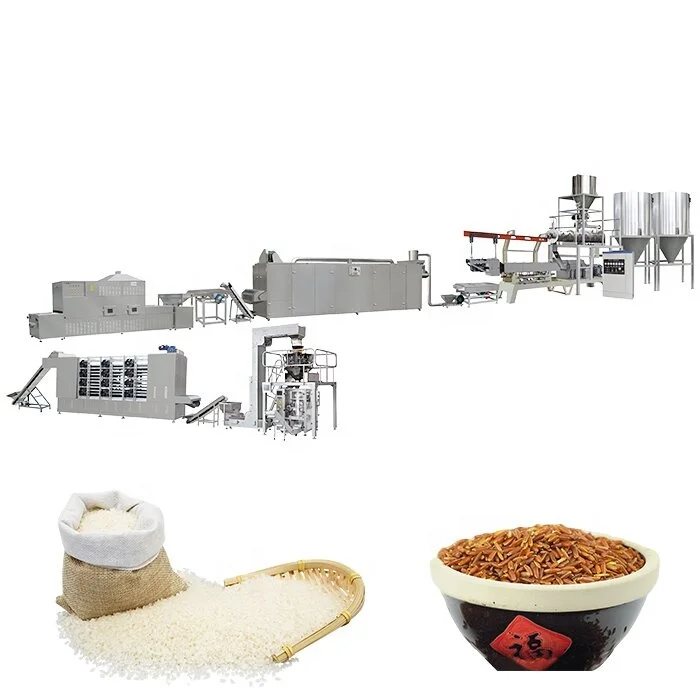
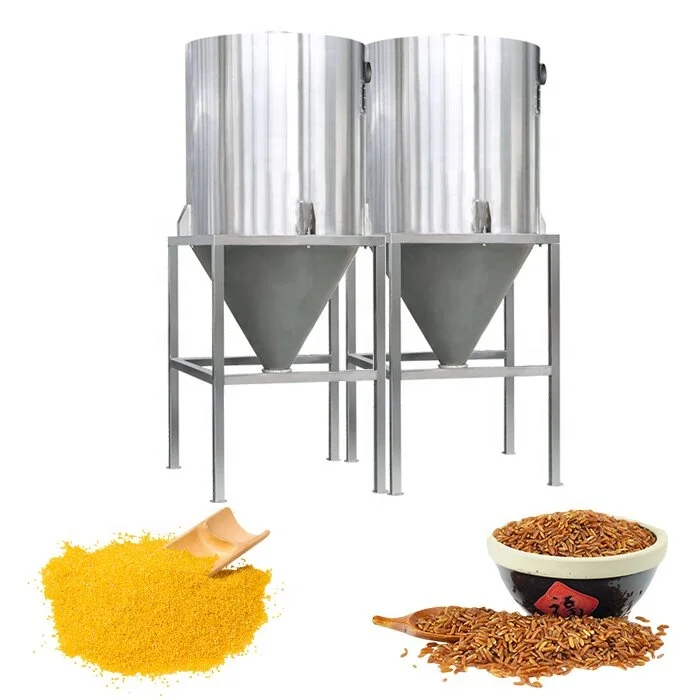
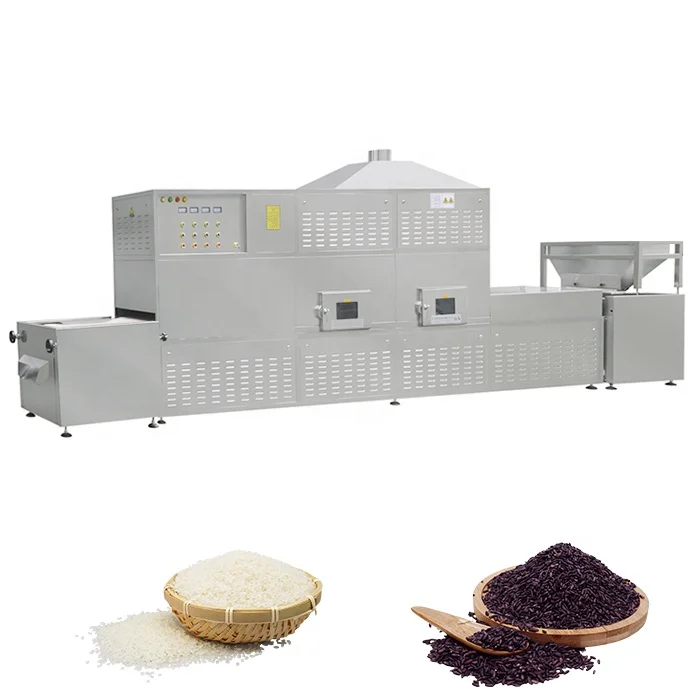
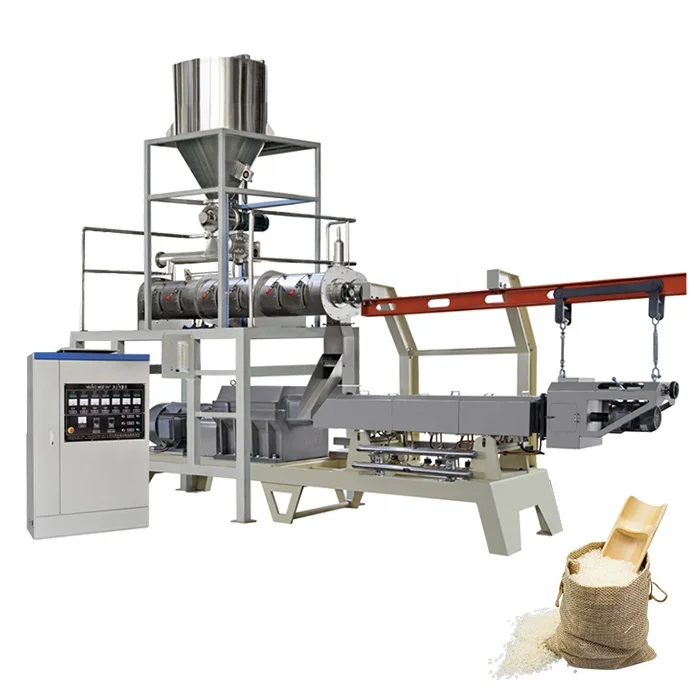
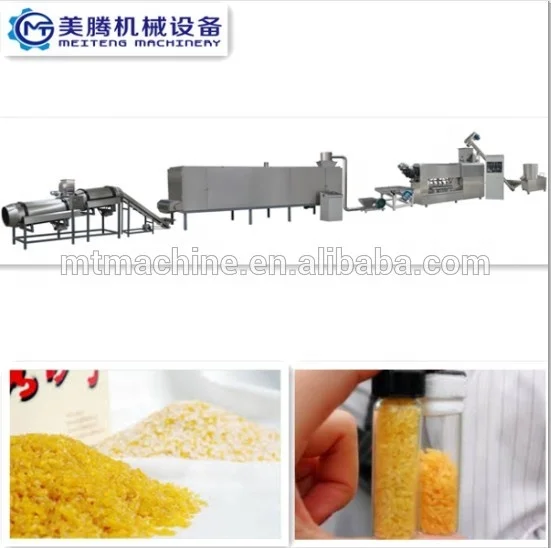
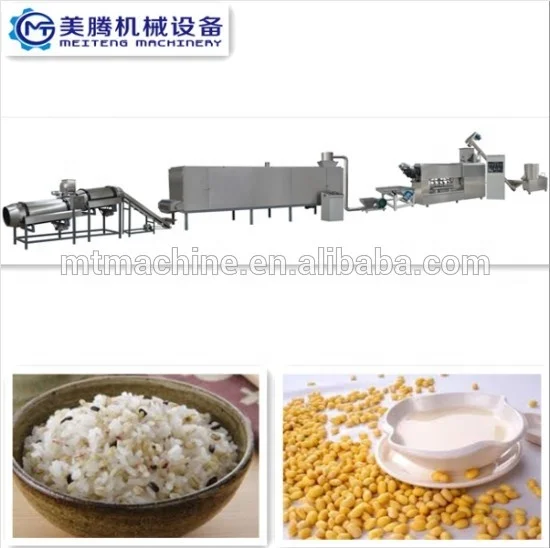
Pre-shipment trial runs on your actual formulation in our testing workshop verify real line performance before installation begins.
Description
Pre-Shipment Line Trials — every MT model runs your actual rice and micro-nutrient blend in our testing workshop before the equipment is crated, so throughput is verified on your formulation rather than promised on paper.
Technical Specifications
| Parameter | Value |
|---|---|
| Model | MT65, MT70, MT85, MT75, MT95 |
| Product Type | Fortified Rice Kernel Extrusion Production Line |
| Screw Type | Twin screw |
| Installed Power | MT65: 85 kW; MT70: 120 kW; MT85: 235 kW; MT75: 180 kW; MT95: 260 kW |
| Power Consumption | MT65: 60 kW; MT70: 85 kW; MT85: 165 kW; MT75: 135 kW; MT95: 195 kW |
| Output Capacity | MT65: 80–100 kg/h; MT70: 100–120 kg/h; MT85: 200–300 kg/h; MT75: 300–500 kg/h; MT95: 800–1000 kg/h (basis to be confirmed with raw material formulation, moisture content, and kernel size) |
| Overall Dimensions (L×W×H) | MT65: 28 × 1.2 × 2.2 m; MT70: 30 × 1.5 × 2.2 m; MT85: 34 × 3.5 × 4.3 m; MT75: 32 × 3.5 × 4.3 m; MT95: 36 × 3.5 × 4.3 m |
| Control System | PLC and MCC automated control with frequency speed controlling |
| Feeding System | Single or double screw feeding selectable based on material characteristics |
| Screw Construction | Wear-resistant special-process alloy |
| Drying System | Circulation drying oven, electric or gas heating, frequency motor-controlled mesh belt speed |
| Line Stations | Mixing → Extruding → Vibrating → Low temperature drying → Cooling → High temperature roasting → Cooling → Packing |
| Raw Material Compatibility | Broken rice, rice, corn, millet, wheat, oats, buckwheat, bean, starch as main ingredient; vitamin and mineral as supplementary ingredient |
| Lubrication | Automatic lubricating and cooling system |
| Assembly State | Complete turnkey production line |
| Certification | CE, ISO |
Application Suitability
| Application | Material or Output |
|---|---|
| Fortified rice kernel for nutrition programmes | Rice flour blended with iron, folic acid, vitamin B12, and zinc premix |
| Artificial rice from broken rice and rice bran | Broken rice and bran reprocessed into whole-kernel shaped grains |
| Instant and quick-cooking rice | Pre-gelatinised rice kernels for rapid rehydration |
| Multi-grain nutritional rice | Corn, millet, buckwheat, oat, and bean blends with micro-nutrient enrichment |
What "Rated Capacity" Really Means on a Fortified Rice Production Line Turnkey Project
Capacity numbers only hold when the line is matched to your exact formulation and moisture profile.
I once saw a nutrition programme supplier sign for a line based on a brochure figure, only to find the actual output was barely half because their high-protein vitamin premix raised the dough viscosity well beyond what a standard screw configuration could handle. The extruder motor ran hot, the die pressure fluctuated, and kernels came out with uneven density. It took a complete screw rebuild and a pre-conditioning stage to bring the line back to a stable run [NEED_CITE: material viscosity effects on twin-screw extrusion throughput]. When you evaluate a Fortified Rice Production Line turnkey proposal, the first question should never be "what is the max output?" — it should be "what does this line produce on my specific blend of rice flour and micro-nutrient premix?"
Screw Geometry and Die Design for Kernel Density Control
On a nutritional rice line, the kernel must survive cooking without disintegrating, yet rehydrate quickly enough for institutional meal preparation. Achieving that balance starts with the screw configuration. The flight depth, kneading block arrangement, and die aperture are all specified against your raw material blend so that starch gelatinisation is completed inside the barrel while the kernel exits at the correct density. A Fortified Rice Production Line turnkey setup that ships with a generic screw build will often produce kernels that either float or crumble during boiling, neither of which passes acceptance testing for government nutrition contracts.
Throughput Matching Across Every Station from Mixer to Packer
A twin-screw extruder running at its rated output means nothing if the downstream dryer cannot remove moisture fast enough, or if the cooling conveyor bottlenecks before packing. Each station on this line is sized so that material flow remains continuous without surge hoppers or manual transfer points. The circulation drying oven uses frequency-controlled mesh belt speed to match the extruder feed rate, and the high-temperature roasting stage is dimensioned to handle the full volume of dried kernels without queue buildup [NEED_CITE: throughput matching principles in continuous food processing lines]. This station-by-station balancing is what separates a line that holds its rated capacity from one that stalls every forty minutes.
Reading the Power and Dimension Data for Your Facility Plan
The installed power range across the MT series — from 85 kW on the MT65 to 260 kW on the MT95 — tells you the transformer capacity and dedicated circuit requirements before you pour concrete. Power consumption figures are lower than installed ratings because the main drive motor does not run at full load continuously, but the heating elements in the drying oven add a separate thermal load that must be on its own breaker. The overall dimensions, reaching up to 36 m in length for the MT95 line, determine your building span and column spacing. If your workshop ceiling is under 4.5 m, the larger models will need roof clearance modifications at the roasting and cooling stations where vertical elevators carry product between levels.
The Cost of Ignoring Voltage Confirmation Before Production Starts
A factory in Southeast Asia once received an extruder wired for 380 V / 50 Hz while the local grid supplied 440 V / 60 Hz. The motor overheated within the first hour, the PLC threw fault codes, and commissioning stalled for weeks until replacement contactors and a step-down transformer arrived by air freight [NEED_CITE: voltage and frequency standards by export market]. On a Fortified Rice Production Line turnkey order, voltage and frequency confirmation must happen during the specification stage, not after crating. The PLC program labels, HMI language, and frequency drive parameters all need to match the destination site, and that alignment only works if the buyer’s electrical data is collected and locked in before the control cabinet is assembled.
Why Procurement Decisions Should Be Grounded in Trial Data
Every configuration decision on this line — from screw element sequence to dryer belt speed — is validated through an in-house trial run on your supplied raw material before shipment. The trial run report documents actual throughput, kernel density, moisture content after drying, and micro-nutrient retention, giving you a data set to compare against your product specification rather than relying on generic capacity claims. This is not a brochure promise; it is a factory-floor measurement taken on your formulation.
- Line layout and capacity calculation confirming station-by-station throughput on your rice flour and premix blend.
- Trial run report documenting kernel density, moisture reduction, and output on your actual raw material before the line ships.
- Screw and die configuration record showing the exact element arrangement selected for your target kernel shape and cooking behaviour.
- Electrical schematic and voltage confirmation sheet matching your local power supply to prevent commissioning delays on site.
- Operation and maintenance manual with wear parts list covering screw elements, die plates, and dryer belt sections.
- CE declaration of conformity covering the complete assembled line, not just individual machines.
Installation, Commissioning & Support
- Foundation plan accounts for the MT95’s 36 m footprint and 260 kW load with dedicated circuits for extruder drive and drying oven heaters.
- PLC and MCC cabinets arrive pre-wired and labelled in your specified language, reducing on-site electrical work to main bus connection.
- Twin-screw barrel alignment and die seating are completed by installation engineers during the first powered run on your material.
- Frequency-controlled dryer belt and roasting conveyor speeds are calibrated to match your confirmed extruder output during commissioning.
- Operator training covers screw element replacement intervals, automatic lubrication system checks, and PLC fault code response procedures.
- Wear parts inventory — screws, dies, mesh belt sections — is specified and shipped with the line to cover initial production runs.
Preparing Your Inquiry for an Accurate Line Proposal
To move from a general inquiry to a detailed Fortified Rice Production Line turnkey layout, share your raw material formulation including the rice variety, micro-nutrient premix composition, and target moisture content. Confirm your local voltage, frequency, and preferred control language, along with workshop dimensions and ceiling height. If you have upstream milling or downstream packing equipment already in place, provide their throughput rates so the line can be matched at the connection points. Requesting a pre-shipment trial run on your material is always recommended before final order confirmation.
Frequently Asked Questions
Q: How is line capacity verified on my specific raw material blend before shipment?
A: Your raw material — rice flour, premix, and any supplementary grains — is shipped to the testing workshop where the selected MT model runs a full production trial. The trial run report records actual throughput, kernel density, moisture after drying, and micro-nutrient retention. These figures are compared against your product specification before the line is approved for crating.
Q: How do you ensure throughput is matched across extruder, dryer, and packing stations?
A: Each station is sized during the layout phase based on the confirmed extruder output on your material. The circulation drying oven belt speed, roasting conveyor capacity, and cooling length are all calculated so that material flows continuously without intermediate buffering or manual transfer between segments.
Q: What voltage and frequency configurations are confirmed before production begins?
A: Your site’s supply voltage, frequency, phase configuration, and preferred control language are collected during the specification stage. The PLC program, HMI labels, MCC component ratings, and frequency drive parameters are all built to match those values before the control cabinets leave the factory.
Q: How is the screw and die configuration selected for fortified rice versus artificial rice?
A: Fortified rice requires a screw profile that achieves full starch gelatinisation while preserving micro-nutrient integrity at controlled barrel temperatures. Artificial rice from broken rice or multi-grain blends typically needs higher shear and different kneading block spacing. The configuration is chosen after the trial run on your specific formulation confirms kernel density and cooking behaviour.
Q: What does the installation and commissioning schedule look like for a complete turnkey line?
A: After the line arrives on site, installation engineers handle mechanical assembly, electrical connection to your main bus, and barrel alignment. Commissioning includes running your raw material through every station, adjusting dryer belt speed and roasting temperature, and training your operators on PLC fault response and wear part replacement procedures.
Related products
-

High Quality Automatic PLC Controlled 500kg/h Twin Screw Extruder Machine for Baby Rice Nutrition Powder
¥8,238.27 Add to cart -

Automatic Iron Fortified Baby Rice Cereal Nutrition Powder Making Machine 500kg/h PLC Controlled
¥8,238.27 Add to cart -
New Automatic Nutritional Powder Making Machine for Baby Food Production Line
¥20.00 Select options This product has multiple variants. The options may be chosen on the product page -
Commercial Stainless Steel Baby Rice Powder Grinding Mixing Machine
¥8,238.27 Select options This product has multiple variants. The options may be chosen on the product page