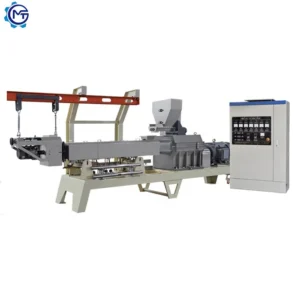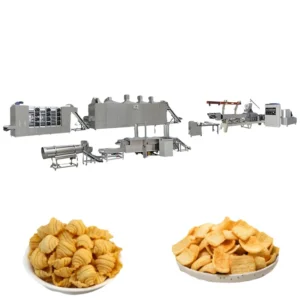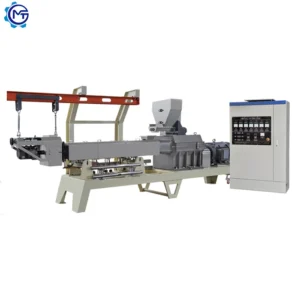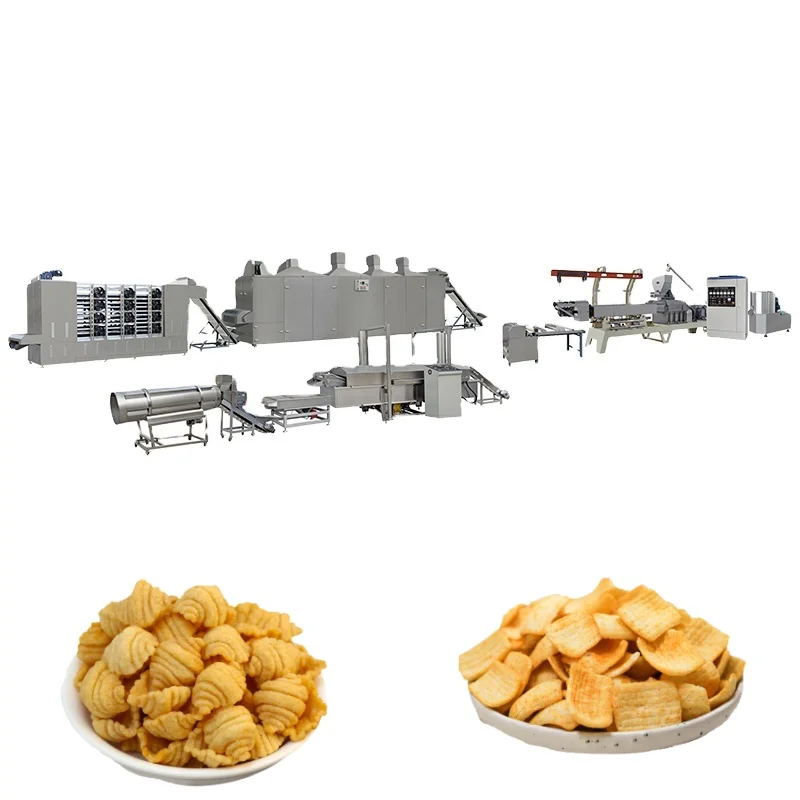


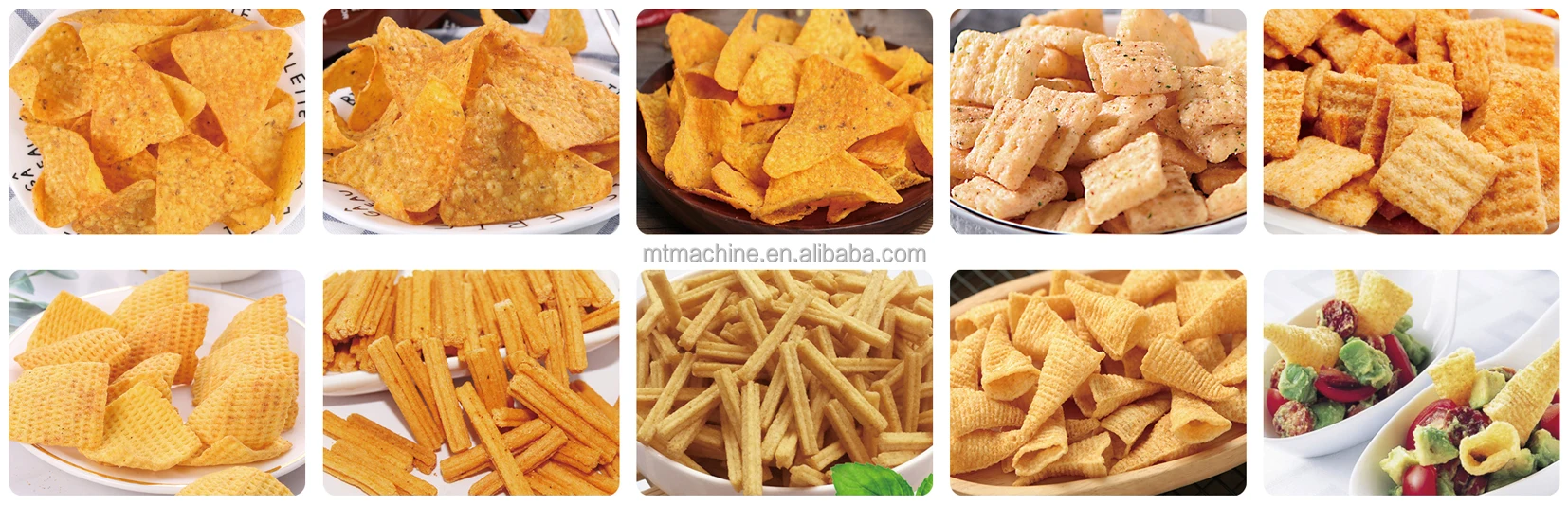


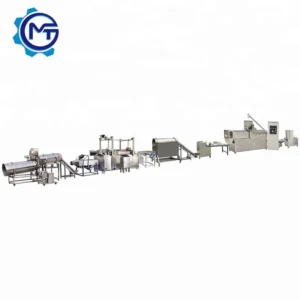
MT-65 / MT-70 / MT-85 / MT-75 / MT-95 Fried Snack Food Processing Line, Twin-Screw Extrusion, 100–280 kW — engineered as a complete turnkey system from batching through extrusion, cutting, drying and frying with throughput matched at every station.
- Co-rotating twin-screw extruder with sectional screw modules and interchangeable dies for bugles, chips, sticks, tubes and shells
- Fryer with 600 mm stainless steel belt, roller-assisted feeding and adjustable belt speed and temperature
- Voltage, frequency and control language confirmed to your market before production
Screw configuration and die design are specified to your raw material formulation, with in-house trial runs on your actual ingredients before shipment and full documentation from line layout to CE declaration.
Description
Turnkey Throughput Matching — Every station from mixer to fryer is capacity-balanced under one supplier, so the fried snack food processing line turnkey runs at its rated output without single-station bottlenecks.
Technical Specifications
| Parameter | Value |
|---|---|
| Product Type | Fried Snack Food Processing Line (Extrusion & Frying) |
| Available Models | MT-65 / MT-70 / MT-85 / MT-75 / MT-95 |
| Extruder Type | Twin screw, co-rotating, sectional modules |
| Main Motor Power | 100 kW (MT-65) / 130 kW (MT-70) / 180 kW (MT-85) / 185 kW (MT-75) / 280 kW (MT-95) |
| Output Capacity | 120–150 kg/h (MT-65) to 800–1000 kg/h (MT-95) (basis not stated in source) |
| Mixer Power | 4 kW / 7.5 kW / 15 kW (matched to line model) |
| Cutting Machine Power | 1.47 kW |
| Fryer Belt Width | 600 mm stainless steel |
| Drying & Heating Options | Gas / Electric / Diesel heating |
| Voltage Options | Customizable (e.g., 3ph 380V 50Hz, 3ph 415V 60Hz, 3ph 220V 60Hz) |
| Line Stations | Mixing → Extrusion → Cutting/Forming → Drying → Frying → Flavouring/Coating |
| Warranty | 1 year complete warranty with lifetime maintenance service |
Application Suitability
| Application | Material or Output |
|---|---|
| Fried corn chips and bugles | Corn flour, corn starch, water |
| Pellet chips and pillow shapes | Potato starch, potato powder, wheat flour |
| Shaped fried snacks (shells, screws, tubes, waves) | Blended grain flour and starch formulations |
| Ribbed and wavy sheet chips | Wheat flour and corn flour base with vegetable oil |
When the Dryer Cannot Keep Up with the Extruder
A fried snack food processing line turnkey is only as fast as its slowest station, and that bottleneck rarely appears on a spec sheet.
When equipment is sourced from separate vendors, the extruder might push 400 kg/h while the dryer handles 250 kg/h. The fryer then sits half-loaded, oil temperature drops with each cold batch, and product colour drifts across the shift. I once walked into a plant where the operator was deliberately starving a twin-screw extruder because the downstream belt fryer could not carry the volume. The line was nominally rated for one output but actually running at less than half. [NEED_CITE: throughput matching between sequential food processing stations] This is the reason a single-supplier fried snack food processing line turnkey configuration matters: the mixer batch cycle, the extruder screw speed, the dryer residence time, and the fryer belt speed are all calculated against the same target throughput before any steel is cut.
How Screw Modules Shape the Pellet Before Frying
The co-rotating twin-screw extruder uses sectional screw modules that can be rearranged to control forward transport, mixing intensity, de-gassing, and cooking shear within a single barrel. For a fried snack food processing line turnkey setup producing bugles or corn chips, the screw profile must gelatinise starch fully before the die so the pellet expands predictably in hot oil. If the screw configuration is copied from a generic build rather than specified to the buyer’s flour-to-starch ratio, the pellet density will fall outside the range the fryer expects.
Why Belt Fryer Design Matters at Scale
The 600 mm stainless steel belt fryer uses roller-assisted feeding and independently adjustable belt speed and temperature to keep product residence time consistent across the full belt width. When pellets enter the oil, surface moisture flashes off and the structure sets within seconds. If the belt speed is too fast, the interior stays doughy; too slow, and the snack over-browns. [NEED_CITE: oil temperature and residence time effects on starch-based fried snacks] Independent control of these two variables lets the operator fine-tune texture without stopping the line, which is critical when switching between thin chips and thicker bugle shapes on the same platform.
Reading the Spec Sheet Beyond Motor Power
The main motor power range from 100 kW on the MT-65 to 280 kW on the MT-95 tells you the extrusion energy available, but the actual product quality depends on how that energy is applied. The length-to-diameter ratio of the barrel determines how long the material stays under shear and heat, which directly controls the degree of starch gelatinisation. For a product like diamond chips that must puff uniformly in the fryer, incomplete gelatinisation means some pieces expand while others stay dense. Die interchangeability across sticks, square sheets, shells, screws, and tubes means a single extruder platform covers multiple product formats, but each die geometry requires its own screw configuration and barrel temperature profile. The mixer power stepping from 4 kW to 15 kW across models ensures batch consistency at the front end matches the extruder’s appetite at the other.
The Hidden Cost of Misaligned Voltage and Control Language
I have been on commissioning trips where the line sat idle for days because the control panel was wired for 380V 50Hz and the local grid runs 415V 60Hz. The VFD tripped on overload, the dryer heating elements ran at the wrong output, and the PLC threw faults that took an entire afternoon to trace. [NEED_CITE: voltage and frequency standards by export market] Beyond the electrical mismatch, if the HMI language does not match the operator’s working language, parameter adjustments become guesswork. A mislabelled temperature set-point on the fryer panel can send a whole batch to scrap before anyone notices. These problems are entirely avoidable when voltage, frequency, and control language are confirmed in the electrical schematic before production begins.
Why Sourcing the Whole Line Together Matters
Every station on this fried snack food processing line turnkey system is specified under one engineering team, so throughput calculations run end-to-end rather than in isolated silos. The screw configuration and die design are matched to the buyer’s raw material formulation, not pulled from a generic template. Before the line ships, an in-house testing workshop runs trial production on the buyer’s actual raw material, so product development happens at the factory, not on the buyer’s floor. Voltage, frequency, and control panel language are confirmed in the electrical documentation before metal is cut, preventing on-site commissioning delays. Pre-sales consultation carries through to engineer design, on-site installation, commissioning, and ongoing maintenance, so the same team that specified the line is responsible for making it run.
Documentation & Verification
- Line layout and capacity calculation showing throughput balance across mixer, extruder, dryer, and fryer
- Screw and die configuration record matched to your raw material formulation and target product shape
- Electrical schematic confirming voltage, frequency, and control panel language before production
- Trial run report on your actual raw material conducted in the testing workshop before dispatch
- CE declaration of conformity and ISO certificate for the complete line assembly
- Wear parts list covering screws, dies, and fryer belt sections for first-year planning
Installation, Commissioning & Support
- Foundation and floor space planning based on overall line dimensions up to 30 m in length
- Dedicated power circuit sizing confirmed against the main motor rating and fryer heating load
- Modular station delivery with matched connection points for sequential assembly on site
- First-run parameter setting covering barrel temperature zones, screw speed, and fryer belt speed
- Operator training on die changeover procedures and fryer oil management for consistent product quality
- Scheduled spare parts supply covering sectional screw modules, die plates, and stainless steel belt sections
What to Share Before Requesting a Quote
To configure the right fried snack food processing line turnkey for your plant, provide the raw material formulation you intend to run, including flour-to-starch ratios and any additives. Specify your target product shapes and the daily output volume you need to meet. Confirm the local voltage, frequency, and the control panel language your operators require. If you have existing upstream or downstream equipment that the new line must integrate with, share the connection dimensions and throughput of those machines so the layout can be planned around them.
Frequently Asked Questions
Q: How is output capacity verified against my specific raw material and moisture content before the line ships?
A: Capacity is confirmed through a trial run in the testing workshop using your actual raw material at your specified moisture content. The extruder screw speed, barrel temperature profile, and dryer residence time are adjusted during the trial, and a written report documenting throughput and product quality is provided before the line is cleared for shipment.
Q: What screw configuration and die design is specified for my target product shape and texture?
A: The screw module arrangement and die geometry are selected based on your raw material formulation and target product density. A configuration record documenting the module sequence, die bore dimensions, and barrel temperature zones is supplied with the line so your production team has a verified starting point for each product format.
Q: How is throughput matched between the extruder, dryer, and fryer to prevent station bottlenecks?
A: Each station is sized during the layout phase so its maximum throughput aligns with the extruder output at the agreed screw speed. The capacity calculation is documented in the line layout and reviewed with you before production begins, ensuring no single station limits the line below its rated output.
Q: What voltage, frequency, and control panel language options are confirmed before production begins?
A: Your local power supply specifications and preferred HMI language are recorded in the electrical schematic before manufacturing starts. This document is shared for your approval, and any discrepancy is corrected at the design stage rather than discovered during on-site commissioning.
Q: What does the pre-shipment trial run on my raw material cover and what report is provided?
A: The trial run covers mixing consistency, extrusion stability, die forming accuracy, drying uniformity, and frying result. A report is issued documenting the process parameters used, the output rate achieved, and product samples are sent to you for evaluation before the line is packed for dispatch.
Related products
-
Puffed Octopus Snack Processing Line – Full-Automatic Fried Octopus Production Machinery
¥65.00 Select options This product has multiple variants. The options may be chosen on the product page -
New Automatic 150-200kg/h Nimko Fried Pasta Snacks & Kurkure Making Machine Food Grade Stainless Steel High Productivity
¥8,585.00 Select options This product has multiple variants. The options may be chosen on the product page -
Hot Selling Full Automatic Fried Dough Wheat Flour Bugles Snacks Frying Machine Fried Puffed Food Bugles Snack Production Line
¥7,349.41 Select options This product has multiple variants. The options may be chosen on the product page -
Fried Puffs Snack Food Making Machine Whole Line Solution Design by Factory Price Crispy Snack Machine
¥20.00 Select options This product has multiple variants. The options may be chosen on the product page