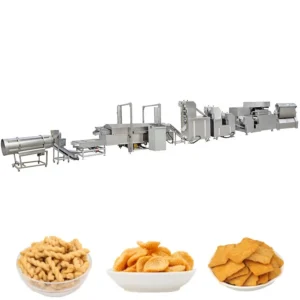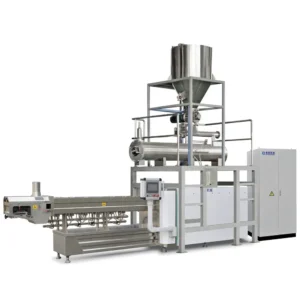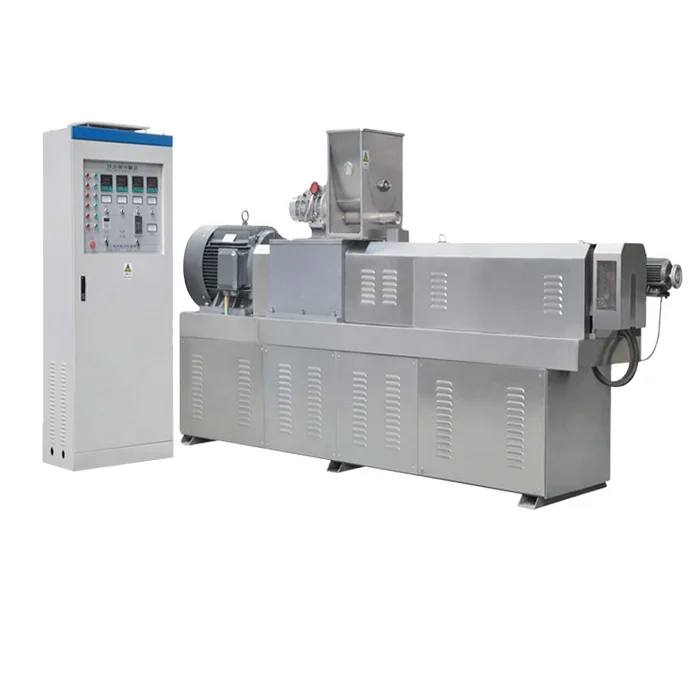


MT65 / MT70 / MT85 / MT75 / MT95 Fried Snack Processing Line, Twin-Screw Extruder, Stainless Steel Construction — configured for bugles, corn chips, and shaped crispy snacks with screw and die design matched to your flour formulation and target density. Full line throughput is balanced across mixing, extrusion, frying, and seasoning stations to prevent bottlenecks. Each layout includes capacity calculation, trial run validation on your raw material, and on-site commissioning with operator training.
- CE and ISO certified
- Twin-screw extrusion with PLC control
- Shapes: bugles, triangles, rice crust, and more
- 1-year warranty with lifetime maintenance support
Description
Capacity-Matched Extrusion — Every station from the mixer through the fryer is sized against the twin-screw extruder’s real throughput on your flour blend, eliminating the bottleneck effect that plagues poorly configured snack lines.
Technical Specifications
| Parameter | Value |
|---|---|
| Product Type | Fried Snack Processing Line (Bugles / Crisp Corn Chips) |
| Model Options | MT65 / MT70 / MT85 / MT75 / MT95 |
| Extruder Type | Twin-screw |
| Installed Power Range | 142 kW (MT65) to 370 kW (MT95) |
| Actual Power Consumption | 100 kW (MT65) to 280 kW (MT95) |
| Output Capacity | 120–1000 kg/h (basis not stated in source — confirm raw material, moisture, product shape) |
| Overall Line Dimensions | 22000×1200×2200 mm (MT65) to 30000×1500×2800 mm (MT95) |
| Extruder Dimensions | 2800×830×1875 mm |
| Extruder Main Motor Power | 30 kW |
| Powder Mixer Tank Volume | 150 kg |
| Powder Mixer Mixing Time | 10 min per batch |
| Fryer Temperature Range | 0–260 °C |
| Material | Stainless steel (food-grade contact parts) |
| Control System | PLC / MCC (options to be confirmed before order) |
| Voltage & Frequency | Configurable (to be confirmed before order) |
| Standards | CE, ISO |
Application Suitability
| Application | Material or Output |
|---|---|
| Bugles and horn-shaped snacks | Corn flour, wheat flour, and starch-based blends |
| Triangular and crisp corn chips | Corn grits and maize flour at controlled moisture |
| Rice crust and panned snacks | Rice flour and composite grain formulations |
| 3D shaped puffed snacks | Potato starch, tapioca, and wheat flour mixes |
| Small fish and golden horn snacks | Multi-grain flour blends with adjustable die plates |
What "500 kg per Hour" Leaves Out on a Fried Snack Processing Line Turnkey
Nominal capacity means nothing if the fryer cannot keep pace with the extruder on your actual dough.
I worked on a Middle East project last year where a Bugles line was quoted at full brochure capacity. The extruder pushed product out faster than the fryer could handle it. Oil temperature dropped under the load, the snacks absorbed excess oil, and the line spent two weeks in re-commissioning before we balanced the throughput. That is a problem that repeats across the industry whenever stations are sourced from different vendors [NEED_CITE: common throughput mismatches in snack processing lines]. A fried snack processing line turnkey only delivers its promised output when the mixer batch cycle, extruder screw speed, fryer belt speed, and seasoning drum rotation are all calculated against the same material flow rate.
Matching Throughput from Mixer to Seasoning Drum
The mixer completes a batch every ten minutes into a 150 kg tank. That rhythm must align with the extruder’s continuous feed rate so that neither a material shortage nor a surge reaches the barrel. On a fried snack processing line turnkey, we calculate the mass balance across every transfer point — from the screw conveyor discharge into the extruder hopper, through the die face, and onto the fryer infeed belt — before the layout is finalized.
Screw Configuration and Die Design for Target Shapes
Bugles require a specific die geometry and screw element arrangement to produce the thin-walled, curled profile that fries into a crisp shell without trapping moisture inside. Triangular chips need different compression ratios and die openings. The screw configuration record is written against your target product shape and flour formulation, not copied from a generic build [NEED_CITE: twin-screw configuration impact on snack texture and expansion].
Reading the Power and Dimension Data
The installed power range spans from 142 kW on the MT65 to 370 kW on the MT95, while actual consumption sits roughly 30% lower — between 100 kW and 280 kW. This gap matters for electrical panel sizing and transformer specification. Line footprints extend from 22 metres to 30 metres in length, so workshop floor planning must account for the fryer exhaust ductwork and the seasoning station’s clearance for drum loading. The fryer’s 0–260 °C range covers the typical 180–200 °C window needed for corn-based snacks, while leaving headroom for products that require a hotter initial flash fry.
The Cost of Skipping Pre-Shipment Verification
When a line ships without a trial run on the buyer’s flour blend, commissioning becomes product development. Screw elements get swapped, die plates get re-cut, and fryer belt speeds get adjusted on the factory floor — all while production deadlines slip. The downstream consequence is a line that runs below capacity for months, with operators compensating through manual intervention that introduces inconsistency between batches [NEED_CITE: commissioning delays from untested raw material behaviour].
Why Source This Line from One Supplier
Every station is sized in-house, so the extruder output never overwhelms the fryer or the seasoning drum. The testing workshop runs your actual raw material before dispatch, producing a documented trial report rather than a generic performance promise. Screw and die configurations are recorded against your product shape, making future reorders and wear-part replacements straightforward. On-site installation includes operator training on the specific control system fitted to your line. Pre-sales engineering covers line layout and utility planning, so you know the electrical load and floor space requirements before signing.
Documentation & Verification
- Line layout with capacity calculation matched to your flour formulation
- Screw and die configuration record for your specific snack shape
- Trial run report on your raw material conducted before dispatch
- Electrical schematic with voltage and control language confirmed pre-production
- CE declaration of conformity and ISO certificate in shipment packet
- Operation and maintenance manual with wear parts list included
Installation, Commissioning & Support
- Foundation must support line lengths up to 30 metres with level tolerance for fryer oil circulation
- Dedicated electrical circuit sized to the 100–280 kW actual consumption range of your selected model
- Twin-screw extruder arrives with barrel and screw elements pre-assembled and aligned
- Fryer temperature profile and belt speed calibrated during on-site commissioning against your product
- Operator training covers PLC or MCC interface in your confirmed control language
- Wear parts list specifies screws, dies, and fryer belt sections for first replacement cycle
Before You Request a Quote
Send your target product shape, the flour or starch formulation you plan to run, and the hourly output you need to sustain. Include your workshop dimensions and ceiling height, your local voltage and frequency standard, and your preferred control language. If you have existing upstream or downstream equipment that the new line must connect to, note the interface points. We will return a line layout with matched throughput at every station.
Frequently Asked Questions
Q: How is line capacity verified on my actual raw material before shipment?
A: We run your flour blend through the twin-screw extruder, fryer, and seasoning drum in our testing workshop. The trial run report documents actual throughput, product density, oil absorption, and seasoning coverage at each station, so you see real performance data before the line leaves the factory.
Q: How do you match throughput between the extruder, fryer, and flavoring stations?
A: Each station is sized during the layout phase based on the mass flow rate your formulation produces through the extruder. The fryer belt speed and oil volume, the seasoning drum rotation rate, and the conveyor transfer speeds are all calculated to the same throughput target, preventing material pile-up at any point.
Q: What voltage, frequency, and control language options are confirmed before production?
A: We confirm your local voltage and frequency standard, then size the motors and electrical panels accordingly. The PLC or MCC control system is configured in your preferred language, and the electrical schematic is shared for approval before manufacturing begins so there are no commissioning delays on site.
Q: What does on-site installation, commissioning, and operator training include?
A: Our team positions each station per the approved layout, connects utilities, and runs your raw material through the full line. Operators learn extruder screw speed adjustment, fryer temperature management, seasoning drum loading, and daily cleaning procedures specific to the model installed in your facility.
Q: Which spare wear parts are supplied and how are replacements handled?
A: The shipment includes a wear parts list identifying screws, die plates, and fryer belt sections specific to your configuration. Replacement parts are manufactured to the same screw and die configuration record, so reordering requires only your project reference number.
Related products
-
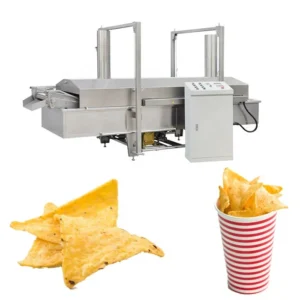
New Fully Automatic Large Capacity 304 Stainless Steel Savory Frying Snack Production Line Crisp Bugles Chips Processing Machine
¥30.00 Select options This product has multiple variants. The options may be chosen on the product page -
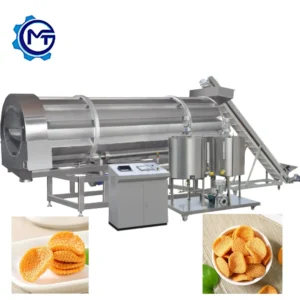
Automatic Rice Crust Chips Making Machine Bugles Pizza Rolls Fried Snack Food Processing Line Machine
¥8,570.00 Select options This product has multiple variants. The options may be chosen on the product page -

New Automatic Bugles Puff Snack Production Line Price Corn Chips Making Machine Fried Maize Machine High Productivity Large
¥8,570.00 Select options This product has multiple variants. The options may be chosen on the product page -
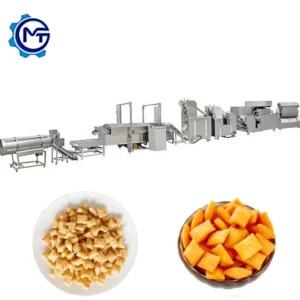
Hot Selling Full Automatic Fried Dough Wheat Flour Bugles Snacks Frying Machine Fried Puffed Food Bugles Snack Production Line
¥7,349.41 Select options This product has multiple variants. The options may be chosen on the product page