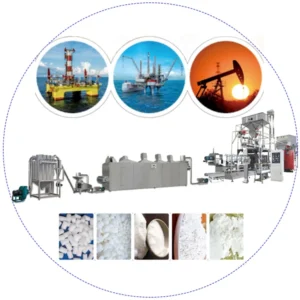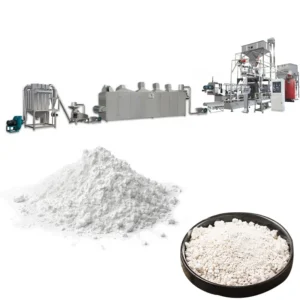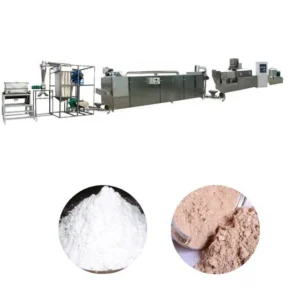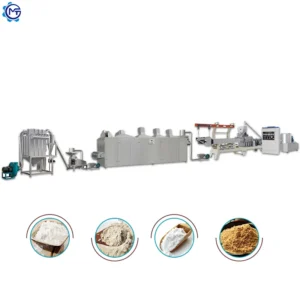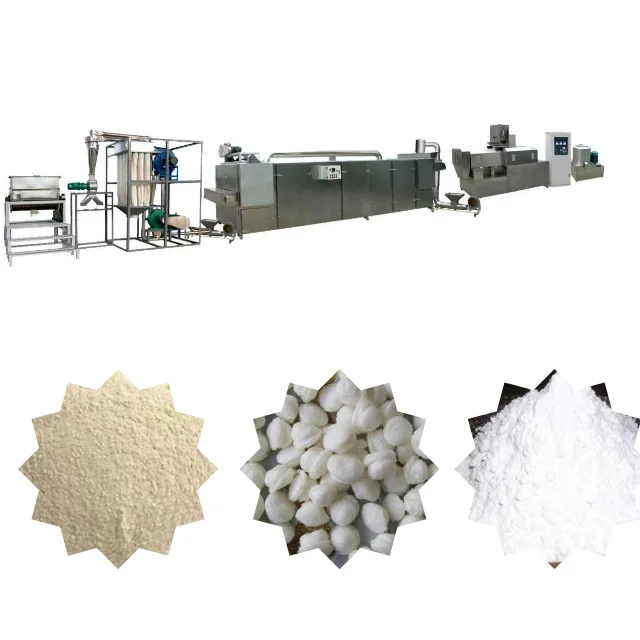


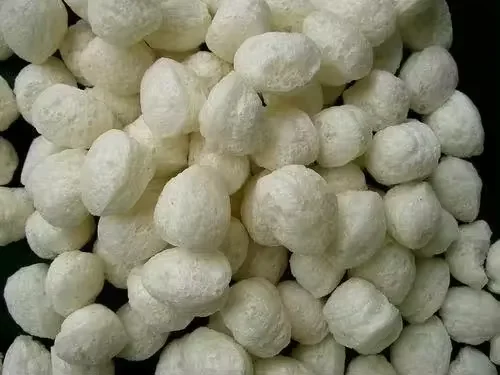
MT85, MT100, MT110, MT135 Modified Starch Processing Line, Twin-Screw Extruder, 90–240 kW Installed Power — complete turnkey configuration from material blending through extrusion, drying, grinding and packing.
- Screw and die configuration specified to your starch source (corn, tapioca, potato), with in-house trial runs validating gelatinisation and expansion before shipment
- Drying station heating configurable to electric, steam, or gas based on your factory utility conditions
- Throughput balanced across every station under one supplier to eliminate bottlenecks
Description
Turnkey Solution Modified Starch Processing Line – Complete Production Line
Throughput-Matched Stations — Every section from material blending through extrusion, drying, grinding, and packing is configured as a single coordinated project, eliminating the bottlenecks that arise when a modified starch processing line turnkey is assembled from separate vendors.
Technical Specifications
| Parameter | Value |
|---|---|
| Product Type | Modified Starch Production Line |
| Model Options | MT85 / MT100 / MT110 / MT135 |
| Extruder Type | Twin-screw extruder |
| Installed Power | 90 kW (MT85) / 180 kW (MT100) / 200 kW (MT110) / 240 kW (MT135) |
| Real Power Consumption | 63 kW (MT85) / 120 kW (MT100) / 150 kW (MT110) / 165 kW (MT135) |
| Output Capacity | 100–200 kg/h (MT85) / 500–600 kg/h (MT100 & MT110) / 1000–1500 kg/h (MT135) (basis not stated in source — confirm raw material type, moisture content and screw configuration) |
| Control System | Frequency speed controlling system with automatic and stable performance |
| Processing Flow | Materials preparation → Material blending → Mixing → Extruding → Drying → Grinding → Packing |
| Dryer Heating Source | Electric, steam, or gas (configurable per site utility conditions) |
| Grinding Station | Food-contact parts in stainless steel 304; bottom butterfly valve discharge; particle fineness < 10 mm |
| Assembly State | Complete turnkey line from batching through packing |
| Voltage & Frequency | To be confirmed per target market |
| Certifications | CE; ISO |
| Warranty | 1 year free warranty |
Application Suitability
| Application | Material or Output |
|---|---|
| Pre-gelatinized starch for food processing | Corn starch, tapioca starch, potato starch with controlled thermal viscosity and gel strength |
| Modified starch for textile sizing and finishing | Starch variants requiring freeze-thaw stability and film-forming properties |
| Industrial starch for paper coating and corrugation | Starch modified for adhesion, viscosity retention, and moisture resistance |
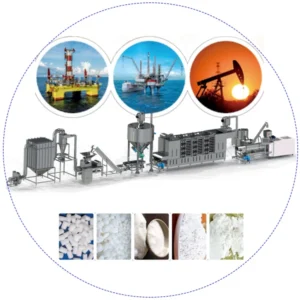
| Modified starch for oil drilling fluids | Starch derivatives with controlled fluid-loss and thermal degradation properties |
| Starch additives for construction materials | Pre-gelatinized starch for dry-mix mortar and gypsum board adhesion |
Why a Modified Starch Processing Line Turnkey Quoted at Nominal Capacity Fails on Arrival
Capacity must be verified on your actual starch source at the moisture content your process requires.
I have watched a modified starch line commissioned in a humid tropical plant where the trial data was generated on standard corn starch at controlled moisture, but the buyer ran cassava starch with a different gelatinisation threshold. The product left the extruder undercooked, and it took a full week of parameter adjustment before output met specification [NEED_CITE: starch gelatinisation temperature ranges by botanical source]. A modified starch processing line turnkey project only delivers its quoted throughput when the screw configuration, die design, and barrel temperature profile are specified to the raw material the buyer will actually feed into the hopper. Without that match, the line may run, but the product will not.
Screw Configuration Specified to the Starch Source
The twin-screw extruder at the heart of this modified starch processing line turnkey project is not supplied with a generic screw build. The screw elements and die geometry are selected based on whether the feedstock is corn, tapioca, or potato starch, each of which gelatinises at a different temperature and responds differently to shear. Corn starch tolerates higher barrel temperatures and mechanical shear, while tapioca starch requires gentler handling to prevent molecular degradation that weakens the final gel structure. The configuration record is documented before production begins, so the buyer has a reference for future screw replacements or product changes.
Thermal Profile and Drying Coordination Across the Line
The extrusion stage determines the degree of starch modification, but the drying station locks it in. If the dryer cannot remove moisture at the rate the extruder delivers product, the line accumulates a bottleneck that forces the extruder to slow down, undermining the capacity the project was designed around. The drying machine on this modified starch processing line turnkey accepts electric, steam, or gas heating, configured to the buyer’s available utility infrastructure [NEED_CITE: industrial dryer energy source selection for starch processing]. In markets where steam is abundant and inexpensive, a steam-heated dryer reduces operating cost while maintaining the thermal profile that the extrusion stage established. Matching the dryer’s evaporation rate to the extruder’s output is a calculation that must happen during layout planning, not after installation.
Interpreting Power Consumption and Capacity for Line Planning
The installed power figures across the four models — from 90 kW on the MT85 to 240 kW on the MT135 — represent peak motor and heating capacity, not continuous draw. Real consumption ranges from 63 kW to 165 kW depending on model, which reflects the load during steady-state extrusion of starch at typical moisture levels. This distinction matters for electrical infrastructure planning: the incoming transformer, circuit breakers, and cable sizing must accommodate the installed peak, while the operating budget should be calculated on real consumption. The grinding station discharges through a bottom butterfly valve with food-contact surfaces in stainless steel 304, producing particle fineness below 10 mm, which is suitable for direct packing or further milling if the end application demands finer powder. The frequency speed control system maintains stable screw rotation across varying feed rates, reducing batch-to-batch variation in gelatinisation degree.
The Cost of Skipping the Trial Run
When a line ships without a factory trial on the buyer’s actual starch source, the entire product development process shifts to the installation site. Commissioning engineers spend days adjusting screw speed, barrel temperature zones, and moisture addition rates while the buyer produces unsaleable output. In one project I worked on, the difference between the factory trial starch and the buyer’s local cassava supply was a gelatinisation temperature gap of several degrees — enough to leave the extrudate partially raw in the core [NEED_CITE: impact of raw material substitution on extrusion process parameters]. An in-house trial run before shipment catches this mismatch while there is still time to adjust the screw elements or die plate without delaying the commissioning schedule.
Why This Project Scope Fits the Buyer
The complete modified starch processing line turnkey from Meiteng covers material blending, mixing, extrusion, drying, grinding, and packing under one supplier, which means throughput is calculated across every station rather than left to chance between separate vendors. The screw and die configuration is specified to the buyer’s stated raw material and target starch properties, with a configuration record included in the documentation package. An in-house testing workshop allows trial runs on the buyer’s own starch before the line ships, reducing the risk of on-site rework. The dryer heating source is configurable to local utility conditions, avoiding the cost of installing a new boiler or gas line. The frequency speed control system provides stable, repeatable screw operation that supports consistent product quality across shifts.
Documentation & Verification
- Line layout drawing with throughput calculation across blending, extrusion, drying, grinding, and packing stations
- Screw and die configuration record tied to buyer’s starch source and target modification level
- Factory trial run report performed on customer-supplied raw material before dispatch
- Electrical schematic with voltage and frequency confirmation for the destination market
- CE declaration of conformity and ISO certificate included with shipment documentation
- Operation and maintenance manual covering daily checks, screw replacement intervals, and cleaning procedures
Installation, Commissioning & Support
- Foundation and floor space planning based on the full line footprint from batching through packing
- Electrical supply specification matching installed power up to 240 kW on the MT135 with confirmed voltage and frequency
- Dryer utility connection configured to available steam, electric, or gas supply at the installation site
- On-site commissioning with screw speed, barrel temperature, and moisture parameters set for buyer’s starch source
- Operator training covering the frequency speed control system, grinding station butterfly valve operation, and daily maintenance
- Wear parts list with screw elements, die plates, and grinder screens identified for first reorder cycle
Preparing a Project Inquiry for a Modified Starch Processing Line Turnkey
A productive inquiry starts with the raw material specification — corn, tapioca, or potato starch — including moisture content and any pre-treatment the starch receives before entering the line. The target output in kilograms per hour and the desired starch modification or gelatinisation degree determine which model fits the project scope. Buyers should also confirm the available voltage and frequency at the installation site, the preferred dryer heating source, and the control language for the operator interface, so that the quotation reflects a line that can be commissioned without electrical or communication delays.
Frequently Asked Questions
Q: How is line capacity verified, and on which raw material basis?
A: Capacity is verified through a trial run in the testing workshop using the buyer’s actual starch source at the moisture content specified for production. The trial run report documents screw speed, barrel temperature profile, and output rate. Without this step, quoted capacity reflects a generic basis that may not match the buyer’s raw material behaviour.
Q: How do you match screw configuration to different starch sources?
A: Corn, tapioca, and potato starch each gelatinise at different temperatures and respond differently to mechanical shear inside the barrel. The screw element arrangement and die geometry are selected to match the specific starch source and target modification properties, and the configuration is documented for future reference.
Q: What utility planning is needed before a modified starch line arrives on site?
A: The buyer needs to confirm available voltage and frequency, the preferred dryer heating source — electric, steam, or gas — and the floor space and foundation requirements for the full line layout. Electrical infrastructure must accommodate the installed peak power of the selected model.
Q: Can the dryer heating source match our factory’s energy supply?
A: The drying station accepts electric, steam, or gas heating, configured during the project planning stage to match the buyer’s existing utility infrastructure. This avoids the cost and delay of installing a new energy supply solely for the dryer.
Q: How is commissioning and operator training handled after installation?
A: Commissioning engineers set extrusion parameters — screw speed, barrel temperature zones, moisture addition — to the buyer’s starch source on site. Operator training covers the frequency speed control system, grinding station operation, and routine maintenance procedures before the engineering team departs.
Related products
-
API Standard Pregelatinized Starch Line for Oilfield Drilling Fluid. High Yield Modified Starch Equipment
¥65.00 Select options This product has multiple variants. The options may be chosen on the product page -
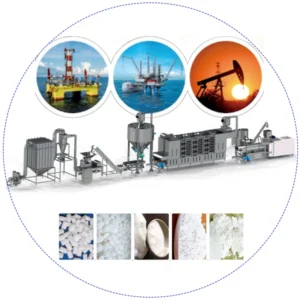
Big Capacity Modified Starch Production Line Making Machine
¥30.00 Select options This product has multiple variants. The options may be chosen on the product page -
Automatic Pregelatinized Starch Processing Machine – Large-Scale New Condition Modified Starch Production Line
¥65.00 Select options This product has multiple variants. The options may be chosen on the product page -
High-Efficiency Customizable Modified Starch Production Line – Automatic Corn Pellet Adhesive Making Equipment
¥65.00 Select options This product has multiple variants. The options may be chosen on the product page