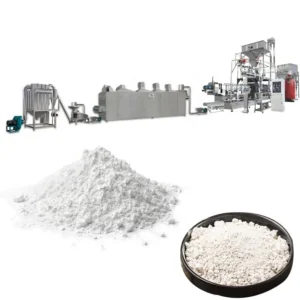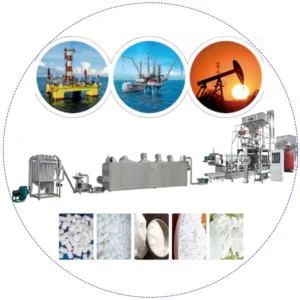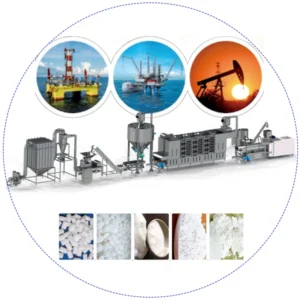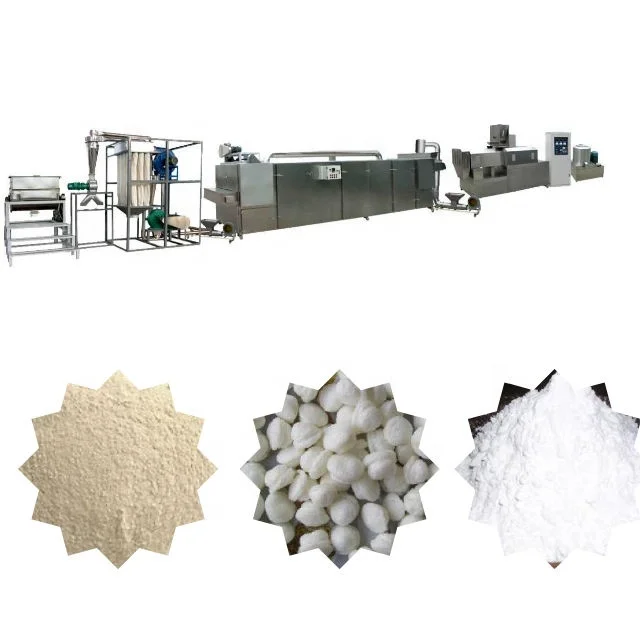


MT70 / MT85 / MT75 Modified Starch Processing Line, Twin-Screw Extrusion, 7-Zone Barrel Temp Control — complete line from batching through extrusion, drying and grinding with throughput matched across every station.
- Screw configuration and die design specified to your raw material and target starch modification degree
- Pulse grinder with cyclone discharge integrated as a line station, not an afterthought add-on
- Voltage, frequency and dryer fuel source confirmed before production to match your site utilities
Every line is trial-run on your actual raw material in our in-house testing workshop before shipment, so capacity and product specification are verified before the machine leaves the factory.
Description
Throughput-Matched Station Design — every mixer batch size, dryer belt speed, and grinder rotor is calculated against the extruder’s actual output on your raw material rather than quoted on a standalone nameplate figure.
Technical Specifications
| Parameter | Value |
|---|---|
| Product Type | Modified Starch Processing Line (Twin-Screw Extrusion Based) |
| Model Options | MT70 / MT85 / MT75 |
| Installed Power | 160 kW (MT70) / 190 kW (MT85) / 210 kW (MT75) |
| Power Consumption | 120 kW (MT70) / 140 kW (MT85) / 150 kW (MT75) |
| Output Capacity | 150–200 kg/h (MT70) / 300–400 kg/h (MT85) / 300–500 kg/h (MT75) (basis not stated in source — confirm raw material type, moisture content, and target starch modification degree) |
| Overall Dimensions (L×W×H) | 41000×1500×2200 mm (MT70) / 43000×1500×3200 mm (MT85) / 45000×1500×3500 mm (MT75) |
| Extruder Screw Type | Twin-screw |
| Screw Material | 38CrMoAl |
| Screw Diameter | 70 mm (MT70 extruder unit) |
| Screw Length | 1510 mm (MT70 extruder unit) |
| Barrel Temperature Control | Heating rings, 7 zones × 2 kW = 14 kW (MT70 unit) |
| Extruder Cooling System | Integrated water cooling for barrel temperature control |
| Main Motor Power | 30 kW (MT70 extruder unit) |
| Feeding Power | 0.75 kW (MT70 extruder unit) |
| Cutting Power | 0.75 kW (MT70 extruder unit) |
| Mixer Power Options | 4 kW / 7.5 kW / 15 kW |
| Mixer Batch Capacity | 20–30 kg/time / 70–80 kg/time / 170–180 kg/time (basis to be confirmed — raw material bulk density dependent) |
| Mixer Contact Material | Stainless steel 201SS or 304SS |
| Dryer Type | 5-layer baking oven |
| Dryer Dimensions | 5000×1200×2300 mm |
| Dryer Power | 3 kW |
| Dryer Weight | 1800 kg |
| Dryer Fuel Options | Gas, diesel, electricity, steam (to be confirmed at quotation) |
| Dryer Speed Control | Inverter controlled |
| Dryer Contact Material | 201 stainless steel (standard) |
| Grinder Type | Pulse grinder with cyclone discharge and dust collector |
| Grinder Components | Main unit, auger feeder, rotor, stator, classifier, cyclone, rotary valve, filter pockets, fan |
| Voltage & Frequency | 380V 50Hz Three Phase (customizable: 380V 60Hz / 415V 60Hz / 220V 60Hz confirmed available) |
| Contact Materials | Food-grade stainless steel throughout (except PVC on select conveyors) |
| Line Stations | Mixing → Twin-screw extrusion → Drying/Cooling → Grinding → (Packing via partner supplier) |
| Assembly State | Complete line, factory tested before shipment |
| Warranty | 1 year complete warranty, life-time maintenance service |
| Standards | CE certified; ISO certified |
Application Suitability
| Application | Material or Output |
|---|---|
| Modified starch production | Corn starch, wheat starch, tapioca starch, potato starch |
| Pre-gelatinized starch processing | Raw starch feedstock for cold-water-soluble starch products |
| Expanded corn starch | Corn grits or corn flour for snack and filler applications |
| Wheat flour-based modified starch | Wheat flour for bakery, meat processing, and sauce thickening |
| Industrial pregelatinized starch | Starch substrates for paper coating, textile sizing, and adhesives |
Why the Dryer Bottleneck Always Appears on Day One
A modified starch processing line turnkey project quoted only on extruder nameplate capacity will almost always stall at the drying station.
The extruder pushes product out continuously, but a dryer undersized for that throughput creates a backlog within hours. Last year a line I scheduled for a Southeast Asian buyer arrived on site and the middle section started piling up immediately — the dryer could not keep pace with what the twin-screw was producing, so the entire line had to run at reduced speed until we reconfigured the drying section. That experience confirmed what I already suspected: when you assemble a line from separate vendors, nobody takes responsibility for the handoff points between stations.
Every MT modified starch processing line turnkey configuration starts with a throughput balance across the mixer, extruder, dryer, and grinder. The mixer batch cycle is timed so the extruder never starves. The dryer belt speed and layer count are matched to the moisture load leaving the die. The grinder rotor capacity is sized so it never chokes on the dried output. This is the kind of planning that only matters after the containers arrive and the power is connected [NEED_CITE: line throughput balancing principles for continuous food processing].
Temperature Zoning and Starch Gelatinization Control
Starch gelatinization requires precise thermal management across the barrel. The MT70 extruder unit uses 7 independent heating zones at 2 kW each, paired with integrated water cooling, to maintain distinct temperature profiles along the screw length. This zoning capability allows the operator to control where gelatinization initiates and how far it progresses before the product exits the die.
Different starch sources — corn, wheat, tapioca, potato — each have a characteristic gelatinization temperature range and moisture requirement. A single-zone heater would push the entire barrel to one compromise setting. With 7 zones, the modified starch processing line turnkey setup can ramp temperature gradually through the barrel, controlling the degree of modification from partial to full gelatinization depending on the target product specification.
Screw Configuration as a Product Design Tool
The twin-screw arrangement in this modified starch processing line turnkey system is not a fixed geometry — screw elements and die plates are selected based on the buyer’s raw material and desired starch modification outcome. Forward-conveying elements, kneading blocks, and reverse elements can be combined to adjust shear intensity, residence time, and mixing energy inside the barrel.
For pregelatinized starch intended to dissolve in cold water, the screw profile favors longer residence with moderate shear. For expanded corn starch used as a filler or snack base, higher shear and a restrictive die create the expansion needed at the exit. The die design determines pellet size and shape, which in turn affects downstream drying uniformity and grinding consistency [NEED_CITE: twin-screw element configuration for starch processing applications].
Reading the Spec Sheet Against Your Production Reality
The installed power figures — 160 kW for the MT70 up to 210 kW for the MT75 — cover the full line including mixer, extruder, dryer, and grinder. Power consumption under load is lower at 120–150 kW, reflecting the duty cycle of heating elements and motor loads during steady-state operation. When planning electrical infrastructure, the installed power figure determines the transformer and circuit breaker sizing, while consumption figures determine operating cost.
The overall line length of 41 to 45 meters means this modified starch processing line turnkey installation requires a continuous bay with adequate headroom — 2.2 to 3.5 meters depending on model. The 5-layer dryer alone is 5 meters long and 1,800 kg, requiring a level foundation and clearance for maintenance access on both sides. Mixer batch capacity ranges from 20–30 kg per cycle up to 170–180 kg per cycle, and the correct selection depends on raw material bulk density as well as extruder feed rate.
The pulse grinder with cyclone discharge and dust collector is integrated as a line station, not bolted on afterward. The classifier, rotary valve, and filter pockets are sized to handle the specific particle size distribution that the dryer delivers. Inverter-controlled dryer speed allows the operator to fine-tune residence time during commissioning without stopping the line.
What Happens When Stations Are Sourced Separately
A buyer who purchases the extruder from one vendor and the dryer from another inherits the integration problem personally. The dryer vendor will quote based on a moisture percentage that may not match what the extruder actually produces at the target throughput. The grinder vendor receives a dried product specification that has never been tested as a complete chain.
When the line runs for the first time at the buyer’s facility, the mismatch surfaces as material backing up between stations or product quality drifting outside specification. Adjusting one station to compensate typically degrades output at the next. These integration failures are expensive to diagnose because each vendor can point to their individual equipment performing within its own nameplate rating [NEED_CITE: equipment integration challenges in multi-vendor processing lines].
Why This Supplier Builds the Whole Line
The modified starch processing line turnkey approach means every station is designed and tested together before the equipment leaves the factory. Screw configuration and die design are specified to the buyer’s raw material and target starch modification degree, not copied from a generic catalog build. The in-house testing workshop runs the buyer’s actual raw material through the complete line before shipment, producing a trial run report that verifies both throughput and product specification.
Throughput matching across mixer, extruder, dryer, and grinder eliminates the bottleneck risk that plagues multi-vendor assemblies. Voltage, frequency, control language, and dryer fuel source are confirmed during the specification stage so the electrical panels and burner systems arrive ready for the target installation site. Pre-sales engineering consultation covers line layout and utility planning, and on-site commissioning includes operator training and wear parts orientation.
Documentation & Verification
- Line layout drawing showing throughput balance across all stations
- Trial run report on your raw material from the in-house testing workshop
- Screw and die configuration record specific to your starch modification target
- Electrical schematic with confirmed voltage, frequency, and control language
- CE declaration of conformity for the complete line assembly
- Wear parts list with part numbers for screws, dies, and filter pockets
Installation, Commissioning & Support
- Foundation must support 1,800 kg dryer and 41–45 m continuous line footprint with level tolerance
- Dedicated three-phase circuit sized to 160–210 kW installed power depending on model selected
- Line arrives in modular sections requiring on-site mechanical and electrical connection
- Commissioning includes barrel temperature profile tuning across all 7 heating zones
- Operator training covers screw configuration changes for different starch sources
- Spare wear parts inventory for screws, dies, and grinder filter pockets supplied at delivery
- Dryer fuel system — gas, diesel, electricity, or steam — connected per site utility availability
What We Need to Start Your Line Configuration
To prepare a modified starch processing line turnkey proposal, share the specific starch source you intend to process and the target modification outcome — whether that is pregelatinized, cross-linked, or expanded starch. We also need your local voltage and frequency standard, preferred dryer fuel source, and available workshop dimensions including ceiling height.
If you can send a sample of your raw material, we will run it through the testing workshop and return a trial report showing verified output capacity and product characteristics before you commit to the order.
Frequently Asked Questions
Q: How is output capacity verified against my specific raw material and starch modification target?
A: Before shipment, we run your actual raw material through the complete line in our in-house testing workshop. The trial run produces a documented report showing throughput, gelatinization degree, and product characteristics. Capacity figures on the spec sheet are nominal — the trial run confirms what your material actually delivers through the configured screw and die setup.
Q: How do you ensure the dryer and grinder capacity matches the extruder output?
A: Every station is calculated against the extruder output on your specific material during the line layout stage. The dryer belt speed, layer count, and heating capacity are sized for the moisture load leaving the die. The grinder rotor and cyclone are matched to the dried product flow rate. Throughput balancing is documented in the line capacity calculation before production begins.
Q: What voltage and frequency options are available, and how is the control language set?
A: The standard configuration is 380V 50Hz three-phase, with 380V 60Hz, 415V 60Hz, and 220V 60Hz confirmed available. Voltage, frequency, and control panel language are confirmed during the specification stage and written into the electrical schematic. This ensures panels, motors, and burner systems arrive configured for your facility.
Q: Can I send my raw material for a trial run before placing the order?
A: Yes. Send a representative sample of your starch source to our testing workshop. We configure the screw elements and die to your target modification, run the material through the extruder and dryer, and return a trial report with throughput data and product samples. This process allows you to evaluate line performance before committing to production.
Q: What does phased installation and commissioning look like for a complete line?
A: The line arrives in modular sections. Mechanical assembly and electrical connection are completed first, followed by cold run testing of each station. Then we run your raw material through the system, adjusting barrel temperatures, dryer speed, and grinder classifier settings until product specification is met. Operator training and wear parts orientation complete the commissioning process.
Related products
-
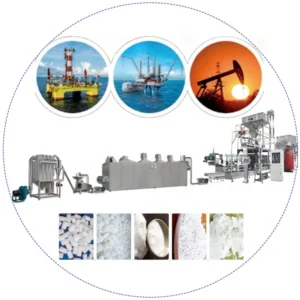
Automatic Modified Tapioca Starch Production Line 304 Stainless Steel Flour Mill and Bakery Machine
¥30.00 Select options This product has multiple variants. The options may be chosen on the product page -
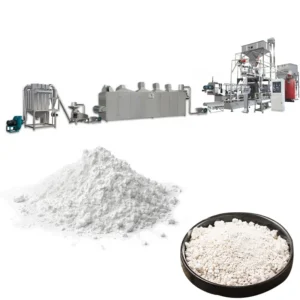
High-Efficiency Customizable Modified Starch Production Line – Automatic Corn Pellet Adhesive Making Equipment
¥65.00 Select options This product has multiple variants. The options may be chosen on the product page -
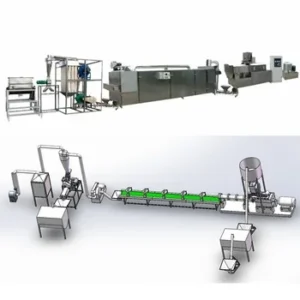
2025 New Design Modified Starch Big Capacity Industrial Use Food Additives Core Components Motor Bearing
¥50.00 Select options This product has multiple variants. The options may be chosen on the product page -
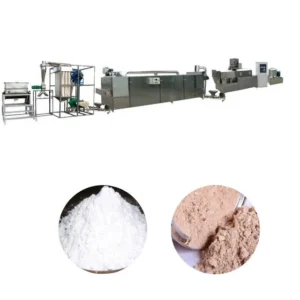
Cassava Corn Potato Flour Starch Production Line – Industrial Pregelatinized & Modified Extrusion Machinery
¥65.00 Select options This product has multiple variants. The options may be chosen on the product page