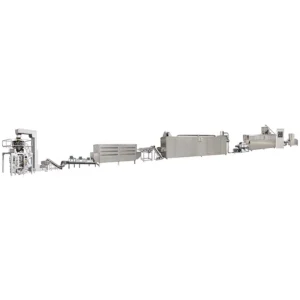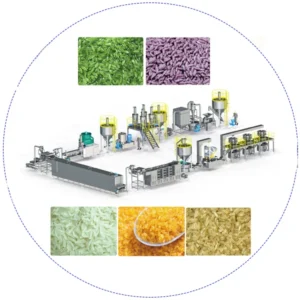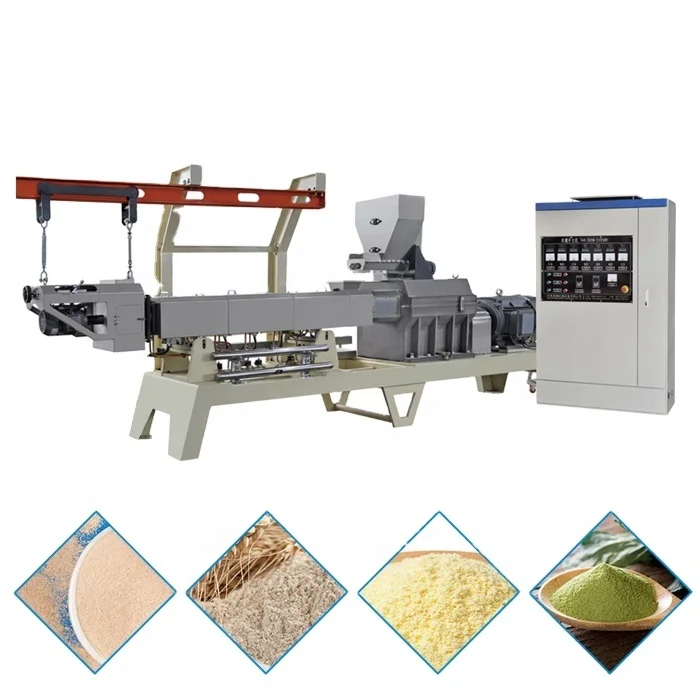


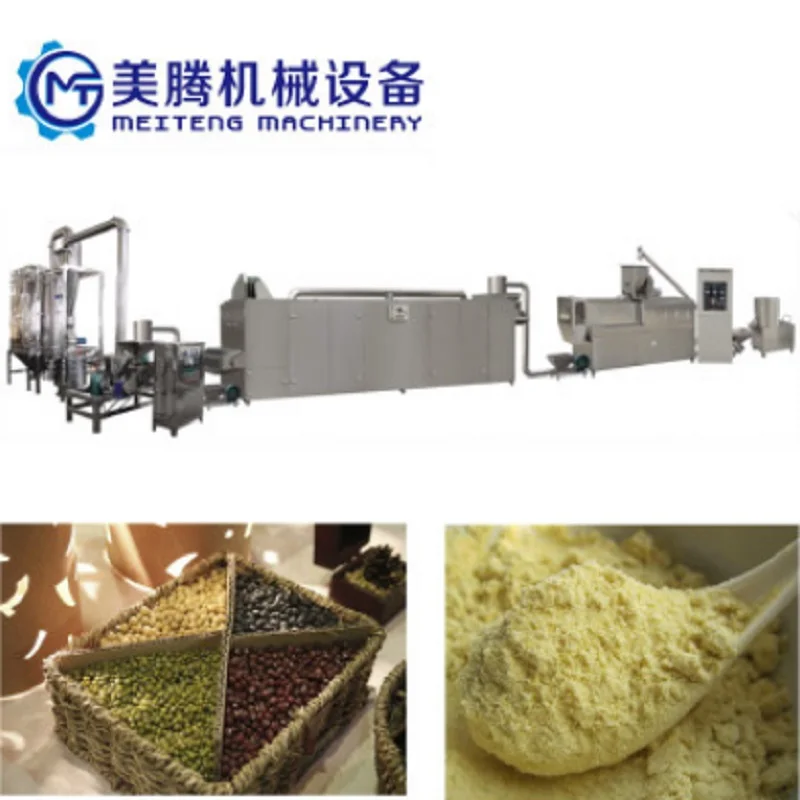
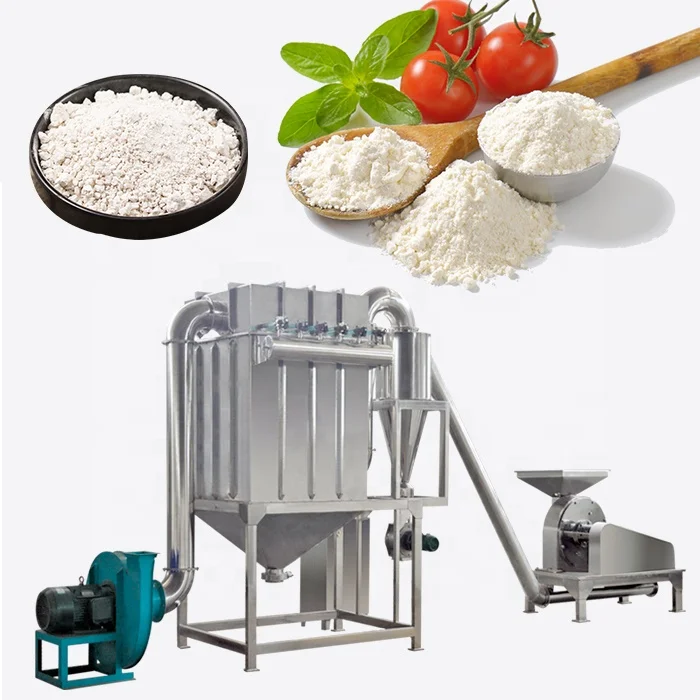
MT65 Nutritional Powder Processing Line, Twin-Screw Extruder, 85 kW Installed Power — complete turnkey system from batching through extrusion, drying, crushing and final blending, with throughput matched across every station. Screw and barrel configuration is specified to your raw material and target powder density, ensuring controlled starch gelatinisation for infant formula, meal replacement and fortified nutrition powders. Stainless steel 304 contact parts and CE certification included. Line layout, capacity calculation and in-house trial run report on your raw material provided before shipment.
- Available in MT65, MT70 and MT85 configurations
- Supports rice, corn, beans and diversified grain inputs
- Voltage, frequency and control language confirmed per destination market
Description
Integrated Throughput Engineering — every station in this nutritional powder processing line turnkey is capacity-matched from powder mixer through roaster, preventing the common bottleneck where extruder output overwhelms downstream drying or blending capacity.
Technical Specifications
| Parameter | Value |
|---|---|
| Product Type | Nutritional Powder Processing Line |
| Model | MT65 / MT70 / MT85 |
| Screw Type | Twin-screw |
| Installed Power (MT65 / MT70 / MT85) | 85 kW / 120 kW / 195 kW |
| Real Power (MT65 / MT70 / MT85) | 65 kW / 90 kW / 165 kW |
| Output Capacity (MT65) | 150–200 kg/h (basis not stated in source) |
| Output Capacity (MT70) | 200–300 kg/h (basis not stated in source) |
| Output Capacity (MT85) | 600–800 kg/h (basis not stated in source) |
| Overall Dimensions (MT65 / MT70 / MT85) | 18000×1300×2300 mm / 20000×1500×2400 mm / 24000×3500×4300 mm |
| Line Stations | Mixing, extrusion, drying/roasting, crushing/pulverizing, secondary mixing |
| High-temperature Roaster Belt Effective Length | 3.5 m |
| High-temperature Roaster Far Infrared Heater Power | 3.9 kW × 24 |
| Double Screw Extruder Main Motor Power | 30 kW |
| Powder Mixer Tank Volume | 150 kg per batch |
| Powder Mixer Rotary Speed | 385 rpm |
| Powder Mixer Mixing Time | 10 min per batch |
| Air Conveyor Power | 1.1 kW |
| Contact Material | Stainless steel (304) |
| Assembly State | Complete line with supporting equipment |
| Certification | CE, ISO |
| Warranty | 1 year complete guarantee |
Application Suitability
| Application | Material or Output |
|---|---|
| Infant formula and baby rice noodle powder | Rice, corn, and bean blends requiring controlled gelatinisation |
| Meal replacement and fortified nutrition powder | Multi-grain mixes including soybean, sesame, and cereal grains |
| Instant corn paste and breakfast drink powder | Corn grits and maize flour with high starch content |
| Modified starch for industrial use | Starch bases for textile, papermaking, building material, and oil drilling applications |
What "Rated Capacity" Actually Means for Your Nutritional Powder Processing Line Turnkey
Capacity only matters when measured against your specific raw material, moisture content, and target particle size.
I spent years watching trial runs in the testing workshop, and the most common failure on nutritional powder lines is a throughput number that looks good on paper but collapses when real material hits the barrel. A meal replacement formula with high protein addition behaves completely differently from a simple corn starch base inside the same extruder. The screw configuration that produces smooth, fully gelatinised powder on one recipe will leave hard, ungelatinised lumps on another [NEED_CITE: raw material behaviour in twin-screw extrusion]. That is why we insist on running the buyer’s actual formulation through the machine before the line is finalized.
Screw Configuration Dictates Powder Quality
The nutritional powder processing line turnkey relies on twin-screw extrusion as its core transformation stage. The screw profile and barrel temperature sequence are selected based on whether the formulation is starch-dominant or protein-dominant, since each requires different shear intensity and residence time to achieve full gelatinisation without burning the product.
Matching the Roaster to the Extruder Output
Downstream of the extruder, the high-temperature roaster uses far infrared heating across a 3.5-metre belt to reduce residual moisture and develop flavour. If roaster throughput falls behind extruder output, material piles up and degrades. The belt speed and heater zones are calculated so that every kilogram leaving the extruder has adequate dwell time for uniform drying [NEED_CITE: moisture reduction targets for nutritional powder specifications]. This balance is what separates a line that runs smoothly from one that constantly requires operator intervention.
Reading the Power and Dimension Data
The MT65 configuration draws 85 kW installed but operates at roughly 65 kW real power, which tells you the main motor is not running at full load continuously — a design choice that extends screw and barrel life when processing abrasive grain blends. The MT85, at 195 kW installed and a 24-metre footprint, is intended for dedicated high-volume production of a single powder type. The powder mixer’s 385 rpm rotary speed with a 10-minute batch cycle means blending completes in sync with the extruder feed rate, eliminating dead time between batches. For buyers comparing these tiers, the deciding factor is usually not the peak capacity number but whether the line will run six days a week on one recipe or switch formulations daily.
The Hidden Cost of Mismatched Station Capacity
When an extruder is sourced from one vendor and the dryer from another, nobody guarantees the material transfer between them. On nutritional powder lines I have seen, the extruder pushes material faster than the roaster belt can carry it, forcing the operator to slow the screw speed and run below the rated output. Over time this under-utilisation means the buyer paid for capacity they never use, while the product quality drifts because residence time inside the barrel changes with every manual adjustment [NEED_CITE: throughput imbalance effects on extrusion consistency]. The nutritional powder processing line turnkey approach avoids this by engineering every station under one layout calculation.
Why Source This Line as a Single Project
The line layout and capacity calculation is performed as one integrated exercise, so the powder mixer batch size, air conveyor transfer rate, extruder screw speed, and roaster belt length all align to the same hourly throughput figure. Screw and die configuration is specified against the buyer’s own raw material sample rather than copied from a generic build. Every food-contact surface is fabricated from 304 stainless steel, meeting the sanitary expectations of infant formula and fortified food production. The in-house testing workshop allows a full trial run on the buyer’s formulation before the equipment leaves the factory, producing a trial run report that confirms gelatinisation degree and powder particle size. Documentation covers electrical schematics with voltage and frequency matched to the destination market, so commissioning is not delayed by incompatible power supplies.
Documentation & Verification
- Line layout drawing showing throughput balance between mixer, extruder, and roaster
- Screw and die configuration record matched to your grain formulation
- Trial run report on your raw material confirming gelatinisation and powder fineness
- Electrical schematic with voltage, frequency, and control language confirmed per destination
- CE declaration of conformity and ISO certificate for customs and import compliance
- Operation and maintenance manual with wear parts replacement schedule
Installation, Commissioning & Support
- MT85 footprint of 24000×3500×4300 mm requires a reinforced floor with adequate ceiling clearance
- Power supply must accommodate up to 195 kW installed load with dedicated circuit breakers
- Line arrives in modular sections for assembly and alignment on-site by installation engineers
- First-run commissioning includes screw speed and barrel temperature calibration to your recipe
- Operator training covers batch changeover procedures for the powder mixer and die swaps
- Wear parts list identifies screws, dies, and mixer blades with reorder lead times
Preparing Your Inquiry
To size the right configuration, share your target powder formulation including the primary grain or protein sources and their approximate ratios. Confirm the daily production target in kilograms and whether the line will run a single recipe or switch between multiple products. Provide your workshop’s available floor length, ceiling height, local voltage and frequency standard, and preferred control language so the electrical package is specified correctly from the start.
Frequently Asked Questions
Q: How is line capacity verified against my actual raw material?
A: Before the line is finalized, your raw material sample is run through the extruder in our testing workshop. We measure gelatinisation degree, moisture content after roasting, and final powder particle size. The trial run report documents these results, and the screw configuration is adjusted if the output does not meet your specification.
Q: How is throughput balanced between the extruder and downstream stations?
A: The line layout calculation starts from your target hourly output and works backward through every station. The powder mixer batch cycle, air conveyor rate, extruder screw speed, and roaster belt length are all set so no station creates a bottleneck or forces another to idle.
Q: What voltage and control options are confirmed before production?
A: During the specification phase we confirm your local voltage, frequency, and preferred control language. The electrical schematic is drawn to match these requirements, and the control panel labels and PLC interface are set before the line ships to avoid commissioning delays.
Q: Is a trial run performed before the equipment ships?
A: Yes. The testing workshop runs your actual raw material through the configured extruder and roaster. The trial run report records screw speed, barrel temperatures, moisture reduction, and powder quality so you can see the results before deciding on any final adjustments.
Q: What documentation accompanies the line shipment?
A: You receive a line layout drawing, screw and die configuration record, trial run report, electrical schematic with confirmed voltage, CE declaration of conformity, ISO certificate, operation manual, and a wear parts list with reorder references.
Related products
-
Automatic Iron Fortified Baby Rice Cereal Nutrition Powder Making Machine 500kg/h PLC Controlled
¥8,238.27 Add to cart -
Commercial Stainless Steel Baby Rice Powder Grinding Mixing Machine
¥8,238.27 Select options This product has multiple variants. The options may be chosen on the product page -
Fully Automatic 500kg/h Baby Cereal Nutrition Powder Extrusion Drying Line with PLC Control
¥9,500.00 Add to cart -

Compact Automatic Baby Cereal Nutrition Powder Production Line with 500kg/h Capacity and PLC Control
¥9,500.00 Add to cart