

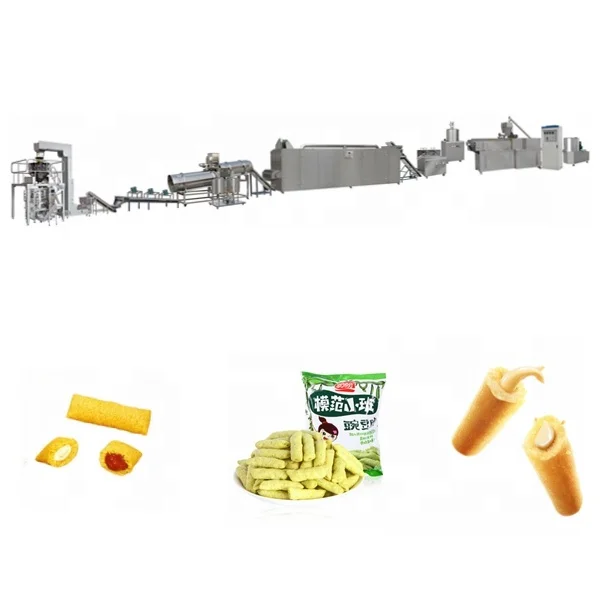
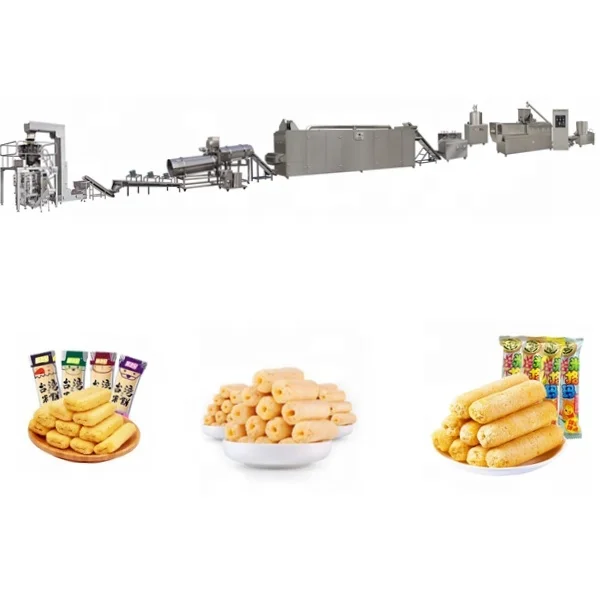
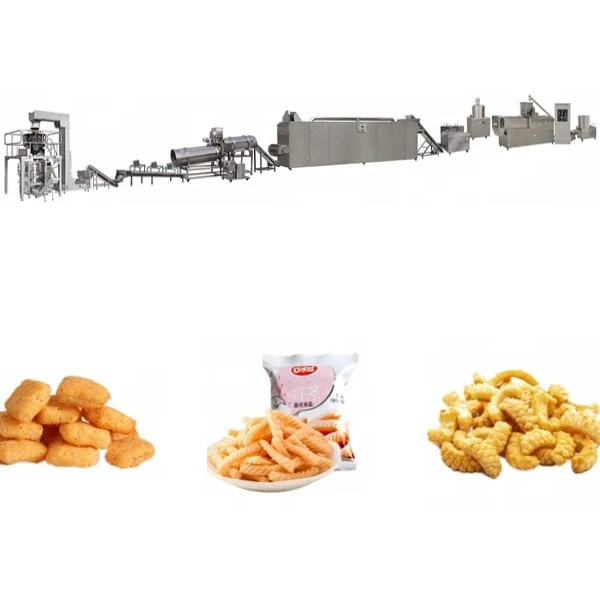
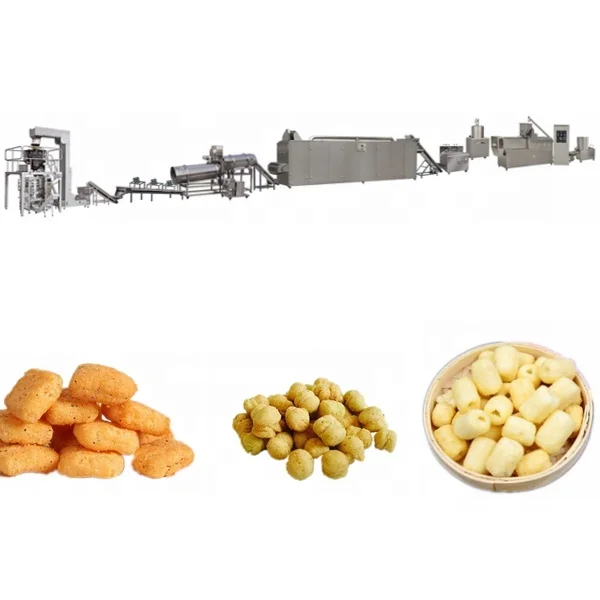
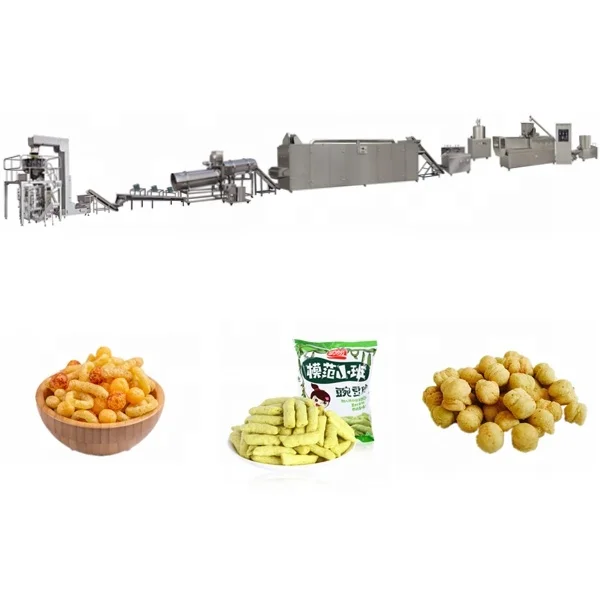
Puff Corn Snack Stick Production Line, Double Screw Extruder, Food Grade Stainless Steel, Three Phase 380V/50Hz — delivered as a turnkey project with matched throughput from batching through packing, screw configuration and die design specified to your raw material and target texture.
- Line layout and capacity calculation with every station engineered to eliminate bottlenecks
- Trial run on your actual raw material before shipment to verify product density and expansion
- Full documentation package including electrical schematic, CE declaration and operator manual for fast on-site commissioning
Description
Matched Line Throughput — every station from mixer to packing is engineered so the extruder never waits on the dryer or the roaster, verified against your raw material before the line ships.
Technical Specifications
| Parameter | Value |
|---|---|
| Product Type | Puff Corn Snack Stick Production Line |
| Extruder Type | Twin screw (double screw) extruder |
| Contact Material | Food grade stainless steel 201/304 |
| Voltage & Frequency | Three phase 380V/50Hz; Single phase 220V/50Hz (customizable to customer’s local voltage) |
| Electrical Power | Approx. 100 kW (basis not stated in source — confirm specific line configuration and capacity) |
| Thermal Power (Gas/Diesel) | Approx. 50–60 kW (basis not stated in source — confirm specific line configuration and capacity) |
| Energy Options | Electricity / Gas / Diesel / Steam |
| Motor & Inverters | Siemens (China-made) or China top-brand motors; Delixi or Delta inverters |
| Control System | PLC / MCC (to confirm) |
| Line Stations | Mixer → Extruder → Vibrate cooler machine → Roasting machine → Packing machine |
| Assembly State | Complete line from batching through packing |
| Standards | CE certified; ISO certified |
Application Suitability
| Application | Material or Output |
|---|---|
| Puffed corn snack sticks | Corn grits, rice, millet blends |
| Core-filled snack bars | Chocolate or cream filled cereal tubes |
| Rice cakes and cereal bars | Rice, buckwheat, brown rice formulations |
| Sheet snacks and pellets | Multi-grain and fortified cereal doughs |
| Artificial and fortified rice | Rice flour with added vitamins, proteins, minerals |
Why the Quoted Capacity Never Reached the Packing Station
A puff corn snack stick production line turnkey only delivers its rated output when every station — extruder, cooler, roaster, packer — is throughput-matched from the start.
I have stood on factory floors in Saudi Arabia and Iran where a twin-screw extruder ran flat out while the roasting machine choked at half that rate. The operator kept slowing the extruder to avoid pile-ups, and the line’s real output sat well below the number on the quotation. The bottleneck is rarely the extruder itself [NEED_CITE: line throughput balancing in multi-stage food extrusion]. It is the station someone assumed could be sourced later or sized loosely. On a puff corn snack stick production line turnkey project, the drying and roasting stages consume as much engineering attention as the barrel and screw, because moisture removal rate directly limits how fast product can advance to packing.
Layout as a Single Engineering Problem
The puff corn snack stick production line turnkey approach treats the floor plan as one system rather than a collection of individual machines dropped beside each other. The mixer must discharge at a rate that keeps the extruder hopper level without flooding it. The vibrate cooler must remove enough surface moisture so the roasting machine receives product at a consistent entry condition, preventing hot spots that scorch one batch while the next passes through under-done. When one supplier designs the entire sequence, the belt speeds, transfer heights, and buffer capacities align from the first drawing.
Raw Material Defines the Screw, Not the Other Way Around
Corn grits from one region carry a different particle size and moisture profile than those from another, and the twin-screw configuration must match. A coarser grind requires deeper screw channels and adjusted pitch to build sufficient shear for proper gelatinisation. I learned this the hard way on a commissioning call where coarser-than-expected grits cut output sharply on day one. Now I pull raw material certificates before opening AutoCAD. The die design works in the same way — the opening geometry controls expansion ratio and stick density, and it must be selected after trial runs, not guessed from a catalogue [NEED_CITE: twin-screw die design for cereal extrusion products].
What the Specs Actually Mean on the Floor
The twin-screw design matters because it provides self-wiping action and adjustable shear across a wider raw material range than a single-screw extruder, letting producers switch between corn, rice, and buckwheat without rebuilding the barrel. Food-grade stainless steel 201/304 contact surfaces resist the acidic and salty seasoning environments typical of snack lines, reducing corrosion-related downtime between sanitation cycles. Siemens-class motors paired with Delixi or Delta inverters give steady torque response when the extruder encounters density variations in the feed, preventing the surging that causes inconsistent puff size. The multiple energy options — electricity, gas, diesel, steam — for the roasting stage let the line adapt to whatever utility infrastructure exists at the installation site, which varies considerably across Middle East and African industrial zones.
The Hidden Cost of an Unmatched Line
When a buyer assembles a line from separate vendors, each supplier guarantees their own machine in isolation. The extruder vendor points at the dryer vendor when output falls short, and the dryer vendor blames upstream moisture levels. No one owns the throughput number. I have seen this dispute delay commissioning by weeks, with the buyer paying for idle installation crews while vendors argue over whose specification was wrong [NEED_CITE: multi-vendor line integration disputes in food processing]. A single-supplier layout eliminates that finger-pointing because the capacity calculation is one document covering every station.
Why Source the Complete Line Here
Screw configuration and die geometry are specified to your raw material sample and target stick texture, not copied from a generic build. The in-house testing workshop runs your actual corn grits or multi-grain blend before the line ships, so product development happens on our floor, not yours. Throughput is matched across mixing, extrusion, cooling, roasting, and packing under one engineering responsibility, removing the station-to-station mismatches that cap real output. Pre-sales consultation covers line layout, utility planning, and phased installation scheduling tailored to your site readiness. Ongoing support includes operator training at commissioning and wear parts supply for screws and dies when the first replacement cycle arrives.
Documentation & Verification
- Line layout drawing with throughput calculation for every station on your puff corn stick line
- Screw and die configuration record matched to your submitted raw material sample
- Trial run report produced on your corn grits or cereal blend before dispatch
- Electrical schematic with confirmed voltage, frequency, and control language for your market
- CE declaration of conformity and ISO certificate for customs and regulatory filing
- Packing photographs and customs documentation support for export shipment
Installation, Commissioning & Support
- Foundation plan showing floor load and leveling requirements for the full line footprint
- Dedicated circuit specification for the approx. 100 kW electrical load and thermal energy supply
- Assembled line stations delivered with matched transfer heights to minimize on-site fabrication
- First-run parameter setting covering barrel temperature profile, screw speed, and roasting time
- Operator training on control interface, sanitation procedures, and screw changeover sequence
- Wear parts list for screws, dies, and seals with recommended first-order quantities
What to Include in Your Inquiry
To size the line accurately, share the raw material type with particle size and moisture range, the target daily output in kilograms, and the stick dimensions or core-filled format you plan to produce. Confirm the available voltage and frequency at your facility and the preferred control language for the operator interface. If you have existing upstream batching or downstream packing equipment, note the connection points so the layout accounts for them.
Frequently Asked Questions
Q: How is line capacity verified, and what is it based on?
A: Capacity is calculated against a specific raw material, moisture content, and product format — not quoted as a standalone number. We run your actual corn grits or cereal blend in our testing workshop and document the sustained output rate, so the capacity figure you receive reflects your material, not a generic lab sample.
Q: How do you ensure stations are throughput-matched?
A: Every station — mixer, extruder, vibrate cooler, roasting machine, and packer — is sized within one layout document. Belt speeds, buffer volumes, and transfer rates are calculated together so no single station creates a bottleneck that limits the line below its engineered rate.
Q: Can a trial run be done on our raw material before shipment?
A: Yes. Our in-house testing workshop runs your submitted raw material on the configured twin-screw extruder with the matched die. The trial report documents screw speed, barrel temperatures, expansion ratio, and product density, and is shared before the line leaves the factory.
Q: What voltage and control language options are confirmed before shipment?
A: Voltage and frequency are confirmed to match your local supply — standard options include three-phase 380V/50Hz and single-phase 220V/50Hz, with customization available. Control language on the PLC interface is set to your operator’s requirement before the electrical panel is finalized.
Q: What documentation is provided for customs clearance and commissioning?
A: The package includes CE declaration of conformity, ISO certificate, electrical schematics, line layout drawings, screw and die configuration records, trial run report, operation and maintenance manual, and packing photographs to support both customs filing and on-site installation.
Related products
-

New Puffed Snack Food Machine Production Line Corn Flake Puff Corn Making Machine Twin Screw Extruder 100-500kg/h Capacity Food
¥8,500.00 Select options This product has multiple variants. The options may be chosen on the product page -

Full Automatic Crispy Maize Chocos Corn Flakes Breakfast Cereals Processing Production Line Industrial Equipment
¥1,000.00 Select options This product has multiple variants. The options may be chosen on the product page -

Automatic Puffed Food Snack Machine Electric Corn Puffs Snacks Making Machinery New Condition Flavorful Puff Snack Production
¥7,550.00 Select options This product has multiple variants. The options may be chosen on the product page -

Puffed Snacks Seasoning Flavor Machine Twin Screw Corn Puffing Food Making Extruder Equipment
¥8,355.00 Select options This product has multiple variants. The options may be chosen on the product page


