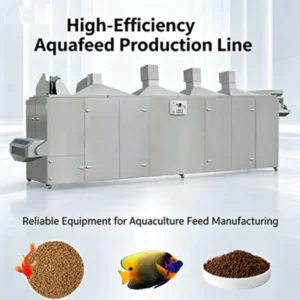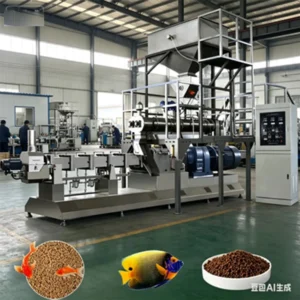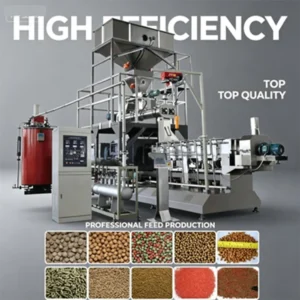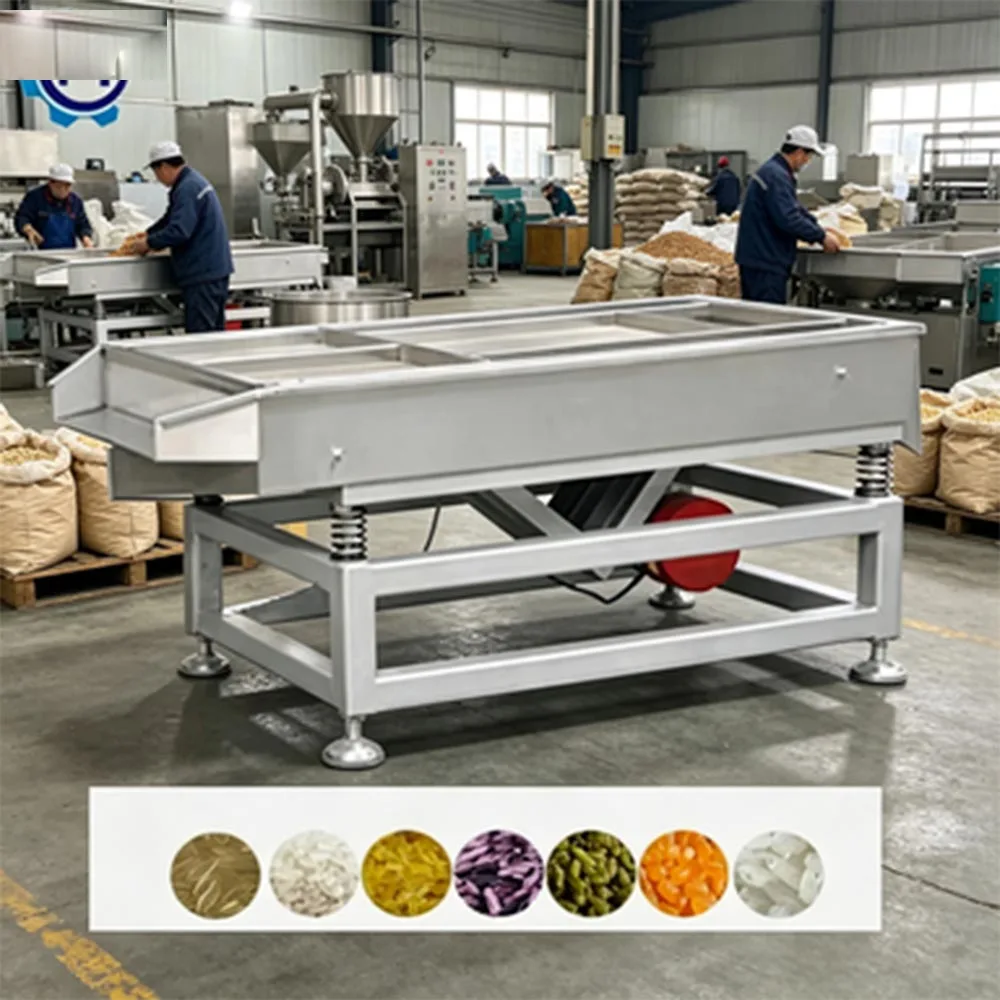

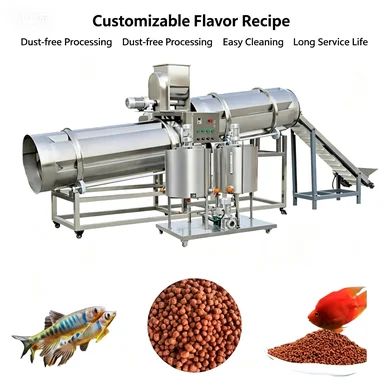


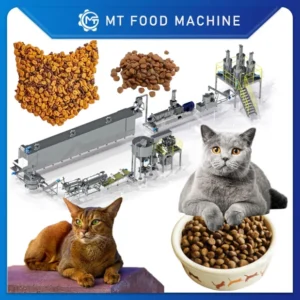
Twin Screw Extruder Production Line for Fish Feed and Pet Feed, Intelligent PLC Control, Food-grade 304 Stainless Steel — configured as one integrated turnkey project from raw material mixing through extrusion, drying, seasoning coating, vibrating screening to finished product discharge.
- Every station throughput matched so no single unit bottlenecks the line output
- Adjustable pellet size, hardness, and buoyancy for floating or sinking aquatic feed and dry pet kibble
- Screw configuration and die design specified to your raw material formulation and target pellet density
Layout, capacity calculation, and trial run report on your actual raw material provided before shipment — single-supplier responsibility from project design through on-site commissioning and operator training.
Description
Line Balance Engineering — throughput matched across mixing, extrusion, drying, and coating stations so the entire line holds one continuous output target without chokepoints.
Technical Specifications
| Parameter | Value |
|---|---|
| Product Type | Twin Screw Extruder Production Line for Fish Feed and Pet Feed |
| Screw Type | Twin Screw |
| Control System | Intelligent PLC Automatic Control System |
| Contact Parts Material | Food-grade 304 Stainless Steel |
| Machine Body Material | Food-grade 304 Stainless Steel |
| Output Capacity | Large stable processing capacity for medium to large scale industrial production (basis to be confirmed) |
| Production Mode | Full continuous automatic production |
| Line Stations | Raw material mixer, extruder, dryer, seasoning coating machine, vibrating sieve, conveyor equipment |
| Pellet Adjustability | Pellet size, hardness, buoyancy adjustable |
| Feed Buoyancy Types | Floating and sinking pellets |
| Energy Feature | Optimized energy saving transmission structure and heating system |
| Maintenance Design | Humanized operation interface, quick replacement of vulnerable parts |
Application Suitability
| Application | Material or Output |
|---|---|
| Floating aquaculture feed | Fish meal, soybean meal, corn powder, compound additives for koi, goldfish, tropical fish |
| Sinking aquaculture feed | Adjusted formulation and die configuration for catfish, tilapia, shrimp bottom-feeders |
| Dry pet kibble | Meat meal, grain blends, and vitamin premixes for dog and cat food production |
| Dual-purpose production | Changeover between aquatic feed and pet food formats on the same line |
Why the Dryer Rating Matters More Than the Extruder Nameplate
A twin screw extruder production line turnkey is only as fast as its slowest downstream station.
I once walked into a pet food plant where the extruder was pushing well beyond what the dryer could handle. The kibble piled up, moisture readings came back inconsistent, and the line choked for weeks before anyone reconfigured the airflow. The extruder nameplate had promised a certain throughput, but the dryer was never sized to match. That mismatch is the most common hidden cost in extrusion projects, and it never shows up on a quotation until the line is already running. [NEED_CITE: typical extrusion line bottleneck causes in feed production]
Matching Every Station to One Throughput Target
When we configure a twin screw extruder production line turnkey, the starting point is never the extruder alone. We calculate the residence time in the dryer, the coating drum capacity, and the conveyor transfer rates to confirm every station can sustain the same output. A line that balances on paper must also balance with your specific raw material formulation, because moisture content and starch ratio change how much drying time each pellet actually needs.
Screw Configuration Specified to Your Pellet, Not a Template
Floating pellets require a different shear profile and die geometry than sinking pellets. The screw element arrangement—forward kneading blocks, reverse elements, and conveying sections—determines how much mechanical energy transfers into the dough. We build the screw configuration around your target pellet density and buoyancy, then verify it in our testing workshop with your actual raw material blend before the machine leaves Jinan. [NEED_CITE: twin screw element configuration for aquaculture feed density control]
Reading the Specs That Actually Matter
The twin screw design gives this line a self-wiping action that single screw extruders lack, which means sticky formulations with high meat meal content will not accumulate on the barrel walls. The food-grade 304 stainless steel contact parts resist corrosion from salt and mineral premixes commonly used in aquaculture formulations. The PLC control system maintains barrel temperature zones and screw speed within tight tolerances, so pellet expansion stays consistent from the first batch of the shift to the last. Die selection directly controls pellet diameter and cut length, and we include multiple die plates so you can switch between product formats without ordering new tooling later.
What Happens When Configuration Is Skipped
I have seen lines shipped with a generic screw build that produced floating pellets with cracked surfaces and inconsistent buoyancy. The buyer then spent months adjusting moisture and temperature, burning raw material on trial runs that should have happened before shipment. When the die design does not match the formulation, pellets deform during drying and the coating drum applies seasoning unevenly. These problems compound because each station downstream amplifies what the extruder failed to get right. [NEED_CITE: pellet surface defect causes in twin screw extrusion]
Why Procurement Here Reduces Project Risk
Complete line responsibility under one supplier means throughput calculations are not split between vendors who each guarantee only their own station. Our in-house testing workshop runs your raw material through the configured extruder before shipment, so product development happens in Jinan instead of on your factory floor. The PLC and MCC panels are built and labeled to your local voltage and frequency, with control language set before wiring is finalized. Screw and die configurations are documented per product format, so your operators have a written baseline when they start production.
Documentation & Verification
- Line layout and capacity calculation showing matched throughput at every station
- Screw and die configuration record specific to your pellet size and buoyancy target
- Trial run report on your raw material formulation before dispatch
- Electrical schematic with voltage, frequency, and PLC language confirmed in writing
- Operation and maintenance manual with wear parts list and replacement intervals
Installation, Commissioning & Support
- Foundation and utility plan provided before equipment arrival based on line footprint
- Dedicated electrical circuit sizing confirmed for PLC panel and heating zones
- Modular station layout allows phased assembly matching your facility readiness
- First-run parameter logging on your formulation during on-site commissioning
- Operator training covers screw changeover, die swap, and PLC alarm response
- Wear parts inventory including screws, dies, and seals listed with reorder lead times
What We Need to Configure Your Line
Send us your target pellet specifications—size range, buoyancy type, and the raw material formulation you plan to run. Include your daily production target, workshop dimensions, and the local voltage and frequency at your facility. If you have existing upstream or downstream equipment, tell us the make and capacity so we can match the interface points correctly.
Frequently Asked Questions
Q: How is line throughput verified across every station, and what raw material formulation is the capacity based on?
A: We calculate residence time for the dryer, coating drum volume, and conveyor transfer rates against the extruder output. The capacity figure is always tied to a specific raw material blend, moisture content, and pellet size. We confirm this with a trial run in our testing workshop using your formulation before shipment.
Q: How do you configure screw and die design for floating versus sinking pellets?
A: Floating pellets need higher expansion, so we increase kneading block intensity and select a die with smaller orifice diameter to raise pressure at the cut point. Sinking pellets use a lower shear configuration with larger die openings. Both setups are documented and tested on your material before the line ships.
Q: What does the turnkey installation and commissioning schedule look like?
A: Our engineer arrives after your utilities are ready. Commissioning covers station alignment, electrical verification, first-run parameter logging, and operator training on the PLC interface. The schedule depends on line size and facility readiness, typically requiring several working days on site.
Q: How are voltage, frequency, and PLC control language confirmed before production?
A: We request your local electrical standards during the quotation stage and confirm them in writing on the electrical schematic. The PLC interface language is set to your preference before the control panel is wired, so no translation is needed during commissioning.
Q: What spare wear parts are included, and what is the lead time for replacements?
A: The line ships with a documented wear parts list covering screws, dies, and seals. We include a first set of spares based on your production volume. Replacement orders are fulfilled from our workshop, and lead times depend on the specific screw element or die plate configuration required.
Related products
-
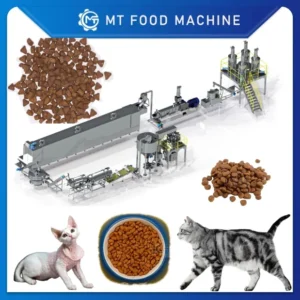
MT100 Brand 1.5-2.0t/h PLC Controlled Multi-Species Cat Food Processing Line
¥45,000.00 Select options This product has multiple variants. The options may be chosen on the product page -
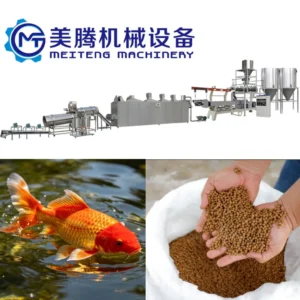
1.0-1.5t/h High Capacity Multi-Species Fish Feed Processing Line to Produce Fish Food
¥45,000.00 Select options This product has multiple variants. The options may be chosen on the product page -
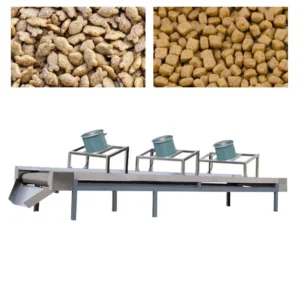
Full Automatic Pet Feed Production Line Large Twin Screw Grain Extrusion Machine
¥9,500.00 Select options This product has multiple variants. The options may be chosen on the product page -
250-300kg/h Capacity PLC Controlled Multi-Species Cat Food Processing Line
¥35,000.00 Select options This product has multiple variants. The options may be chosen on the product page