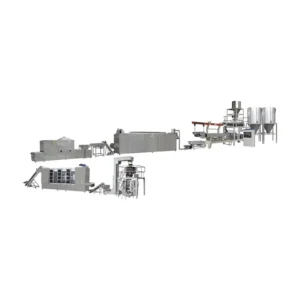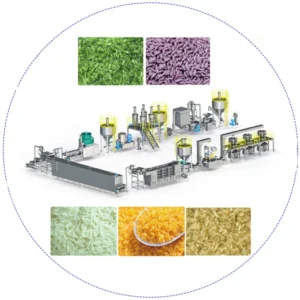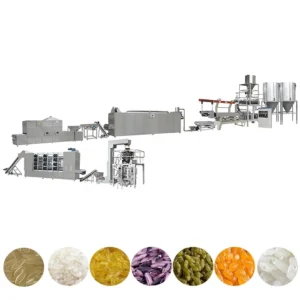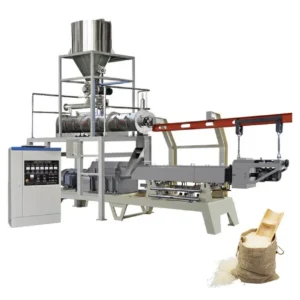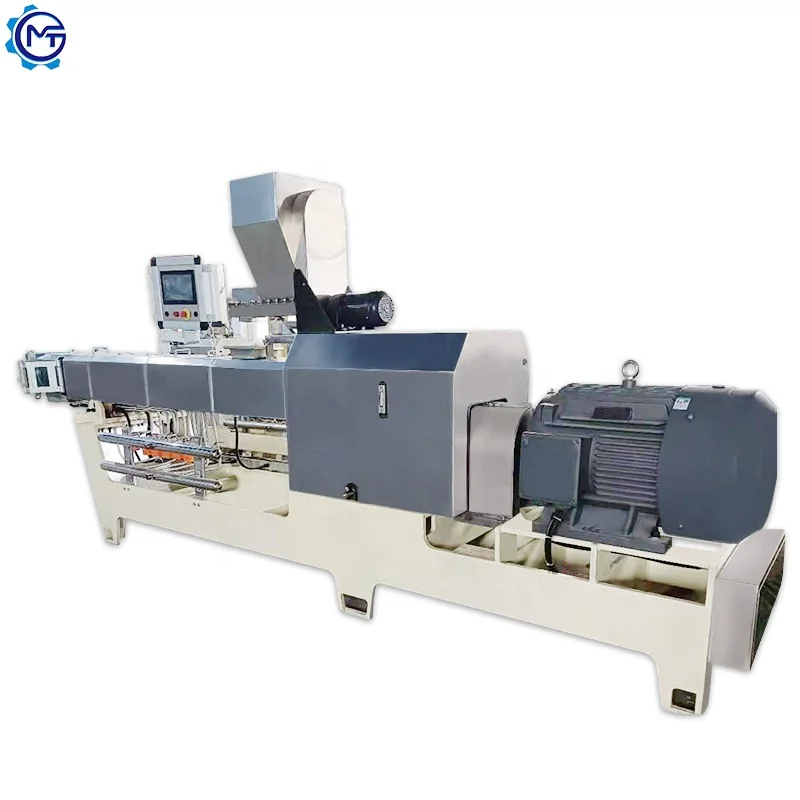


MT65 / MT70 / MT85 / MT75 / MT95 Fortified Rice Processing Line, Twin-Screw Extrusion, Frequency Speed Control — configured for artificial and nutritional rice production from broken rice, corn, millet, and vitamin additives, with mixing, extruding, vibrating, drying, roasting, and cooling stations. Screw configuration and die design matched to your raw material and target kernel density, ensuring throughput balance across every station. Line layout and voltage customized to your factory, validated by in-house trial runs before shipment, supported by complete documentation and on-site commissioning.
- CE & ISO certified, serving 60+ countries
- Complete turnkey line from batching to packing
- Trial run on customer raw material before delivery
Description
Turnkey Line Delivery — Every station from batching to packing is specified under one supplier, so the Fortified Rice Processing Line turnkey avoids the throughput mismatches that plague multi-vendor assemblies.
Technical Specifications
| Parameter | Value |
|---|---|
| Product Type | Fortified Rice Processing Line |
| Model | MT65, MT70, MT85, MT75, MT95 |
| Installed Power | MT65: 85 kW / MT70: 120 kW / MT85: 235 kW / MT75: 180 kW / MT95: 260 kW |
| Power Consumption | MT65: 60 kW / MT70: 85 kW / MT85: 165 kW / MT75: 135 kW / MT95: 195 kW |
| Output Capacity | MT65: 80–100 kg/h (basis to be confirmed) / MT70: 100–120 kg/h (basis to be confirmed) / MT85: 200–300 kg/h (basis to be confirmed) / MT75: 300–500 kg/h (basis to be confirmed) / MT95: 800–1000 kg/h (basis to be confirmed) |
| Overall Dimensions (L×W×H) | MT65: 28×1.2×2.2 m / MT70: 30×1.5×2.2 m / MT85: 34×3.5×4.3 m / MT75: 32×3.5×4.3 m / MT95: 36×3.5×4.3 m |
| Screw Type | Twin-screw, with single or double screw feeding system option |
| Control System | Frequency speed controlling |
| Drying Oven Heating Source | Electric or gas |
| Line Stations | Mixing → Extruding → Vibrating → Low temperature drying → Cooling → High temperature roasting → Cooling → Packing |
| Raw Materials | Broken rice, corn, millet, wheat, oats, buckwheat, bean, starch, vitamin and mineral additives |
| Assembly State | Complete turnkey line |
| Customization | Voltage and factory layout configured to customer requirements |
| Standards | CE, ISO |
Application Suitability
| Application | Material or Output |
|---|---|
| Nutritional rice from broken rice and rice bran | Broken rice blended with vitamin and mineral additives |
| Fortified staple rice for food nutrition programmes | Rice flour with iron, folic acid, and zinc premix |
| Multigrain rice-shaped kernels | Corn, millet, buckwheat, oats with starch binder |
| Artificial rice from non-rice cereals | Wheat and bean flour reformed into rice-like granules |
| Value-added rice processing for commercial brands | Broken rice upcycled into uniform fortified kernels |
What a Nominal Capacity Figure Hides About Your Fortified Rice Processing Line Turnkey
The rated kilogram-per-hour number means nothing until it is validated on your actual raw material blend.
I learned this the hard way on a Southeast Asian project last year. The line was quoted at a comfortable capacity based on plain rice flour, but the customer’s real formula included millet, buckwheat, and a micronutrient premix. The extruder could not gelatinise the mixed starches evenly at the quoted speed. Half the output came out as fractured kernels, and we spent two weeks re-tuning screw speed, barrel temperatures, and moisture levels before the line held steady. [NEED_CITE: starch gelatinisation behaviour varies across grain types and moisture levels] A Fortified Rice Processing Line turnkey that has never seen your formula is a guess, not a guarantee.
Throughput Matching Across Every Station
A complete artificial rice line involves eight distinct stations, from the initial mixer through to the packing end. Each station must handle the same mass flow. If the extruder pushes 300 kg/h but the low-temperature dryer can only pass 200 kg/h, product backs up, residence time drifts, and kernel colour and texture become inconsistent. The Fortified Rice Processing Line turnkey is designed so that mixing volume, extruder throughput, vibrating screen area, dryer belt length, roasting chamber capacity, and packing speed are all calculated against one another before the layout is drawn.
Why Your Raw Material Dictates the Screw and Die Design
Twin-screw extrusion for rice kernels depends on the ratio of amylose to amylopectin in the feed stock, the particle size after milling, and the mineral loading from fortification additives. A screw configuration that works for pure broken rice may produce uneven expansion when 15% of the blend is a vitamin-mineral premix. Die orifice diameter and land length control the density and surface finish of each kernel. [NEED_CITE: die geometry influence on extrudate density in starch-based food systems] Every Fortified Rice Processing Line turnkey we build starts with a screw and die specification matched to the buyer’s documented formula, not a generic template.
Reading the Power and Capacity Data Correctly
The installed power figures — ranging from 85 kW on the MT65 to 260 kW on the MT95 — represent the total connected load across every motor and heater on the line. Actual power consumption is lower because the dryer, roaster, and main drive do not all run at peak simultaneously. When comparing models, the critical variable is not the headline capacity but the relationship between screw diameter, barrel length-to-diameter ratio, and the residence time your specific grain blend needs to achieve full gelatinisation. A longer barrel at moderate screw speed often produces more consistent kernels than a shorter barrel running faster. The frequency-controlled drive lets operators fine-tune screw RPM during commissioning to find the stable window for each recipe.
The Cost of Skipping the Trial Run
Buyers who approve shipment without a factory trial on their own raw material frequently discover problems only after the line is bolted to their floor. Kernels that look perfect with test starch may crack during drying when the real formula has a higher fibre content. The roasting stage may scorch the surface if the sugar content in the premix is higher than assumed. [NEED_CITE: common causes of post-installation rework in food extrusion projects] These issues are solvable, but fixing them on site costs weeks of production time. Running your exact blend in our testing workshop before dispatch removes most of this risk.
Why Procurement Through a Single Turnkey Source Matters
All stations — mixer, extruder, vibrating conveyor, dryer, cooler, roaster, second cooler, and packing — come from one engineering team, so interfaces between machines are designed rather than improvised. Screw and die configurations are documented per project, not copied from a catalogue build. The testing workshop allows trial runs on your actual grain and additive blend before the line ships. Voltage, frequency, and control language are confirmed against your site utilities before production begins. Electrical schematics, layout drawings, and a wear parts list are included as standard documentation. The same team that designs the Fortified Rice Processing Line turnkey also handles on-site installation, commissioning, and operator training.
Documentation & Verification
- Line layout drawing with throughput calculations for each station matched to your capacity target
- Trial run report generated on your specific grain blend and fortification premix before dispatch
- Electrical schematic with confirmed voltage, frequency, and control panel language for your site
- Screw and die configuration record detailing geometry selected for your raw material formula
- CE declaration of conformity covering the complete assembled line
- Wear parts list identifying screws, dies, and seals with recommended first-order quantities
Installation, Commissioning & Support
- Foundation plan provided based on the overall line dimensions, up to 36 m in length for the MT95 configuration
- Dedicated power circuit sized to the model’s installed power, ranging from 85 kW to 260 kW depending on selection
- Line arrives in modular sections for sequential assembly, with station-to-station conveyors aligned on site
- First-run parameter setting covers screw speed, barrel zone temperatures, and dryer belt speed for your recipe
- Operator training includes die change procedure, screw withdrawal for cleaning, and daily inspection routines
- First-order spare screws and dies shipped with the line to cover initial wear period before local stocking
Before You Send an Inquiry
To configure a Fortified Rice Processing Line turnkey that matches your project, we need your raw material specification including grain types and additive ratios, your target hourly output on that specific blend, and your workshop dimensions with ceiling height. Please also confirm your local voltage and frequency, preferred control language, and whether you want an electric or gas-fired drying and roasting system. If you can send a sample of your milled grain mix, we will run a trial in our testing workshop before finalising the quotation.
Frequently Asked Questions
Q: How is the line capacity confirmed for my specific grain and additive blend?
A: We run a trial using your raw material sample in our testing workshop before the quotation is finalised. The extruder screw speed, barrel temperature profile, and moisture level are adjusted until kernel shape, density, and surface quality meet your specification. The confirmed output under those conditions is then documented in the trial run report and used as the basis for sizing the dryer, roaster, and packing station.
Q: What electrical information do I need to provide before production starts?
A: We need your site voltage, phase configuration, and frequency — for example 380 V / 50 Hz or 440 V / 60 Hz — along with your preferred language for the control panel labels and HMI display. This is confirmed in writing and reflected in the electrical schematic before the control cabinet is wired, so there are no delays during commissioning.
Q: How are the dryer and roaster sized relative to the extruder output?
A: Each station’s belt width, chamber length, and heating capacity are calculated so that residence time at the confirmed extruder throughput is sufficient for proper moisture removal and surface roasting. If the extruder model is changed or capacity is later increased, the dryer and roaster specifications are recalculated to prevent bottlenecking.
Q: What does on-site commissioning involve and how long does it typically take?
A: Our engineers assemble the line station by station, align conveyors, connect utilities, and run sequential tests starting from the mixer. Full production trials with your raw material follow, with parameter adjustments until the line holds stable output within your kernel quality specification. Operator training covers daily start-up, shutdown, cleaning, and die change procedures.
Q: Which spare parts should I order with the initial shipment?
A: The wear parts list included with your documentation identifies screws, dies, barrel liners, and seals specific to your model. We recommend ordering one full replacement screw set and two die sets with the initial shipment so that you can schedule the first changeover without waiting for international delivery.
Related products
-
Full Automatic Complete Baby Food Nutrition Powder Porridge Processing Production Line for Infant Nutrition Factory
¥9,500.00 Add to cart -
Commercial Stainless Steel Baby Rice Powder Grinding Mixing Machine
¥8,238.27 Select options This product has multiple variants. The options may be chosen on the product page -

Automatic Iron Fortified Baby Rice Cereal Nutrition Powder Making Machine 500kg/h PLC Controlled
¥8,238.27 Add to cart -
Compact Automatic Baby Cereal Nutrition Powder Production Line with 500kg/h Capacity and PLC Control
¥9,500.00 Add to cart