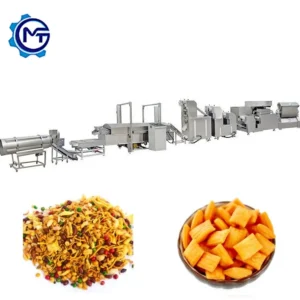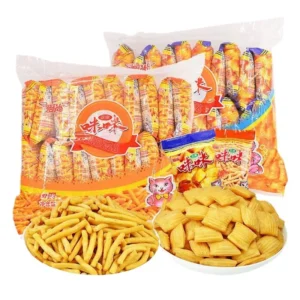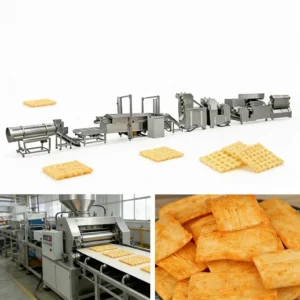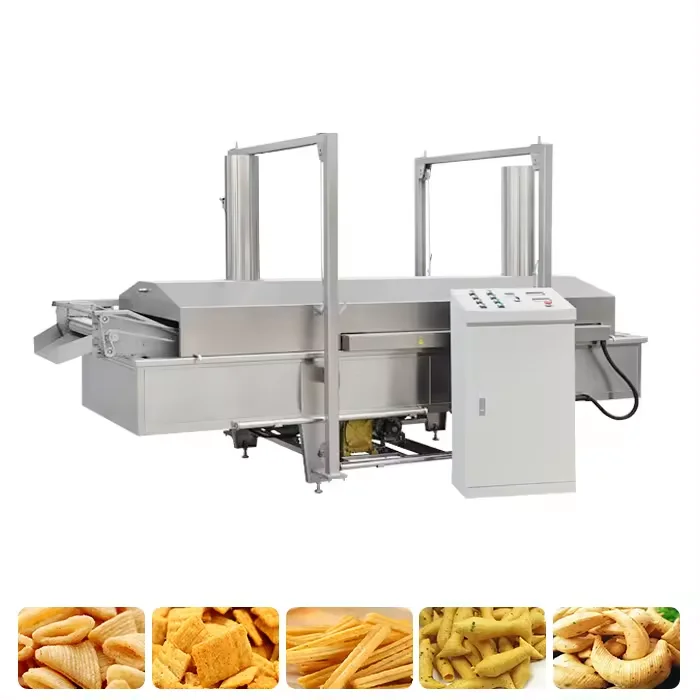
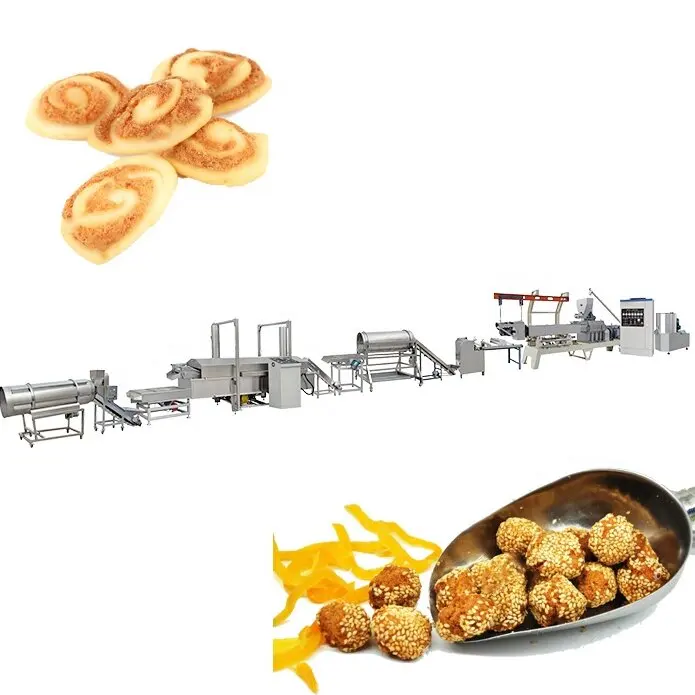
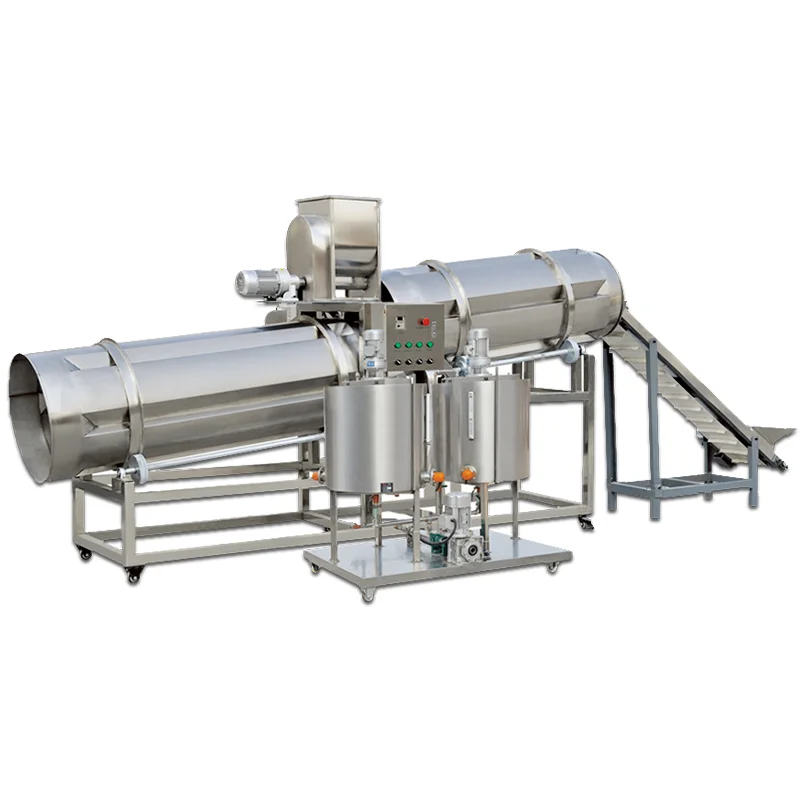
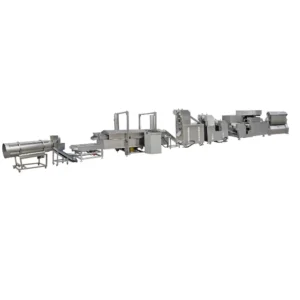
Automatic Fried Corn Chips Snack Food Frying Machine, 380V/50Hz, PLC Control, 320L Oil Capacity — designed as one integrated station within a complete turnkey snack extrusion line.
- Double-layer mesh belt clamping prevents floatation for uniform frying of light extruded shapes like corn chips and bugles
- Automatic oil circulation filtration extends oil service life; frequency conversion stepless speed regulation matches frying time to product density
- Throughput sized to actual upstream extruder output and downstream seasoning capacity, eliminating line bottlenecks
Pre-shipment trial runs on your raw material ensure frying performance meets your product specification before installation.
Description
Matched Frying Station — throughput sized against upstream twin-screw extruder output on the buyer’s actual raw material, not quoted as a standalone nominal figure.
Technical Specifications
| Parameter | Value |
|---|---|
| Product Type | Continuous Deep Fryer for Snack Food Production Line |
| Heating Method | Electricity / Gas |
| Voltage | 380V/50HZ |
| Heating Tube Power | 60 kW |
| Drive Power | 2.6 kW |
| Oil Capacity | 320 L |
| Belt Type | Upper and lower double-layer mesh belt |
| Speed Regulation | Frequency conversion stepless speed regulation |
| Oil Filtration | Automatic oil circulation filtration system |
| Slag Discharge | Bottom slag discharge system |
| Lifting System | Automatic lifting system for upper hood and mesh belt |
| Control System | PLC |
| Material | Food-grade 304 Stainless Steel |
| Overall Dimensions (L×W×H) | 6700 × 2200 × 1200 mm |
| Net Weight | 2000 kg |
| Capacity | 100–1000 kg/h (basis to be confirmed) |
| Standards | CE, ISO |
| Warranty | 1 Year (core components included) |
Application Suitability
| Application | Material or Output |
|---|---|
| Fried corn chip production | Extruded corn dough from twin-screw line, fried to target crunch density |
| Salad bugle and horn snack line | Light extruded pellets requiring clamped frying to prevent floatation |
| Pellet snack finishing station | 2D/3D extruded pellets fried after drying for uniform expansion |
| Snack food processing plants | Continuous deep frying integrated between extrusion and seasoning drums |
What Happens When the Fryer Is Undersized for the Extruder
The extruder runs fine but product piles up waiting for fryer slots, and operators throttle back the whole line to keep pace.
A snack frying machine turnkey production line only works when every station is balanced. I have walked into workshops where a high-output twin-screw extruder was paired with a fryer rated well below the extruder’s real throughput. The result is not a slow fryer — it is an entire line running at half speed. Burnt oil accumulates because batches sit too long, and the moisture gradient across the belt becomes uneven. Sizing the frying station to the extruder’s actual output on your specific corn blend or pellet recipe matters more than the number on any nameplate [NEED_CITE: industrial frying throughput matching principles].
How Double-Layer Mesh Belt Clamping Controls Frying Uniformity
Extruded snacks like corn chips and bugles are lighter than oil. Without a clamping mechanism, they float to the surface, fry unevenly on one side, and tumble against each other. The upper and lower mesh belt system on this fryer holds the product in place throughout the full submersion path. The result is consistent color, consistent moisture removal, and consistent bulk density across every batch. For a snack frying machine turnkey production line, this clamping arrangement is what separates uniform crunch from a mix of scorched edges and soft centers.
Oil Filtration and Its Effect on Product Consistency
Every hour of continuous frying leaves behind fine carbonized particles from starch and protein breakdown. The automatic oil circulation filtration system on this unit continuously pulls residue from the oil bath through a dedicated filter loop, and the bottom slag discharge removes heavier sediment that settles. Without this, oil darkens noticeably within a single shift and free fatty acid levels rise, which changes both the flavor profile and the oil absorption rate of the snack. Fresh oil top-ups extend service life, but they cannot replace mechanical filtration running in real time [NEED_CITE: edible oil degradation mechanisms in continuous frying].
Reading the Specs That Matter Most
The 60 kW heating tube power determines how fast the oil recovers temperature after cold product enters the bath. On a high-moisture extruded pellet, thermal recovery directly sets the maximum belt speed and therefore the line throughput. The 320 L oil capacity defines the thermal mass — a larger bath absorbs the temperature drop from incoming product with less fluctuation at the heating elements. Frequency conversion stepless speed regulation lets the operator tune frying time from the PLC panel without stopping the belt, which is essential when switching between products with different densities or moisture targets. Food-grade 304 stainless steel contact surfaces resist both hot oil corrosion and the caustic cleaning agents used during daily wash-downs. The 2.6 kW drive power is sufficient for the belt load at rated speed, but any increase in belt width or product weight would require recalculation.
The Hidden Cost of a Standalone Fryer Quote
When a fryer is quoted in isolation, nobody checks whether the seasoning drum downstream can handle the fried output volume or whether the cooling conveyor has enough length to bring product temperature down before packaging. I have seen lines where the fryer ran perfectly but hot snacks piled up at the flavoring station because the drum was sized for a slower upstream extruder. The oil degrades faster when the line stops and starts to clear bottlenecks, and maintenance intervals shorten because thermal cycling stresses the heating elements. Every station in a snack frying machine turnkey production line must be capacity-matched, or the weakest link dictates the real output [NEED_CITE: turnkey line throughput balancing in food processing].
Why Source the Frying Station as Part of the Line
The layout drawing we produce shows the fryer positioned between the extruder discharge conveyor and the cooling belt, with exact distances calculated so product temperature and moisture stay within the window the seasoning drum expects. The PLC panel on the fryer communicates with the MCC that controls the entire line, so a speed change at the extruder propagates automatically to belt speed and oil temperature setpoints. Before shipment, the testing workshop runs your actual extruded product through the fryer at your target throughput, and the trial run report documents oil temperature profiles, belt speeds, and final product moisture. Screw and die configurations from the upstream extruder are matched to the frying parameters so density and oil absorption fall within market specifications. The electrical schematic confirms voltage, frequency, and control language for the destination market before the machine leaves the factory floor.
Documentation & Verification
- Line layout drawing showing fryer position and throughput matched to extruder output
- Electrical schematic with voltage and frequency confirmed for destination market
- Trial run report on your extruded snack product documenting oil temperature and belt speed
- Wear parts list covering mesh belt segments, heating elements, and filtration media
- CE declaration of conformity and ISO certificate for export compliance
- Operation and maintenance manual with daily wash-down and oil change procedures
Installation, Commissioning & Support
- Foundation must support 2000 kg static load plus dynamic vibration from the drive motor
- Dedicated 380V circuit with breaker sized above the 60 kW heating plus 2.6 kW drive draw
- Unit arrives as a single assembly; hood lifting system allows mesh belt access without overhead crane
- First-run commissioning includes oil temperature ramp-up curve and PLC parameter entry for your product
- Operator training covers stepless speed adjustment, filtration cycle timing, and bottom slag discharge
- Mesh belt replacement schedule and heating element specs provided in the wear parts documentation
What We Need to Size the Frying Station Correctly
Send us the raw material composition and moisture content of your extruded product, your target fried output per hour, and the local voltage and frequency at your facility. If you already have an upstream twin-screw extruder, share its model and the screw configuration you are running so we can match the fryer belt speed and oil volume to its real discharge rate. For buyers planning a full snack frying machine turnkey production line, workshop floor dimensions and ceiling height let us produce an accurate layout drawing before quotation.
Frequently Asked Questions
Q: How is fryer capacity verified against the upstream extruder’s actual output?
A: We request a sample of your extruded product or the raw material blend and run it through the fryer in our testing workshop. Belt speed, oil temperature, and residence time are recorded, and the trial run report confirms whether the rated throughput holds on your specific product density and moisture content.
Q: What voltage and control language options are available?
A: The standard configuration is 380V/50Hz, but the electrical system can be built for other industrial voltages. The PLC interface language is set during the specification confirmation stage before production begins, matching the language your operators will use daily on the factory floor.
Q: How is the frying station footprint integrated into the full line layout?
A: The line layout drawing positions the fryer between the extruder discharge conveyor and the cooling or seasoning station, with transfer heights and distances calculated so product temperature stays within the range the downstream equipment requires.
Q: What oil filtration and maintenance schedule is required?
A: The automatic oil circulation filtration system runs continuously during operation, removing fine particles in real time. The bottom slag discharge is activated on a schedule matched to your product type, and the wear parts list specifies mesh belt inspection intervals and heating element replacement criteria.
Q: Is a trial run on the buyer’s extruded snack product performed before shipment?
A: Yes. The buyer sends raw material or finished extruded samples to the testing workshop, where the fryer is run at target throughput. The trial run report documents oil temperature, belt speed, product moisture, and color before the machine is packed for dispatch.
Related products
-
Industrial Fully Automatic Stainless Steel Deep Fried Line – Snack Factory Miscellaneous Grains Special Processing Equipment
¥65.00 Select options This product has multiple variants. The options may be chosen on the product page -
Industrial Wheat Flour Snacks Processing Equipment – Stainless Steel Fried Food Production Line
¥65.00 Select options This product has multiple variants. The options may be chosen on the product page -
Automatic Rice Crust Chips Making Machine Bugles Pizza Rolls Fried Snack Food Processing Line Machine
¥8,570.00 Select options This product has multiple variants. The options may be chosen on the product page -
Frying Crispy 3D Corn Bugles Pellets Fried Chips Snacks Food Machine Production Line Bugles Making Extruder
¥100.00 Select options This product has multiple variants. The options may be chosen on the product page