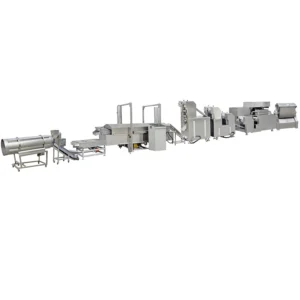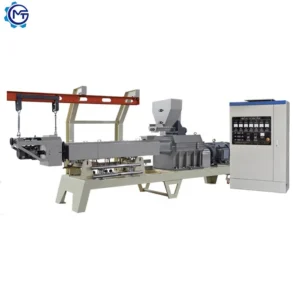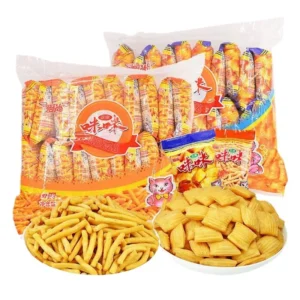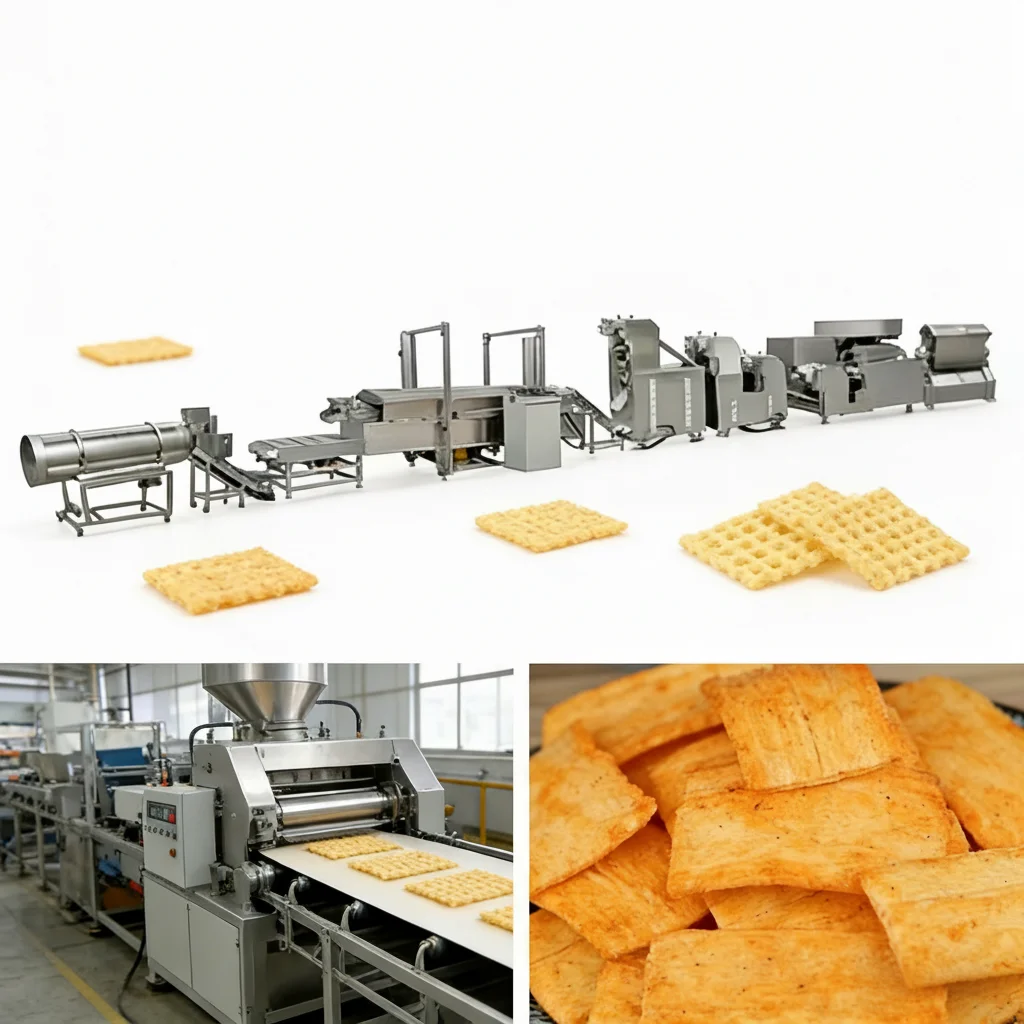

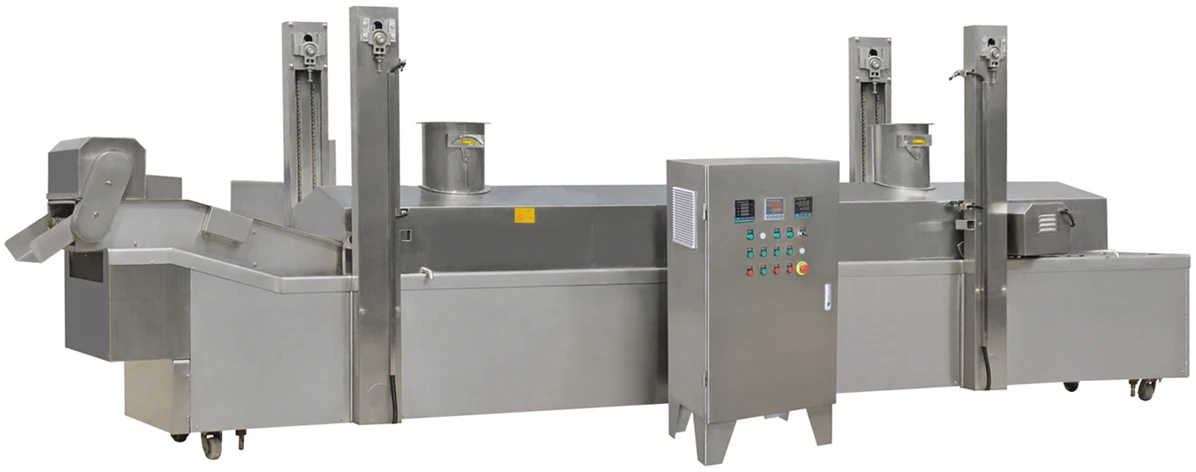


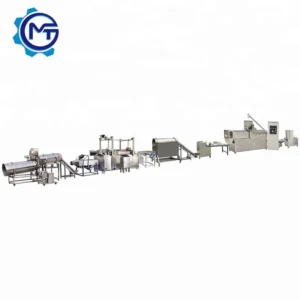
MT100/MT120 Single Screw Extrusion Line, 120 kg/h, 50–70 kW — complete frying chips and golgappa production system from mixing through extruding, frying, and automatic flavoring.
- Single screw with high/low pressure configuration handles wheat flour, corn starch, and potato starch across multiple die shapes
- Energy options include electricity, gas, diesel, and steam to match your facility utilities
Delivered as a throughput-matched turnkey line with in-house trial runs on your raw material before shipment.
Description
Extruder-Dryer-Fryer Throughput Alignment — every station on this MT100/MT120 line is rated and balanced against the others so the extruder does not outpace the fryer or flavoring drum.
Technical Specifications
| Parameter | Value |
|---|---|
| Model | MT100 / MT120 |
| Product Type | Golgappa / Pani Puri Making Machine (Single Screw Extrusion Line) |
| Extruder Type | Single Screw Extruder |
| Output Capacity | 120 kg/h (basis not stated in source — confirm raw material formulation / moisture content) |
| Rated Power | 50–70 kW (electric); 50–60 kW (gas/diesel heating) |
| Voltage & Frequency | 380 V / 50 Hz (3-phase); 220 V / 50 Hz (1-phase); customizable |
| Overall Dimensions (L×W×H) | 12,000–26,000 × 1,200 × 2,200 mm |
| Energy Options | Electricity / Gas / Diesel / Steam |
| Material of Construction | Food-grade stainless steel 201 (304 available) |
| Screw Configuration | High and low pressure screw |
| Die Configuration | Interchangeable dies (screw shell, round tube, square tube, ring, cartoon shapes) |
| Process Flow | Mixer → Screw Conveyor → Single Screw Extruder → Pulling & Cutting → Automatic Fryer → Automatic Flavoring → Cooling |
| Raw Materials | Wheat flour, corn starch, potato starch |
| Certification | CE / ISO 9001 |
| Warranty | 1 year (lifetime technical guidance) |
Application Suitability
| Application | Material or Output |
|---|---|
| Golgappa / Pani Puri shells | Wheat flour and potato starch blends |
| Secondary puffing pellet snacks | Corn starch and wheat flour mixtures |
| Screw-shell and tube-shaped fried snacks | Corn starch, potato starch, wheat flour |
| Ring and cartoon-shape crispy snacks | Starch-based formulations for retail snack markets |
| Hotpot ingredient pellets | Wheat flour and starch composites |
Why "120 kg/h" Means Nothing Without the Recipe
The rated capacity of any golgappa making machine production line depends entirely on the raw material formulation and moisture content fed into the extruder.
I once spent a week on-site in Bogotá watching a single-screw line choke on a high-cassava-starch blend that the supplier had never tested. The extruder nameplate promised a certain throughput, but with the buyer’s actual recipe the dough viscosity was wrong, expansion dropped, and the fryer received half-formed pellets that soaked up oil unevenly. Whole batches were scrapped before we re-profiled the screw and adjusted barrel zones [NEED_CITE: starch gelatinisation behaviour across different flour-to-starch ratios]. A turnkey pani puri extrusion line must be validated on your specific recipe, not a generic benchmark flour, before capacity claims hold any weight.
Matching Screw Profile to Starch Behaviour
The MT100 and MT120 use a high-and-low-pressure screw arrangement that lets the operator adjust shear intensity along the barrel. Wheat flour requires moderate shear to develop gluten networks that trap steam during frying, while pure potato starch needs gentler handling to avoid over-gelatinisation before the die. This golgappa making machine production line gives you two pressure zones to dial in, rather than forcing one fixed compression ratio across every formulation.
Die Geometry and Oil Uptake Control
Interchangeable dies — screw shell, round tube, square tube, ring, cartoon shapes — do more than change appearance. Wall thickness and internal cavity volume set by the die directly govern how much oil the pellet absorbs during frying. A thin-walled ring shape fries faster and absorbs less oil than a thick-walled tube, shifting both texture and cost-per-kilogram of finished product [NEED_CITE: relationship between extrudate wall thickness and oil absorption in secondary puffing snacks]. Choosing the right die is therefore a product-design decision, not just a cosmetic one.
Reading the Power and Footprint Numbers
The 50–70 kW electric rating covers the full line from mixer through cooler when all stations run simultaneously. If your facility has limited transformer headroom, the gas or diesel heating option for the dryer and fryer sections shifts thermal load off the electrical supply. The 12–26 m line length reflects the number of downstream stations; a shorter layout means fewer buffering conveyors but tighter maintenance access. Voltage customisation — 380 V three-phase or 220 V single-phase — must be locked in before production begins, because rewiring a control panel after arrival delays commissioning by weeks.
The Hidden Cost of Mismatched Downstream Stations
An extruder that pushes out shaped pellets faster than the fryer can cook them creates a buffer pile-up where moisture re-condenses on the pellet surface, causing clumping and uneven expansion in the hot oil. Conversely, an oversized fryer running half-empty wastes thermal energy and degrades oil quality through prolonged idle heating. I have seen lines where the flavoring drum was the bottleneck, forcing operators to hand-scoop product off the conveyor — exactly the kind of manual intervention that introduces contamination risk and inconsistent seasoning coverage [NEED_CITE: throughput imbalance consequences in snack extrusion lines].
Why Buyers Source This Line Here
Every station — mixer, screw conveyor, single-screw extruder, puller-cutter, fryer, flavoring drum, cooler — is supplied and throughput-matched by one builder, so there is no finger-pointing between vendors when a bottleneck appears. The screw and die configuration is specified to your raw material, not copied from a generic build. Before shipment, the line runs your actual flour or starch blend in the in-house testing workshop, generating a trial run report you can review before the crate is sealed. CE and ISO 9001 documentation ships with every unit, and operator training covers parameter setting, die changeover, and daily maintenance routines on your specific product shape.
Documentation & Verification
- Line layout drawing showing station spacing and utility drop points for your MT100/MT120 configuration
- Screw and die configuration record matched to your flour-to-starch ratio
- Trial run report produced on your raw material before dispatch
- Electrical schematic with confirmed voltage, frequency, and control language
- CE declaration of conformity and ISO 9001 certificate copy
- Wear parts list with first-order quantities for screws and dies
Installation, Commissioning & Support
- Foundation must support the 12–26 m line length on a level concrete slab with drainage near the fryer section
- Dedicated electrical circuit sized for 50–70 kW peak draw or gas supply piping for thermal stations
- Line arrives in modular sections; station-to-station conveyors are bolted and aligned on-site
- First production run includes barrel temperature profiling and fryer oil-temperature curve setting for your recipe
- Operator training covers die changeover procedure and screw cleaning between product shapes
- Spare screw and die sets recommended at initial order to avoid downtime during first replacement cycle
What to Include in Your Inquiry
Send your raw material formulation — flour type, starch percentage, target moisture at the die — along with the golgappa or pani puri shape you plan to run. Specify your local voltage and frequency, preferred control-panel language, and available workshop floor length so the line layout fits your building. If you need a trial run on your own flour blend before shipment, state that requirement up front so raw material can be shipped to the testing workshop in advance.
Frequently Asked Questions
Q: What conditions must be met for the line to reach its rated 120 kg/h output?
A: The stated capacity depends on raw material formulation, moisture content at the die, and the specific die shape in use. A dense tube shape with high wheat-flour content behaves differently from a thin ring made with potato starch. Before quoting throughput, we run your actual recipe in the testing workshop and report real measured output.
Q: Can the voltage and control language be matched to our country’s standard?
A: Yes. The line supports 380 V three-phase or 220 V single-phase at 50 Hz, and other voltages are configurable. Control-panel labels and PLC interface language are confirmed during the specification stage before production starts, so operators can read instructions in their own language from day one.
Q: How is throughput balanced between the extruder, fryer, and flavoring drum?
A: Each downstream station is sized to handle the extruder output without creating a bottleneck. The fryer belt speed, oil volume, and residence time are calculated against the pellet mass flow. If you later change product shape or recipe, individual stations can be re-evaluated for capacity.
Q: Will you run our flour blend before the machine ships?
A: The in-house testing workshop conducts a trial run on your raw material. The resulting report documents barrel temperatures, screw speed, die pressure, and finished-product characteristics including expansion ratio and oil absorption, giving you data before installation begins.
Q: What is the replacement cycle for screws and dies, and how are spares supplied?
A: Wear rate depends on raw material abrasiveness and daily run hours. A wear-parts list ships with every line, identifying screw sections and die plates most likely to need replacement. Ordering a first spare set with the initial line avoids production stops while waiting for international freight.
Related products
-
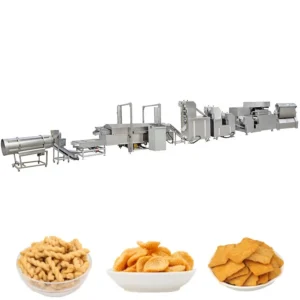
Frying Crispy 3D Corn Bugles Pellets Fried Chips Snacks Food Machine Production Line Bugles Making Extruder
¥100.00 Select options This product has multiple variants. The options may be chosen on the product page -
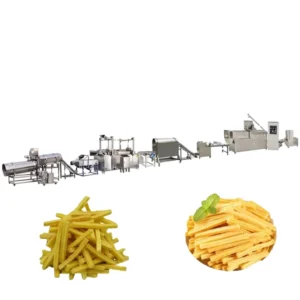
High-Yield Automated Fried Snack Production Line – Double Screw Salad Strips & Millet Crust Making Equipment
¥65.00 Select options This product has multiple variants. The options may be chosen on the product page -
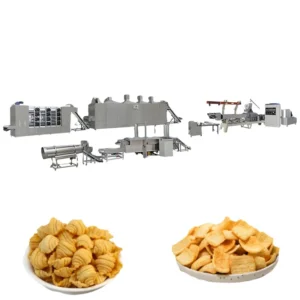
New Automatic Portable High Productivity Frying Salad Sticks Chips Snacks Food Production Line
¥100.00 Select options This product has multiple variants. The options may be chosen on the product page -
Fried Puffs Snack Food Making Machine Whole Line Solution Design by Factory Price Crispy Snack Machine
¥20.00 Select options This product has multiple variants. The options may be chosen on the product page