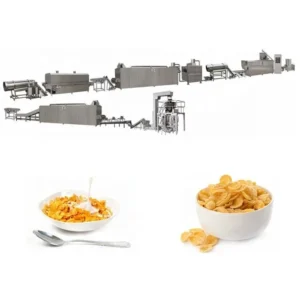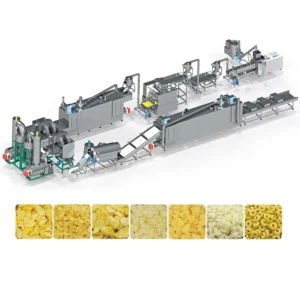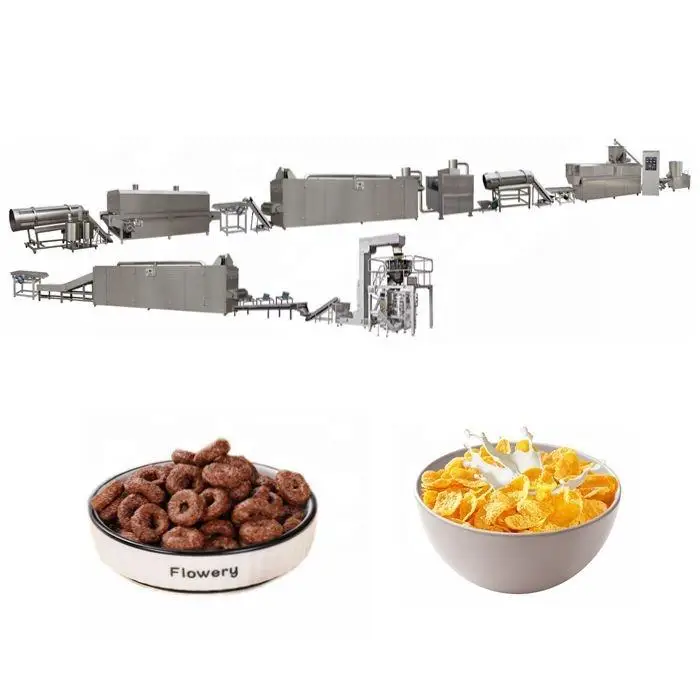
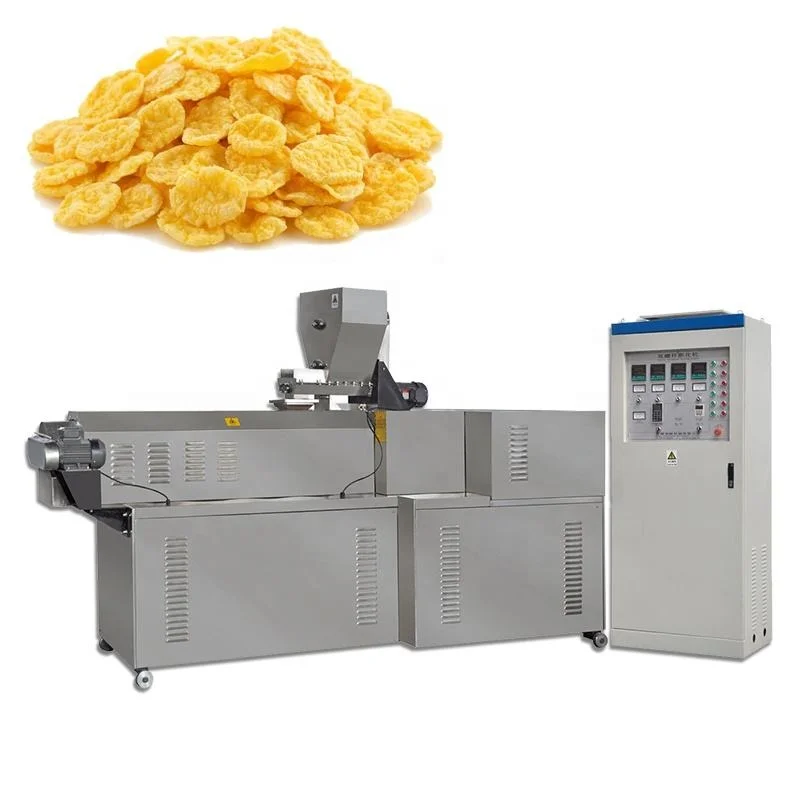


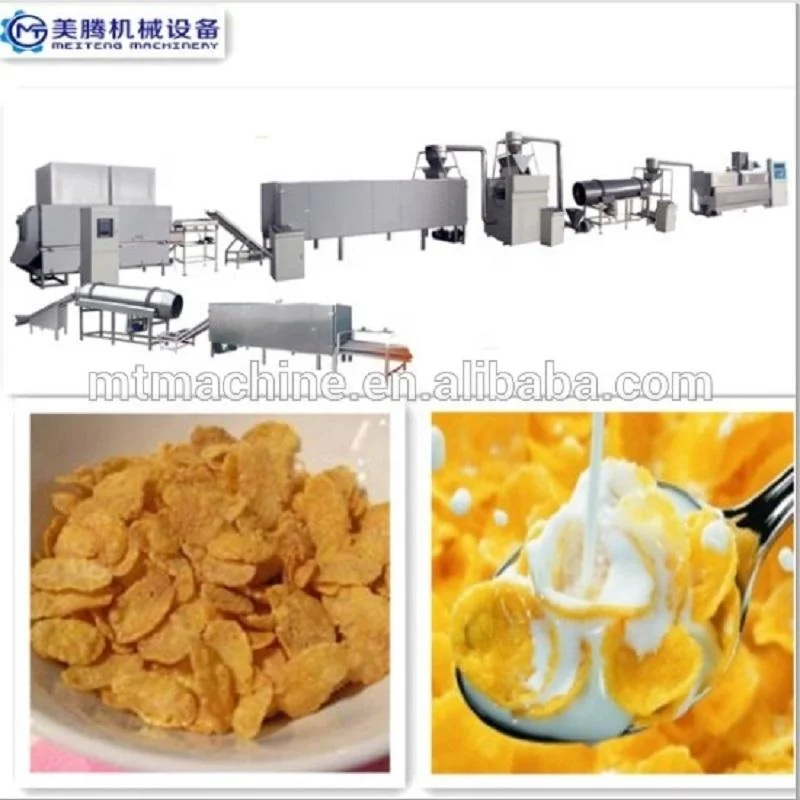
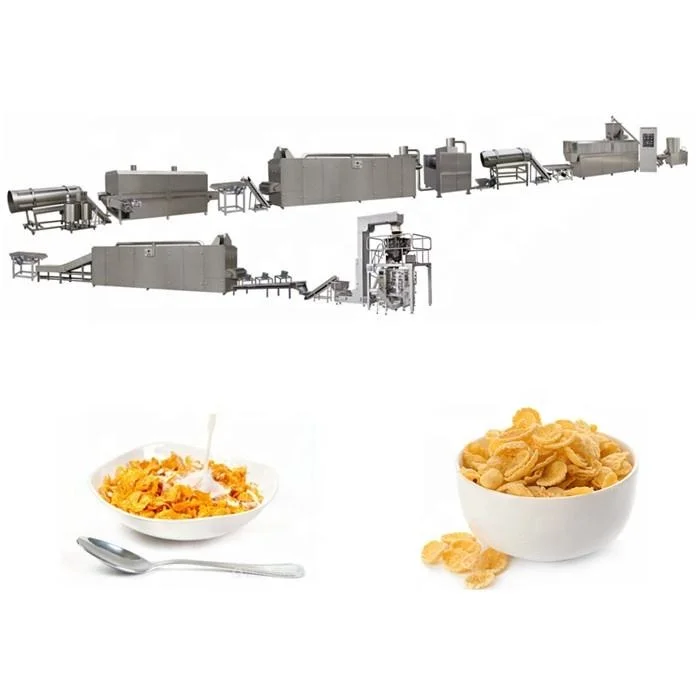
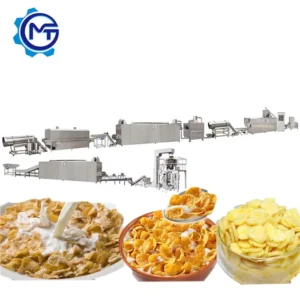
MT75 Corn Flake Production Line, 300-500 kg/hr, Twin-Screw Extrusion, PLC Control — engineered as a single turnkey project from batching through extrusion, flaking, roasting, coating and packing. Every station is throughput-matched so rated capacity holds on your actual corn or multi-grain recipe rather than a nameplate figure. Screw configuration and die design are specified to your raw material and target flake density.
- Line layout, capacity calculation and trial run report provided before shipment
- Voltage, frequency and PLC language confirmed to destination market
- On-site installation, commissioning and operator training included
Description
Throughput-Matched Engineering — Every station on the MT75 corn flake line is sized against your actual grain recipe, not a generic nameplate figure, so rated output holds from mixing through packing.
Technical Specifications
| Parameter | Value |
|---|---|
| Product Type | Corn Flake Production Line |
| Model | MT75 |
| Extruder Type | Twin Screw (MT-75) |
| Installed Power | 210 kW |
| Power Consumption | 150 kW |
| Output Capacity | 300–500 kg/hr (basis not stated in source — confirm raw material, moisture, flake thickness) |
| Extruder Capacity | 200–300 kg/hr (basis not stated in source — confirm raw material and moisture) |
| Overall Dimensions (L×W×H) | 45 × 1.5 × 3.5 m |
| Control System | PLC control (flaking station), MCC line control |
| Flaking Machine Drive | Double motors with hydraulic roller system |
| Roasting Oven Heating | Hot air with conciliation burner, dual circulating fans, cyclone dust removal |
| Dryer Heating Source | Gas or electric |
| Coating System | Double tumble sugar melting, elevator, coating drum, spraying nozzle |
| Line Stations | Mixing → Extruding → Flaking → Drying → Hot Air Roasting → Sugar Coating → Drying → Cooling → Packing |
| Raw Materials | Corn, rice, wheat, oat, barley powder |
| Final Product Shapes | Natural flakes, sugar-coated flakes; adjustable extruder shapes (ball, tube, stick, ring, fruit loop, star, wheel, flower, heart) |
| Screw Construction | Wear-resistant alloy, special technology |
| Lubrication | Automatic lubricating system on extruder |
| Standards | CE, ISO |
Application Suitability
| Application | Material or Output |
|---|---|
| Natural corn flake breakfast cereal production | Corn flour or grits at controlled moisture |
| Sugar-coated corn flake SKU launch | Corn base with sugar tumble coating stage |
| Multi-grain flaked cereal expansion | Rice, wheat, oat, or barley flour blends |
| Turnkey breakfast cereal plant installation | Full line from batching to packing, single supplier |
| Fortified breakfast cereal production | Vitamin-mineral premix blended at mixing station |
What "300–500 kg/hr" Leaves Out About Corn Flake Line Sizing
A line rated at 300–500 kg/hr means nothing until you confirm the grain type, incoming moisture, and target flake thickness it was measured on.
Last year I configured a corn flake line for a Middle East buyer who ordered based on brochure capacity. Their corn flour was coarser than the test standard, which caused uneven flake thickness at the roller station and nearly doubled the breakage rate after roasting. The line stopped repeatedly for sifting. That corn flakes production line turnkey project only stabilized after we re-ran trials with their actual flour and adjusted the screw profile and roller gap. [NEED_CITE: effect of corn grit particle size on extrudate uniformity in twin-screw processing]
Buyers often compare lines on a single capacity number, but the extruder, flaker, dryer, and roaster each have their own throughput ceiling. When those stations come from different vendors, one bottleneck silently caps the whole line well below the quoted figure.
Station-by-Station Throughput Matching
A corn flakes production line turnkey system lives or dies on whether each station can sustain the same mass flow. The MT75 uses a twin-screw extruder feeding a PLC-controlled flaking station with hydraulic double rollers, then a hot-air roaster with dual circulating fans. If the flaker cannot keep pace with the extruder, material backs up and moisture migrates unevenly through the sheet. Every motor, belt width, and drying zone length on this line is specified so the rated mass flow carries through from the mixer to the packing scale without one station throttling the next.
Screw Configuration Tuned to Your Grain Blend
Corn, rice, oat, and barley each gelatinize at different barrel temperatures and require distinct screw element sequences. A configuration built for pure corn will under-cook an oat-heavy blend, leaving raw starch centres that shatter during roasting. On this line, screw elements and die geometry are selected after reviewing the buyer’s exact flour blend and target flake density. The in-house testing workshop runs the buyer’s own raw material before the extruder is finalized for production, catching mismatches that would otherwise surface only after installation. [NEED_CITE: twin-screw extruder screw element arrangement for varying starch sources]
Reading the Power and Drive Specifications
The 210 kW installed power and 150 kW running consumption tell you the transformer capacity and cable sizing required at the site. The double-motor flaking drive with a hydraulic roller gap gives independent torque to each roller, which keeps flake thickness consistent even when feed moisture varies between batches. The roaster’s conciliation burner with dual circulating fans and a cyclone dust collector controls surface blistering without scorching the edges — a detail that separates a crisp, bowl-ready flake from one that disintegrates in milk. Automatic lubrication on the extruder reduces unplanned stops during continuous shifts.
The Hidden Cost of Skipping the Trial Run
Lines shipped without a factory trial run push all product development to the buyer’s floor, where raw material waste, utility hookups, and production schedules collide. When the first batch reveals the wrong density or coating adhesion, the buyer pays for engineer flights, replacement parts, and lost shelf space. [NEED_CITE: typical commissioning delays when extrusion trial runs are deferred to site]
Why Source This Corn Flake Line Here
- Single-supplier integration — Every station from mixer to packer is built and tested under one roof, eliminating vendor-to-vendor finger-pointing when throughput falls short.
- In-house testing workshop — Your corn, rice, or oat flour is extruded and flaked before shipment, generating a trial run report that locks the screw and die configuration to your recipe.
- PLC and MCC documentation — Electrical schematics, voltage confirmations, and HMI language files are verified against the destination market before crating.
- Throughput-matched design — Motor ratings, roller widths, and drying zone lengths are calculated together, not copied from a catalogue of standalone machines.
- Post-delivery support — On-site installation, operator training, and a documented wear-parts list for screws, dies, and roller surfaces keep the line running past the first production season.
Documentation & Verification
- Line layout and capacity calculation matched to your corn or multi-grain recipe
- Screw and die configuration record tied to target flake density and shape
- Factory trial run report on your actual flour blend before dispatch
- Electrical schematic with voltage, frequency, and PLC language confirmed for your market
- CE declaration of conformity and ISO certificate for customs and regulatory filing
Installation, Commissioning & Support
- 45 m line length requires clear floor span with level concrete slab and anchor points
- 210 kW installed power needs dedicated transformer tap and MCC panel at site
- Line ships in sectional modules for container loading and on-site reassembly
- First-run parameter setting covers barrel zones, roller gap, and roaster temperature
- Operator training includes PLC fault diagnostics and HMI language navigation
- Wear-parts list covers screws, dies, roller shells, and fan belts with reorder codes
What to Share Before Quoting
To size each station correctly, we need your exact flour type and particle size distribution, target flake thickness and density, daily output goal in kilograms, workshop length and ceiling height, and local voltage and frequency. If you are adding this line alongside existing packing or storage systems, share the upstream and downstream interface points so the layout integrates without rework.
Frequently Asked Questions
Q: How is the 300–500 kg/hr capacity verified before the line ships?
A: We run your actual corn or multi-grain flour through the extruder and flaker in our testing workshop, measuring output at the target moisture and flake thickness. The trial run report documents the sustained mass flow at each station, and the screw configuration is locked to those results before production begins.
Q: How do you prevent station bottlenecks across the full line?
A: Each station — extruder, flaker, dryer, roaster, coater, cooler — is sized on the same mass-flow calculation rather than sourced independently. Motor ratings, belt widths, and drying zone lengths are cross-checked so no single station caps throughput below the line’s rated capacity.
Q: What electrical and control details are confirmed before dispatch?
A: We verify your site voltage, frequency, and phase against the motor and heater specifications, and configure the PLC and HMI in your preferred language. Electrical schematics and a wiring diagram ship with the line, and the MCC panel layout matches your facility’s power distribution plan.
Q: Can the same line produce natural and sugar-coated flakes?
A: Yes. The coating station includes a double tumble sugar melter, elevator, coating drum, and spray nozzle that can be bypassed for natural flake runs. Shape changes — ball, tube, ring, fruit loop — are handled by swapping the extruder die, and multi-grain blends are managed through screw configuration adjustments.
Q: What support is included after the line arrives at our facility?
A: Our engineers handle on-site installation, utility hookup verification, and commissioning runs with your raw material. Operator training covers PLC operation, routine maintenance, and troubleshooting. A documented wear-parts list for screws, dies, and roller surfaces is provided so replacements can be ordered before the first scheduled changeover.
Related products
-
1000 Lbs Automatic Corn Flakes Production Line Mixer Breakfast Cereal Corn Flakes Production Line
¥45,000.00 Select options This product has multiple variants. The options may be chosen on the product page -

Small Scale Breakfast Cereal Manufacturing Machine for Corn Flakes Process Line
¥45,000.00 Select options This product has multiple variants. The options may be chosen on the product page -
Corn Flakes Machine Breakfast Cereal Corn Flakes Production Line Cornflakes Making Machine
¥85,800.00 Select options This product has multiple variants. The options may be chosen on the product page -
Sweet Corn Flakes Maize Breakfast Cereal Full-automatic Food Grade Stainless Steel Heat Exchanger Mixer Fryer Processing Line
¥8,000.00 Add to cart