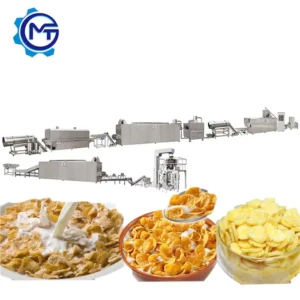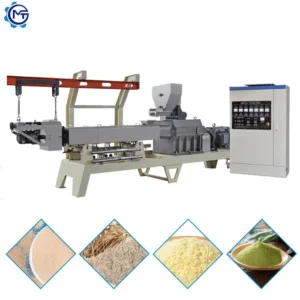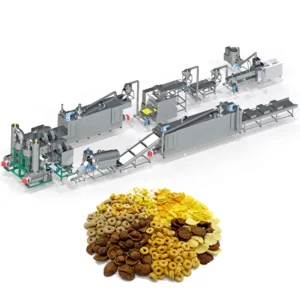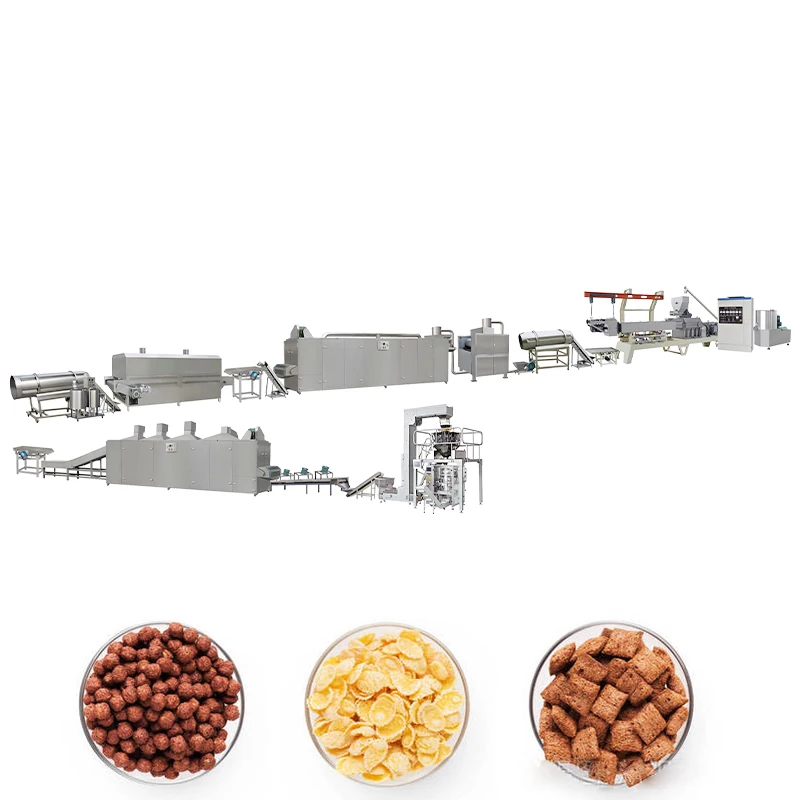


MT-65 / MT-70 / MT-85 / MT-75 Corn Flakes Production Line, Twin-Screw Extruder, PLC Control — engineered as one integrated turnkey project where every station from batching through packing is throughput-matched to eliminate bottlenecks.
- Screw configuration and die design specified to your grain formulation and target flake density
- Water-cooled cast iron flaking rollers with adjustable gap for precise thickness control
- Hot air roaster up to 400 °C for consistent puffing and blister formation
Complete line layout, capacity calculation, and trial run on your raw material performed in-house before shipment — single-source accountability from design through commissioning.
Description
Throughput-matched stations — Every unit from the mixer to the vertical packing machine is sized so that material flows without waiting or backing up on the conveyor between the flaker and the dryer.
Technical Specifications
| Parameter | Value |
|---|---|
| Product Type | Corn Flakes Breakfast Cereal Production Line |
| Model | MT-65 / MT-70 / MT-85 / MT-75 |
| Extruder Type | Twin Screw |
| Installed Power | 84 kW (MT-65) / 132 kW (MT-70) / 239 kW (MT-85) / 186 kW (MT-75) |
| Real Power | 59 kW (MT-65) / 92 kW (MT-70) / 167 kW (MT-85) / 140 kW (MT-75) |
| Output Capacity | 120–150 kg/h (MT-65) / 200–250 kg/h (MT-70) / 300–400 kg/h (MT-85) / 400–500 kg/h (MT-75) (basis not stated in source — confirm raw material formulation, moisture content and flake thickness) |
| Overall Dimensions (L×W×H) | 21000×1200×2200 mm (MT-65) / 23000×1500×2200 mm (MT-70) / 28000×3500×4300 mm (MT-85) / 24000×1500×2800 mm (MT-75) |
| Control System | PLC with real-time data storage, monitoring, alarm and reminder functions |
| Flaking Machine Roller Material | Cast iron rollers, 45# steel shaft, carbon steel frame |
| Flaking Machine Roller Gap | Adjustable (determines final flake thickness) |
| Flaking Machine Cooling | Integrated water cooling system |
| Hot Air Roaster Max Temperature | Up to 400 °C |
| Hot Air Roaster Heating Source | Electric or gas (configured per site utility) |
| Dryer Layers | Three, five, or seven mesh belt layers |
| Dryer Heating Method | Electric or gas |
| Dryer Mesh Belt Speed | Adjustable |
| Sugar Spraying System Total Power | 28.75 kW |
| Sugar Spraying System Roller Size | Ø600 × 2700 mm |
| Packing Machine Options | Model 420 / 520 / 620 / 720 vertical automatic with combination head weigher |
| Nitrogen Flushing | Optional |
| Standards | CE |
Application Suitability
| Application | Material or Output |
|---|---|
| Corn flakes and maize flakes | Corn grits, corn flour |
| Multi-grain breakfast cereal | Blends of corn, rice, wheat, oat, barley |
| Sugar-coated and plain cereal flakes | Sugar syrup coating on extruded and flaked grain pellets |
| Fortified nutrition programme cereal | Grain blends with added vitamin and mineral premix |
| Vegan breakfast cereal | Plant-based grain formulations without dairy or animal-derived ingredients |
Why the Extruder-to-Dryer Gap Ruins More Lines Than Bad Recipes
Matching throughput at every station is what keeps a corn flakes production line turnkey in practice, not just on paper.
I once watched a breakfast cereal line in Shandong where the extruder pushed material faster than the dryer could handle. Flakes piled up on the transfer belt, cooled unevenly, and clumped into unusable lumps before reaching the roaster. The entire batch was scrapped. When stations are sourced from different vendors, nobody takes responsibility for that gap. The extruder supplier says their machine hits the rated output. The dryer supplier says their unit handles the stated load. But nobody calculated what happens in between — the moisture content entering the dryer, the belt speed required, the residence time at a given temperature [NEED_CITE: thermal residence time requirements for grain flake drying]. A corn flakes production line turnkey project only works when one team owns every handoff point.
Station Sequencing and the Logic Behind Each Handoff
The line follows a deliberate sequence: mixer, screw conveyor, twin-screw extruder, air conveyor, dryer, hoister, flavoring drum with oil sprayer, cooling machine, and packing machine. Each station is positioned so that material temperature and moisture level are correct when the product arrives at the next stage. After extrusion, the cooked dough pellets must cool slightly before flaking, but not so much that they harden beyond what the cast iron rollers can press. Getting this sequence right is what defines a reliable corn flakes production line turnkey installation.
Phased Installation and Utility Planning Before the First Bolt Goes Down
Before any machine leaves the factory, the layout must account for utility drops — electrical circuits for the extruder motor, gas lines for the roaster if the site runs on gas heating, compressed air for pneumatic gates, and water supply for the flaker cooling loop. I have seen projects stall for weeks because a gas line was not stubbed out to the roaster position, forcing temporary electric heating that could not reach the temperatures needed for proper blister formation on the flakes [NEED_CITE: industrial gas and electric utility planning for food processing plants]. Utility planning is part of the turnkey scope, not an afterthought handed to the buyer’s local contractor.
Reading the Specs That Actually Matter on a Cereal Line
The twin-screw extruder sits at the heart of this line, and its screw configuration determines how thoroughly the starch in the corn or multi-grain blend gelatinises. Barrel temperature profiles across multiple heating zones control the cook, and the PLC system stores those profiles so that each production run starts from a known baseline rather than an operator’s guess. The adjustable-gap flaking machine uses water-cooled cast iron rollers because flake thickness directly affects how the roaster performs — a thicker flake needs more residence time at higher temperature to achieve the same crispness. The hot air roaster reaching up to 400 °C is what creates the characteristic blisters on a corn flake surface; without that thermal shock, the flake comes out dense and flat. Mesh belt dryers available in three, five, or seven layers give you flexibility on drying capacity to match the upstream extruder output.
The Cost of Treating Each Station as a Standalone Purchase
When equipment is assembled from separate suppliers, the flaking machine may have a capacity range that does not overlap with your extruder output. The roaster may not reach the temperature your product requires. The sugar spraying system — rated at 28.75 kW with a Ø600 × 2700 mm roller — may apply coating faster than the downstream dryer can set it. These mismatches do not show up in quotations. They show up on the first production day when material backs up, temperatures drift, and operators improvise settings that nobody documented. Fixing those problems after installation costs far more than specifying them correctly during the layout phase [NEED_CITE: cost of post-installation line modification versus pre-shipment configuration].
Why Sourcing the Full Line from One Project Scope Changes the Outcome
Every station on this corn flakes line is specified under a single project layout, so the mixer batch size, extruder screw speed, flaker gap, roaster temperature, and dryer belt speed are all calculated against the same target output. Screw and die configurations are set to the buyer’s specific grain blend and target flake texture, not copied from a generic build. An in-house testing workshop runs trial production on the buyer’s actual raw material before shipment, so product development does not start from zero on installation day. Electrical schematics confirm voltage and frequency against the buyer’s site utility before the control panels are wired. Documentation covers line layout, capacity calculation, screw configuration records, and trial run reports — the paperwork that matters when a third-party inspector or a nutrition programme auditor asks for traceability.
Documentation & Verification
- Line layout drawing showing throughput matching across all stations from batching to packing
- Screw and die configuration record matched to your grain blend and target flake density
- Trial run report produced on your actual raw material in the testing workshop before dispatch
- Electrical schematic with voltage and frequency confirmed against your site utility specification
- CE declaration of conformity covering the complete assembled line
- Operation and maintenance manual with wear parts list specific to your line configuration
Installation, Commissioning & Support
- Foundation and floor space planned around the full line length, up to 28000×3500×4300 mm for the MT-85 configuration
- Dedicated electrical circuits sized for installed power up to 239 kW on the MT-85 extruder station
- Water cooling loop connected to the flaking machine cast iron rollers before first production run
- PLC control parameters loaded with trial run profiles from pre-shipment testing on your raw material
- Operator training covering screw configuration changes, flaker gap adjustment, and roaster temperature profiles
- Wear parts list supplied for twin-screw elements, die plates, and flaker roller surfaces
What to Prepare Before Requesting a Line Proposal
To scope a corn flakes production line turnkey project properly, share your target grain formulation — whether straight corn grits or a multi-grain blend with rice, wheat, oat, or barley — along with your target flake thickness and whether you need sugar coating. Provide your site voltage and frequency, available gas supply if you prefer gas-fired roasting and drying, and the floor area and ceiling height of your production hall. If you have existing upstream or downstream equipment that the new line must connect to, include those specifications so the layout accounts for the integration points.
Frequently Asked Questions
Q: How is line capacity verified against my specific grain formulation and target flake thickness?
A: Before shipment, a trial run is conducted in the in-house testing workshop using your actual raw material at your specified moisture content. The extruder screw configuration, die design, and flaker gap are set to match your target flake density and thickness. Results are documented in a trial run report that travels with the shipment.
Q: What utility planning is confirmed before production starts?
A: Voltage, frequency, and control language are confirmed during the specification stage. Gas supply requirements for the roaster and dryer are calculated based on your selected heating method. Compressed air demand for pneumatic gates and water flow for the flaker cooling loop are included in the utility layout before the line enters production.
Q: How are stations throughput-matched so downstream equipment does not bottleneck the extruder?
A: Each station is sized during the layout phase against the same target output. The dryer capacity, roaster residence time, sugar spraying roller speed, and cooling conveyor length are all calculated so that material flows continuously without queuing between the extruder and the packing machine.
Q: What does the installation and commissioning schedule look like for a complete cereal line?
A: Installation follows a phased sequence — extruder and flaker first, then dryer and roaster, then coating and packing stations. Commissioning starts with individual station testing, progresses to linked-station dry runs, and finishes with full-line production trials using your raw material. Operator training runs alongside the final commissioning stage.
Q: What operator training and documentation are included at handover?
A: Training covers PLC operation, screw and die changeover procedures, flaker gap adjustment, roaster temperature control, and routine maintenance intervals. Documentation includes the line layout, capacity calculation, screw configuration record, electrical schematic, trial run report, and a wear parts list specific to your configuration.
Related products
-
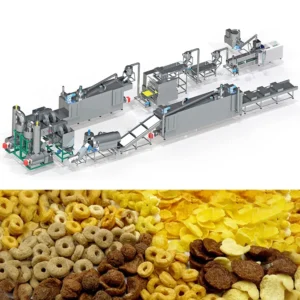
Automatic Instant Breakfast Cereals Snack Food Making Machine
¥10,000.00 Select options This product has multiple variants. The options may be chosen on the product page -
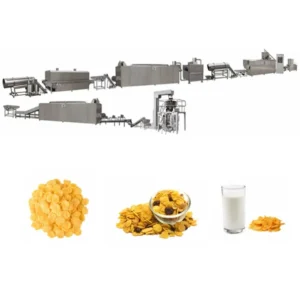
Cereals Corn Flakes with Sugar Corn Flakes Extrusion Food Machine Breakfast Cereal Production Line
¥23,000.00 Select options This product has multiple variants. The options may be chosen on the product page -
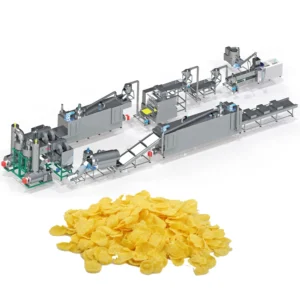
New Automatic Cornflakes Making Machine Oats Snack Food Chips Extruder Processing Line
¥30.00 Select options This product has multiple variants. The options may be chosen on the product page -
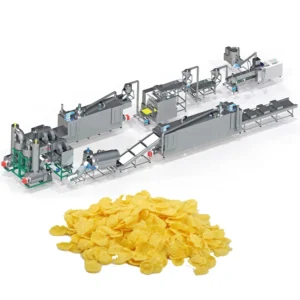
Complete Corn Flakes Production Line Breakfast Cereal Processing Machine Core Motor Component Cornflakes Processing Equipment
¥19,000.00 Select options This product has multiple variants. The options may be chosen on the product page