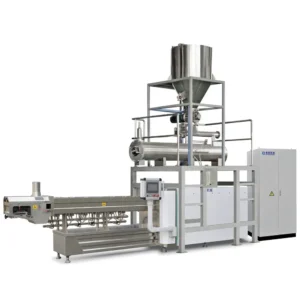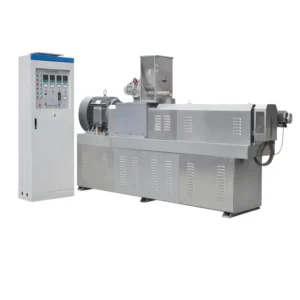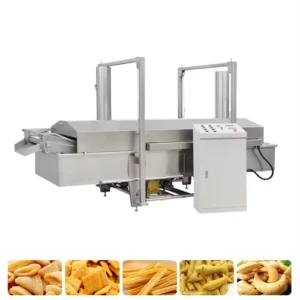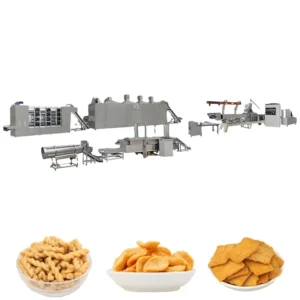
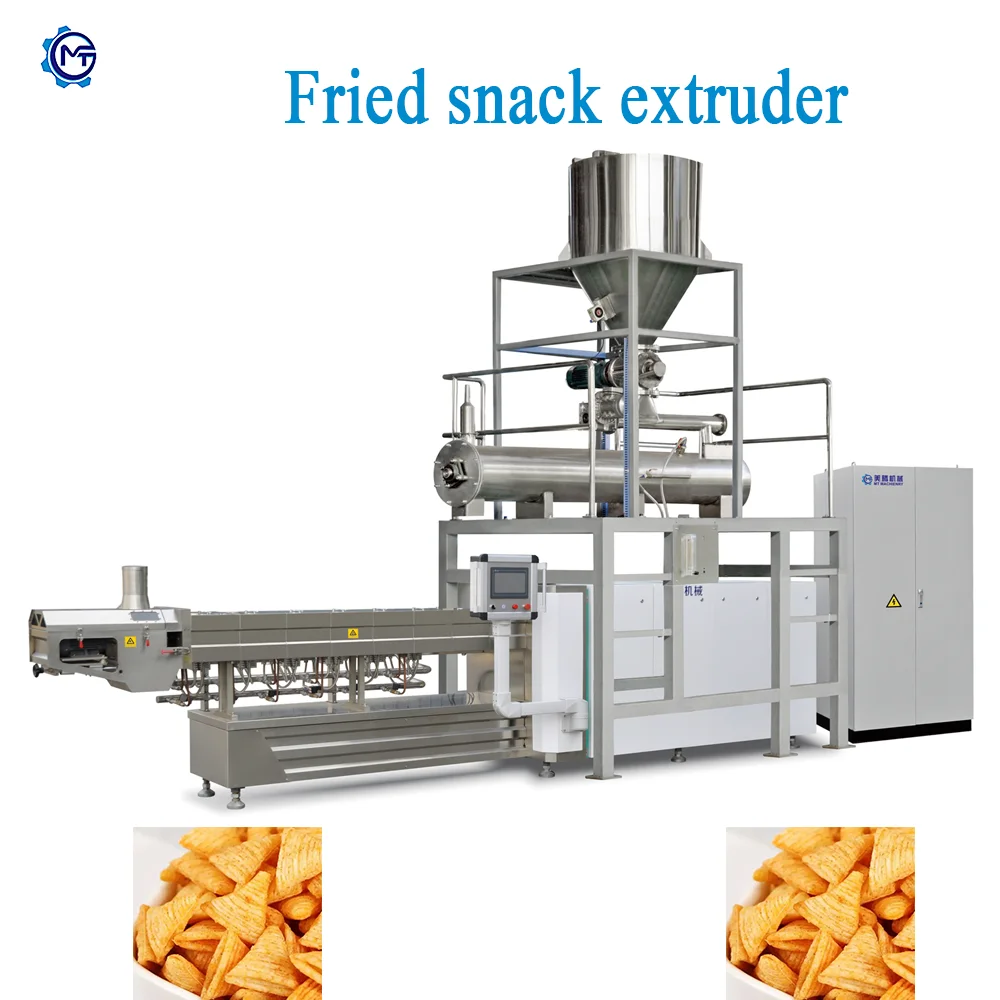


MT65 / MT70 / MT85 / MT75 / MT95 Fried Bugles Snack Production Line, Twin-Screw Extrusion, Continuous Fryer 0–260 °C, PLC & MCC Control — complete turnkey layout from batching through frying, seasoning to packing.
- Screw configuration and die design matched to your flour formulation and target shape (bugles, tortilla chips, 3D pellet forms)
- Fryer throughput balanced to extruder output, eliminating line bottlenecks
- Voltage, frequency and control language confirmed to your facility before build
In-house trial runs on your raw material verify capacity and product density before shipment, backed by full line layout documentation and on-site commissioning support.
Description
Capacity-Matched Line Design — We verify throughput across mixing, extrusion, frying and packing before build, using your actual recipe and moisture content rather than quoting nominal figures that collapse on real raw material.
Technical Specifications
| Parameter | Value |
|---|---|
| Model | MT65 / MT70 / MT85 / MT75 / MT95 |
| Product Type | Fried Bugles Snack Production Line (Twin-Screw Extrusion + Continuous Fryer) |
| Screw Type | Twin-screw (Double Screw Extruder) |
| Installed Power | 142 kW (MT65) / 185 kW (MT70) / 240 kW (MT85) / 245 kW (MT75) / 370 kW (MT95) |
| Real Power Consumption | 100 kW (MT65) / 130 kW (MT70) / 180 kW (MT85) / 185 kW (MT75) / 280 kW (MT95) |
| Output Capacity | 120–150 kg/h (MT65) / 200–250 kg/h (MT70) / 300–500 kg/h (MT85) / 400–500 kg/h (MT75) / 800–1000 kg/h (MT95) (basis not stated in source — confirm raw material formulation, moisture content, and product shape) |
| Overall Dimensions (Line) | 22000×1200×2200 mm (MT65) / 24000×1500×2400 mm (MT70) / 26000×1500×2300 mm (MT85) / 26000×1500×2800 mm (MT75) / 30000×1500×2800 mm (MT95) |
| Powder Mixer Output | 300–600 kg/h (basis not stated in source — confirm batch size and mixing cycle) |
| Powder Mixer Tank Volume | 150 kg |
| Powder Mixer Rotary Speed | 385 rpm |
| Powder Mixer Power | 4 kW |
| Fryer Temperature Range | 0–260 °C |
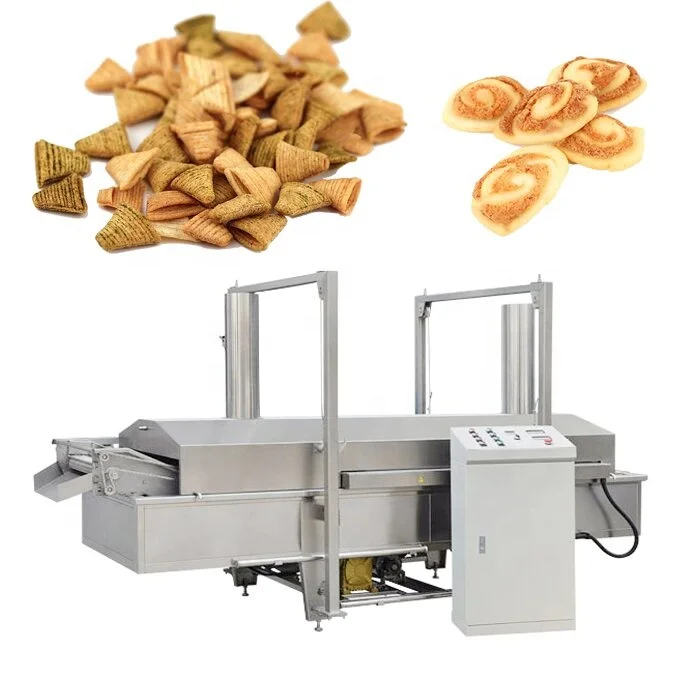
| Fryer Capacity | 200–300 kg/h (basis not stated in source — confirm product moisture and frying time) |
| Fryer Dimension | 4500×1350×2350 mm |
| Flavor Line Output | 400 kg/h (basis not stated in source — confirm seasoning type and coating ratio) |
| Flavor Line Power | 1.5 kW |
| Material | Stainless steel (food-grade contact parts) |
| Control System | PLC and MCC control available |
| Warranty | 1 year complete warranty, life-time maintenance service |
| Standards | CE, ISO |
Application Suitability
| Application | Material or Output |
|---|---|
| Fried bugles (wonderful crisp corners / golden horns) | Corn flour, wheat flour, rice flour, starch blends |
| Tortilla chips and rice crust snacks | Corn masa flour, rice flour formulations |
| 2D and 3D pellet-style fried snacks (small fish crisps, gourd shapes, ducks, Christmas trees, triangles) | Flour-based formulations with varying starch ratios |
| Snack food manufacturers expanding fried puffed formats | Batching through packing complete production |
What "300 kg/h" Leaves Out When Sizing a Fried Bugles Snack Production Line Turnkey
A quoted capacity that ignores upstream moisture and downstream fryer belt speed creates a bottleneck the moment you switch to your actual recipe.
I spent years on factory floors in the Pearl River Delta watching lines stall because someone quoted extruder throughput without asking what the fryer could actually handle. One project for a South American client paired a fast-running extruder with a frying bath sized for low-moisture crisps. The bugles came out dark, oil content exceeded spec, and the entire line had to run below rated speed to compensate. A fried bugles snack production line turnkey only delivers what was promised when the extruder, fryer and seasoning drum are balanced against the same formulation [NEED_CITE: extrusion and frying line capacity matching principles].
Screw Configuration Dictates Density Before the Fryer Sees the Product
The twin-screw extruder is where expansion and moisture reduction begin. Screw configuration and die design are matched to the buyer’s raw material and target shape, whether that is a thin-walled bugle or a solid 3D pellet form. A fried bugles snack production line turnkey that ships with a generic screw build will produce the wrong texture regardless of how well the fryer performs downstream.
Fryer Length and Belt Speed Must Track Extruder Output
The continuous fryer operates across a 0–260 °C range, and its effective capacity depends on product moisture entering the bath, frying time required for target colour and oil absorption, and belt speed. If the extruder pushes more mass than the fryer can carry through at the right residence time, product accumulates or the line slows. The 4500×1350×2350 mm fryer dimension on this line reflects a belt length chosen to match upstream output at a defined moisture level [NEED_CITE: continuous fryer residence time and oil absorption standards for extruded snacks].
Reading the Power and Dimension Specs Across Model Sizes
The installed power scales from 142 kW on the MT65 to 370 kW on the MT95, while real consumption sits noticeably lower — 100 kW to 280 kW respectively — indicating the motors operate below peak load during steady-state running. Line length extends from 22 metres to 30 metres across the range, which matters for facility planning: the full footprint from mixer through packing must fit a single production hall with adequate clearance for maintenance access on both sides. The powder mixer’s 150 kg tank volume and 385 rpm rotary speed suit batch cycles that feed the extruder hopper without interrupting continuous operation, but actual throughput depends on batch formulation density and cycle time. The fryer’s 200–300 kg/h capacity figure carries a basis not stated in source, meaning it should be validated against your specific product moisture and frying duration before the line is finalised.
The Hidden Cost of Skipping Upstream-Downstream Balancing
When extruder output and fryer throughput are not matched on paper before they are matched on the floor, the first sign is usually product quality variation: uneven colour, oil content drifting outside specification, seasoning adhesion failing on surfaces that emerged from the fryer at the wrong temperature. Over time this forces operators to throttle the entire line below its quoted capacity just to maintain consistency. Buyers end up running a machine sized for higher output at a fraction of its potential, paying for capacity they cannot access [NEED_CITE: production line bottleneck analysis in snack food manufacturing].
Why Source the Full Line from One Supplier
Capacity matching across stations is only reliable when one entity designs the entire chain from batching through packing — the extruder, fryer, flavouring drum and cooling conveyor are each sized against the same material balance sheet rather than assembled from independent vendor quotes. Screw and die configurations are specified to the buyer’s raw material and target product shape before production begins, not copied from a previous build. The in-house testing workshop runs trial production on the customer’s own formulation before the line ships, catching density or expansion issues at the factory rather than on the buyer’s floor after installation. Voltage, frequency and control language are confirmed in writing so the PLC and MCC system arrives ready for the local power grid. On-site installation, commissioning and operator training are included, with wear parts such as screws and dies listed and available for first replacement.
Documentation & Verification
- Line layout showing throughput match between extruder, fryer and packing station
- Screw and die configuration record tied to buyer’s flour formulation and target shape
- Trial run report on customer raw material from the in-house testing workshop
- Electrical schematic with voltage, frequency and control language confirmed pre-build
- CE declaration of conformity and ISO certificate for the complete line
- Wear parts list with screw and die replacement schedule
Installation, Commissioning & Support
- Line footprint up to 30000×1500×2800 mm requires level concrete floor with drainage near fryer station
- Installed power up to 370 kW demands dedicated circuit with confirmed local voltage and frequency before wiring
- PLC and MCC control panels configured to buyer’s language and commissioned on-site with operator walkthrough
- Twin-screw extruder screw configuration adjusted during commissioning to match actual raw material behaviour
- Trial run on buyer’s formulation repeated post-installation to validate output against factory test results
- First set of replacement screws and dies shipped with line; reorder process documented in manual
What to Include in Your Inquiry
To size the line correctly, we need your raw material formulation including flour type and moisture percentage, target product shape and density, daily production volume, and the voltage and frequency at your facility. If you have existing upstream or downstream equipment that this line must connect to, share those interface details. Buyers who can send a sample of their actual raw material enable a pre-shipment trial run in the testing workshop.
Frequently Asked Questions
Q: How is line output verified on my actual raw material and recipe before shipment?
A: Your raw material is run through the twin-screw extruder in the in-house testing workshop using the specified screw and die configuration. Product density, expansion and moisture content leaving the extruder are recorded, then fryer residence time is validated against those values. A trial run report ships with the line documenting the results.
Q: How do you ensure fryer capacity matches extruder throughput so neither station bottlenecks the line?
A: The line layout document calculates mass flow from the extruder against the fryer belt speed and residence time required at your product’s moisture level. If the fryer cannot carry the extruder’s full output at the correct frying duration, the fryer length or belt width is adjusted before the order is confirmed.
Q: What voltage, frequency and control language options are available, and how are they confirmed?
A: The PLC and MCC control system is built to your facility’s voltage and frequency. Control language is confirmed in writing before production begins, and the electrical schematic reflects these choices. This avoids commissioning delays caused by mismatched power or unreadable HMI screens.
Q: What does on-site installation, commissioning and operator training include?
A: Engineers supervise uncrating, station alignment and utility connections. The extruder screw configuration is fine-tuned on your raw material, fryer temperature profile is set, and operators are trained on daily start-up, shutdown and cleaning procedures. A signed commissioning record is provided at completion.
Q: Which spare wear parts ship with the line, and how are replacements supplied?
A: A first set of replacement screws, dies and fryer belt sections ships with the line. The wear parts list included in the documentation specifies part numbers and replacement intervals. Reorders are processed through the same supply channel with lead times noted in the manual.
Related products
-
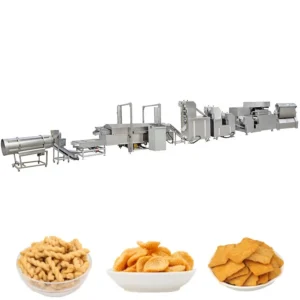
Frying Crispy 3D Corn Bugles Pellets Fried Chips Snacks Food Machine Production Line Bugles Making Extruder
¥100.00 Select options This product has multiple variants. The options may be chosen on the product page -
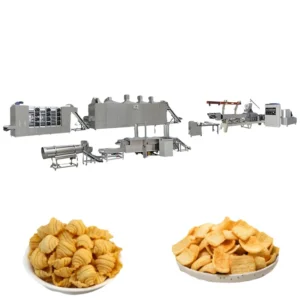
New Doritos Chips Frying Equipment Machine Automatic Tortilla Corn Chips Making Line Portable High Productivity
¥100.00 Select options This product has multiple variants. The options may be chosen on the product page -

Electric Heating Fried Puffed Food Production Line – Salad Sticks Making Equipment
¥65.00 Select options This product has multiple variants. The options may be chosen on the product page -
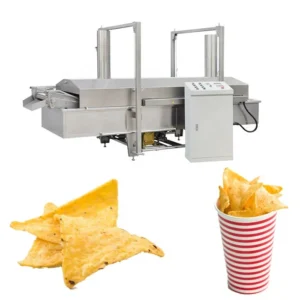
New Fully Automatic Large Capacity 304 Stainless Steel Savory Frying Snack Production Line Crisp Bugles Chips Processing Machine
¥30.00 Select options This product has multiple variants. The options may be chosen on the product page