

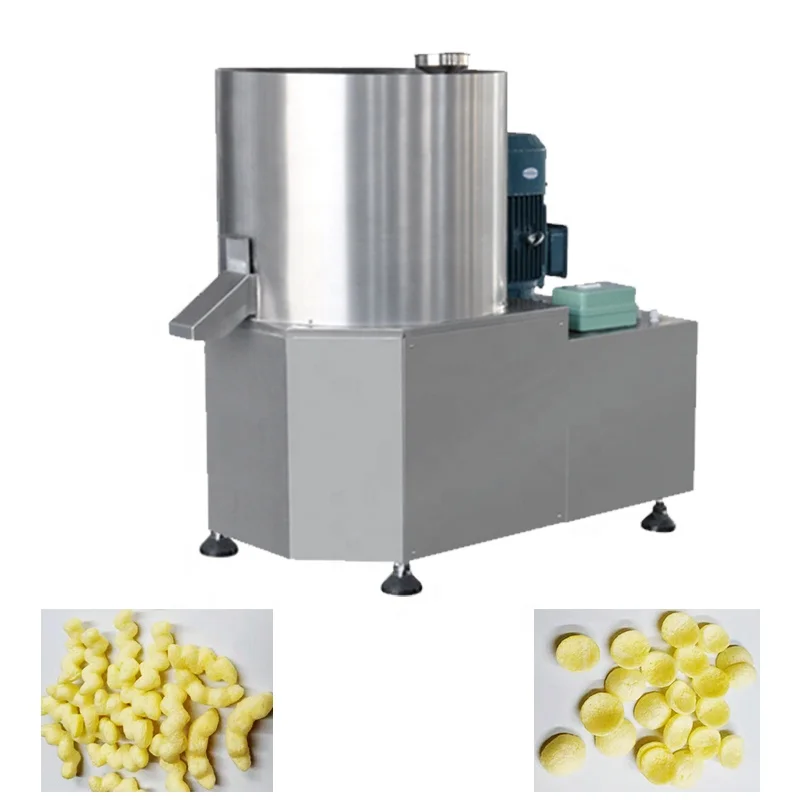
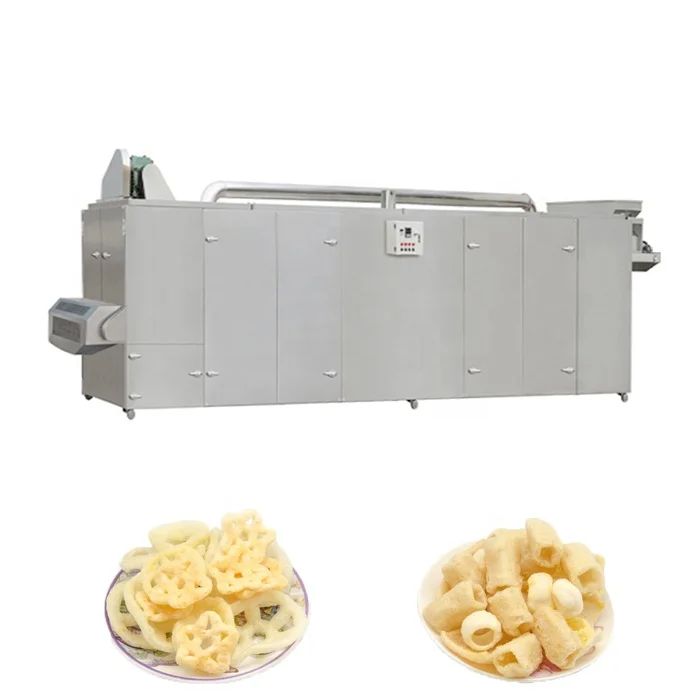
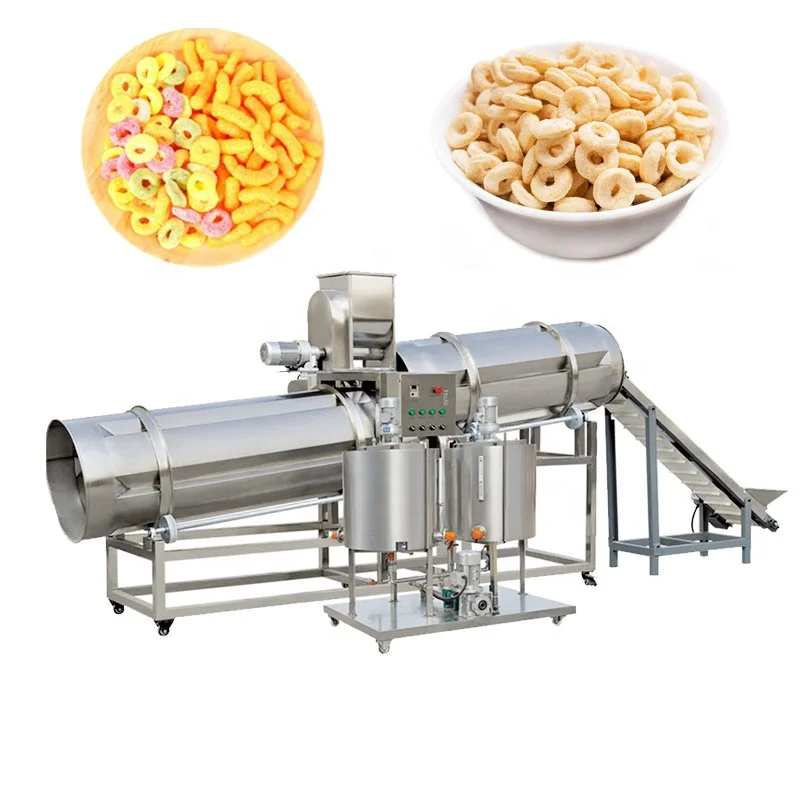
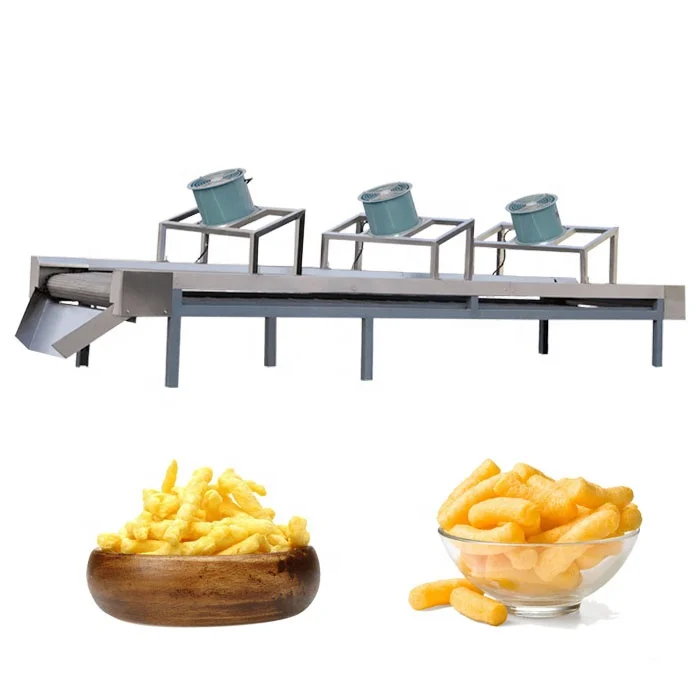
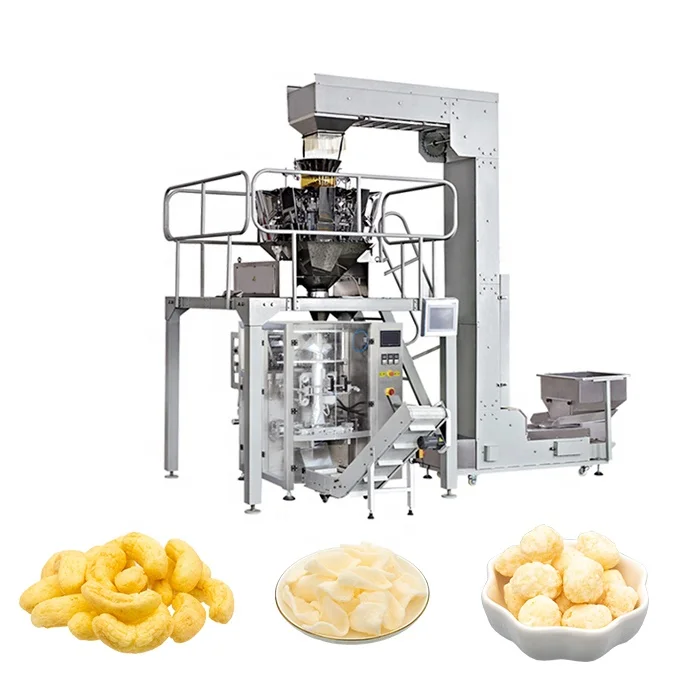
Twin Screw Puffed Snack Food Extrusion Line, 380V/50Hz, Food Grade SS 201/304 — delivers integrated processing from mixing through extrusion, drying, flavouring to packing for corn, rice, wheat, and maize-based snacks.
- Screw configuration and die design matched to cereal type and target texture, controlling expansion and density
- Multi-station throughput balancing prevents bottlenecks between extruder, dryer, and flavouring drum
- Flexible energy options: electricity, gas, diesel, or steam based on site utility conditions
Complete line layout, capacity calculation, and in-house trial runs on your raw material provided before shipment.
Description
Integrated line throughput balance — every station from mixer through roaster and packing is sized against your cereal feedstock, so the extruder never starves and the dryer never floods.
Technical Specifications
| Parameter | Value |
|---|---|
| Product Type | Twin Screw Puffed Snack Food Extrusion Line |
| Screw Type | Twin-screw (double screw extruder) |
| Line Stations | Mixer → Extruder → Vibration cooler → Roasting machine → Packing machine |
| Energy Options | Electricity, Gas, Diesel, or Steam |
| Rated Power (Electricity) | ~100 kW (source value — verify against manufacturer catalog) |
| Rated Power (Gas/Diesel) | ~50–60 kW (source value — verify against manufacturer catalog) |
| Voltage & Frequency | 380V/50Hz (three phase); 220V/50Hz (single phase); customizable to local voltage |
| Contact Material | Food grade stainless steel 201/304 |
| Motor Brand | Siemens (China) or China top brand; Delixi or Delta inverter |
| Die Configuration | Interchangeable moulds for various shapes |
| Dryer Type | Multi-layer belt dryer, length and layer configurable per product |
| Flavoring System | Semi-automatic or automatic; supports sugar, oil, and powder seasoning |
| Certification | CE |
Application Suitability
| Application | Material or Output |
|---|---|
| Puffed corn and maize snack production | Corn grits, maize flour, whole corn meal |
| Rice puff and cereal puff processing | Rice, millet, brown rice, buckwheat |
| Wheat-based extruded snack formats | Wheat flour, wheat grits, blended cereals |
| Core-filled snack production | Chocolate, cream, fruit filling injected post-extrusion |
| Sheet snack and cereal bar formats | Cereal doughs formed via interchangeable moulds |
Why the Line Capacity Quote Often Fails at Startup
A puffed snack food extrusion production line turnkey only holds its rated output when every station is matched to your actual cereal blend, not a generic test flour.
I worked with a buyer last year who sourced a corn chip line quoted at a nominal throughput — but that figure was established on wheat flour. When he ran full corn meal through the extruder, starch gelatinisation dropped and forming yield fell sharply, bottlenecking the entire line at the twin-screw stage. The dryer ran half-empty while the extruder struggled. That mismatch cost him weeks of reconfiguration. [NEED_CITE: starch gelatinisation requirements differ across cereal types]
The lesson was clear: before any quotation goes out, the raw material ratio has to be confirmed and a trial run on that exact feedstock has to happen in the testing workshop. A puffed snack food extrusion production line turnkey quoted on assumed materials is not a quote — it is a guess.
Matching Screw Configuration to Your Cereal Feedstock
The twin-screw extruder in this puffed snack food extrusion production line turnkey accepts configurable screw and die setups matched to your cereal type. Rice and millet behave very differently under shear than corn or wheat — each demands a specific screw pitch, compression ratio, and barrel temperature profile. A generic screw build copied from a standard catalogue will produce inconsistent expansion or fail to reach the gelatinisation threshold your product requires. The configuration is therefore specified after reviewing your raw material data sheet and confirmed through an in-house trial.
Throughput Balance Across Every Station
An extruder running at full output means nothing if the downstream dryer cannot handle the volume or the flavouring drum cannot coat evenly at that feed rate. Each station — mixer, extruder, vibration cooler, roasting or drying unit, flavouring system, and packing — is sized so that throughput is balanced end to end. The multi-layer belt dryer length and layer count are configurable to match the moisture removal rate your specific product demands, preventing a common bottleneck where wet product backs up between extrusion and drying. [NEED_CITE: throughput mismatch between extruder and dryer in snack lines]
Reading the Specs That Actually Matter
The twin-screw design gives this line a wider processing window than single-screw extruders, handling high-fat and high-moisture cereal blends without surging. Interchangeable moulds allow producers to switch between puffed shapes, core-filled formats, and sheet snacks on the same extrusion platform, though each changeover requires matching die pressure to the new product geometry. The energy options — electricity, gas, diesel, or steam — let buyers align the line with site utility conditions rather than forcing expensive electrical upgrades. Voltage and frequency are confirmed against the buyer’s local grid before production begins, avoiding commissioning delays caused by incorrect motor windings or control panel incompatibility.
The Hidden Cost of Skipping the Trial Run
Buyers who waive the pre-shipment trial run to save time often discover texture, density, or expansion problems only after installation. By then, the line is bolted to the floor, utilities are connected, and every adjustment costs production days. A floating snack that sinks or a corn chip that breaks during packing points back to screw configuration and die selection — variables that should have been locked down on the buyer’s own raw material before the equipment left the factory. [NEED_CITE: post-installation reconfiguration costs in extrusion lines]
Why Sourcing This Line from MT Machinery
Every station from batching through packing comes from one supplier, so throughput is matched across the line rather than assembled from separate vendors who shift blame when bottlenecks appear. Screw configuration and die design are specified to the buyer’s raw material and target product shape, not pulled from a generic build sheet. The in-house testing workshop runs your actual cereal blend before shipment, generating a trial run report that documents expansion, texture, and forming yield. Twin-screw expertise spans puffed snacks, core-filled formats, and sheet snack applications within the same platform. Pre-sales consultation covers line layout, utility planning, and phased installation scheduling through to operator training.
Documentation & Verification
- Line layout and capacity calculation specifying throughput at every station against your cereal blend
- Screw and die configuration record documenting the exact setup for your target snack shape
- Trial run report on your raw material performed in the testing workshop before shipment
- Electrical schematic with voltage, frequency, and control language confirmed to your site
- CE declaration of conformity and ISO certificate available for customs and regulatory submission
- Wear parts list with reorder codes for screws, dies, and seals
Installation, Commissioning & Support
- Foundation and floor space plan matched to the full station sequence from mixer to packing machine
- Dedicated electrical circuit planning for ~100 kW rated power or gas/diesel supply routing
- Assembly guidance covering vibration cooler alignment and multi-layer belt dryer tensioning
- First-run parameter setting including barrel temperature profile and screw speed calibration
- Operator training on die changeover procedures and flavouring system adjustment
- Wear parts supply covering replacement screws, dies, and seals for the twin-screw extruder
What to Share with Your Inquiry
To configure a puffed snack food extrusion production line turnkey that holds its capacity on your actual feedstock, share your cereal type and blend ratio, target product shape and density, daily output requirement, factory floor dimensions, and local voltage and frequency. If you plan to run multiple formats — puffed, core-filled, or sheet snacks — list every SKU so die and screw configurations can be specified for each.
Frequently Asked Questions
Q: How is line capacity verified against my specific raw material and moisture content?
A: Before quotation, we review your cereal blend data sheet and run a trial in the testing workshop using your actual raw material. The trial run report documents expansion rate, texture, and forming yield at your specified moisture level, and the capacity figure in the quotation reflects those tested conditions — not a generic flour benchmark.
Q: What is the phased installation and commissioning schedule for a complete turnkey line?
A: Installation proceeds station by station following a pre-agreed schedule — foundation work, mechanical assembly, utility connections, then individual station testing before full-line commissioning. The timeline depends on your site readiness, utility availability, and the number of product formats being commissioned.
Q: How is throughput matched between extruder, dryer, and flavouring stations?
A: Each station is sized during the layout phase based on your target output and product moisture curve. The multi-layer belt dryer length and the flavouring drum capacity are calculated so neither starves nor floods at the extruder’s confirmed throughput on your raw material.
Q: What utility planning is required before equipment arrives on site?
A: You need to confirm electrical voltage and frequency, gas or diesel supply pressure if applicable, steam boiler capacity, water supply for cooling, and compressed air availability. The electrical schematic and utility requirement sheet provided before shipment specify exact values for your site contractor.
Q: Is operator training included, and what documentation is provided at handover?
A: On-site training covers extruder operation, die changeover, flavouring adjustment, and routine maintenance. Handover documentation includes the operation manual, electrical schematic, screw and die configuration record, wear parts list, and the trial run report from your raw material test.
Related products
-

Corn Puff Processing Line with Mixer Fryer Baking Oven Automatic High Productivity Grain Products Snack Making Machine
¥8,300.00 Select options This product has multiple variants. The options may be chosen on the product page -

New Puffed Snack Food Machine Production Line Corn Flake Puff Corn Making Machine Twin Screw Extruder 100-500kg/h Capacity Food
¥8,500.00 Select options This product has multiple variants. The options may be chosen on the product page -

Twin Screw Corn Puffs Extruder Machine Small Corn Snack Food Extruder Machine
¥100.00 Select options This product has multiple variants. The options may be chosen on the product page -

Puffed Snack Food Machine Snack Food Machine Puffed Snack Machine
¥11,050.00 Select options This product has multiple variants. The options may be chosen on the product page


