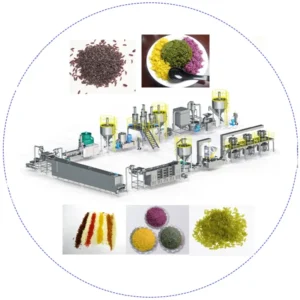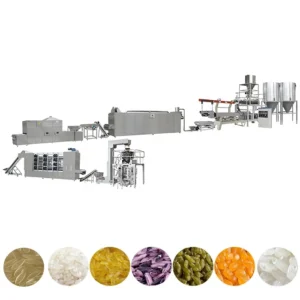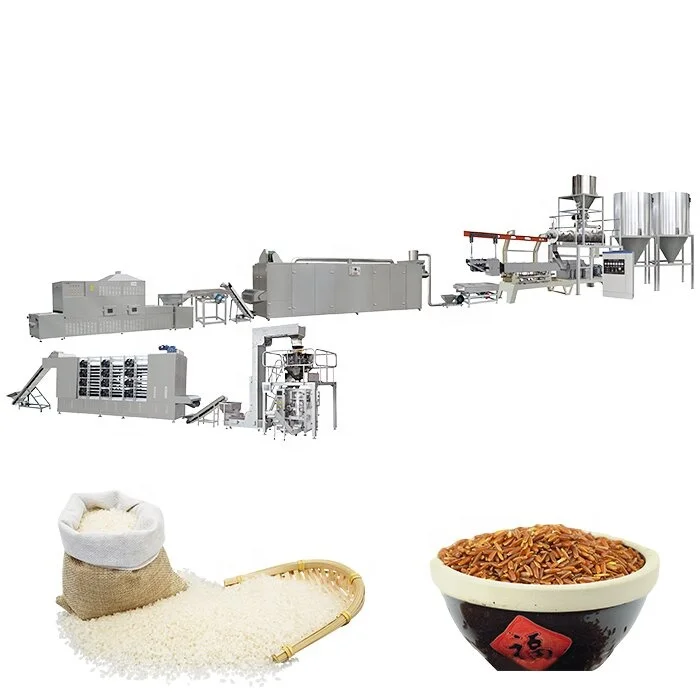


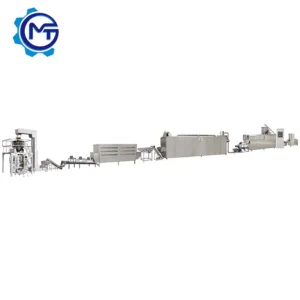
MT65 / MT70 / MT85 / MT75 / MT95 Fortified Artificial Rice Extrusion Line, Twin-Screw, Batching to Packing — configured as a complete turnkey project with throughput matched across every station.
- Single or double screw feeding selected to grain formulation; circulation drying oven with frequency-controlled belt adjusts moisture for kernel integrity
- Five capacity tiers from 80 to 1000 kg/hr allow scaling to the project’s target output
Layout, utility planning, and on-site commissioning are delivered under one supplier so the extruder, dryer, and roaster run balanced from day one.
Description
Integrated Project Engineering — A complete line from batching to packing under one supplier ensures throughput is matched across every station rather than assembled from separate vendors, preventing bottlenecks between the extruder, dryer, and roaster in your fortified artificial rice production line turnkey project.
Technical Specifications
| Parameter | Value |
|---|---|
| Model | MT65 / MT70 / MT85 / MT75 / MT95 |
| Product Type | Fortified Artificial Rice Extrusion Line |
| Screw Type | Twin-screw |
| Feeding System | Single or double screw feeding (selected by material) |
| Control System | Frequency speed controlling, automatic lubrication and cooling |
| Output Capacity | 80–1000 kg/hr depending on model (basis not stated in source — confirm raw material formulation and moisture content) |
| Basic Material | Broken rice, corn, millet, wheat, oats, buckwheat, bean, starch; vitamins and minerals |
| Final Products | Artificial rice, fortified rice kernels |
| Drying Oven Heating | Electric or gas |
| Drying Oven Feature | Circulation drying; frequency motor controls mesh belt speed |
| Line Stations | Mixing → Extruding → Vibrating → Low Temp Drying → Cooling → High Temp Roasting → Cooling → Packing |
| Assembly State | Complete line (batching through packing) |
| Model MT65 | Installed Power 85 kW, Consumption 60 kW, 80–100 kg/hr, 28 × 1.2 × 2.2 m |
| Model MT70 | Installed Power 120 kW, Consumption 85 kW, 100–120 kg/hr, 30 × 1.5 × 2.2 m |
| Model MT85 | Installed Power 235 kW, Consumption 165 kW, 200–300 kg/hr, 34 × 3.5 × 4.3 m |
| Model MT75 | Installed Power 180 kW, Consumption 135 kW, 300–500 kg/hr, 32 × 3.5 × 4.3 m |
| Model MT95 | Installed Power 260 kW, Consumption 195 kW, 800–1000 kg/hr, 36 × 3.5 × 4.3 m |
| Standards | CE, ISO |
Application Suitability
| Application | Material or Output |
|---|---|
| Nutritionally fortified rice kernel production | Broken rice, rice bran, and grain-based formulations with added vitamins and minerals |
| Artificial rice manufacturing | Corn, millet, wheat, oats, buckwheat, and starch blends shaped into rice-like kernels |
| Fortified food programme supply | Grain and micronutrient formulations targeting government or NGO nutritional contracts |
| Reformed lentil-shaped grain products | Soya dal and legume-based blends processed through twin-screw extrusion |
Why Matching Dryer Capacity to Extruder Output Matters for a Fortified Artificial Rice Production Line Turnkey
A line quoted on nominal extruder capacity will still fail if the downstream dryer cannot handle the same throughput.
I have walked into factories where a 300 kg/hr extruder was paired with a dryer rated for less than half that volume. The result was wet, sticky kernels piling up between stations, forcing operators to run the extruder at reduced speed just to keep the line moving. When you source each station from a different vendor, nobody takes responsibility for the gap. A properly configured fortified artificial rice production line turnkey project treats the entire chain as one throughput calculation, not a collection of individual machine quotes [NEED_CITE: industrial extrusion line throughput balancing].
Station-by-Station Throughput Balancing Across the Full Extrusion Line
A fortified artificial rice production line turnkey project requires more than sizing the extruder to your target output. The vibrating separator, low-temperature dryer, high-temperature roaster, and cooling conveyors each have their own residence time and capacity ceiling. If any one of those stations runs slower than the extruder, the entire line backs up and operators end up throttling production below what was promised in the quotation.
Every station on this line is specified as part of a single layout document so that effective output is consistent from the mixer through to the packing station. The frequency-controlled mesh belt speed on the drying oven is calibrated to match the extruder discharge rate, ensuring that kernel moisture reduction happens within the required window rather than becoming the constraint that limits your shift output.
Screw Configuration and Die Design Matched to Your Grain Formulation
The twin-screw extrusion process behaves differently depending on whether you are running broken rice, corn grits, or a high-legume blend with added micronutrient premix. Screw element arrangement — the sequence of conveying, kneading, and reverse-flight sections — directly controls residence time, shear intensity, and the degree of starch gelatinisation inside the barrel.
Die design determines kernel shape, surface texture, and expansion ratio. A die specified for pure rice flour will produce a different result when fed a formulation containing 30% soybean powder and mineral additives. This is why screw configuration and die geometry are documented against your specific raw material and target product rather than copied from a generic build [NEED_CITE: twin-screw extrusion die design principles].
Reading the Capacity Data Without Being Misled
The five models in this range span from MT65 to MT95, with installed power from 85 kW to 260 kW and listed output figures that vary accordingly. Those capacity numbers appear in the table with a note: the raw material formulation and moisture premise has not been stated. This is intentional honesty, not an omission.
A line processing broken rice at 14% moisture will behave very differently from one running a fortified blend with 25% added premix at 18% moisture. Kernel size also affects throughput — smaller lentil-shaped products pass through the die at a different mass rate than standard rice-shaped kernels. The frequency-controlled feeding system and automatic lubrication reduce operational variance, but the starting formulation is what determines where you actually land on the capacity range. Always confirm your expected output against a trial run on your own material before finalising the line configuration.
The Hidden Cost of Overlooking Voltage and Utility Planning
Factories in different regions operate on different voltage and frequency standards, and an extruder motor wound for 380V/50Hz will not run correctly on a 440V/60Hz supply without consequences. I have seen control panels arrive at a site where the local frequency did not match the factory test settings, causing the variable frequency drives to fault repeatedly during the first week of commissioning.
Utility planning extends beyond the electrical connection. The drying oven can be configured for electric or gas heating, and the choice affects your gas line sizing, exhaust ducting, and floor space allocation. The larger models such as the MT85 and MT95 require a dedicated power circuit to handle installed loads above 200 kW. If your facility was not planned with these utility requirements in mind, you will face delays and rework before the line can be switched on [NEED_CITE: industrial equipment voltage and frequency standards by export market].
Why This Configuration Approach Exists
The line is supplied as a single integrated project rather than a collection of standalone machines. The layout, throughput matching, and utility plan are documented together so that installation follows a defined sequence.
Screw configuration and die design are recorded against the buyer’s specific raw material and target kernel shape, not pulled from a generic catalogue. The in-house testing workshop runs your actual formulation through the extruder before shipment, producing a trial run report that confirms the line will perform on your material. The drying oven features a circulation process with frequency motor-controlled mesh belt speed, adjustable to match the moisture profile your kernel requires. Frequency speed controlling with automatic lubrication and cooling keeps operation stable across varying grain blends, reducing the manual adjustments that introduce batch inconsistency.
Documentation & Verification
- Line layout and capacity calculation confirming throughput matching across every station from mixer to packer
- Trial run report produced on your specific grain formulation and target kernel shape before shipment
- Screw and die configuration record documented against your raw material characteristics
- Electrical schematic and voltage confirmation matched to your facility supply standard
- Factory test record verifying assembled line performance prior to dispatch
- Operation and maintenance manual with wear parts list for ongoing production support
Installation, Commissioning & Support
- Floor space planning based on the selected model footprint, ranging from 28 m to 36 m line length depending on configuration
- Dedicated power circuit sizing confirmed against the installed power of your chosen model, up to 260 kW for the MT95
- On-site assembly and station alignment following the phased installation schedule for the complete line
- First-run parameter setting on the frequency speed controlling system calibrated to your actual grain formulation
- Operator training covering twin-screw feeding adjustment, drying oven belt speed tuning, and routine lubrication checks
- Wear parts supply including replacement screws and dies, with configuration records maintained for reordering
What to Prepare Before Requesting a Quotation
Before we can configure a fortified artificial rice production line turnkey project for your facility, we need to understand the specifics of your production target. Please share your raw material formulation — including the base grain, any legume or starch additions, and the micronutrient premix ratio — along with your target kernel shape and size.
Provide your local voltage, frequency, and available gas supply so the electrical and heating systems can be matched to your site. Confirm your workshop dimensions and ceiling height to determine whether the larger models with heights above four metres will fit your building envelope.
Frequently Asked Questions
Q: How is line throughput verified across every station to avoid bottlenecks between extruder, dryer, and roaster?
A: Each station is specified as part of a single layout document where effective output is calculated across the full chain. The drying oven mesh belt speed and roaster residence time are matched to the extruder discharge rate for your specific model and formulation, ensuring no single station constrains the line below its designed capacity.
Q: What utility planning is required for a complete fortified artificial rice production line?
A: Your facility must provide a dedicated power circuit matched to the installed power of your selected model, gas supply piping if the drying oven is configured for gas heating, and sufficient floor space for the full line length. Voltage and frequency must be confirmed before production so that control systems are wound and programmed to your local standard.
Q: Can the line be installed in phases, and what is the typical commissioning sequence?
A: Yes. The installation follows a phased schedule — foundation and utility connections first, then station-by-station assembly from the mixer through to the packing end. Commissioning begins with dry runs of individual stations, proceeds to wet runs with your raw material, and concludes with sustained production trials and operator training on the frequency-controlled systems.
Q: How are screw configuration and die design matched to the specific grain formulation and kernel shape?
A: The screw element sequence and die geometry are specified based on your raw material characteristics — starch content, protein level, moisture, and particle size — and your target kernel shape and expansion ratio. A trial run on your actual formulation is conducted in the testing workshop before shipment, and the configuration is documented for future reference and reordering.
Q: What operator training is included after on-site installation and commissioning?
A: Training covers twin-screw feeding system adjustment, extruder parameter setting on the frequency speed controlling panel, drying oven temperature and belt speed tuning, and routine maintenance including the automatic lubrication system. Operators also learn how to recognise wear indicators on screws and dies and when to schedule replacements from the documented wear parts list.
Related products
-

Industrial Automatic 500kg/h Baby Cereal Nutrition Powder Extruder Manufacturing Process Line
¥8,238.27 Add to cart -
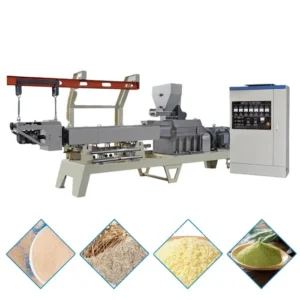
Automatic Nutritional Powder Making Machine Safe Rice Cereal for Babies
¥30.00 Select options This product has multiple variants. The options may be chosen on the product page -
Industrial Instant Corn Paste Production Line Nutritional Powder Processing Equipment Meal Replacement Nutrition Powder Machine
¥65.00 Select options This product has multiple variants. The options may be chosen on the product page -

High Precision Automatic 500kg/h Baby Food Nutrition Powder Rice Extrusion Processing Line
¥8,238.27 Add to cart