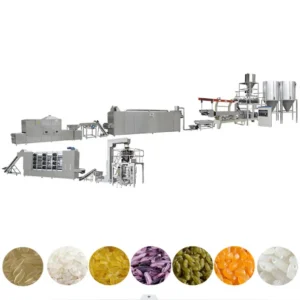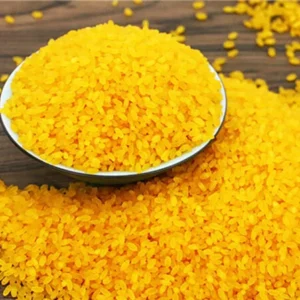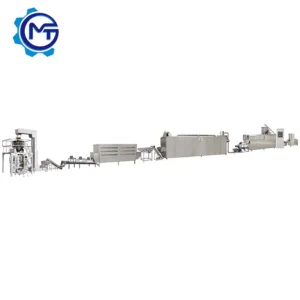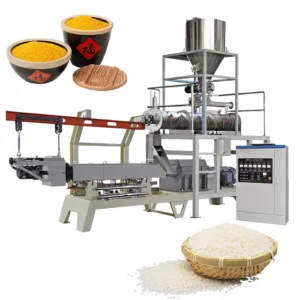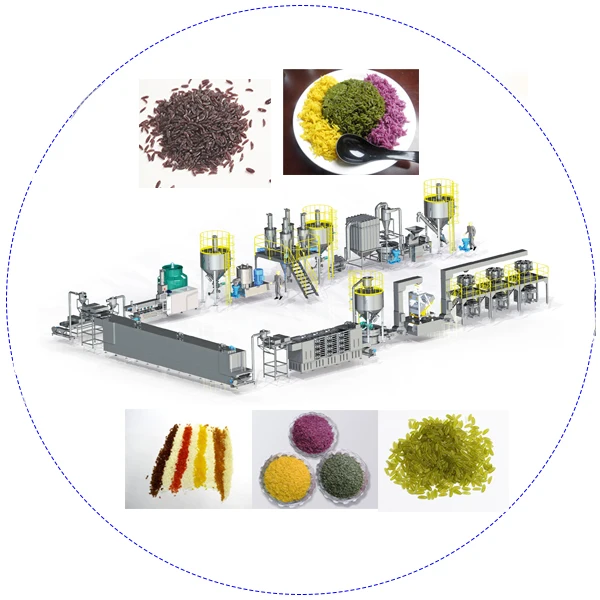
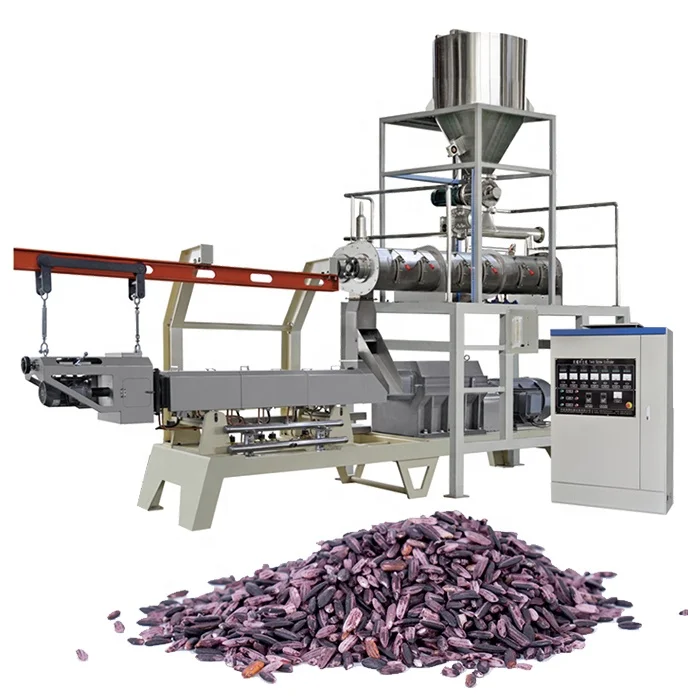
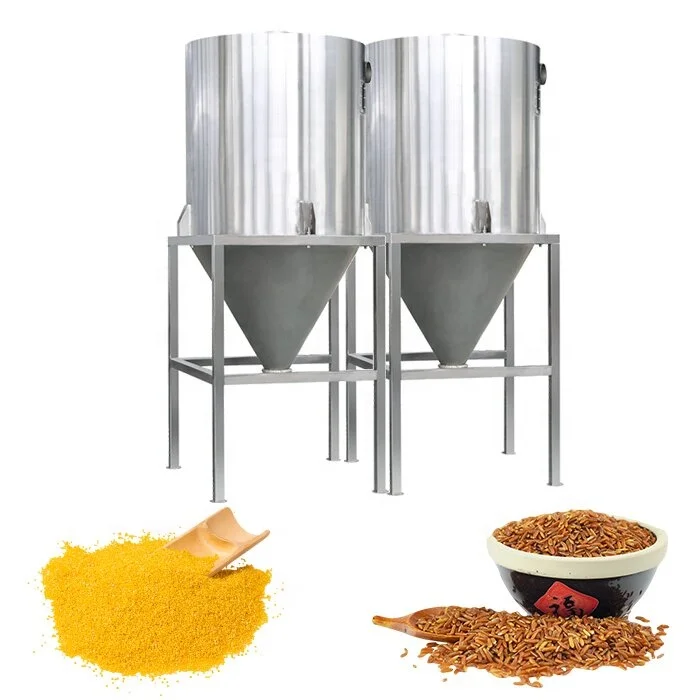


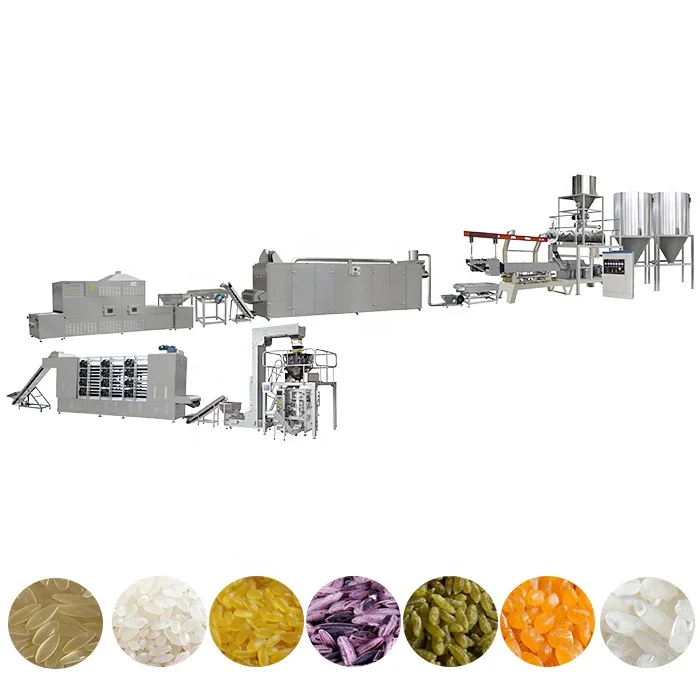
MT65 / MT70 / MT85 / MT75 / MT95 Fortified Rice Kernel Production Line, Twin-Screw Extrusion, Frequency Speed Control — engineered as a complete turnkey project from batching through extrusion, multi-stage drying, cooling, and packing. Screw configuration and die design are matched to your specific grain blend and target kernel density, with throughput balanced across every station. – In-house trial runs on your raw material verify kernel shape and nutritional retention before shipment
Description
Integrated Project Delivery — Every station on this Fortified Rice Kernel Production Line turnkey is sized against the next, eliminating the throughput mismatches that stall commissioning on multi-vendor builds.
Technical Specifications
| Parameter | Value |
|---|---|
| Product Type | Fortified Rice Kernel Production Line |
| Available Models | MT65 / MT70 / MT85 / MT75 / MT95 |
| Extruder Type | Twin-screw |
| Installed Power (MT65–MT95 range) | 85 kW to 260 kW |
| Power Consumption (MT65–MT95 range) | 60 kW to 195 kW |
| Capacity (MT65) | 80–100 kg/hr (basis not stated in source — confirm raw material / moisture content) |
| Capacity (MT70) | 100–120 kg/hr (basis not stated in source — confirm raw material / moisture content) |
| Capacity (MT85) | 200–300 kg/hr (basis not stated in source — confirm raw material / moisture content) |
| Capacity (MT75) | 300–500 kg/hr (basis not stated in source — confirm raw material / moisture content) |
| Capacity (MT95) | 800–1000 kg/hr (basis not stated in source — confirm raw material / moisture content) |
| Control System | Frequency speed controlling |
| Overall Dimensions (MT65) | 28 × 1.2 × 2.2 m |
| Overall Dimensions (MT85) | 34 × 3.5 × 4.3 m |
| Overall Dimensions (MT95) | 36 × 3.5 × 4.3 m |
| Basic Raw Materials | Broken rice, corn, millet, wheat, oats, buckwheat, bean, starch, vitamin and mineral additives |
| Final Products | Artificial rice, fortified rice kernels |
| Assembly State | Complete line with supporting stations |
Application Suitability
| Application | Material or Output |
|---|---|
| Public health nutrition programmes | Vitamin and mineral-enriched rice kernels blended from milled rice flour and micronutrient premix |
| Broken rice valorisation | Reprocessed broken rice and rice bran formed into uniform artificial rice kernels |
| Multi-grain fortified rice production | Blends incorporating corn, millet, oats, buckwheat, and bean flour with nutritional additives |
| Government tender and aid supply | Shelf-stable fortified rice kernels meeting programme specification for kernel density and shape |
What a Nominal Capacity Figure Leaves Out of a Fortified Rice Kernel Production Line Turnkey
Capacity is only meaningful when tied to the exact grain blend, moisture content, and target kernel density you intend to produce.
I remember a project where a line was quoted at a fixed hourly output based on standard rice flour, but the buyer’s actual formulation included a substantial proportion of whey protein isolate. On arrival, the extrusion behaviour shifted entirely — expansion was erratic, kernels fractured during drying, and the line took days of adjustment before it ran within tolerance. That gap between a brochure number and reality is where most turnkey projects stall [NEED_CITE: typical extrusion behaviour variance across protein-enriched grain formulations]. With a Fortified Rice Kernel Production Line turnkey, capacity must be validated against your specific raw material before any commercial commitment is made.
Screw Geometry and Die Selection for Kernel Formation
On a twin-screw extruder processing grain-based formulations, screw configuration directly controls shear intensity and residence time inside the barrel. For fortified rice kernels, the screw profile must balance sufficient starch gelatinisation against over-expansion that would distort kernel shape. Die aperture and land length are then matched to produce the target kernel dimensions and density. Each configuration is specified against the buyer’s declared raw material blend rather than copied from a generic build.
Multi-Stage Thermal Processing and Nutritional Retention
The production procedure moves from extrusion through vibrating separation into low temperature drying, then cooling, followed by high temperature roasting and a second cooling stage before packing. This sequence matters because rapid single-pass drying at high temperature can degrade heat-sensitive vitamins while leaving internal moisture uneven. The staged approach allows moisture to migrate outward gradually during the low temperature phase, then the roasting stage develops kernel hardness and shelf stability. Frequency speed controlling across the line lets operators adjust throughput at each station to maintain this thermal balance [NEED_CITE: thermal degradation thresholds for common micronutrients in grain extrusion].
Reading the Power and Dimension Data Across Models
The installed power range spans 85 kW on the MT65 up to 260 kW on the MT95, with corresponding power consumption figures that reflect actual operating draw rather than peak motor rating. For facility planning, the distinction between installed and consumed power determines transformer sizing and running cost. Overall dimensions expand from a relatively compact 28 m line length on the MT65 to 36 m on the MT95, with the larger models also requiring greater width and headroom — the MT85 and above need 3.5 m width and 4.3 m height clearance. Twin-screw extrusion across all models ensures consistent material handling whether processing pure rice flour or high-fibre multi-grain blends. Control via frequency speed regulation allows each station to be tuned independently, which is essential when a formulation change shifts the optimal throughput balance between extruder output and dryer capacity.
The Cost of Underspecified Line Integration
When the dryer or cooling conveyor is sized to a different capacity than the extruder, the entire line bottlenecks at the weakest station. I have seen projects where the extruder could produce steadily, but the drying stage could not keep pace, forcing operators to run the extruder at partial output or accept kernels that were insufficiently dried and prone to mould in storage. These mismatches are rarely visible in a quotation that lists each machine separately without a throughput reconciliation document [NEED_CITE: consequences of throughput mismatch in multi-stage food processing lines]. The result is a line that technically works but never reaches the output the buyer planned their business case around.
Why This Line Is Specified as a Single Coordinated Project
Throughput matching across every station — from batching and mixing through extrusion, drying, roasting, cooling, and packing — is calculated before the line layout is finalised, so no single station constrains the others. Screw configuration and die design are selected against the buyer’s actual raw material formulation rather than pulled from a standard library. An in-house testing workshop allows trial runs on customer-supplied raw material before shipment, catching formulation-specific issues early. Pre-sales consultation covers line layout, utility planning, and phased installation scheduling, continuing through on-site commissioning and operator training. Documentation delivered with the line includes the configuration records and test data needed for future maintenance and capacity audits.
Documentation & Verification
- Line layout and capacity calculation confirming throughput match between extruder, dryer, and packing stations
- Trial run report on customer raw material demonstrating kernel shape, density, and nutritional retention
- Screw and die configuration record specific to buyer’s formulation
- Electrical schematic with voltage and frequency confirmation for destination market
- CE declaration of conformity and ISO certificate for the complete line
- Operation and maintenance manual with wear parts list
Installation, Commissioning & Support
- Foundation and floor space planning based on line dimensions up to 36 × 3.5 × 4.3 m for the MT95 configuration
- Dedicated electrical circuit sizing according to installed power up to 260 kW with voltage and frequency confirmed pre-production
- Sequential station assembly with extruder, dryer, and cooling conveyors aligned to the approved layout drawing
- First-run parameter setting including barrel temperature profile, screw speed, and dryer zone temperatures against target kernel specification
- Operator training covering formulation changeover, frequency speed adjustment, and die cleaning procedures
- Wear parts supply schedule for screws, dies, and dryer belts with recommended replacement intervals
Preparing Your Project Brief
To move from initial enquiry to a line configuration proposal, the most useful information you can share includes your exact raw material formulation with moisture percentages, target daily output in finished kernel weight, and the physical dimensions of the workshop including ceiling height. Confirming local voltage and frequency standards early prevents redesign during production. If your formulation includes heat-sensitive micronutrients or unconventional protein sources, submitting a raw material sample for trial running in the testing workshop will surface processing issues before the line is built.
Frequently Asked Questions
Q: How is line capacity verified against my specific grain blend and moisture content?
A: Capacity figures for each model are established under defined conditions. We run your actual raw material formulation — including any protein isolates, fibre additions, or micronutrient premixes — through the testing workshop to measure real throughput, kernel density, and shape consistency before quoting a line capacity you can rely on.
Q: How are screw configuration and die design selected for my fortified rice formulation?
A: Screw element arrangement and die aperture are chosen based on your raw material’s starch-to-protein ratio, fibre content, and target kernel density. A configuration record documenting these selections is delivered with the line, so future reorders or adjustments have a documented baseline.
Q: How do you ensure the dryer and cooling stations keep pace with extruder output?
A: Each station’s capacity is calculated during the layout phase so that dryer belt speed, roasting zone length, and cooling conveyor throughput all match or slightly exceed extruder output at full rated speed. This prevents material backlog and ensures consistent kernel moisture at the packing station.
Q: Can I run a trial on my own raw material before the line ships?
A: Yes. The in-house testing workshop accepts customer-supplied raw material samples for trial extrusion runs. The resulting trial run report documents kernel appearance, density, expansion behaviour, and any formulation adjustments needed, giving you verified output data before accepting delivery.
Q: What does on-site installation, commissioning, and operator training cover?
A: Engineers oversee station alignment, utility connections, and sequential startup. Commissioning includes running your production formulation through the complete line and adjusting parameters until kernel output meets specification. Operator training covers daily operation, formulation changeover procedures, wear part replacement, and routine maintenance scheduling.
Related products
-

New Automatic Nutritional Powder Making Machine for Baby Food Production Line
¥20.00 Select options This product has multiple variants. The options may be chosen on the product page -
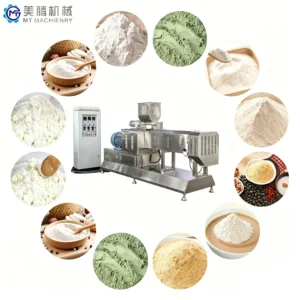
150-500kg/h Twin Screw Extruder Baby Rice Flour Making Machine
¥9,500.00 Select options This product has multiple variants. The options may be chosen on the product page -
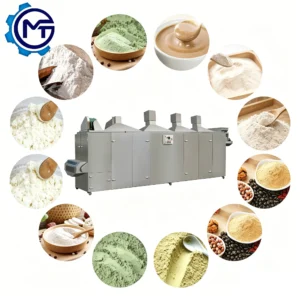
500kg/h Automatic PLC Controlled Nutrition Baby Food Extruder Machine for Rice Cereal Processing
¥9,500.00 Add to cart -

Compact Automatic Baby Cereal Nutrition Powder Production Line with 500kg/h Capacity and PLC Control
¥9,500.00 Add to cart