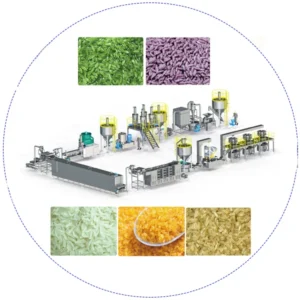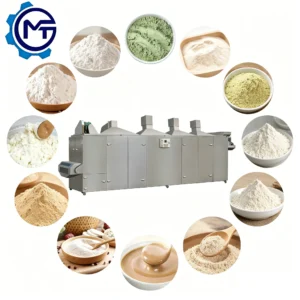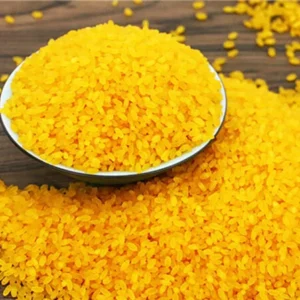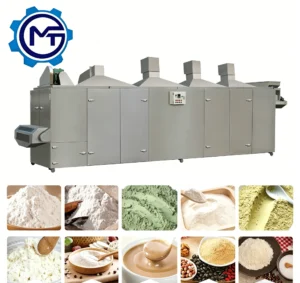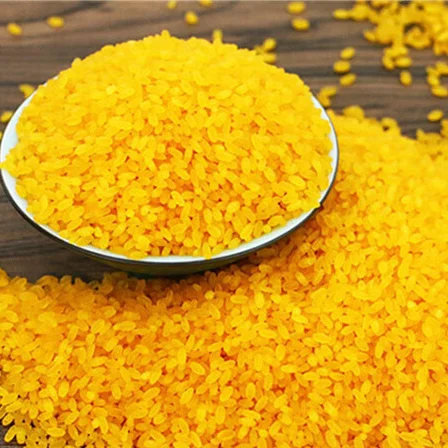
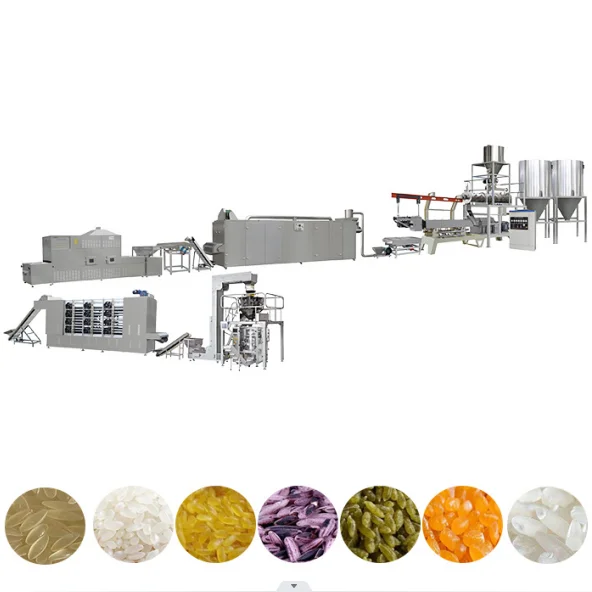

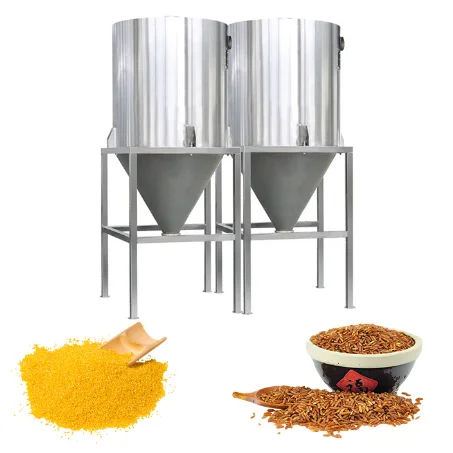
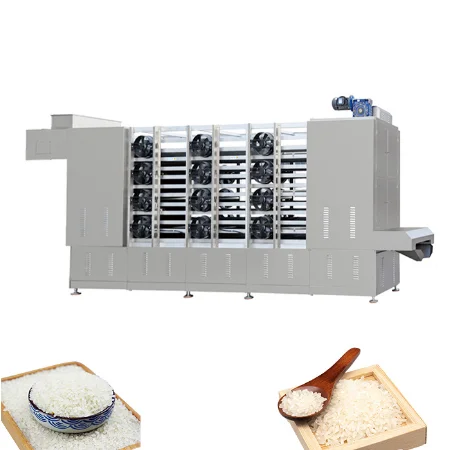

MT65, MT70, MT85, MT75, MT95 Nutritionally Fortified Artificial Rice Production Line, Twin-Screw Extrusion, CE — designed for grain-based nutrition projects from broken rice, corn, millet, and starch formulations with added vitamins and minerals.
- Complete turnkey layout: mixing → extruding → vibrating → drying → cooling → roasting → packing
- Each station throughput is matched to the extruder output, preventing bottlenecks at drying or cooling stages
- Frequency speed control adapts screw shear and feed rate to different raw material systems
We run trial production on your actual formulation in our testing workshop before shipment, so you confirm kernel density and shape before the line leaves the factory.
Description
Throughput-Matched Turnkey Engineering — Every station from batching to packing is sized against the extruder’s actual output on your grain formulation, eliminating the bottleneck effect where dryers or coolers choke a line quoted at nominal capacity.
Technical Specifications
| Parameter | Value |
|---|---|
| Product Type | Nutritionally Fortified Artificial Rice Production Line |
| Available Models | MT65, MT70, MT85, MT75, MT95 |
| Extruder Configuration | Twin screw (single screw feeding option available) |
| Control System | Frequency speed controlling |
| Installed Power Range | 85 kW (MT65) to 260 kW (MT95) |
| Power Consumption Range | 60 kW (MT65) to 195 kW (MT95) |
| Output Capacity | 80–1000 kg/hr depending on model and formulation (basis to be confirmed) |
| Overall Dimensions | From 28 × 1.2 × 2.2 m (MT65) to 36 × 3.5 × 4.3 m (MT95) |
| Drying Oven Heating Source | Electric or gas |
| Line Stations | Mixing → Extruding → Vibrating → Low Temperature Drying → Cooling → High Temperature Roasting → Cooling → Packing |
| Raw Materials | Broken rice, rice, corn, millet, wheat, oats, buckwheat, bean, starch, vitamin, mineral |
| Assembly State | Complete turnkey line |
Application Suitability
| Application | Material or Output |
|---|---|
| Nutritionally fortified rice kernels | Broken rice and rice bran blended with vitamins and minerals |
| Multi-grain reconstituted rice | Corn, millet, buckwheat, oats, and wheat formulations |
| Public nutrition and food aid programs | Standardized fortified rice with controlled micronutrient dosing |
| High-fiber and specialty grain rice | Bean and starch-based formulations with dietary fiber additions |
What "Nominal Capacity" Leaves Out About Your Fortified Artificial Rice Production Line Turnkey Project
A line rated at a certain hourly output on paper frequently delivers less when your specific grain blend and moisture content hit the barrel.
I spent a week crouched on a factory floor in Shandong watching an extruder starve because the upstream mixer discharged batches slower than the screws could consume them. The motor ran, the barrel heated, but the die sputtered half-formed kernels that cracked during drying. Nobody had calculated the actual residence time of that particular vitamin-fortified rice slurry through the preconditioner. The rated capacity assumed a corn-based formulation with different gelatinisation behaviour [NEED_CITE: residence time variation across starch sources in twin-screw extrusion]. When buyers evaluate a fortified artificial rice production line turnkey proposal, the number they should scrutinise is not the nameplate output but the throughput each downstream station can sustain on their actual recipe.
How Screw Configuration Shapes Kernel Density and Cooking Behaviour
The twin-screw arrangement in this line allows operators to adjust the screw element sequence — alternating conveying, kneading, and reverse elements — to control shear intensity inside the barrel. For a broken-rice formulation with added iron and folic acid, excessive shear can degrade heat-sensitive micronutrients before the material reaches the die. The die plate itself determines kernel geometry: a rice-shaped orifice with a specific land length produces the elongated profile that downstream roasting and cooling stations expect. Mismatch the die to the formulation and the extrudate either collapses into fragments or exits too dense for the drying oven to handle within its belt speed range.
Why the Drying and Roasting Sequence Matters for Fortified Rice Stability
After extrusion, the shaped kernels carry significant internal moisture that must be reduced in stages. The low-temperature drying station removes free water without case-hardening the kernel surface, which would trap moisture inside and cause cracking during storage. The subsequent high-temperature roasting stage then develops the translucent, polished appearance that distinguishes reconstituted rice from conventional puffed products [NEED_CITE: two-stage drying protocol for artificial rice kernel integrity]. Gas-fired and electric oven options let the line adapt to local utility costs and available infrastructure. Skipping the intermediate cooling conveyor between drying and roasting would cause thermal shock fractures in the kernels, raising the broken-grain percentage at the packing station.
Reading the Power and Dimension Data Across the Model Range
The jump from 85 kW installed power on the smallest unit to 260 kW on the largest reflects more than motor size — it accounts for the barrel heaters, the drying oven elements, and the vibrating screen drives that scale with throughput. Overall line length stretches from 28 metres to 36 metres, meaning facility planners must confirm floor space and overhead clearance before committing to a larger model. The power consumption figures sit roughly 25 to 30 percent below installed capacity, indicating that the frequency-controlled drives do not run at full draw continuously. Frequency speed controlling across the line allows operators to dial back the extruder screw speed when a slower-drying formulation requires extended oven residence time, keeping upstream and downstream stations synchronised without manual intervention.
The Hidden Cost of Undersized Downstream Stations
When the drying oven belt is specified for a lighter load than the extruder actually delivers, kernels pile up on the mesh, overlap, and fuse together into clumps that the cooling conveyor cannot separate. I have seen entire batches of fortified rice rejected because the roasting stage received unevenly dried input — some kernels were still soft while others had already scorched. The packing station then faces a product stream with inconsistent moisture, leading to bag weight variation and potential mould growth during shipping [NEED_CITE: moisture variation tolerance for packaged rice products]. These failures trace back to a line assembled from independently quoted stations rather than engineered as a single throughput chain.
Why Procurement Here Differs from Assembling Vendors Separately
Every station in this fortified artificial rice production line turnkey package is sized against the extruder output on your specific grain formulation, so the dryer belt width, the cooling conveyor length, and the packing hopper volume all match rather than compete. Screw configuration and die geometry are recorded against your raw material sample before the machine leaves the factory, not guessed from a generic template. The in-house testing workshop runs your actual broken rice or multi-grain blend through the extruder and documents kernel shape, density, and moisture at each stage. Electrical schematics confirm voltage and frequency for your destination country before production begins, preventing the week-long delays that occur when a control cabinet arrives wired for the wrong grid standard. Pre-sales engineering through on-site commissioning and operator training stays with one technical team, so accountability does not fracture across multiple suppliers.
Documentation & Verification
- Line layout drawing with capacity calculation based on your grain formulation and target kernel size
- Screw and die configuration record matched to your raw material sample and desired rice density
- Factory trial run report on your actual broken rice or multi-grain blend before shipment
- Electrical schematic with voltage, frequency, and control language confirmed for your destination market
- CE declaration of conformity and ISO certificate for import compliance documentation
Installation, Commissioning & Support
- Floor plan confirming the 28 to 36 metre line footprint, including dryer oven clearance and cooling conveyor run-out space
- Dedicated electrical circuit sized to the model’s installed power, from 85 kW up to 260 kW, with correct voltage and frequency
- On-site assembly of modular extruder barrel sections, drying oven panels, and vibrating screen frames
- First-run parameter setting for screw speed, barrel temperature zones, and oven belt speed on your formulation
- Operator training covering die changeover, frequency drive adjustment, and moisture monitoring at each station
- Wear parts schedule for screw elements, die plates, and dryer mesh belt with recommended replacement intervals
What to Include in Your Next Inquiry
To receive a line configuration that matches your facility, share your primary grain materials and any vitamin or mineral premix ratios, your target daily production volume, and the floor dimensions available for the line layout. Specify your local voltage and frequency standard along with the preferred control panel language so the electrical design aligns before manufacturing starts. If you have existing upstream milling or downstream bagging equipment, note the connection points so the turnkey package interfaces correctly at both ends.
Frequently Asked Questions
Q: How is the actual output capacity confirmed for my specific rice formulation?
A: Output depends on your raw material blend, moisture content, and target kernel dimensions. Before quotation, we run your sample through the testing workshop and document throughput at the extruder die, the drying oven exit, and the packing station. The confirmed figure replaces the nominal model rating in your proposal.
Q: How do you prevent the drying oven from becoming a bottleneck on a multi-grain formulation?
A: Each line station is capacity-matched during the layout phase. If your formulation requires longer drying residence time due to higher initial moisture or denser kernel structure, the oven belt length and air flow are specified accordingly rather than defaulting to a standard module.
Q: What electrical details must I provide before the control cabinet is built?
A: We need your site voltage, phase configuration, and frequency — for example, 380 V / 50 Hz or 440 V / 60 Hz — along with the preferred language for the frequency drive displays. This confirmation happens before production to avoid on-site rewiring delays during commissioning.
Q: How is operator training structured around the extrusion and drying stages?
A: Training covers screw speed adjustment via the frequency drives, barrel temperature zone monitoring, die plate changeover for different kernel shapes, and oven belt speed tuning. Sessions run during the commissioning period with your actual raw material on the line.
Q: What is the replacement cycle for screws, dies, and the dryer mesh belt?
A: Wear depends on the abrasiveness of your grain blend and daily run hours. The wear parts list provided with your line specifies each component and its expected service interval. Initial spare sets ship with the line so replacements are on hand before the first changeover is needed.
Related products
-
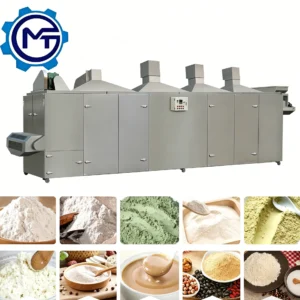
CE Approved MT Brand Organic Baby Rice Nutrition Powder Extrusion Production Line with 500kg/h Capacity and Automatic Grade
¥9,500.00 Add to cart -
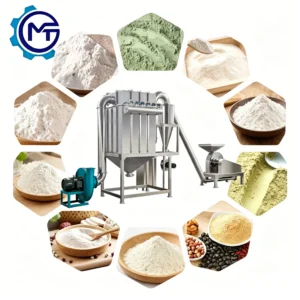
Compact Automatic Baby Cereal Nutrition Powder Production Line with 500kg/h Capacity and PLC Control
¥9,500.00 Add to cart -
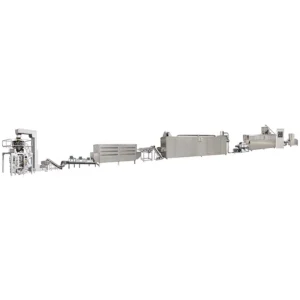
High Productivity New Condition Nutritious Baby Food Meal Replacement Powder Production Line
¥30.00 Select options This product has multiple variants. The options may be chosen on the product page -

Automatic Instant Powder Production Line Nutritional Powder Extruder Machine
¥10,000.00 Select options This product has multiple variants. The options may be chosen on the product page