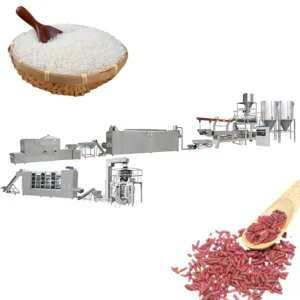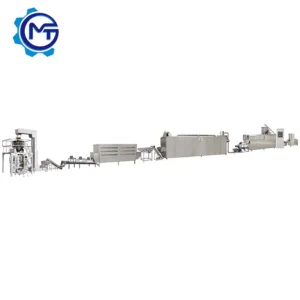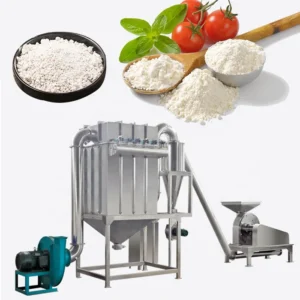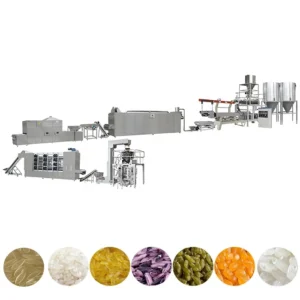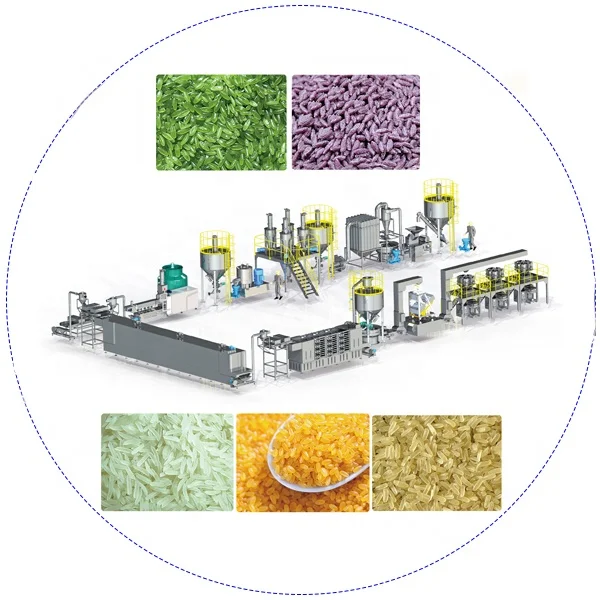

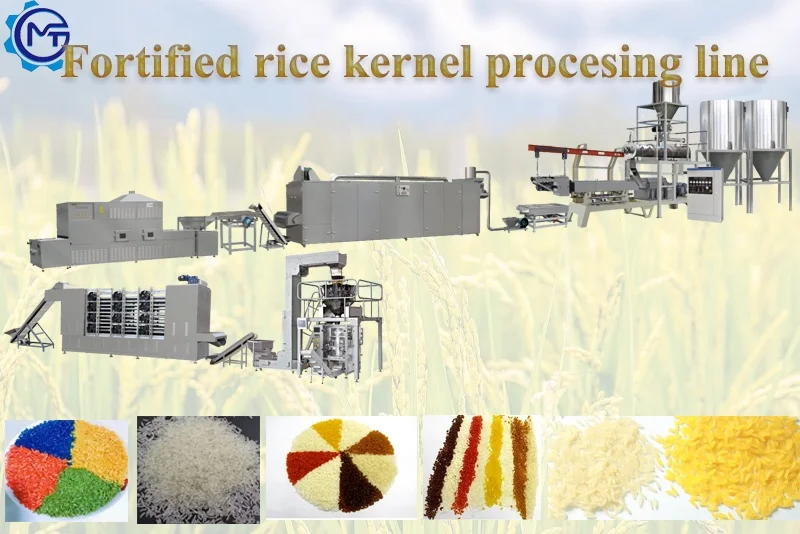


MT65 / MT70 / MT85 / MT75 / MT95 Fortified Rice Processing Line, Twin Screw Extruder, 85–260 kW Installed Power — complete turnkey line from mixing through extrusion, drying, roasting, cooling, and packing.
- Screw configuration and die design matched to your raw material blend — broken rice, corn, millet, starch with vitamin and mineral premix
- Every station throughput-balanced so dryer and cooling capacity keeps pace with extruder output
Layout, capacity calculation, and in-house trial run on your actual raw material provided before shipment — confirming kernel density and cooking behaviour to your specification.
Description
Throughput-Matched Stations — Every section from mixing to packing is balanced so the extruder output never waits on a slower dryer or cooler.
Technical Specifications
| Parameter | Value |
|---|---|
| Model | MT65 / MT70 / MT85 / MT75 / MT95 |
| Product Type | Fortified Rice Processing Line with Twin Screw Extruder |
| Screw Configuration | Twin-screw extrusion with die geometry matched to raw material blend |
| Installed Power | MT65: 85 kW; MT70: 120 kW; MT85: 235 kW; MT75: 180 kW; MT95: 260 kW |
| Power Consumption | MT65: 60 kW; MT70: 85 kW; MT85: 165 kW; MT75: 135 kW; MT95: 195 kW |
| Output Capacity | MT65: 80–100 kg/h; MT70: 100–120 kg/h; MT85: 200–300 kg/h; MT75: 300–500 kg/h; MT95: 800–1000 kg/h (basis to be confirmed based on raw material and moisture content) |
| Dimensions (L×W×H) | MT65: 28 × 1.2 × 2.2 m; MT70: 30 × 1.5 × 2.2 m; MT85: 34 × 3.5 × 4.3 m; MT75: 32 × 3.5 × 4.3 m; MT95: 36 × 3.5 × 4.3 m |
| Control System | Frequency speed control with high automation |
| Dryer Heating Source | Electric or gas |
| Line Assembly | Complete turnkey line |
| Certification | CE referenced in customer profile; ISO referenced in customer profile (verify documentation) |
Application Suitability
| Application | Material or Output |
|---|---|
| Fortified and Artificial Rice Production | Broken rice, rice flour, corn, millet, wheat, oats, buckwheat, beans, and starch base ingredients |
| Nutritional Staple Food Programs | Vitamin and mineral premix added to starch and cereal blends |
| Rice Milling Byproduct Upcycling | Conversion of broken rice and rice bran into reconstituted high-nutrition kernels |
Why "Nominal Capacity" Can Stall a Fortified Rice Processing Line Turnkey
A machine rated for a specific output on standard rice flour may fail to hold that volume when the buyer introduces a high micronutrient load.
Many extruders are quoted based on a standard starch matrix, but adding heavy vitamin and mineral premixes alters the material density, shear requirements, and gelatinization behavior. I recall a project where the micronutrient addition caused the kernel formation rate to drop noticeably because the screw configuration was not adjusted for the specific blend. When the extruder output slows down or becomes inconsistent, the downstream low-temperature drying and high-temperature roasting stations cannot maintain their cycle times, causing the entire line to bottleneck. A fortified rice processing line turnkey solution must be evaluated on how it handles your specific material formula, not just a generic capacity number [NEED_CITE: extrusion behavior of fortified starch blends].
Screw Geometry and Micronutrient Dispersion
The core of this technology is the twin-screw configuration, which must be specified to handle the abrasiveness and density of the added minerals. If the premix is heavy, standard screw elements may struggle to maintain the necessary shear and heat transfer for uniform gelatinization. The die design is then matched to ensure the kernels have the correct density to survive the drying process without sinking or clumping. A proper fortified rice processing line turnkey setup accounts for these material variables before the machine is built.
Thermal Profile and Kernel Integrity
Managing the moisture and temperature gradient is critical when extruding artificial rice. The line includes a low-temperature drying phase to set the kernel structure, followed by cooling and a high-temperature roasting step to achieve the final texture. If the thermal profile is not synchronized with the extruder output, the kernels may crack or fail to maintain their shape during cooking. This station-to-station matching is what separates a collection of machines from a functional production system [NEED_CITE: temperature control in starch extrusion and drying].
Power and Motor Load Interpretation
The installed power and consumption figures across the MT series reflect the mechanical work required to process different volumes of starch-based blends. A higher motor rating on the MT85 or MT95 models indicates the torque necessary to maintain screw speed under heavier material loads. For a buyer, these figures are more relevant than a generic "high efficiency" claim, as they reveal how the extruder manages the resistance of a mineral-heavy formula. Frequency-controlled drives allow the operator to fine-tune the screw speed to match the exact behavior of the local raw materials.
The Cost of a Configuration Mismatch
When a line is assembled from separate vendors or based on generic specifications, the result is often a mismatch in throughput or utility requirements. An extruder that outpaces its dryer will lead to a buildup of wet product that spoils or deforms before roasting. Furthermore, if the voltage, frequency, and control language are not confirmed before shipment, the commissioning phase can be delayed for weeks while technicians wait for the correct components. This turns a planned startup into a troubleshooting exercise [NEED_CITE: industrial machine commissioning and utility standards].
Why Source a Fortified Rice Processing Line Turnkey Here
The primary advantage of this approach is the integration of every station under one responsibility.
- Throughput Matching: The capacity of the dryer, cooler, and roaster is calculated to handle the exact output of the selected extruder model.
- In-House Testing: Your actual raw material blend is trial-run in the testing workshop to verify screw configuration and kernel formation before the line ships.
- Die and Screw Design: Components are specified to your target kernel density and nutritional profile.
- Utility Planning: Electrical schematics and heating sources are confirmed to match your factory’s local infrastructure.
Documentation & Verification
- Line layout and capacity calculation showing throughput matching across every station
- Screw and die configuration record specific to your raw material formula
- Trial run report on customer raw material before shipment
- Electrical schematic with voltage, frequency, and control language confirmed
- Operation and maintenance manual for the complete turnkey line
Installation, Commissioning & Support
- Site layout planning based on the specific dimensions of the MT series models
- Power supply verification for the selected installed power and voltage requirements
- On-site assembly and station-by-station throughput balancing
- Parameter setting for screw speed, barrel temperature, and dryer circulation
- Operator training on frequency-controlled drives and control interface
- Wear parts list including replacement screws and dies for the specific configuration
Preparing Your Inquiry for a Fortified Rice Processing Line Turnkey
To move toward a finalized layout, we need to know the exact composition of your raw material, particularly the percentage of broken rice or starch and the type of micronutrient premix you intend to use. Please also specify your local voltage and frequency, as well as the target production capacity based on your actual working hours. Sharing a sample of your intended blend allows us to perform a trial run and provide a proposal that reflects real-world performance rather than nominal estimates.
Frequently Asked Questions
Q: How is the output capacity verified for my specific formula?
A: Output is verified through a trial run on your actual raw material blend in our testing workshop. We measure the capacity based on your specific moisture content, micronutrient load, and target kernel density, ensuring the quoted figures reflect your production reality.
Q: How are the screw and die selected for fortified rice?
A: The screw configuration and die design are matched to the abrasiveness and gelatinization requirements of your blend. This ensures the micronutrients are evenly dispersed and the kernels maintain their shape and density through the drying and roasting phases.
Q: Can I test my raw material before the line is shipped?
A: Yes. We conduct trial runs on your raw material in our in-house testing workshop. This allows us to adjust the screw geometry and thermal profiles to your exact formula before the machine is finalized for production and dispatch.
Q: How do you prevent the dryer from bottlenecking the extruder?
A: The dryer and roaster capacities are calculated to match the maximum output of the selected extruder model. We provide a line layout and capacity calculation document that shows the throughput balance across every station, ensuring smooth material flow.
Related products
-

Fully Automatic 500kg/h Baby Cereal Nutrition Powder Extrusion Drying Line with PLC Control
¥9,500.00 Add to cart -

High Quality Automatic PLC Controlled 500kg/h Twin Screw Extruder Machine for Baby Rice Nutrition Powder
¥8,238.27 Add to cart -

Hygienic Stainless Steel Infant Rice Powder Processing Line Automatic 500kg/h Capacity PLC Controlled
¥9,500.00 Add to cart -
Commercial Stainless Steel Baby Rice Powder Grinding Mixing Machine
¥8,238.27 Select options This product has multiple variants. The options may be chosen on the product page