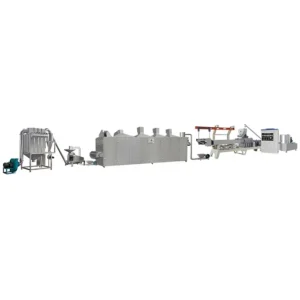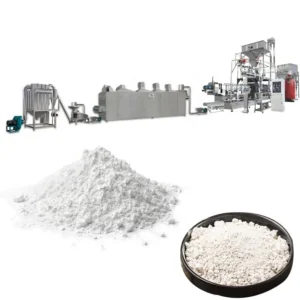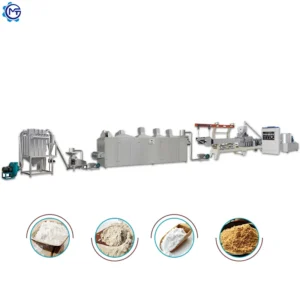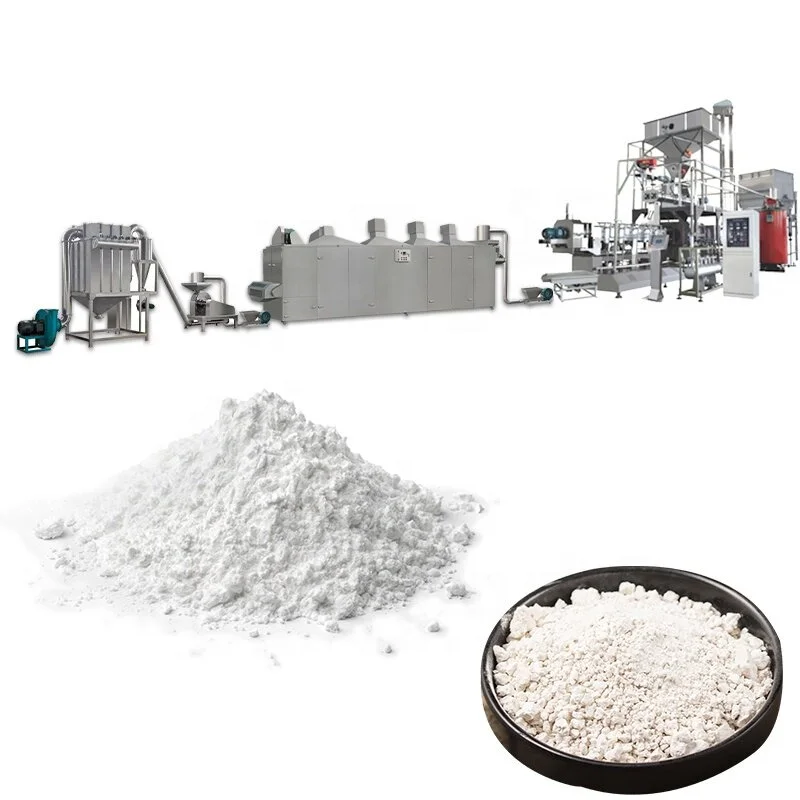


MT70 / MT85 / MT75 Twin Screw Pre-Gelatinized Modified Starch Processing Line, PLC & MCC Control, 5-Layer Dryer — engineered for complete throughput alignment from mixing through extrusion to grinding. Screw configuration and die design are specified to your starch raw material and target gelatinization degree, with barrel cooling ensuring precise temperature control during processing. Every station is sized to match, avoiding bottlenecks common in multi-vendor setups. Trial runs on your actual corn or potato starch are completed in our testing workshop before shipment, verifying output and product quality in advance.
Description
Precision starch gelatinization engineering — Twin-screw pre-gelatinized modified starch processing line where screw configuration, barrel cooling, and die geometry are matched to your specific starch feedstock, not pulled from a generic build.
Technical Specifications
| Parameter | Value |
|---|---|
| Model | MT70 / MT85 / MT75 |
| Product Type | Twin Screw Pre-Gelatinized Modified Starch Processing Line |
| Screw Type | Twin-screw, 38CrMoAl |
| Installed Power | MT70 — 160 kW; MT85 — 190 kW; MT75 — 210 kW |
| Power Consumption | MT70 — 120 kW; MT85 — 140 kW; MT75 — 150 kW |
| Output Capacity | MT70 — 150–200 kg/h (basis to be confirmed); MT85 — 300–400 kg/h (basis to be confirmed); MT75 — 300–500 kg/h (basis to be confirmed) |
| Overall Dimensions (L×W×H) | MT70 — 41000×1500×2200 mm; MT85 — 43000×1500×3200 mm; MT75 — 45000×1500×3500 mm |
| Control System | PLC and MCC |
| Voltage & Frequency | 380 V / 50 Hz / Three Phase (configurable to target market) |
| Mixer Capacity | 20–30 kg/batch; 70–80 kg/batch; 170–180 kg/batch (by model) |
| Mixer Power | 4 kW / 7.5 kW / 15 kW (by model) |
| Mixer Material | 201 SS or 304 SS |
| Dryer Type | 5-layer, gas or diesel fired |
| Dryer Dimensions | 5000×1200×2300 mm |
| Dryer Power | 3 kW |
| Dryer Speed Control | Inverter |
| Grinder | Pulse grinder with cyclone discharge and dust collector |
| Barrel Temperature Control | Integrated cooling system |
Application Suitability
| Application | Material or Output |
|---|---|
| Oil drilling fluid loss agents | Pre-gelatinized corn or potato starch stable at elevated borehole temperatures |
| Textile industry sizing starch | Denatured starch derivatives from corn or cassava feedstock |
| Paper industry coating starch | Modified starch with controlled viscosity for surface sizing |
| Food-grade functional starch | Pre-gelatinized starch for fortified foods and infant formula bases |
| Starch derivatives production | Chemically or physically modified starch from corn, potato, or cassava |
Why Nominal Capacity Figures Mislead Starch Processors
Output is only meaningful when tied to your exact starch type, moisture content, and target gelatinization degree.
I have watched buyers sign contracts based on a capacity number that held up on corn starch, only to discover their cassava feedstock required a completely different screw configuration and temperature curve. The extruder ran, but throughput dropped significantly because the material behaved differently under shear. This mismatch is the single most common cause of commissioning disputes in starch extrusion projects. A modified starch processing line turnkey solution only delivers its rated performance when every parameter is validated against the buyer’s actual raw material before the line ships. [NEED_CITE: raw material variability in starch extrusion and gelatinization behavior]
Matching Screw Geometry to Starch Feedstock Behavior
Different starches respond to shear and heat in fundamentally different ways inside the extruder barrel. Corn starch, potato starch, and cassava starch each require distinct screw element sequencing to achieve consistent gelatinization without degrading the polymer chains. The MT70, MT85, and MT75 extruders use 38CrMoAl screws with configurable element arrangements so the compression ratio and residence time match your material. Barrel cooling zones maintain precise temperature control across each section, preventing hot spots that cause uneven gelatinization or thermal breakdown of the starch structure.
Why the Dryer and Grinder Must Be Sized to the Extruder
A common failure in starch processing lines is oversizing the extruder while undersizing downstream stations. If the five-layer dryer cannot remove moisture fast enough to match extruder discharge rate, wet starch accumulates and blocks the feed to the pulse grinder. The dryer on this modified starch processing line turnkey project is equipped with inverter speed control and gas or diesel heating, allowing belt speed and temperature to be tuned to the specific moisture profile of your gelatinized starch. The pulse grinder with cyclone discharge then produces a controlled particle size distribution essential for downstream formulation or direct packaging. [NEED_CITE: dryer throughput matching in continuous starch processing]
Reading the Specifications That Actually Matter
The installed power ratings across the three models — from 160 kW on the MT70 to 210 kW on the MT75 — reflect the mechanical and thermal energy required to gelatinize starch under pressure inside the twin-screw barrel. Higher power does not automatically mean better output; it means the extruder can handle denser feedstock or higher moisture addition while maintaining screw speed. The barrel cooling system is critical because starch gelatinization is an endothermic process requiring steady heat input without localized overheating. PLC and MCC control allows operators to set and replicate temperature profiles across production batches, which directly affects the consistency of the final modified starch viscosity. Mixer batch sizes from 20–30 kg up to 170–180 kg are paired to each extruder model so that feed continuity is maintained without the mixer cycling too slowly or flooding the feed hopper. Stainless steel contact surfaces in either 201 SS or 304 SS are selected based on whether the line produces food-grade or industrial-grade starch.
The Hidden Cost of Skipping Raw Material Validation
When a starch line is configured without trial runs on the buyer’s actual feedstock, the first week of commissioning becomes an expensive experiment. Screw elements get swapped, barrel temperatures adjusted, and moisture ratios recalculated — all while raw material is consumed and production deadlines slip. I have seen this delay stretch into a second week, with the buyer’s own customers waiting for product samples. Every configuration change on site also means re-training operators who had just learned the initial settings. This is avoidable when the supplier runs the material in-house before the line leaves the factory. [NEED_CITE: commissioning delays caused by untested raw material configurations]
What This Line Delivers as a Single-Supplier Project
Sourcing the mixer, extruder, dryer, and grinder from separate vendors introduces throughput mismatches that only appear during continuous operation. This modified starch processing line turnkey configuration is designed as one system where every station is capacity-matched from the start. Screw configuration and die design are specified to your starch raw material and target gelatinization degree, not copied from a generic catalog build. The in-house testing workshop runs trial production on your corn, potato, or cassava starch before shipment, so output and product quality are verified in advance. Voltage, frequency, and control language are confirmed to your facility’s electrical supply before production begins. The line carries CE certification and is manufactured under ISO quality management, with documentation traceable from raw material to finished machine.
Documentation & Verification
- Line layout drawing showing throughput calculation across mixer, extruder, dryer, and grinder
- Screw and die configuration record matched to your starch feedstock type
- Trial run report on your raw material conducted before dispatch
- Electrical schematic with voltage and frequency confirmed to your facility
- Operation and maintenance manual with wear parts list for screws and dies
- CE declaration of conformity and factory test record
Installation, Commissioning & Support
- Foundation plan provided based on the 41 to 45 meter line footprint and station weights
- Dedicated power circuit required matching 160 to 210 kW installed capacity per model
- Dryer gas or diesel burner commissioned on site with local fuel supply verification
- PLC interface language set to operator preference before initial starch trial runs
- Screw element and die wear parts list supplied with first recommended replacement intervals
- Barrel cooling system flow rates checked and balanced during commissioning week
What to Prepare Before Requesting a Quotation
To configure a modified starch processing line turnkey project accurately, we need your starch type (corn, potato, cassava, or other), the target gelatinization degree, and your daily production target. Share your facility’s available floor space and ceiling height so the line layout can be drafted to fit. Confirm your local voltage, frequency, and whether the control panel language should be in English or another language. If you can send a raw material sample or a recent lab analysis report, we can schedule a trial run in the testing workshop before the quotation is finalized.
Frequently Asked Questions
Q: How is the actual output capacity confirmed for my starch material?
A: Output figures are validated through trial production on your specific starch raw material in our in-house testing workshop before the line ships. We measure throughput, gelatinization degree, and moisture content at discharge to confirm the line meets your production target. Nominal capacity numbers without raw material context are not used as delivery commitments.
Q: Can the screw configuration be changed if I switch between corn and cassava starch?
A: Yes, the 38CrMoAl twin-screw elements are modular and can be rearranged to suit different starch types. We document the screw configuration for each material you plan to process, and operators can switch setups following the configuration record provided with the line. Die design is also adjusted to match the expansion behavior of each starch.
Q: What voltage and frequency options are available for export markets?
A: The standard configuration is 380 V / 50 Hz / three phase, but the motor and control specifications are confirmed to match your facility’s electrical supply before production begins. This includes control panel labeling and PLC interface language to match your operator team. Voltage mismatches are a frequent cause of commissioning delays, so this step is completed early in the sales process. [NEED_CITE: voltage and frequency standards by export market]
Q: Is it possible to visit the factory and watch a trial run on my material?
A: The in-house testing workshop is available for buyer-witnessed trial production on your raw material. This allows you to see the extruder running your starch, check the gelatinized product quality firsthand, and discuss any configuration adjustments before the full line enters production. Trial run reports with measured parameters are provided regardless of whether you attend in person.
Q: How do you ensure the dryer and grinder keep up with extruder output?
A: Each station in the line is sized based on the extruder’s discharge rate at the confirmed throughput level. The five-layer dryer has inverter speed control to adjust residence time, and the pulse grinder with cyclone discharge is rated to handle the full output without bottlenecking. Throughput matching across stations is documented in the line layout and capacity calculation provided with your project.
Related products
-
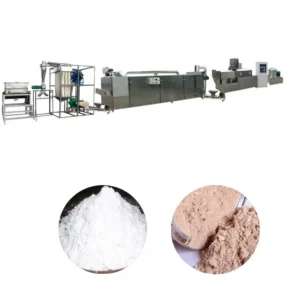
Automatic Modified Starch Making Machine Oil Drilling Starch Processing Production Line
¥30.00 Select options This product has multiple variants. The options may be chosen on the product page -
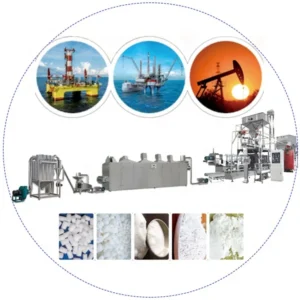
Automatic Industrial Adhesive Starch Modification Production Line – Pre-Gelatinization Extrusion Equipment
¥65.00 Select options This product has multiple variants. The options may be chosen on the product page -
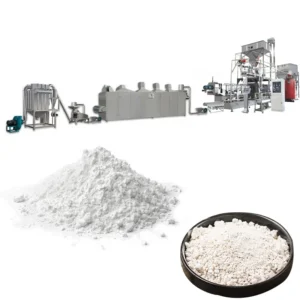
API Standard Pregelatinized Starch Line for Oilfield Drilling Fluid. High Yield Modified Starch Equipment
¥65.00 Select options This product has multiple variants. The options may be chosen on the product page -
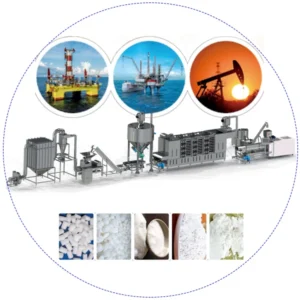
Modified Starch Production Line for Industrial Drilling Twin Screw Extruder Large Output Modified Starch Manufacturing Machine
¥50.00 Select options This product has multiple variants. The options may be chosen on the product page