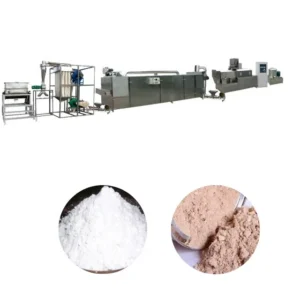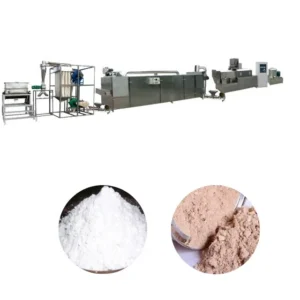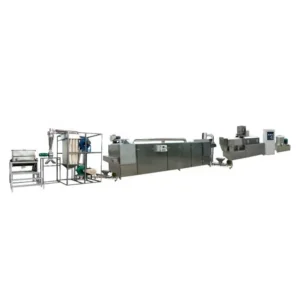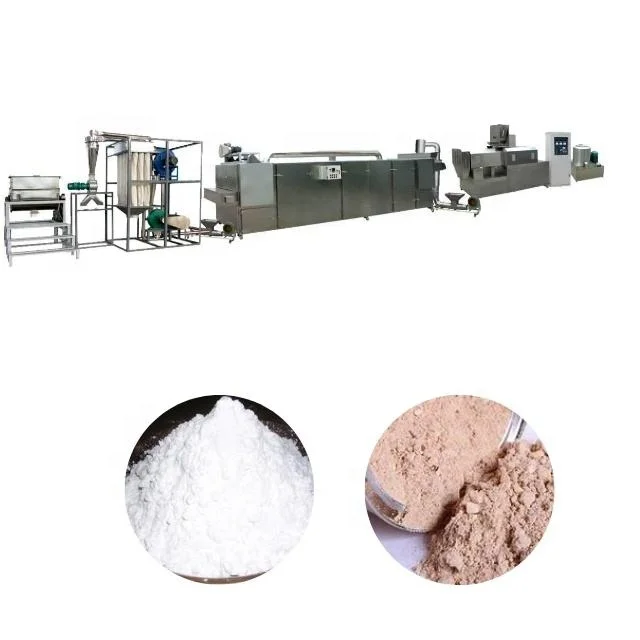


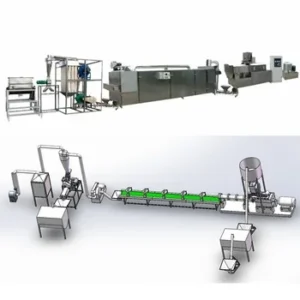
MT70 / MT85 / MT100 Modified Starch Processing Line, twin-screw extrusion, PLC & MCC control, 38CrMoAl screws — engineered for precise gelatinisation and denaturation across food-grade and industrial starch applications.
- Screw configuration and die design matched to your starch source and target modification degree, with multi-zone barrel heating and integrated cooling for tight temperature profiling
- Three capacity tiers with voltage and control language confirmed pre-production to fit your facility supply
- In-house trial runs on your raw material before shipment verify real throughput and product specification
Description
Integrated Extrusion Architecture — Throughput-matched stations from starch hydrolysis to packing eliminate the bottlenecking that plagues lines assembled from separate vendors.
Technical Specifications
| Parameter | Value |
|---|---|
| Model | MT70 / MT85 / MT100 |
| Product Type | Modified Starch Processing Line (Twin-Screw Extrusion) |
| Screw Configuration | Twin-screw, 38CrMoAl alloy steel |
| Screw Diameter (MT70) | 70 mm |
| Screw Length (MT70) | 1520 mm |
| Installed Power (MT70 / MT85 / MT100) | 160 kW / 190 kW / 210 kW |
| Power Consumption (MT70 / MT85 / MT100) | 120 kW / 140 kW / 150 kW |
| Output Capacity | MT70: 150–200 kg/h, MT85: 300–400 kg/h, MT100: 300–500 kg/h (basis not stated in source — confirm raw material type, moisture content and modification degree) |
| Overall Dimensions (L×W×H) | MT70: 41000×1500×2200 mm / MT85: 43000×1500×3200 mm / MT100: 45000×1500×3500 mm |
| Voltage & Frequency | 380V 50Hz 3-Phase (configurable to 415V 60Hz, 220V 60Hz, etc.) |
| Control System | PLC and MCC (available with PLC or MCC control) |
| Heating Zones (MT70) | 7 zones × 2 kW |
| Barrel Cooling | Integrated water cooling circuits for multi-zone temperature management |
| Line Stations | Starch hydrolysis, saccharification, denaturation treatment, drying |
| Dryer Fuel Options | Gas, diesel, electricity, or steam |
| Contact Materials | Food-grade stainless steel (except PVC conveyors where applicable) |
| Standards | CE, ISO |
Application Suitability
| Application | Material or Output |
|---|---|
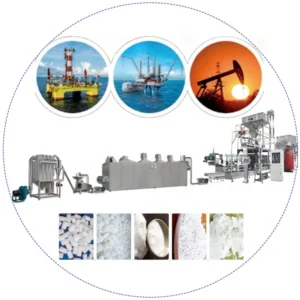
| Food-grade thickener and binder production | Corn starch, wheat flour modified for viscosity control in sauces and bakery |
| Pregelatinised starch for instant foods | Corn and wheat starch gelatinised for cold-water solubility in instant porridge and soup mixes |
| Industrial starch for textile sizing | Modified corn starch with controlled film-forming properties for yarn treatment |
| Paper coating and surface sizing | Denatured wheat and corn starch adjusted for rheology in paper manufacturing |
| Nutritional powder base ingredients | Partially hydrolysed starch for infant formula and dietary supplement carriers |
What "300 kg/h Capacity" Leaves Out on a Modified Starch Processing Line Turnkey
Nominal capacity means nothing when your cassava starch gelatinises at a completely different temperature than the corn starch used for factory testing.
I learned this the hard way on a project in West Africa. We shipped a line tested on standard corn flour, and it ran perfectly in our workshop. The buyer’s actual raw material was high-amylose cassava starch with a gelatinisation onset nearly fifteen degrees off what our barrel profile was set for. The output came out half-cooked, full of ungelatinised cores, and we had to tear down the entire temperature curve and rebuild it from scratch on site. [NEED_CITE: gelatinisation temperature variation across starch sources] That experience is why every modified starch processing line turnkey project we ship now requires a trial run on the buyer’s exact raw material before the crate gets sealed.
How Barrel Zones Define Your Modification Degree
Each heating zone along the twin-screw barrel operates independently, and that segmentation is what gives you control over the degree of starch modification. A modified starch processing line turnkey configuration with seven individually managed zones allows the operator to create a stepped temperature profile — starting mild in the feed section to prevent premature gelatinisation, then ramping through the compression and metering zones where the actual denaturation reaction occurs. The integrated barrel cooling circuits are just as critical as the heating rings, because overshooting the target temperature by even a small margin can push past the desired modification window and degrade the starch polymer chains you are trying to preserve.
Matching Screw Geometry to Starch Rheology
Twin-screw extrusion for starch modification depends heavily on screw element arrangement rather than a fixed screw design. Forward-conveying elements, kneading blocks, and reverse elements each serve a different function in managing shear, residence time, and mixing intensity. A high degree of cross-linking modification requires longer residence time under moderate shear, which means more kneading blocks and fewer aggressive conveying elements. For pregelatinised starch where the goal is complete gelatinisation with minimal molecular degradation, the screw profile shifts toward gentle compression with rapid throughput. [NEED_CITE: screw element configuration impact on starch modification] Getting this wrong does not produce a slightly off product — it produces output that fails the buyer’s downstream specification entirely.
Reading the Specs That Actually Matter
The screw diameter and length together define the L/D ratio, which governs how much residence time the material has inside the barrel before exiting the die. A longer barrel relative to its diameter gives more room for staged temperature transitions and more thorough starch modification, which matters when you are targeting precise functional properties like cold-water solubility or specific viscosity ranges. Installed power figures across the MT70, MT85, and MT100 models scale with barrel volume and throughput class, but power consumption running roughly twenty to thirty percent below installed capacity reflects the difference between peak mechanical demand and steady-state operation. The heating ring specification — for instance, seven zones at two kilowatts each on the MT70 — tells you the thermal energy budget available for gelatinisation, and whether that budget is sufficient depends directly on the modification degree your target product demands. Voltage configuration must be locked in before production begins because rewiring a PLC cabinet and heating circuits on site is far more disruptive than confirming the buyer’s supply standard during the quotation stage.
The Cost of Skipping the Raw Material Trial
Buyers who accept a line tested only on generic starch and skip the factory trial on their own material frequently discover the problem after the machine is bolted to their floor. The extruder may run, but the dryer capacity could be mismatched to the actual moisture content of the extrudate, creating a bottleneck that caps the entire line below the quoted output. Die configuration chosen without knowing the real viscosity behaviour of the buyer’s starch can produce extrudate that is too dense to dry uniformly, leading to inconsistent modification across the batch. [NEED_CITE: throughput mismatch between extruder and dryer in starch processing lines] These are not adjustment issues that get solved with a parameter tweak — they require physical hardware changes that delay production for weeks.
Why This Supplier Configuration Works for Starch Projects
Every station on this line — hydrolysis, saccharification, denaturation extrusion, drying, and packing — is engineered under one supplier, which means throughput calculations account for the actual mass flow between each stage rather than assuming nominal ratings from separate equipment vendors. Screw and die configurations are documented and matched to the buyer’s target modification specification, not copied from a generic build. The in-house testing workshop runs the buyer’s actual starch source before shipment, producing a trial report that confirms real-world behaviour. Electrical schematics, voltage confirmation, and control language are verified during the specification stage so commissioning is not delayed by mismatched supply standards. PLC and MCC control integration means the entire line from batching to packing operates under a unified logic system rather than disconnected standalone controllers.
Documentation & Verification
- Line layout and capacity calculation showing throughput matching from hydrolysis station through drying to packing
- Screw and die configuration record matched to your target modification degree and starch source
- Factory trial run report on your specific raw material conducted before dispatch
- Electrical schematic with confirmed voltage, frequency, and control language specification
- CE declaration of conformity and ISO certificate for customs and regulatory clearance
- Wear parts list covering screws, dies, and heating rings with recommended replacement intervals
Installation, Commissioning & Support
- Foundation plan accounting for the 41 to 45 metre line length and dynamic load from twin-screw operation
- Dedicated power circuit sized for up to 210 kW installed capacity with voltage matching confirmed pre-shipment
- Modular station delivery with documented reassembly sequence for hydrolysis, extrusion, and drying sections
- First-run parameter setting for barrel zone temperatures, screw speed, and feed rate on your starch source
- Operator training covering PLC interface navigation, alarm response, and screw configuration changeover
- Wear parts inventory including spare 38CrMoAl screw elements and die plates for initial replacement cycle
What We Need to Scope Your Line Accurately
To configure a line that holds its rated throughput on your actual material, we need to know your starch source type and any pre-treatment it receives before extrusion. Share your target modification specification — whether pregelatinisation, cross-linking, or denaturation — along with the functional properties your downstream customer requires. Confirm your facility voltage, frequency, and preferred control language so the electrical build matches your site conditions from day one.
Frequently Asked Questions
Q: How is output capacity verified against my specific starch source and modification target?
A: We conduct a trial run in our in-house testing workshop using your actual raw material, not generic corn starch. The trial measures real throughput, gelatinisation behaviour, and extrudate moisture entering the dryer. A full report with process parameters is shared before shipment so you can review the data against your product specification.
Q: What prevents dryer or packing bottlenecks on a modified starch processing line turnkey project?
A: Every station is throughput-calculated under one supplier. We match dryer evaporation capacity to the actual moisture content of extrudate from your trial run, and packing speed to the cooled output rate. This eliminates the common failure where an extruder rated at one output is paired with a dryer that cannot keep up.
Q: How are screw configuration and barrel zones selected for different modification degrees?
A: Screw element arrangement — the ratio of conveying elements to kneading blocks — is specified based on the residence time and shear your target modification requires. Barrel zone temperatures are then profiled to match the gelatinisation and denaturation thresholds of your specific starch source, documented in the configuration record.
Q: What voltage and control language options are confirmed before production begins?
A: The standard configuration is 380V 50Hz three-phase, but the line is configurable to 415V 60Hz, 220V 60Hz, or other supply standards. Control language on the PLC interface is confirmed during the specification stage, and electrical schematics are issued for buyer approval before manufacturing starts.
Q: What does on-site installation and commissioning include?
A: Our engineers handle station reassembly, utility connections, and first-run parameter tuning on your raw material. Operator training covers PLC operation, screw changeover procedures, and daily maintenance routines. A wear parts list with replacement intervals is provided so your team can plan inventory before the first changeover is due.
Related products
-
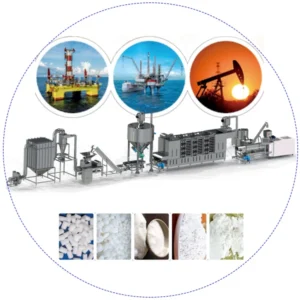
Automatic Pregelatinized Starch Processing Machine – Large-Scale New Condition Modified Starch Production Line
¥65.00 Select options This product has multiple variants. The options may be chosen on the product page -
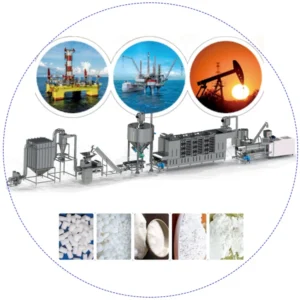
Automatic 304 Stainless Steel Modified Corn Starch Making Machine TWIN SCREW 500kg/h Capacity Starch Processing Production Line
¥50.00 Select options This product has multiple variants. The options may be chosen on the product page -
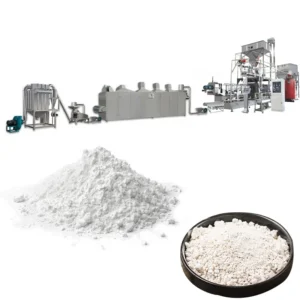
API Standard Pregelatinized Starch Line for Oilfield Drilling Fluid. High Yield Modified Starch Equipment
¥65.00 Select options This product has multiple variants. The options may be chosen on the product page -
2025 New Design Modified Starch Big Capacity Industrial Use Food Additives Core Components Motor Bearing
¥50.00 Select options This product has multiple variants. The options may be chosen on the product page