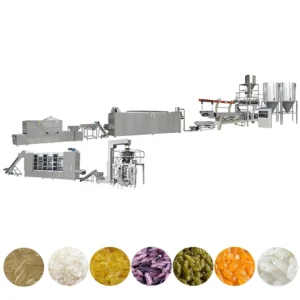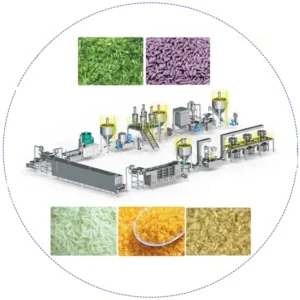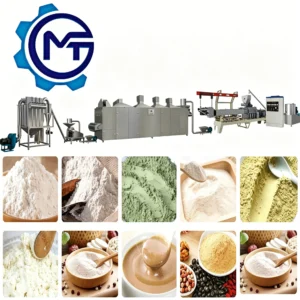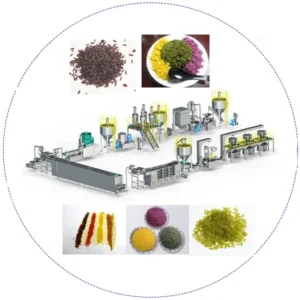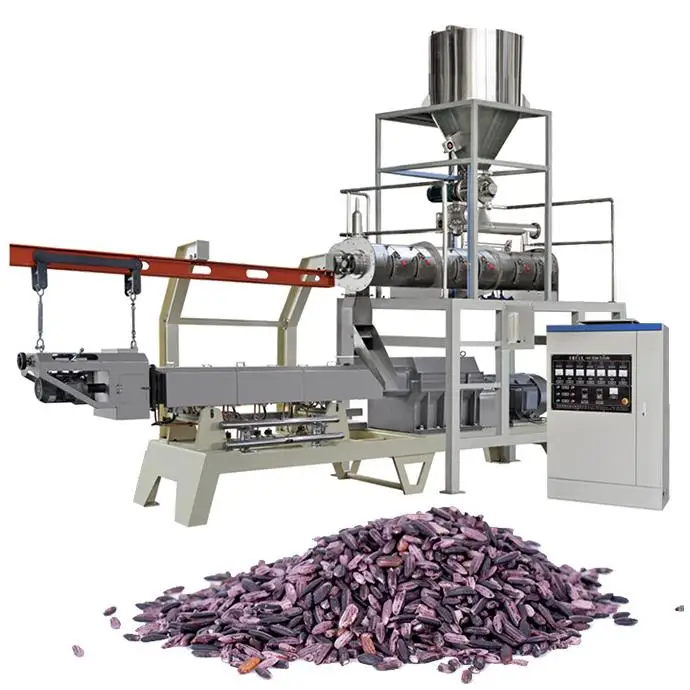


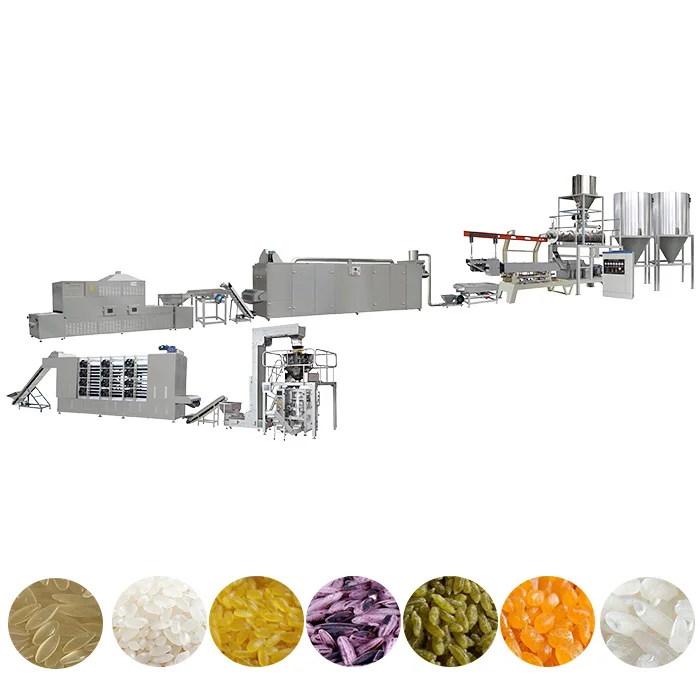
MT65 Nutritional Fortified Rice Extrusion Line, Twin Screw, 85 kW Installed Power — engineered for turnkey project integration from batching through packing.
- Screw configuration and die design matched to your raw material blend and target rice kernel shape
- Circulation drying with adjustable mesh belt speed ensures precise moisture control without kernel cracking
- Frequency speed control across extruder and dryer maintains stable throughput
Backed by in-house trial runs on your actual formulation before shipment, complete line layout documentation, and ongoing wear parts support.
Description
Throughput Matched End-to-End — Every station on this nutritional fortified rice extrusion line, from the batching hopper through the packing weigher, is sized against the same validated capacity rather than assembled from off-the-shelf components that choke or idle downstream.
Technical Specifications
| Parameter | Value |
|---|---|
| Product Type | Nutritional Fortified Rice Extrusion Line |
| Model | MT65 |
| Extruder Type | Twin Screw Extruder |
| Installed Power | 85 kW |
| Power Consumption | 60 kW |
| Output Capacity | 80–100 kg/h (basis not stated in source — confirm raw material type, moisture content, and final product shape) |
| Overall Dimensions | 28 × 1.2 × 2.2 m |
| Control System | Frequency speed control, high automation |
| Feeding System | Single or double screw feeding (selected according to material) |
| Screw Material | Special wear-resistant alloy (source value — verify against manufacturer catalog) |
| Lubrication | Automatic lubricating and cooling system |
| Heating Source (Dryer) | Electric or gas |
| Dryer Feature | Circulation drying, frequency motor controls mesh belt speed |
| Line Stations | Mixing → Extruding → Vibrating → Low temperature drying → Cooling → High temperature roasting → Cooling → Packing |
Application Suitability
| Application | Material or Output |
|---|---|
| Fortified food and nutrition programme rice | Broken rice, rice bran, corn, millet with vitamin and mineral premix |
| Artificial rice kernel production | Reconstituted rice flour, starch blends shaped into natural-grain-look kernels |
| Colored and functional rice variants | Purple sweet potato, multigrain blends, buckwheat, oats, beans |
| Micro-nutrient solidification | Mineral and vitamin fortification embedded in starch matrix during extrusion |
Why "Rated Capacity" Misses the Real Output on Fortified Rice Blends
A nominal throughput figure means nothing until the line is validated on your actual grain and premix formulation.
I have watched lines arrive at sites in West Africa and South Asia only to stall at half their quoted output because the screw profile was copied from a standard corn snack build, not specified for a sticky purple sweet potato blend or a high-fiber multigrain mix. The extruder runs, but the dryer cannot keep up, the cooling belt overloads, and the packing station sits idle waiting for product that never stabilizes in moisture. Buyers end up recalibrating temperature zones and screw speeds for weeks before the Fortified Rice Extrusion Line turnkey produces acceptable kernels [NEED_CITE: common commissioning delays on grain-based extrusion lines]. The capacity number on the quotation sheet becomes irrelevant the moment a real formulation hits the feed hopper.
Screw Configuration and Die Design Dictate Kernel Integrity
The twin-screw extruder on this line is configured after the buyer’s raw material and target rice kernel shape are confirmed, not pulled from a generic catalog build. Screw pitch, compression ratio, and die aperture together determine whether a vitamin-fortified blend expands into a firm, separate kernel or collapses into a starchy mass. Moisture content at the feeding stage and barrel temperature profile across multiple heating zones must align with the specific starch gelatinisation behaviour of the buyer’s grain mix. When a purple sweet potato formulation replaces white rice flour, the shear and residence time requirements shift entirely, and the screw arrangement must be rebuilt to match.
How Line-Wide Throughput Matching Prevents Downstream Bottlenecks
A Fortified Rice Extrusion Line turnkey project succeeds or fails on whether every station passes product at the same rate. The vibrating separator after extrusion must handle peak output without blinding, the low-temperature drying belt must reduce moisture to a safe level before the cooling stage, and the high-temperature roasting section must finish the kernel surface without introducing thermal shock cracks. If the dryer is undersized, partially dried kernels jam the roaster. If the cooling conveyor runs faster than the roaster discharges, product spreads too thin and temperature equalisation fails. This line is laid out so that the rated mass flow at the extruder die is carried through each subsequent station without accumulation or starvation [NEED_CITE: throughput balancing principles in multi-stage food processing lines].
Reading the Specifications That Matter on the Floor
The 85 kW installed power and 60 kW running consumption tell you the electrical infrastructure required — a dedicated circuit with headroom for start-up surge, not a shared workshop bus. Frequency speed control on both the extruder main drive and the dryer mesh belt motor means operators can fine-tune output rate and moisture removal independently, which is critical when switching between a high-starch broken rice formula and a fiber-rich multigrain blend. The single or double screw feeding option, selected according to material flow characteristics, prevents bridging in the hopper when handling fine premix powders versus coarse ground grains. The automatic lubricating and cooling system on the gearbox extends service intervals and protects the screw shaft bearings during continuous multi-shift runs, reducing unplanned stops that would otherwise interrupt the entire line rhythm.
The Hidden Cost of Skipping a Pre-Shipment Trial Run
When a line ships without a trial run on the buyer’s actual raw material, commissioning becomes a full-scale product development exercise conducted on the factory floor under production pressure. Screw speed, barrel temperature, die clearance, and dryer belt speed all need recalibration once real formulation data replaces the assumptions made at quotation stage. In my experience across installations in tropical climates, the ambient humidity alone shifts drying curves enough to require re-tuning of the circulation dryer’s temperature zones and mesh belt timing. Buyers lose weeks of sellable output while engineers chase parameters that should have been locked down in the testing workshop before crating [NEED_CITE: impact of ambient conditions on extrusion drying curves].
Why Sourcing the Full Line from One Supplier Matters Here
Matching throughput across mixing, extruding, vibrating, drying, roasting, cooling, and packing under one engineering responsibility eliminates the blame-shifting that occurs when each station comes from a different vendor. The screw configuration and die design are specified to the buyer’s exact grain blend and kernel shape target, not borrowed from a reference project running a different formulation. An in-house testing workshop allows trial runs on the customer’s raw material before the Fortified Rice Extrusion Line turnkey ships, so process parameters are documented and transferable rather than guessed on site. Pre-sales line layout and capacity calculation, followed by on-site installation, commissioning, and operator training, keep one technical team accountable from first drawing to stable production. Electrical schematics and voltage confirmation are completed before production begins, so the control cabinet arrives wired for the destination market’s frequency and language requirements.
Documentation & Verification
- Line layout drawing showing matched throughput at each station from mixer to packer
- Trial run report on buyer’s grain blend and premix, recorded before crating
- Screw and die configuration sheet tied to the validated formulation
- Electrical schematic with destination voltage, frequency, and control language noted
- CE declaration of conformity covering the complete integrated line
- Operation and maintenance manual with wear parts list and replacement intervals
Installation, Commissioning & Support
- 28 m line length requires clear floor span with level concrete base and anchor points at each station
- 85 kW installed load needs dedicated switchgear and soft-start or VFD on the main extruder motor
- Twin screw extruder ships with barrel and screw elements separated for container loading, reassembled on site
- First-run commissioning includes moisture profiling across the circulation dryer and roaster to lock belt speed
- Operator training covers frequency drive adjustment, feeding system changeover, and automatic lubrication checks
- Wear parts list specifies screw elements, die plates, and dryer belt sections with reorder part numbers
What We Need to Quote Accurately
Share the raw material formulation you intend to run — grain types, ratios, moisture content, and any vitamin or mineral premix additions — along with the target kernel size and shape. Confirm the daily output target so the line can be sized beyond a single shift if required. Provide the workshop floor plan and ceiling height, plus the local voltage, phase, and frequency at the installation site so the electrical package is built to match before the Fortified Rice Extrusion Line turnkey leaves the factory.
Frequently Asked Questions
Q: How is the line capacity verified on my specific raw material blend before shipment?
A: Your grain formulation and premix are run in the testing workshop on the same twin-screw extruder model specified for your order. Output rate, moisture reduction across the dryer, and kernel integrity are measured and recorded. The trial run report is shared with you before crating, so the capacity figure you receive is tied to your actual material, not a generic benchmark.
Q: What screw configuration and die design do you recommend for my fortified rice formulation?
A: The screw element arrangement and die aperture are selected after your raw material data and target kernel shape are reviewed. A high-starch broken rice blend requires a different compression profile than a fiber-heavy multigrain mix. The configuration record is documented and shipped with the line so future rebuilds or replacements match the validated setup.
Q: How do you ensure the dryer and packing station match the extruder throughput without bottlenecking?
A: The line layout and capacity calculation document specifies mass flow at every station based on the validated extruder output. The circulation dryer belt speed, roaster residence time, and cooler length are all sized to carry the same throughput, and the packing weigher is rated for the resulting batch rate so no station accumulates or starves product.
Q: What voltage, frequency, and control language options are confirmed before production begins?
A: The destination market electrical standard is confirmed during the specification stage, and the control cabinet is wired for the correct voltage and phase. The frequency drive parameters and HMI language are set to match the site requirements. The electrical schematic reflecting these choices is included in the documentation package shipped with the line.
Q: How are spare wear parts such as screws and dies stocked and supplied after installation?
A: A wear parts list specific to your screw configuration and die design is included in the documentation. Replacement screw elements, die plates, and dryer belt sections carry distinct part numbers for reorder. Consumable components are available directly from the factory, and lead times are confirmed at the time of initial spare parts procurement to align with your maintenance schedule.
Related products
-

High Precision Automatic 500kg/h Baby Food Nutrition Powder Rice Extrusion Processing Line
¥8,238.27 Add to cart -
500kg/h Automatic PLC Controlled Nutrition Baby Food Extruder Machine for Rice Cereal Processing
¥9,500.00 Add to cart -
Hygienic Stainless Steel Infant Rice Powder Processing Line Automatic 500kg/h Capacity PLC Controlled
¥9,500.00 Add to cart -

New Automatic Nutritional Powder Making Machine for Baby Food Production Line
¥20.00 Select options This product has multiple variants. The options may be chosen on the product page