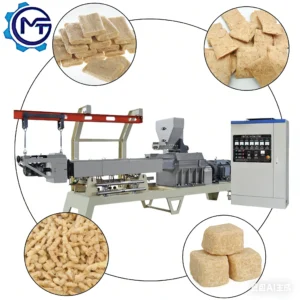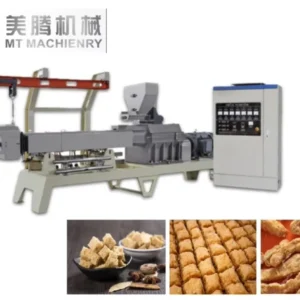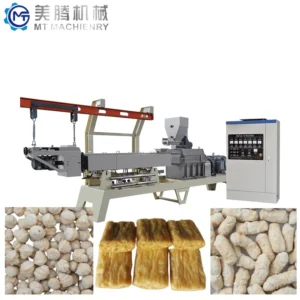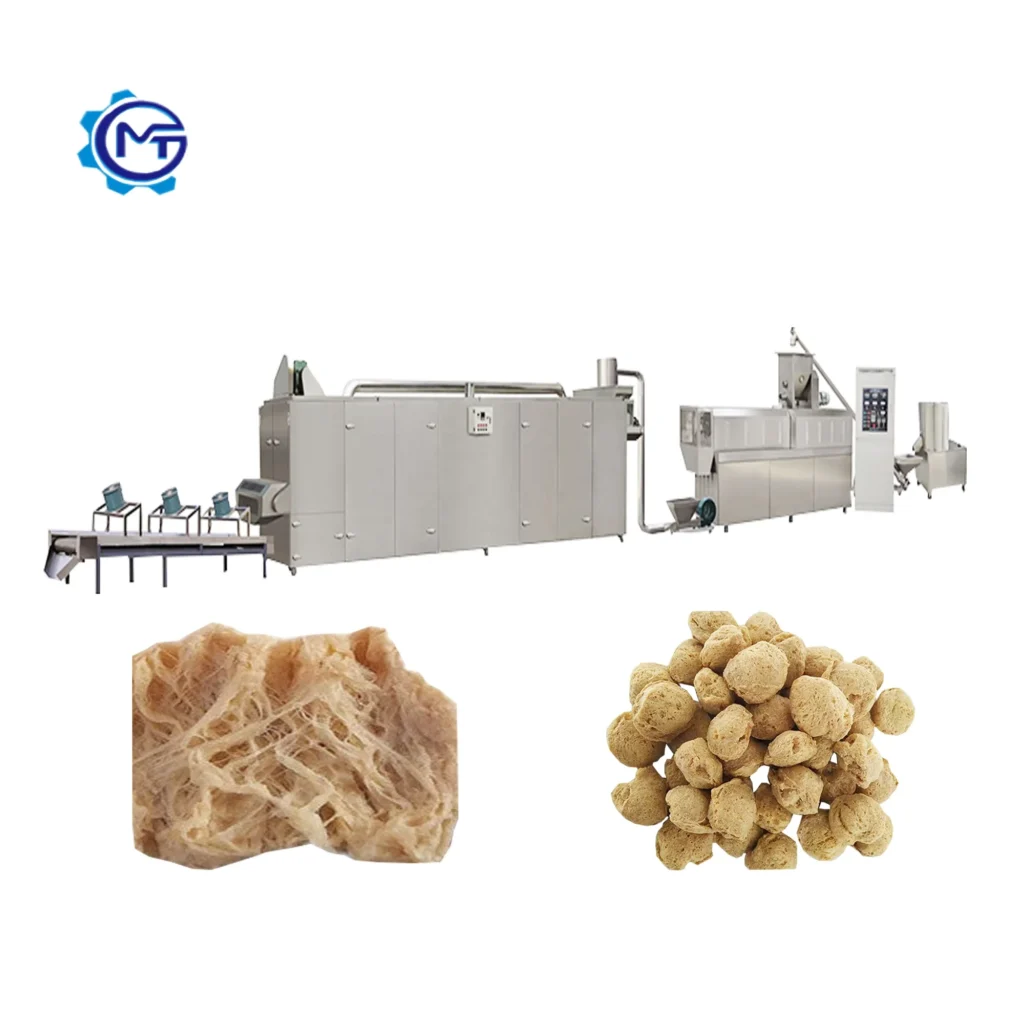


MT65 / MT70 / MT85 Texturized Vegetable Protein Extrusion Line, Twin-Screw, Stainless Steel — engineered for plant-based meat processing from raw material batching through extrusion, drying, cooling, and packing.
- High-shear twin-screw extrusion reorganizes protein molecules into fibrous, meat-like texture; screw configuration and die design specified to your soybean meal, peanut meal, or pea protein blend and target fiber density
- Three capacity tiers (MT65 / MT70 / MT85) support phased scaling from pilot output to full production runs
- Dedicated roaster with far-infrared heating ensures consistent drying without case-hardening protein fibers
In-house testing workshop validates fiber structure, density, and water absorption on your actual raw material before shipment, with full line layout and throughput-matched station calculations provided.
Description
Turnkey line engineering — Every station from batching to packing is throughput-matched under one supplier, with screw and die configuration specified to the buyer’s actual protein feedstock rather than copied from a generic build.
Technical Specifications
| Parameter | Value |
|---|---|
| Product Type | Texturized Vegetable Protein (TVP) Extrusion Line |
| Models Available | MT65, MT70, MT85 |
| Screw Type | Twin-screw (Double Screw Extruder) |
| Output Capacity (MT65) | 150–200 kg/h (basis not stated in source — confirm raw material blend & moisture content) |
| Output Capacity (MT70) | 200–300 kg/h (basis not stated in source — confirm raw material blend & moisture content) |
| Output Capacity (MT85) | 600–800 kg/h (basis not stated in source — confirm raw material blend & moisture content) |
| Installed Power (MT65) | 85 kW |
| Real Power (MT65) | 65 kW |
| Installed Power (MT70) | 120 kW |
| Real Power (MT70) | 90 kW |
| Installed Power (MT85) | 195 kW |
| Real Power (MT85) | 165 kW |
| Overall Dimensions (MT65) | 18000 × 1300 × 2300 mm |
| Overall Dimensions (MT70) | 20000 × 1500 × 2400 mm |
| Overall Dimensions (MT85) | 24000 × 3500 × 4300 mm |
| Line Stations | Raw material preparation → Mixing → Conveying → Extrusion → Conveying → Drying → Cooling → Packing |
| Mixer Motor Power | 4 kW |
| Mixer Tank Volume | 150 kg per batch, 10 min mixing cycle |
| Extruder Main Motor Power | 30 kW |
| Extruder Installed Power | 45.87 kW |
| Extruder Actual Power | 30–35 kW |
| Extruder Dimensions | 2800 × 830 × 1875 mm |
| Roaster Effective Belt Length | 3.5 m |
| Roaster Far Infrared Heater Power | 3.9 kW × 24 units |
| Roaster Gas Consumption | 6.8 m³/h |
| Cooling Machine Capacity | 200–300 kg/h |
| Construction Material | Stainless steel across all stations |
| Standards | CE certified, ISO certified |
Application Suitability
| Application | Material or Output |
|---|---|
| TVP chunks for ham and sausage formulation | Low-temperature soybean meal |
| Plant-based meat strips for fast-food assembly | Peanut meal or soy-pea protein blends |
| TVP flakes and granules for canned food | Soybean meal with controlled moisture |
| Meat-alternative ingredients for quick-frozen products | Defatted soy flour and protein concentrates |
| Pilot-scale recipe development | Customer-supplied raw material blends |
Why "Rated Capacity" Means Nothing Without Your Raw Material
A plant based meat processing line turnkey quoted at a nominal throughput can drop to half that output when the buyer’s actual protein blend behaves differently under shear and heat.
I learned this the hard way on a project a few years back. The customer sent us wheat gluten powder after we had already sized the line around soybean meal. The protein structure was completely different — the extrudate came out dense, and once pan-fried the pieces fell apart. We spent two weeks reworking screw elements and die geometry to rebuild the fiber matrix. [NEED_CITE: twin-screw extrusion behavior differences across plant protein sources] That kind of delay on a commissioning site is expensive and stressful. Since then, the rule has been simple: the buyer’s raw material must run through the extruder in our testing workshop before anything ships.
Protein Fiber Formation Under High Shear and Temperature
The twin-screw extruder applies high temperature, high pressure, and intense mechanical shear to spherical protein molecules, forcing them to open into chain structures and reorganize into a fibrous, meat-like texture. Screw element sequencing and barrel temperature zones are configured around the specific protein source — soybean meal, peanut meal, or blended concentrates — so the gelatinisation and texturisation happen at the right point along the barrel. A plant based meat processing line turnkey must get this step right, because no downstream station can fix a poorly structured extrudate.
Drying Without Case-Hardening the Fiber Matrix
The dedicated high-temperature roaster uses far-infrared heating elements across a 3.5-meter effective belt length, with a gas-fired option for facilities that prefer combustion heating. Uniform heat distribution matters here: too aggressive a surface temperature seals the outside of the TVP chunk while trapping moisture inside, and the fiber structure collapses during cooling. [NEED_CITE: far-infrared drying uniformity in protein extrudate processing] The belt speed and zone temperatures are adjustable so the drying curve matches the density and size of the extrudate coming off the die.
Matching Power Draw to What the Barrel Actually Requires
Looking at the spec sheet, MT65 shows 85 kW installed but draws 65 kW in real operation; MT85 is rated 195 kW installed against 165 kW real consumption. The gap between installed and actual power reflects startup surges, heater ramp-up, and the headroom needed when feedstock moisture or protein content shifts between batches. Sizing electrical infrastructure on real power rather than installed power avoids overbuilding transformer capacity while still leaving margin for process variation. The extruder itself, with a 30 kW main motor and 30–35 kW actual draw, represents the core energy consumer on the line.
The Hidden Cost of Mismatched Station Throughput
When the mixer batches at a rate the extruder cannot absorb, wet material sits in the hopper and begins to ferment. When the dryer belt cannot keep pace with extruder output, product backs up on the conveyor and cools unevenly before entering the roaster, producing inconsistent moisture content in the finished TVP. I have walked onto sites where every individual machine was well-built but the line was assembled from separate vendors who never confirmed throughput across stations. [NEED_CITE: throughput bottlenecks in multi-station food extrusion lines] The result is a plant based meat processing line turnkey in name only, with operators constantly adjusting feeder speeds to prevent pile-ups or starvation.
Why Procurement Through a Single Line Integrator Matters
Every station on this line — mixer, conveyor, extruder, roaster, cooler, packing — is specified so its throughput aligns with the adjacent station, eliminating the guesswork of assembling equipment from multiple vendors. Screw configuration and die design are documented against the buyer’s raw material and target product format, whether that is chunks, flakes, granules, or strips. An in-house testing workshop runs the buyer’s actual soybean meal or peanut meal before shipment, generating a trial run report that captures fiber structure, density, and water-absorption characteristics. Electrical schematics confirm voltage and frequency for the destination market before production begins, preventing commissioning delays. CE and ISO certifications are held on file, and line layout drawings show the physical footprint and utility connections needed for installation planning.
Documentation & Verification
- Factory trial run report on buyer’s soybean or peanut meal, recording fiber density and water absorption before dispatch
- Screw and die configuration record matched to target TVP format — chunks, flakes, granules, or strips
- Line layout drawing with station-by-station throughput calculation and utility connection points
- Electrical schematic confirming voltage, frequency, and control language for the destination market
- CE declaration of conformity and ISO certificate on file for customs and regulatory review
- Operation and maintenance manual with wear parts list and replacement intervals
Installation, Commissioning & Support
- MT85 line requires a 24-meter clear floor length with 4.3-meter ceiling clearance for the tallest station
- Electrical supply must match confirmed voltage and frequency; dedicated circuit breaker sized to real power draw
- Extruder barrel sections and screw shafts ship disassembled for container loading and are reassembled on site
- First production run uses trial-run parameters as baseline, then fine-tunes moisture feed and barrel temperatures
- Operator training covers screw element replacement, die cleaning, and roaster belt tension adjustment
- Wear parts list identifies screws, dies, and mixer blades with reorder lead times for planning
Preparing Your Line Inquiry
To size a plant based meat processing line turnkey accurately, provide your raw material type and protein content, target daily output, and the product format you need — chunks, strips, flakes, or granules. Confirm your facility’s available floor space, ceiling height, and local voltage and frequency standards. If you have existing upstream milling or downstream packing equipment, share the make and throughput so we can match the interface. Sending a representative sample of your raw material for a workshop trial run is the most reliable way to lock in screw configuration and die geometry before production begins.
Frequently Asked Questions
Q: How is line capacity verified on my specific raw material blend?
A: We run your actual soybean meal, peanut meal, or blended protein through the extruder in our testing workshop before shipment. The trial run documents extrudate fiber structure, density, and water-absorption rate, and we use those results to finalize screw element sequencing and die geometry. Capacity figures are then confirmed against your material rather than quoted as generic nominal values.
Q: What screw configuration and die design suit my target product shape?
A: Screw element arrangement and die aperture are specified to your desired TVP format — chunks, flakes, granules, or strips — and to the protein behavior of your raw material. The configuration record is documented before production, so you know exactly what is inside the barrel and can reorder wear parts when replacement is due.
Q: How do you ensure no station bottlenecks the rest of the line?
A: Every station is selected and matched under one supplier, so mixer batch cycle time, extruder throughput, roaster belt speed, and cooler capacity are calculated against each other during the layout phase. The line capacity calculation is shared with the buyer for review before fabrication begins, eliminating surprises during commissioning.
Q: What electrical and control details are confirmed before production?
A: Voltage, frequency, and control panel language are confirmed with the buyer before the electrical cabinet is built. An electrical schematic is provided showing circuit layout, breaker sizing based on real power consumption, and motor protection settings, so the facility’s electrical contractor can prepare the supply side in advance.
Q: What support is included once the line arrives on site?
A: On-site installation covers mechanical assembly, electrical connection verification, and a first production run using the trial-run parameters as baseline. Operator training addresses daily startup, screw and die maintenance, and roaster adjustment. A wear parts list with reorder codes and an operation manual are handed over at commissioning completion.
Related products
-
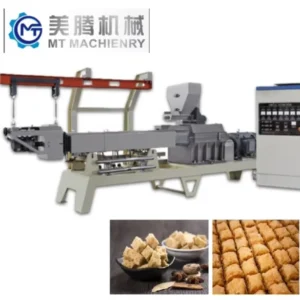
Vegetarian Beef Substitute Making Machine with Twin Screw Extruder
¥9,500.00 Select options This product has multiple variants. The options may be chosen on the product page -
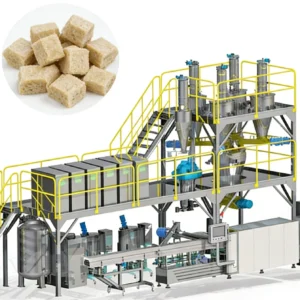
CE Certified Vegetarian Meat Processing Machine
¥9,500.00 Select options This product has multiple variants. The options may be chosen on the product page -
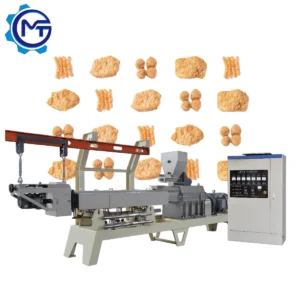
Textured Soy Protein Production Line for Vegetarian Meat Nugget Manufacturing
¥8,238.27 Select options This product has multiple variants. The options may be chosen on the product page -
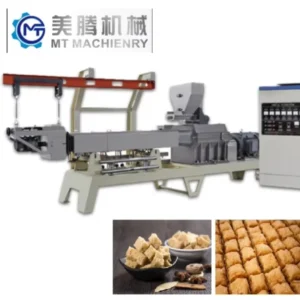
Automatic TVP Vegetarian Meat Manufacturing Plant
¥9,500.00 Select options This product has multiple variants. The options may be chosen on the product page