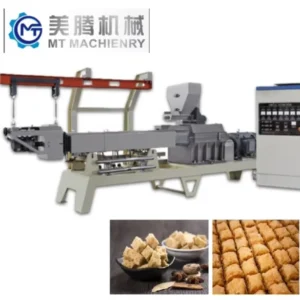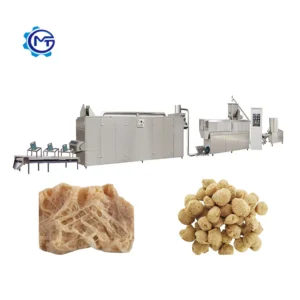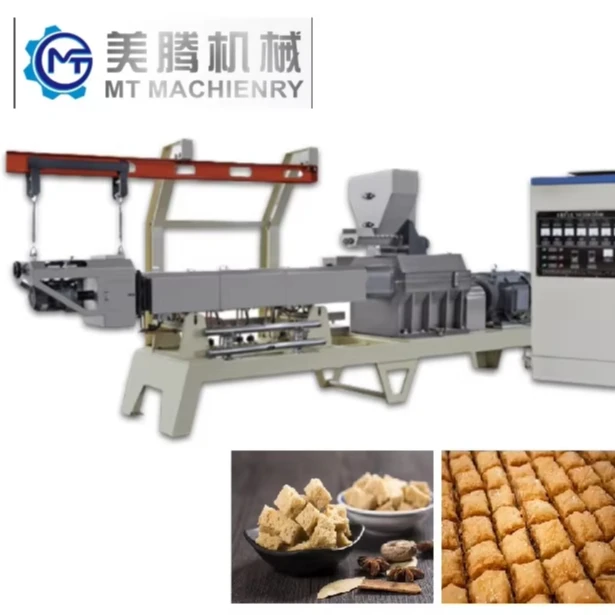
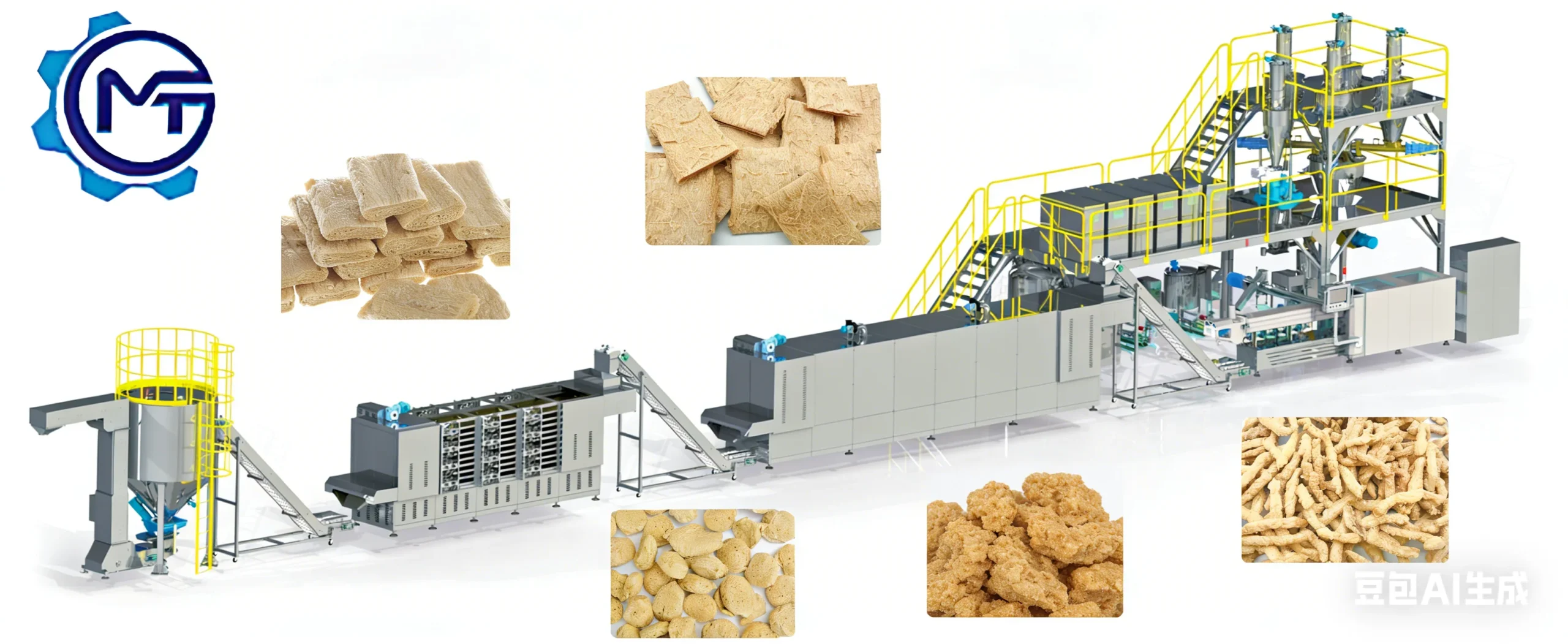
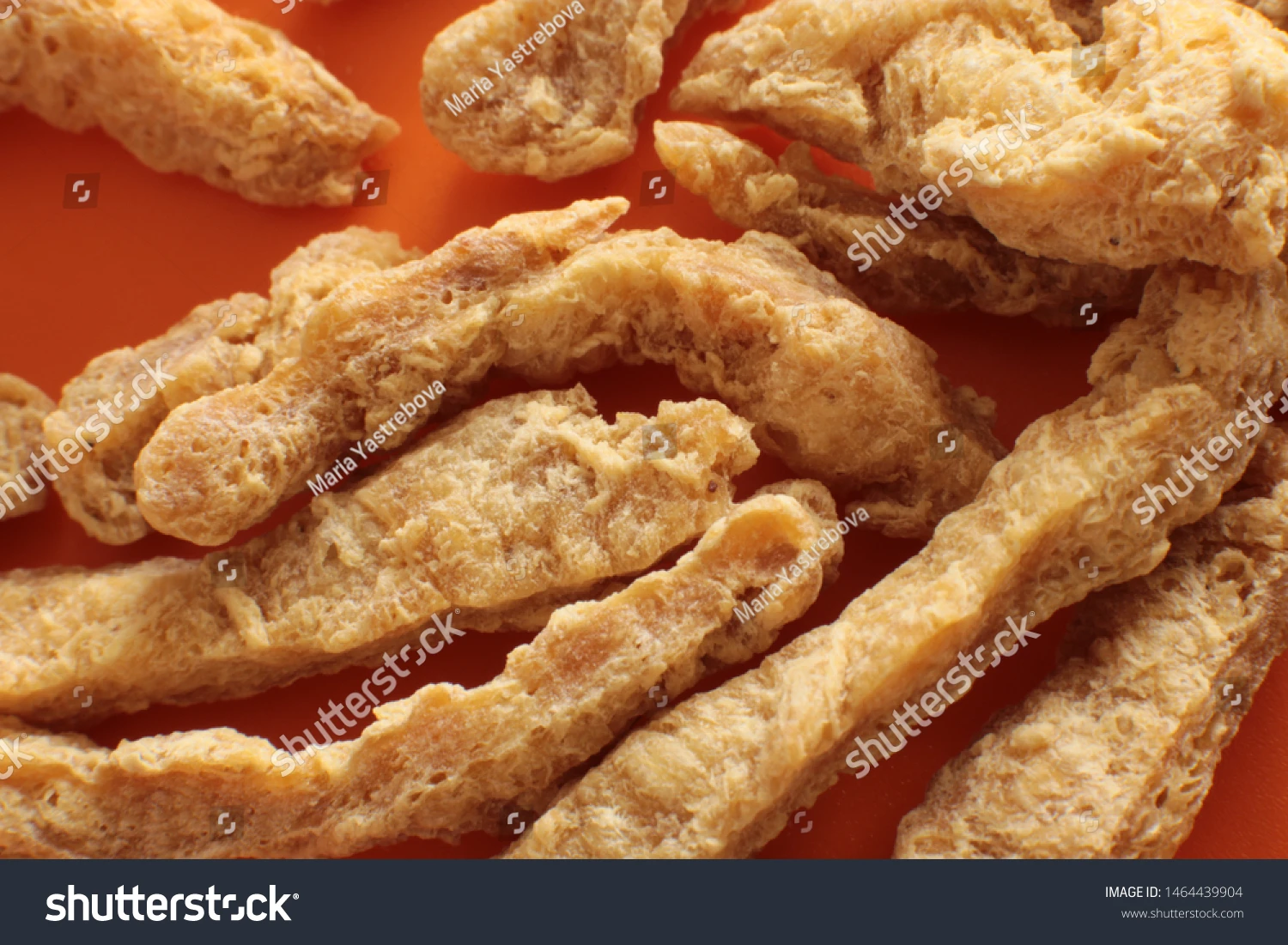
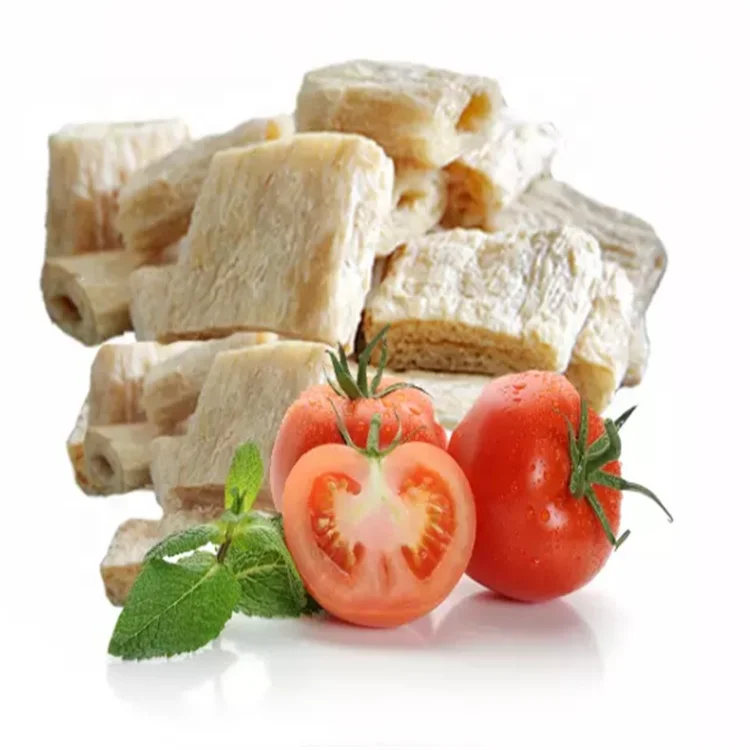
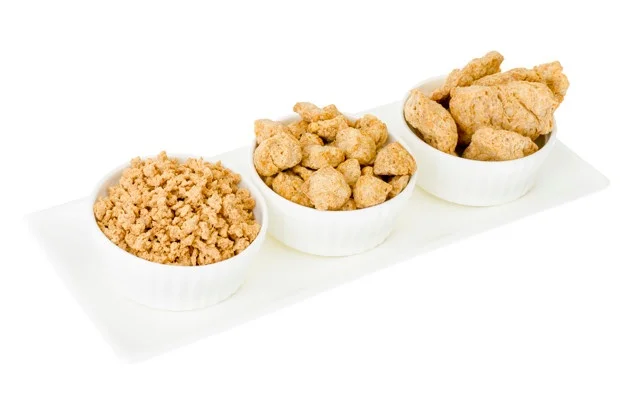
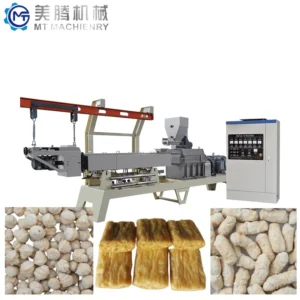
MT65 / MT70 / MT75 / MT85 Twin Screw Extruder Production Line for Texturized Vegetable Protein (TVP), PLC and MCC control, multi-layer dryer with adjustable temperature — delivers matched throughput from batching through extrusion to cooling for consistent TVP texture.
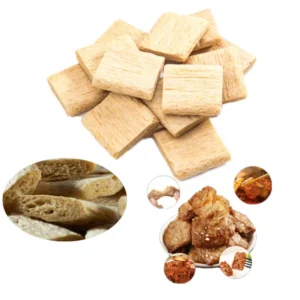
Screw configuration and die design are specified to your raw material, whether defatted soya flour or low-temperature soya flakes, controlling expansion and fiber structure for soya chunks, nuggets, or granular plant-based meat formats.
- In-house testing workshop verifies output on your specific formulation before shipment
- Complete turnkey layout with every station’s capacity matched to eliminate bottlenecks
- On-site installation, commissioning, and operator training included with full documentation
Description
Throughput-Matched Turnkey Engineering — every station from batching to packing is calculated against your raw material behaviour, not assembled from generic catalog modules.
Technical Specifications
| Parameter | Value |
|---|---|
| Product Type | Twin Screw Extruder Production Line for Texturized Vegetable Protein (TVP) |
| Available Models | MT65, MT70, MT75, MT85 |
| Screw Type | Twin-screw |
| Screw Length | 1050 mm / 1520 mm |
| Main Motor Power | 22 kW / 30 kW / 45 kW |
| Feeding Motor Power | 0.75 kW |
| Rotary Cutting Motor Power | 0.75 kW |
| Pump Motor Power | 0.37 kW |
| Heating Power | 10 kW / 14 kW |
| Installed Power (MT65) | 84 kW |
| Installed Power (MT70) | 160 kW |
| Installed Power (MT75) | 190 kW |
| Installed Power (MT85) | 210 kW |
| Power Consumption (MT65) | 59 kW |
| Power Consumption (MT70) | 120 kW |
| Power Consumption (MT75) | 140 kW |
| Power Consumption (MT85) | 140 kW |
| Output Capacity (MT65) | 100–150 kg/h (basis to be confirmed) |
| Output Capacity (MT70) | 150–200 kg/h (basis to be confirmed) |
| Output Capacity (MT75) | 150–200 kg/h (basis to be confirmed) |
| Output Capacity (MT85) | 250–300 kg/h (basis to be confirmed) |
| Overall Dimensions (MT65) | 40000 × 1200 × 2200 mm |
| Overall Dimensions (MT70) | 41000 × 1500 × 2200 mm |
| Overall Dimensions (MT75) | 43000 × 1500 × 3200 mm |
| Overall Dimensions (MT85) | 45000 × 1500 × 3500 mm |
| Control System | PLC and MCC (configuration to be confirmed) |
| Mixer Type | Vertical, stainless steel 304 mixing ruler, carbon steel shelf |
| Mixer Power Options | 4 kW / 7.5 kW / 15 kW |
| Mixer Capacity Options | 20–30 kg / 70–80 kg / 170–180 kg |
| Dryer Type | Multi-layer, double pitch roller chain drive, round-trip drying |
| Dryer Fuel Options | Fuel / gas / electricity (customer selectable) |
| Dryer Temperature & Time | Adjustable |
| Line Stations | Mixer → Screw Conveyor → Twin Screw Extruder → Air Conveyor → Multi-layer Dryer → Cooling Machine |
| Assembly State | Complete turnkey line |
| Standards | CE, ISO |
Application Suitability
| Application | Material or Output |
|---|---|
| Texturized vegetable protein (TVP / TSP) | Defatted soya flour, low-temperature soya flakes |
| Soya chunks and soya nuggets | Soya flour blended with starch and fibre |
| Plant-based meat analogues | Pea protein, soy protein isolate, wheat gluten blends |
| Vegetarian meat alternatives | Soybean dregs, peanut dregs mixed with binders |
| Fortified protein ingredients | Cereal and snack formats via screw configuration change |
Why Nominal Capacity Fails on Actual Protein Blends
A plant based meat processing line turnkey quoted on generic throughput will underperform the moment your formulation hits the barrel.
I learned this the hard way in Shandong. Last year we configured a line using lab-grade soy data, then the buyer switched to a pea protein mix and the expansion ratio collapsed — an entire week of trial production wasted. The extruder was pushing material at the rated screw speed, but the die pressure and moisture window were wrong for that specific blend. Capacity numbers without raw material context are just marketing [NEED_CITE: raw material variability in protein extrusion processes]. A serious TVP production line proposal must show how each station handles your actual recipe, not a theoretical average.
Screw Configuration Dictates Protein Fibre Alignment
The twin-screw geometry determines shear intensity, residence time, and the degree of protein molecular alignment inside the barrel. For TVP nuggets, a high-shear screw profile with a short residence zone produces a dense, meat-like fibre structure. For soya chunks requiring a more open, spongy texture, the screw elements are rearranged to reduce shear and extend the melting zone. Every plant based meat processing line turnkey we ship leaves the factory with a screw configuration record tied to the buyer’s specific raw material sample.
Die Geometry Controls Expansion and Rehydration Behaviour
The die plate is where the extrudate takes its final shape and where the pressure drop triggers expansion. A small die opening with high back-pressure yields dense chunks that rehydrate slowly and hold their shape in cooking. Larger openings produce lighter, faster-rehydrating granules suited for instant meal applications. Getting this wrong means the end consumer either bites into a rubbery lump or a mushy fragment. Our die designs are matched to your target product format and validated in the testing workshop before the line ships [NEED_CITE: die design influence on TVP texture and rehydration].
Reading the Power and Dimension Data
The main motor power steps from 22 kW on the MT65 to 45 kW on the MT85, reflecting the torque required to push higher-viscosity protein dough through longer screw barrels. Installed power spans 84 kW to 210 kW across the full line, with actual consumption typically lower — 59 kW to 140 kW — because heating elements cycle and motors rarely run at full load simultaneously. The overall dimensions stretch from 40 metres to 45 metres in length, which means your facility needs a straight-run floor space of at least 50 metres including raw material staging and finished product cooling. Multi-layer dryer fuel options — fuel, gas, or electricity — should be selected based on your local energy cost and availability, as this station alone has a significant impact on operating expense.
The Hidden Cost of a Mismatched Dryer Station
An extruder producing at full rate means nothing if the dryer cannot remove moisture fast enough to prevent mould growth downstream. I have seen lines where the extruder was correctly sized but the dryer belt speed and temperature zones were calculated for a different product density, causing a backlog that forced the entire line to throttle back. The multi-layer, double pitch roller chain dryer on this line is sized to match the extruder output and the specific moisture content of your TVP formulation. When that match is wrong, you either over-dry and create brittle product or under-dry and risk spoilage [NEED_CITE: moisture content targets for shelf-stable TVP].
Why Procure the Full Line from One Source
Throughput matching across every station eliminates the finger-pointing that happens when separate vendors supply the mixer, extruder, and dryer. Our in-house testing workshop runs your actual raw material through the configured screw and die setup before the line leaves Shandong — not after installation on your floor. Electrical schematics confirm voltage, frequency, and control language to your site conditions before production starts. The PLC and MCC control architecture is designed at the line level, so every station communicates correctly from day one. CE and ISO documentation ships with the line, not as an afterthought.
Documentation & Verification
- Line layout showing throughput calculation for each station matched to your TVP recipe
- Screw and die configuration record tied to your raw material sample test
- Trial run report from factory testing workshop using customer-supplied protein blend
- Electrical schematic with voltage, frequency, and PLC language confirmed to site conditions
- Operation and maintenance manual covering every station from mixer to cooling conveyor
- Wear parts list specifying screw elements, die plates, and dryer chain components
Installation, Commissioning & Support
- Floor space allocation based on the 40–45 metre line footprint plus utility clearances
- Dedicated power circuit sized to the 84–210 kW installed power range of your selected model
- Phased station-by-station commissioning starting with mixer calibration before extruder start
- First-run parameter setting on your raw material with screw speed, barrel temperature, and die pressure logged
- Operator training covering PLC interface, screw configuration changes, and dryer temperature adjustment
- Wear parts supply plan for screw elements, die plates, and mixer blades from day one
What We Need to Configure Your Line
To build an accurate plant based meat processing line turnkey proposal, send us your raw material specification sheet including protein content, particle size, and moisture level. Tell us the target product format — nuggets, chunks, or granules — and the daily output you need to hit. Confirm your facility voltage, frequency, and preferred control language so the electrical package is correct before fabrication begins.
Frequently Asked Questions
Q: How is line capacity verified against my specific raw material and recipe?
A: We run your actual raw material blend through the configured screw and die setup in our in-house testing workshop before shipment. The trial run report documents throughput, expansion ratio, and product texture against your target specification, so capacity is confirmed on your formulation rather than a generic benchmark.
Q: How do you match throughput between the extruder, dryer, and downstream stations?
A: Each station is calculated from the extruder output forward. The mixer batch size and cycle time, screw conveyor feed rate, dryer belt speed and temperature zones, and cooling conveyor length are all sized so no single station creates a bottleneck or forces the line to throttle back during continuous operation.
Q: What screw and die configuration will be used for my target TVP format?
A: The screw element arrangement and die plate geometry are selected based on your raw material behaviour and target product — whether dense chunks, fibrous nuggets, or fast-rehydrating granules. The configuration record ships with the line so your team can replicate or adjust it for future production runs.
Q: What is the commissioning schedule and phased installation process for a complete line?
A: Installation follows a station sequence starting with the mixer and conveyor, then the extruder, dryer, and cooling machine. Each station is powered on and calibrated individually before the full line runs together. Commissioning typically spans several working days depending on facility readiness and utility connections.
Q: What operator training and documentation are included with the turnkey project?
A: Training covers PLC operation, screw configuration changes, dryer temperature adjustment, and daily maintenance routines. Documentation includes the line layout, capacity calculation, screw and die record, electrical schematic, trial run report, and a wear parts list with replacement intervals for every station.
Related products
-
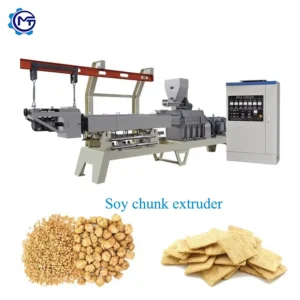
Textured Soybean Protein Extruder Plant Protein Processing Production Line TVP Making Machine
¥30.00 Select options This product has multiple variants. The options may be chosen on the product page -
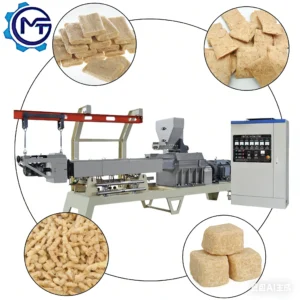
Automatic Vegetarian Meat Production Line with Twin Screw Extruder
¥9,500.00 Select options This product has multiple variants. The options may be chosen on the product page -
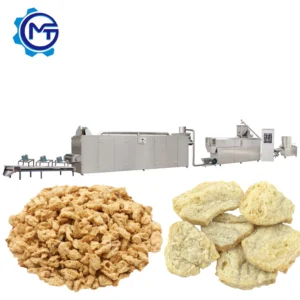
Meat Taste Textured Soybean Protein Processing Machine Vegetable Protein Soy Meat Making Machine
¥8,650.00 Select options This product has multiple variants. The options may be chosen on the product page -
Small Multifunctional Textured Soy Protein Machine – Soy Protein Production Line – Vegetarian Meat Processing Equipment
¥65.00 Select options This product has multiple variants. The options may be chosen on the product page