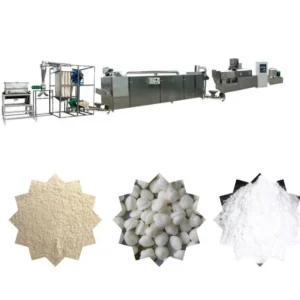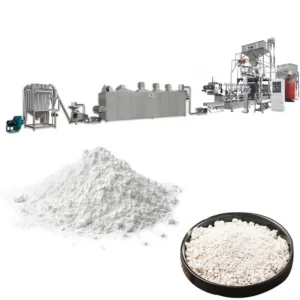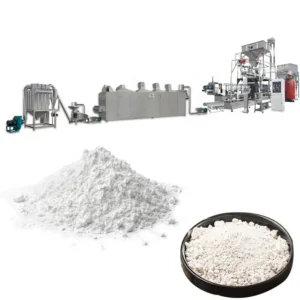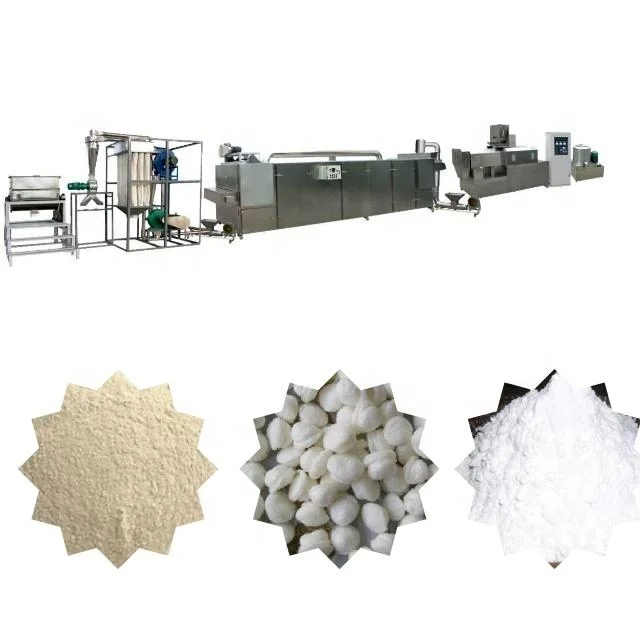


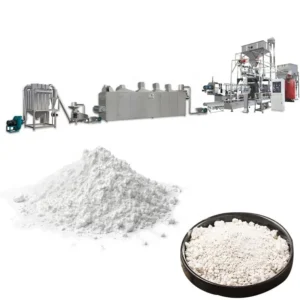
MT70 / MT85 / MT75 Twin Screw Modified Starch Extrusion Line, 150–500 kg/h Capacity Range — complete turnkey processing line from batching through extrusion to packing under one supplier.
- Screw configuration and die design specified to buyer’s starch type and target modification
- 70 mm twin-screw with 38CrMo material and dedicated barrel cooling for starch gelatinisation
- Integrated 5-layer dryer with inverter speed control and pulse grinder with cyclone discharge
Trial runs on customer raw material conducted in-house before shipment ensure product specification is met.
Description
Integrated Throughput Engineering — Every station in this modified starch processing line, from mixing to pulse grinding, is capacity-matched under one supplier to prevent the bottlenecks that plague multi-vendor assemblies.
Technical Specifications
| Parameter | Value |
|---|---|
| Product Type | Twin Screw Modified Starch Extrusion Line |
| Models | MT70 / MT85 / MT75 |
| Installed Power | 160 kW (MT70) / 190 kW (MT85) / 210 kW (MT75) |
| Power Consumption | 120 kW (MT70) / 140 kW (MT85) / 150 kW (MT75) |
| Output Capacity | 150–200 kg/h (MT70) / 300–400 kg/h (MT85) / 300–500 kg/h (MT75) (basis not stated in source — confirm raw material type, moisture content, and target starch specification) |
| Overall Dimensions | 41000×1500×2200 mm (MT70) / 43000×1500×3200 mm (MT85) / 45000×1500×3500 mm (MT75) |
| Screw Type | Twin-screw |
| Screw Diameter | 70 mm |
| Screw Length | 1510 mm |
| Screw Material | 38CrMo |
| Main Motor Power | 30 kW |
| Feeding Power | 0.75 kW |
| Cutting Power | 0.75 kW |
| Oil Pump Power | 0.37 kW |
| Heating Ring | 7 × 2 kW = 14 kW |
| Barrel Cooling | Cooling system for temperature control |
| Voltage & Frequency | 380V 50Hz Three Phase (confirm target market voltage and frequency) |
| Mixer Power Options | 4 kW / 7.5 kW / 15 kW |
| Mixer Batch Capacity | 20–30 kg / 70–80 kg / 170–180 kg per batch (verify against raw material density) |
| Dryer Type | 5-layer baking oven |
| Dryer Dimensions | 5.0 × 1.2 × 2.3 m |
| Dryer Power | 3 kW |
| Dryer Weight | 1800 kg |
| Dryer Fuel Options | Gas or diesel |
| Dryer Speed Control | Inverter |
| Dryer Material | 201 stainless steel |
| Pulse Grinder | Main unit with cyclone discharge and dust collector |
| Machine Material | Stainless steel (food-grade contact parts; 201SS / 304SS options) |
| Line Stations | Mixing → Twin-screw extrusion → Drying → Pulse grinding → Packing |
| Control System | Available with PLC or MCC control (confirm specification) |
| Warranty | 1 year complete warranty, life-time maintenance service |
| Certification | CE |
Application Suitability
| Application | Material or Output |
|---|---|
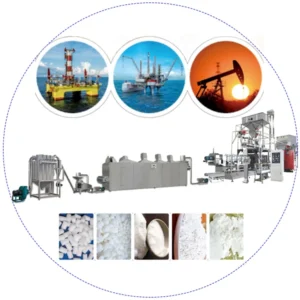
| Oil drilling fluid production | Pre-gelatinized corn or cassava starch with consistent hydration and viscosity |
| Textile sizing and coating | Modified starch from corn, potato, or cassava for warp sizing |
| Paper manufacturing | Denatured starch for surface sizing and coating formulations |
| Building materials processing | Modified starch additives for gypsum board and mortar applications |
| Casting foundry operations | Pre-gelatinized starch binders for sand core formulations |
| Food-grade starch processing | Functional starch modification for thickeners and stabilizers |
Why Nominal Line Capacity Numbers Mislead Starch Buyers
Real throughput depends on matching every station to your specific starch formulation, not quoting the extruder in isolation.
I once watched a modified starch line — extruder rated for high output — choke within twenty minutes because the five-layer dryer could not handle the evaporation load from high-viscosity gelatinized material. The mesh belt plugged with sticky starch, operators scraped it by hand, and the whole shift was lost. [NEED_CITE: gelatinized starch evaporation rates vary significantly by moisture input and viscosity] When a modified starch processing line turnkey is quoted, the number attached to the extruder often ignores the drying curve, the grinding throughput, and the batch cycle of the mixer upstream. Buyers sign off on a capacity figure that only one station can hold. The rest of the line quietly bottlenecks.
Matching Extruder Output to Dryer Evaporation Rate
The twin-screw extruder pushes gelatinized starch out at high moisture, and that material must be dried before grinding without sticking to the conveyor belt. A 5-layer dryer with inverter speed control allows the operator to adjust residence time to the specific starch viscosity. If the dryer is undersized relative to extruder output, the starch remains too wet for the pulse grinder downstream, causing screen blinding and irregular particle size. This modified starch processing line turnkey integrates the dryer as a matched station, not an afterthought selected from a separate vendor catalog.
Screw Configuration for Starch Modification vs. Simple Gelatinization
Pre-gelatinized starch for oil drilling fluids requires a different degree of molecular breakdown than modified starch for textile sizing. The screw elements must generate sufficient shear and residence time for the target modification type, and the barrel cooling system prevents runaway temperature spikes during the exothermic gelatinization reaction. [NEED_CITE: twin screw starch extrusion temperature control during gelatinization] Getting the screw configuration wrong means the starch either under-processes, leaving raw granules that fail hydration tests, or over-processes into a degraded polymer with poor viscosity performance.
Reading the Screw and Barrel Specifications
The 38CrMo screw material across all three models provides wear resistance when running abrasive starch formulations, particularly cassava starch which can carry residual fiber and sand particles. The 70 mm screw diameter and 1510 mm screw length define the L/D ratio, which governs residence time inside the barrel — a critical variable for achieving consistent starch modification across batches. The seven heating rings, each at 2 kW, deliver zoned temperature profiling along the barrel, while the integrated cooling system prevents thermal overshoot during exothermic gelatinization. The 30 kW main motor must generate enough torque to push high-viscosity gelatinized starch through the die without stalling. Mixer batch capacity options — from 20 kg to 180 kg per cycle — must align with the extruder feed rate to maintain continuous operation without starvation or surge.
The Cost of Ignoring Station-to-Station Balance
When the dryer is sourced separately and specified only by belt area, the buyer often discovers during commissioning that the evaporation capacity falls short of what the extruder actually delivers at operating moisture levels. [NEED_CITE: industrial drying capacity mismatch in food processing lines] The result is wet material entering the pulse grinder, which then clogs the cyclone discharge and forces repeated shutdowns for cleaning. Downtime accumulates across shifts, and operators begin running the extruder below rated speed to compensate — meaning the line never reaches the output the quotation promised. The buyer pays for capacity they cannot use.
Why Sourcing the Full Line From One Supplier Matters
The modified starch processing line turnkey from MT covers mixing, twin-screw extrusion, drying, pulse grinding, and packing under a single engineering responsibility, so throughput calculations account for every station. Screw configuration and die design are specified to the buyer’s starch type — corn, cassava, or potato — and the target modification, rather than copied from a generic build. An in-house testing workshop runs trial production on the buyer’s actual raw material before shipment, generating a test report that confirms product specification. Electrical schematics and voltage are confirmed to the target market before production begins. Installation, commissioning, and operator training are handled by the same team that designed the line layout.
Documentation & Verification
- Line layout drawing with throughput calculation across every station from mixer to packing
- Screw and die configuration record matched to your starch type and modification target
- Trial run report on your raw material produced in the testing workshop before shipment
- Electrical schematic with confirmed voltage, frequency, and control language for your market
- CE declaration of conformity covering the complete line assembly
- Operation and maintenance manual with wear parts list and replacement intervals
Installation, Commissioning & Support
- Floor space requirement based on the selected model’s overall dimensions up to 45000×1500×3500 mm
- Dedicated electrical circuit sized for installed power up to 210 kW at confirmed voltage and frequency
- Line arrives in modular sections; dryer and grinder positioned and connected on-site
- First-run commissioning includes screw speed, barrel temperature, and dryer belt speed calibration
- Operator training covers batch mixing ratios, extruder feed rate, and inverter dryer adjustment
- Wear parts list specifies 38CrMo screw elements and die plates with replacement schedule
- Pulse grinder screen and cyclone maintenance intervals documented in operation manual
What We Need to Configure Your Line
Send your starch source material — corn, cassava, or potato — along with the target modification type and any viscosity or particle size specification your downstream customer requires. Include your local voltage, frequency, and preferred control language so the electrical schematic matches your facility before production starts. If you have existing mixing or packing equipment, share the interface requirements so the line integrates cleanly.
Frequently Asked Questions
Q: How is output capacity verified for my specific starch material?
A: Capacity figures quoted for each model are based on reference conditions. We run your actual raw material — corn, cassava, or potato starch — in our testing workshop before shipment. The trial run report documents throughput, moisture levels, and product specification achieved under those specific conditions, so the capacity number you receive reflects your material.
Q: How do you match screw configuration to different starch modification targets?
A: Pre-gelatinized starch for oil drilling requires a different shear profile and residence time than modified starch for textile sizing. We select screw element arrangement, die geometry, and barrel temperature zones based on your starch source and target functional property. The configuration record is documented and included with your shipment.
Q: What electrical and control specifications are confirmed before production?
A: We confirm voltage, frequency, plug type, and control panel language for your target market before the electrical schematic is finalized. Available control options include PLC or MCC systems. This prevents commissioning delays caused by mismatched power supply or untranslated operator interfaces when the line arrives at your facility.
Q: What does the pre-shipment trial run include?
A: The trial uses your raw material in our testing workshop. We document extruder screw speed, barrel temperature profile, dryer settings, and grinder output. The report includes product samples, moisture readings, and throughput data. You review and approve the results before the line is released for packing and shipment.
Q: How do you prevent bottlenecks between the extruder, dryer, and grinder?
A: Each station is sized based on the extruder’s actual output at your material’s moisture content. The 5-layer dryer with inverter speed control is specified to handle the evaporation load, and the pulse grinder with cyclone discharge is matched to the dried throughput. Throughput calculations across all stations are included in the line layout documentation.
Related products
-
High-Efficiency Customizable Modified Starch Production Line – Automatic Corn Pellet Adhesive Making Equipment
¥65.00 Select options This product has multiple variants. The options may be chosen on the product page -
New Automatic Modified Starch Puffing Production Line – Long Service Life Pregelatinized Starch Equipment
¥65.00 Select options This product has multiple variants. The options may be chosen on the product page -
Automatic 304 Stainless Steel Modified Corn Starch Making Machine TWIN SCREW 500kg/h Capacity Starch Processing Production Line
¥50.00 Select options This product has multiple variants. The options may be chosen on the product page -
Modified Starch for Construction Adhesives Production – Custom Built Double Screw Extruder Line
¥65.00 Select options This product has multiple variants. The options may be chosen on the product page