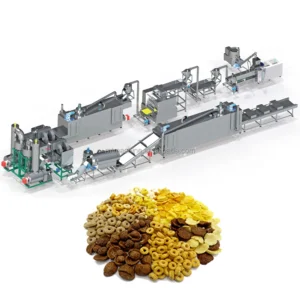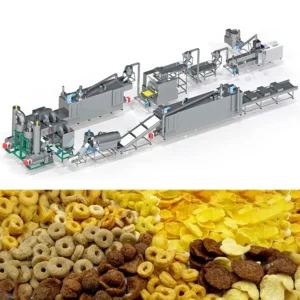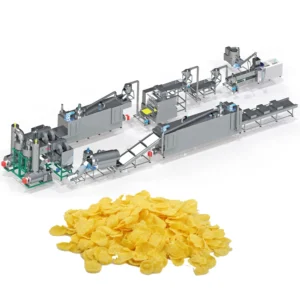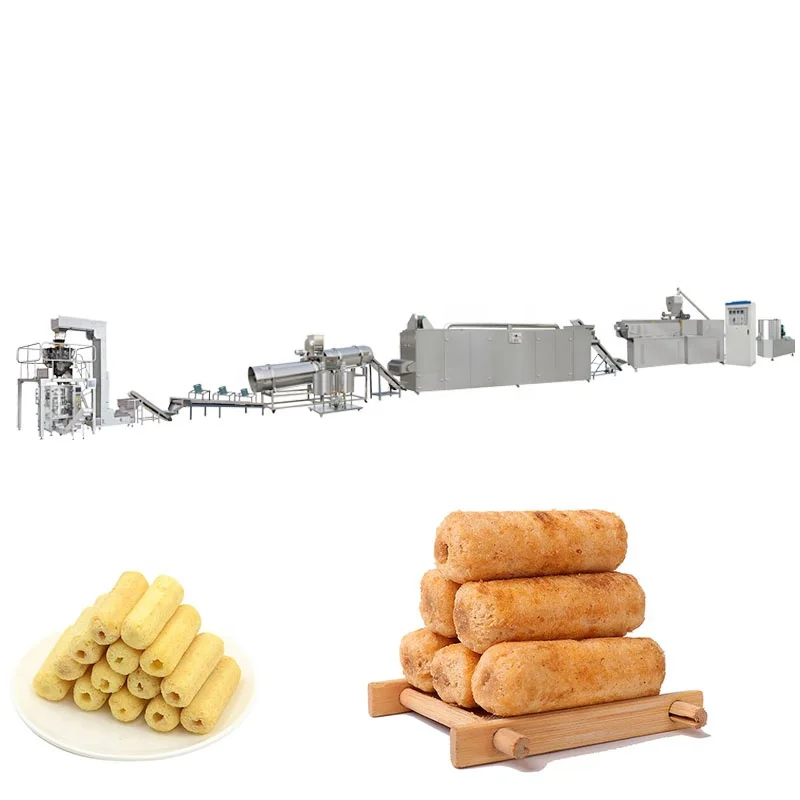


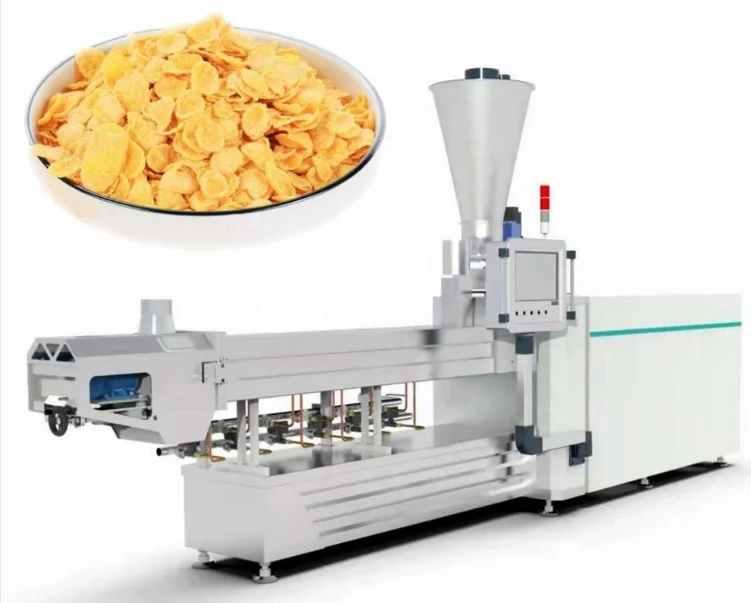
MT70 / MT85 / MT75 Breakfast Cereal Corn Flakes Production Line, twin-screw extrusion, PLC & MCC control — configured as a complete turnkey system from mixing through flaking, roasting and packing.
- Screw configuration and die design specified to your grain raw material for correct flake expansion and density, validated by in-house trial runs before shipment
- Hydraulic double-roller flaking with infrared temperature control and hot air roasting oven with dual circulating fans ensure uniform thickness and consistent blistering across natural or sugar-coated variants
Every station throughput is matched under one supplier, backed by a testing workshop trial run on your actual raw material prior to delivery.
Description
Screw configuration specified to your raw material — we run your actual corn or grain flour in our testing workshop to verify expansion, texture, and throughput before the extruder ships.
Technical Specifications
| Parameter | Value |
|---|---|
| Product Type | Breakfast Cereal Corn Flakes Production Line |
| Model Options | MT70, MT85, MT75 |
| Screw Type | Twin Screw |
| Installed Power | 160 kW (MT70) / 190 kW (MT85) / 210 kW (MT75) |
| Power Consumption | 120 kW (MT70) / 140 kW (MT85) / 150 kW (MT75) |
| Output Capacity | 150–200 kg/h (MT70, basis not stated in source — confirm raw material and moisture) |
| Output Capacity | 300–400 kg/h (MT85, basis not stated in source — confirm raw material and moisture) |
| Output Capacity | 300–500 kg/h (MT75, basis not stated in source — confirm raw material and moisture) |
| Overall Dimensions | 41 × 1.5 × 2.2 m (MT70) / 43 × 1.5 × 3.2 m (MT85) / 45 × 1.5 × 3.5 m (MT75) |
| Control System | PLC and MCC control |
| Heating Source (Dryer) | Gas or Electric |
| Flaking Machinery | Hydraulic double rollers, separate motor driving, infrared sensor temperature control |
| Roasting Oven | Vibrating pan, conciliation burner, dual circulating fans, cyclone dust removal |
| Coating System | Double tumble sugar melting, elevator, coating drum, spraying nozzle |
| Standards | CE, ISO |
Application Suitability
| Application | Material or Output |
|---|---|
| Natural corn flakes | Corn, rice, wheat, oat, or barley powder processed through extrusion, flaking, drying, and hot air roasting |
| Sugar-coated corn flakes | Same grain base with added sugar spraying, coating drum, and secondary drying stages |
| Shaped breakfast cereals | Ball, tube, stick, ring, fruit loop, star, wheel, flower, and heart forms via adjustable extruder die |
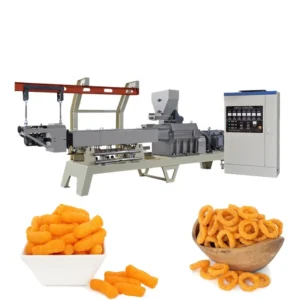
| Snack food variants | Shared line equipment repurposed for puffed or extruded snack formats from similar grain inputs |
Why Nominal Line Capacity Rarely Survives Contact With Your Raw Material
A breakfast cereal corn flakes production line turnkey is only as reliable as the trial data behind it.
I once watched a plant manager in West Africa stare at an extruder that was supposed to run 400 kg/h on standard corn flour. His local supplier had sent coarse-ground meal with higher fiber content. The screw couldn’t feed properly, and output dropped to roughly half. The line was technically correct — on paper [NEED_CITE: raw material particle size and fiber content effect on twin-screw feeding rate]. The buyer had simply never been asked what he was actually grinding. That is why our process starts with your raw material in the workshop, not with a catalog number.
Matching Every Station From Mixer to Packing Conveyor
A breakfast cereal corn flakes production line turnkey fails when one station chokes the rest. We calculate the dryer residence time, flaking roll throughput, and roasting oven belt speed against the extruder’s verified output on your specific grain blend. If the flaking machinery cannot keep pace with the MT85 at full screw speed, the line is not balanced — and we adjust the specification before building.
What Screw Profile and Die Geometry Actually Control
The twin-screw configuration determines how much shear and heat your corn or oat dough receives before it exits the die. We select screw element arrangement and die opening diameter based on the starch gelatinisation behaviour of your raw material. A coarse corn grit requires a different compression ratio than fine wheat flour [NEED_CITE: starch gelatinisation temperature range by grain type]. Getting this wrong produces flakes that either shatter during roasting or stay too dense to crisp properly.
Reading the Spec Sheet Like an Engineer
Installed power on the MT70 sits at 160 kW with actual consumption around 120 kW, which tells you the motor has headroom for harder grain blends without tripping thermal protection. The flaking machinery uses a hydraulic system for the double rollers with separate motor driving — meaning each roller can maintain surface speed independently, producing uniform flake thickness even when feed rate fluctuates. The roasting oven’s conciliation burner and dual circulating fans manage surface blistering without scorching, and the cyclone dust removal captures fine particulate that would otherwise settle on the finished flake. Infrared sensor temperature control on the flaking rolls keeps dough temperature within the narrow band where it sheets cleanly rather than tearing or sticking.
The Cost of Skipping the Trial Run
When a corn flakes line ships without a documented test on the buyer’s actual raw material, commissioning becomes product development. Screw elements get swapped, die openings get resized, and dryer temperatures get guessed — all while the factory floor is waiting for saleable output [NEED_CITE: commissioning delays caused by untested extruder configuration]. Wear parts consume budget faster because the initial configuration was a generic copy rather than a calculated build.
Why Buyers Source This Line Here
- Every station from mixing through packing comes from one supplier, so the MT85 extruder output is matched to the flaking roll, dryer, and roasting oven capacity by design rather than by accident.
- Screw configuration and die design are specified to your raw material and target flake density, documented in a configuration record you receive before shipment.
- Your grain flour runs in the in-house testing workshop before the line is crated, generating a trial report that confirms real throughput and flake quality.
- Twin-screw expertise spans corn flakes, aquatic feed, pet food, and snack applications, meaning the same engineering team understands how different grain starches behave under pressure and shear.
- Layout is customized to your factory dimensions, with utility planning for gas or electric dryer heating and PLC control language set to your operator preference before production begins.
Documentation & Verification
- Line layout and capacity calculation drawn to your factory footprint and target output
- Trial run report on your raw material from the in-house testing workshop
- Screw and die configuration record matched to your grain type and flake density target
- Electrical schematic with voltage and frequency confirmed for your local grid
- CE declaration of conformity and ISO certificate for export compliance
- Operation and maintenance manual with wear parts list for the extruder and flaking machinery
Installation, Commissioning & Support
- Foundation and floor space planned around the line’s 41–45 m length depending on model selected
- Dedicated electrical circuit sized for the MT85’s 190 kW installed power and gas or electric dryer supply
- PLC and MCC panels configured to local voltage, frequency, and operator language before dispatch
- First production run supervised on-site with screw speed, barrel temperature, and flaking pressure dialled in
- Operator training covers die changes for shaped cereal formats and sugar coating drum adjustment
- Wear parts list includes screw elements, die inserts, and flaking roller surfaces with replacement intervals
What We Need to Build Your Line
Send us the grain type and grind specification you intend to run — particle size distribution and moisture content matter more than the brand name on the bag. Tell us your target hourly output and whether you need both natural and sugar-coated formats from the same line. Include your workshop dimensions, ceiling height, and local voltage and frequency so the layout and electrical package are correct from the start.
Frequently Asked Questions
Q: How do you verify line capacity against my specific raw material and moisture content?
A: We run your actual grain flour or grit in our testing workshop before shipment. The trial records real throughput, flake expansion, and texture on the twin-screw extruder with the screw and die configuration intended for your line. You receive a trial report confirming performance before the equipment is crated.
Q: How is throughput matched between the extruder, flaking rolls, dryer, and roasting oven?
A: Each station is sized against the extruder’s verified output on your raw material. The hydraulic flaking rollers, dryer belt speed, and roasting oven capacity are calculated so no single station creates a bottleneck, and the layout document shows the throughput balance across the full line.
Q: What voltage, frequency, and control language options are confirmed before production?
A: We confirm your local grid voltage and frequency, then build the MCC and PLC panels accordingly. The PLC interface language is set to your operator preference. The electrical schematic is included in your documentation package before the line ships.
Q: Can the same line produce natural and sugar-coated corn flakes?
A: Yes. The sugar-coated variant adds a sugar spraying station, coating drum, and secondary dryer after the roasting oven. We configure the full line for both paths, so switching between natural and coated formats requires only a changeover in the coating section.
Q: What does installation and operator training cover on-site?
A: Our engineers supervise mechanical assembly, utility connection, and the first production run. Training covers PLC operation, screw and die changeover for different cereal shapes, flaking roller adjustment, and roasting oven temperature management. A wear parts list with replacement guidance is handed over at commissioning.
Related products
-

Hot Selling Automatic Corn Flakes Breakfast Cereal Production Line Making Machine
¥20,000.00 Select options This product has multiple variants. The options may be chosen on the product page -

Best Price Corn Flakes Making Machine Breakfast Cereals Processing Line with Motor As Core Component
¥19,000.00 Select options This product has multiple variants. The options may be chosen on the product page -
Automatic Instant Breakfast Cereals Snack Food Making Machine
¥10,000.00 Select options This product has multiple variants. The options may be chosen on the product page -

Small Scale Breakfast Cereal Manufacturing Machine for Corn Flakes Process Line
¥45,000.00 Select options This product has multiple variants. The options may be chosen on the product page