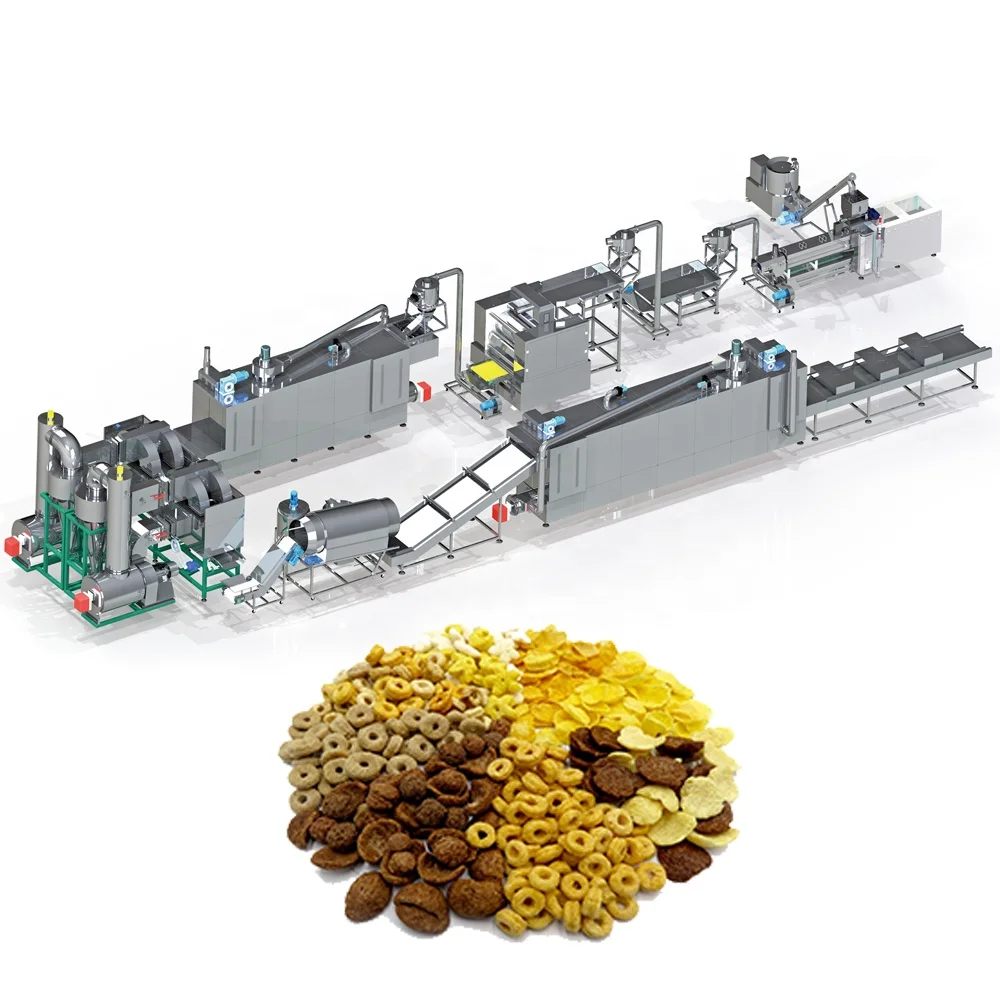

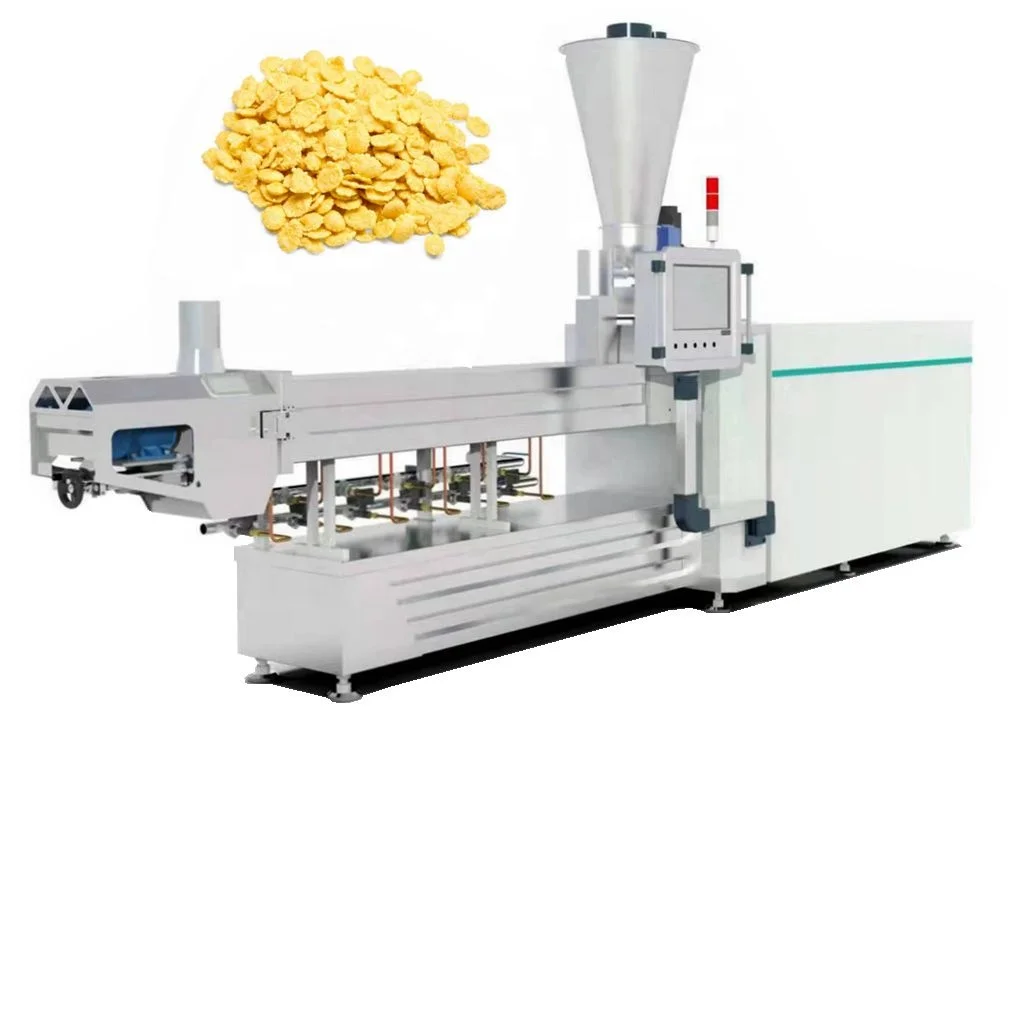
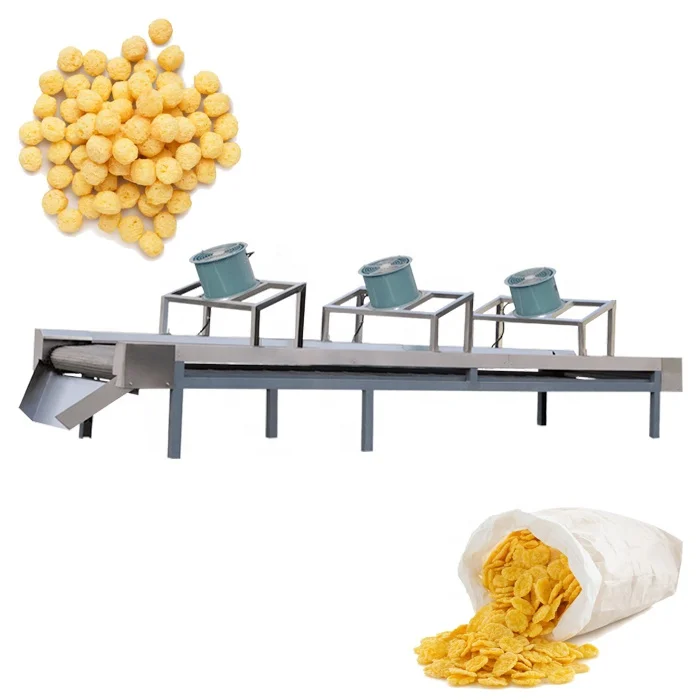

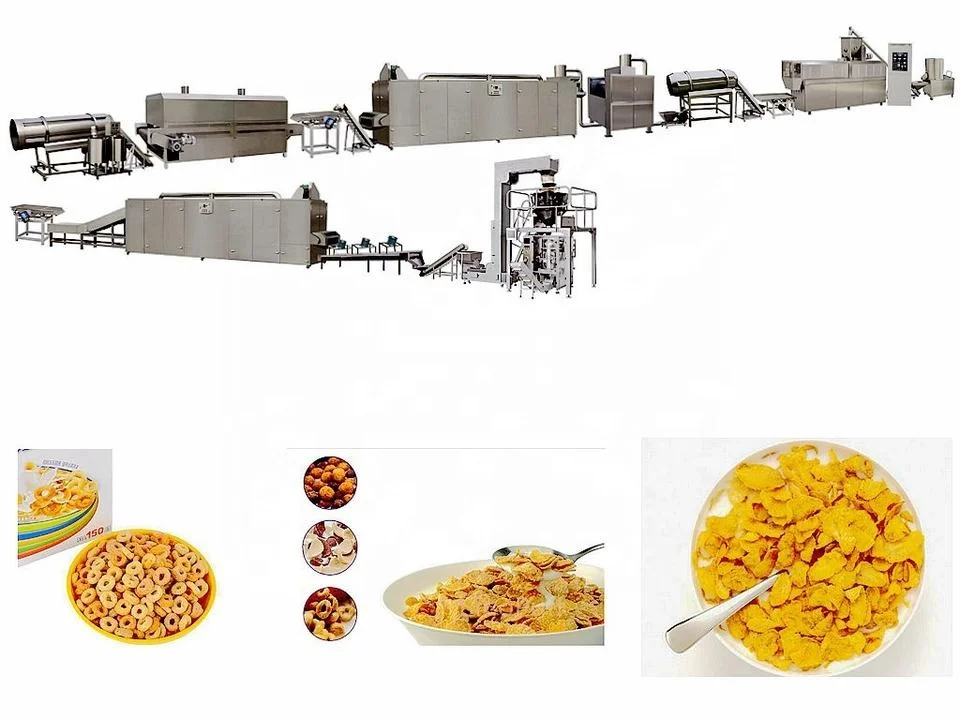
MT70 / MT85 / MT75 Corn Flakes Production Line, Twin-Screw Extrusion, PLC Flaking Control — engineered as a turnkey system from mixing through roasting and coating.
- Screw configuration and die design specified to raw material formulation and target flake density
- Hydraulic double-roller flaker with independent dual-motor drive and infrared temperature monitoring for consistent thickness
- Hot air roasting oven with dual circulating fans and cyclone dust removal for uniform blistering
Layout, throughput matching, and in-house trial runs on buyer-supplied raw material validated before shipment.
Description
Throughput-Matched Engineering — Every station in this line is sized against the same output target so the extruder, flaker, and roaster never bottleneck one another.
Technical Specifications
| Parameter | Value |
|---|---|
| Product Type | Corn Flakes Breakfast Cereal Production Line |
| Extruder Models Available | MT70, MT85, MT75 |
| Extruder Type | Twin Screw |
| MT70 Installed Power / Consumption | 160 kW / 120 kW |
| MT70 Output Capacity | 150–200 kg/h (basis not stated in source — confirm raw material formulation and moisture content) |
| MT70 Overall Dimensions | 41 × 1.5 × 2.2 m |
| MT85 Installed Power / Consumption | 190 kW / 140 kW |
| MT85 Output Capacity | 300–400 kg/h (basis not stated in source — confirm raw material formulation and moisture content) |
| MT85 Overall Dimensions | 43 × 1.5 × 3.2 m |
| MT75 Installed Power / Consumption | 210 kW / 150 kW |
| MT75 Output Capacity | 300–500 kg/h (basis not stated in source — confirm raw material formulation and moisture content) |
| MT75 Overall Dimensions | 45 × 1.5 × 3.5 m |
| Screw Feature | Automatic lubricating and cooling; wear-resistant manufacturing technology |
| Flaking Machine Control | PLC control system |
| Flaking Machine Drive | Hydraulic double-roller system with independent dual-motor drive |
| Flaking Temperature Monitoring | Infrared sensor for even temperature pipe control |
| Dryer Heating Source Options | Gas, Electric |
| Roasting Oven Type | Hot air roasting oven with vibrating pan, conciliation burner, dual circulating fans, cyclone dust removal |
| Coating System | Double tumble drum for sugar melting, elevator, coating drum, spraying nozzle |
| Line Control | MCC / PLC automation |
| Raw Materials | Corn, rice, wheat, oat, barley powder |
| Final Product Shapes | Natural corn flakes, sugar-coated corn flakes; adjustable die shapes (ball, tube, stick, ring, fruit loop, star, wheel, flower, heart) |
| Certifications | CE, ISO |
Application Suitability
| Application | Material or Output |
|---|---|
| Natural corn flakes for retail breakfast cereal markets | Corn grits and corn flour blends |
| Sugar-coated corn flakes for food-service and retail | Corn base with sugar spray and tumble coating |
| Multi-grain and fortified breakfast cereals | Rice, wheat, oat, and barley powder formulations |
| Shaped cereal snacks (rings, stars, fruit loops) | Corn and multi-grain blends with interchangeable extrusion dies |
What "Nominal Capacity" Actually Means on a Corn Flakes Line
A twin-screw extruder rated at 300–400 kg/h on one formulation may deliver half that on a different starch profile.
I have stood in processing halls in Central America where a brand-new corn flakes line sat idle because the local corn variety had a different amylose-to-amylopectin ratio than the supplier assumed. The extruder ran, but the flakes came off the roller too dense to toast properly. Every corn flakes production line turnkey project must start with the buyer’s actual raw material, not a generic benchmark. When the formulation changes, the screw configuration, barrel temperature profile, and moisture window all shift — and so does the real throughput [NEED_CITE: starch gelatinisation behaviour across corn varieties].
Screw Configuration and Die Design Dictate Flake Density
On a corn flakes line, the twin-screw extruder does more than cook and convey — it controls the degree of starch gelatinisation that determines whether the final flake will blister evenly in the roasting oven. The screw configuration and die geometry are selected against the buyer’s specific corn or multi-grain formulation. A die that works for high-amylose corn may over-expand a waxy variety, producing flakes that shatter during drying. This corn flakes production line turnkey package specifies screw elements and die apertures after reviewing the buyer’s raw material data sheet and, ideally, running a trial batch.
Flaking Station Precision Determines the Final Crunch
The PLC-controlled flaking station uses a hydraulic double-roller system with independent dual-motor drive, allowing each roller to be adjusted for gap and speed separately. An infrared sensor monitors roller surface temperature continuously, preventing uneven dough sheet cooling that leads to variable flake thickness. Consistent flake thickness across the full roller width is what allows the hot air roasting oven to blister every piece uniformly. If the upstream extruder produces a dough with inconsistent moisture, no amount of flaking adjustment can compensate — which is why throughput matching between extruder output and flaker intake matters at every stage of a corn flakes production line turnkey installation [NEED_CITE: roller mill gap tolerances in cereal flaking].
How Power Draw and Line Dimensions Map to Factory Planning
The MT70 draws 120 kW in operation and occupies roughly 41 m in line length, while the MT75 pulls 150 kW and stretches to 45 m. These figures determine transformer sizing, cable runs, and the minimum bay length a facility must provide. The hot air roasting oven adds its own thermal load — gas-fired or electric — and the cyclone dust removal device requires ductwork routing. Buyers planning a corn flakes production line turnkey layout need to confirm ceiling height, floor load rating, and utility drop points against these dimensions before the line ships. Selecting the right extruder model is not just about output; it is about whether the building can support the equipment.
The Hidden Cost of Mismatched Station Sizing
I once saw a line where the extruder could push enough dough for 400 kg/h of flakes, but the dryer was spec’d for 250 kg/h. The result was a wet backlog accumulating on the conveyor, forcing the operator to slow the extruder and run the whole line at dryer speed. Undersized downstream stations silently cap your output and inflate per-kilo energy cost because the extruder and roaster cycle below their efficient operating range [NEED_CITE: energy consumption at partial load on food extrusion lines]. Every corn flakes production line turnkey proposal should include a throughput calculation that shows each station — mixing, extruding, flaking, drying, roasting, coating, cooling — rated against the same target figure on the buyer’s formulation.
Why Procurement From a Single Line Builder Matters
Sourcing the extruder from one vendor and the roaster from another leaves nobody responsible for the interface between them. This corn flakes production line turnkey approach keeps mixing, extrusion, flaking, drying, roasting, coating, cooling, and packing under one engineering scope, so conveyor heights, transfer chutes, and control logic are designed together. Screw configuration and die design are matched to the buyer’s raw material rather than copied from a generic build. The in-house testing workshop allows trial runs on customer-supplied corn or multi-grain flour before the equipment leaves the factory, catching formulation mismatches early. MCC and PLC integration across every station means one control language and one troubleshooting point during commissioning.
Documentation & Verification
- Line layout showing throughput matching across mixing, extruding, flaking, drying, roasting, and packing stations
- Trial run report on buyer-supplied corn or multi-grain raw material conducted before shipment
- Screw and die configuration record matched to target flake density and expansion profile
- Electrical schematic with voltage, frequency, and control language confirmed for destination market
- CE declaration of conformity and ISO certificate for the complete line
- Wear parts list covering screws, dies, and roller surfaces with replacement intervals
Installation, Commissioning & Support
- Floor plan and foundation load requirements mapped to the MT70, MT85, or MT75 footprint and line length
- Dedicated power circuit sized to the selected extruder’s installed power, up to 210 kW for the MT75
- Equipment ships in modular sections with plastic bubble film protection and wooden cases for spare parts
- On-site extruder start-up includes barrel temperature profiling and screw speed calibration for local corn variety
- Operator training covers PLC interface navigation, flaking roller gap adjustment, and roasting oven burner tuning
- Spare screw elements and die plates stocked for the specific twin-screw configuration shipped
What to Include in Your Inquiry
To size a line accurately, share your raw material type and typical formulation, your target hourly output, and the starch characteristics of your local corn or grain supply. Confirm your facility voltage, frequency, and preferred control language so the electrical package matches the site from day one. If you are replacing an existing extruder or adding a coating station to a current line, provide details on the upstream and downstream equipment already in place.
Frequently Asked Questions
Q: How is line capacity verified against my specific corn or multi-grain formulation?
A: We request a sample of your raw material and run it through the extruder in our testing workshop. The trial measures actual throughput, dough moisture at the die, and flake density after roasting. Those results feed into the final line configuration and capacity document, so the quoted output reflects your formulation rather than a generic benchmark.
Q: Can I run a trial on my own raw material before the line ships?
A: Yes. Our in-house testing workshop accepts customer-supplied corn flour, multi-grain blends, or any formulation you plan to run. We test extrusion behaviour, flake thickness consistency, and roasting response, then share a trial run report. Any screw or die adjustments identified during the trial are implemented before the equipment is packed for dispatch.
Q: How do you confirm voltage, frequency, and control language for my site?
A: During the specification phase we request your local electrical standards and the preferred language for the PLC and MCC interface. The electrical schematic is then drawn to match your facility supply, and the control panels are labelled and programmed accordingly before the factory test, preventing commissioning delays caused by mismatched voltage or unreadable HMI text.
Q: What documentation verifies throughput matching between every station?
A: You receive a line layout and capacity calculation showing each station — mixer, extruder, flaker, dryer, roaster, coater, cooler — rated against the same output target on your raw material. This is supported by the factory test record and the trial run report, giving you a complete paper trail from formulation through to packed product weight.
Q: How are screw and die configurations chosen for natural versus sugar-coated corn flakes?
A: Natural flakes need a specific expansion ratio so they blister correctly in the roasting oven without added sugar weight. Sugar-coated flakes require a slightly denser base flake to carry the coating without breaking in the tumble drum. We select screw elements and die apertures for each target, and the wear parts list identifies replacement components so you can reorder the correct configuration when service intervals are due.
Related products
-
Corn Flakes Machine Breakfast Cereal Corn Flakes Production Line Cornflakes Making Machine
¥85,800.00 Select options This product has multiple variants. The options may be chosen on the product page -
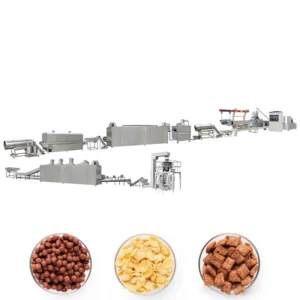
Kelloggs Corn Flakes Breakfast Cereal Normal Making Machine Breakfast Cereal Extruder Production Line
¥30,000.00 Select options This product has multiple variants. The options may be chosen on the product page -
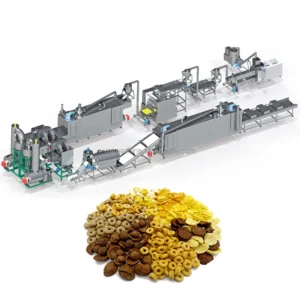
Stainless Steel Honey Small Corn Flake Breakfast Cereal Flakes Maker Making Machine Production Plant
¥30,000.00 Add to cart -
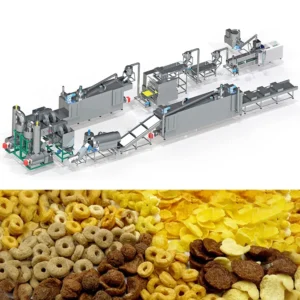
Automatic Instant Breakfast Cereals Snack Food Making Machine
¥10,000.00 Select options This product has multiple variants. The options may be chosen on the product page