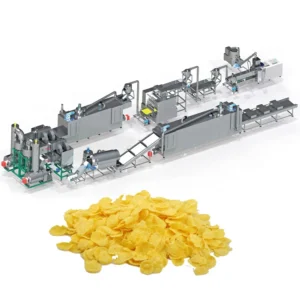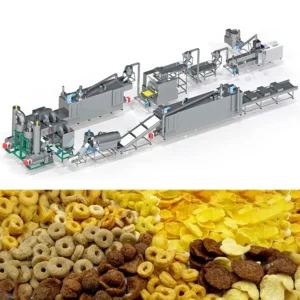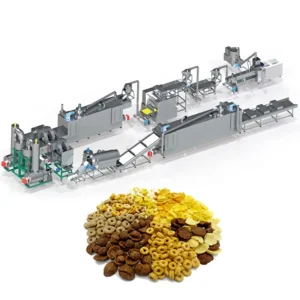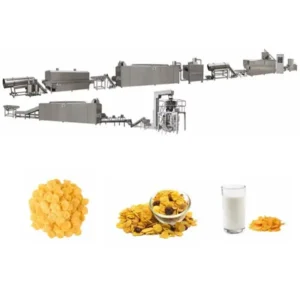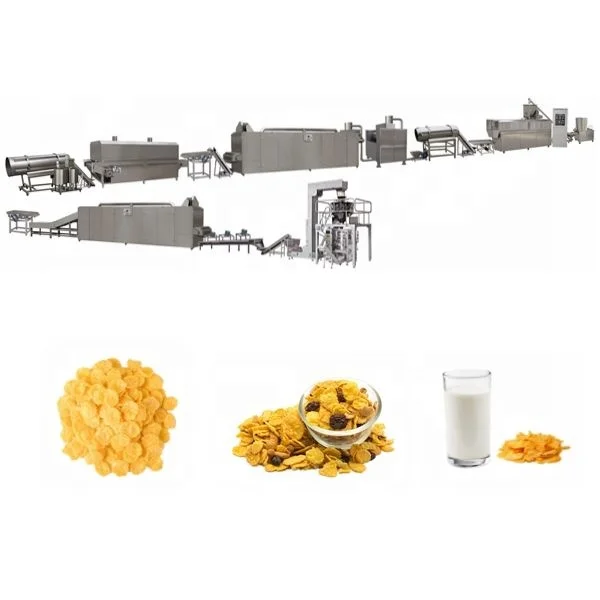


MT65 / MT70 / MT85 Twin Screw Corn Flakes Production Line, 70–200 kW Installed Power, 38CrMoAL Nitriding Screws — engineered for breakfast cereal manufacturers building or expanding maize-based flake output.
- Full line from batching through extrusion, pressing, drying, sugar coating to packing, with throughput matched at every station to avoid bottlenecks
- Twin screw co-rotating design with modular barrel sections and custom die configuration matched to your grain formulation and target flake density
- MCC/PLC control with Delta inverters synchronizing feeding, extrusion, and cutting speeds across the line
- High-temperature oven with gas or electric heating and 3–7 layer dryer options sized to extruder output
Trial runs on your actual raw material in our testing workshop confirm real capacity and flake quality before shipment, backed by on-site installation and operator training.
Description
Throughput Synchronization — Every station from batching to packing is calculated against the same target output so no segment becomes a bottleneck, confirmed before shipment by trial runs on your actual grain formulation.
Technical Specifications
| Parameter | Value |
|---|---|
| Product Type | Twin Screw Corn Flakes Production Line |
| Model | MT65 / MT70 / MT85 |
| Screw Type | Co-rotating twin screw, sectional modules |
| Installed Power | 70 kW (MT65) / 100 kW (MT70) / 200 kW (MT85) |
| Real Power | 40 kW (MT65) / 70 kW (MT70) / 150 kW (MT85) |
| Output Capacity | 100–150 kg/h (MT65) / 200–240 kg/h (MT70) / 300–400 kg/h (MT85) (basis not stated in source — confirm raw material formulation & moisture content) |
| Motor Brand | SIEMENS (China) |
| Barrel & Screw Material | Alloy 38CrMoAL, nitriding process |
| Gearbox | Automatic lubrication function |
| Control System | Delta inverters; automated feeding, extrusion & cutting speed adjustment |
| Cutting System | Rotary knife on die head seat, V-belt drive |
| Mixer Output | 10–30 kg/load; 4 kW |
| Corn Flakes Press Machine | 16.12 kW; Roller 510×310×1050 mm |
| High-Temperature Oven | Gas heating, both-side baking; 4.5×1.4×1.8 m; 3.75 kW |
| Sugar Spraying System | 28.75 kW; 4000×1900×1880 mm; Roller Ø600×2700 mm |
| Dryer Options | Electric (0–200 °C) or steam; 3-layer / 5-layer / 7-layer; lengths 5–11 m |
| Line Stations | Mixer → Screw Conveyor → Twin Screw Extruder → Corn Flakes Press → High-Temperature Oven → Sugar Spraying → Cooling Conveyor → Sifter → Packing |
| Overall Dimensions | 20000×1200×2200 mm (MT65) / 25000×1500×2200 mm (MT70) / 30000×3500×4300 mm (MT85) |
| Standards | CE, ISO |
| Warranty | 1 year from commissioning completion |
Application Suitability
| Application | Material or Output |
|---|---|
| Corn flakes breakfast cereal | Maize grits, whole corn |
| Multi-grain cereal flakes | Rice, wheat, oat, rye blends |
| Sugar-coated flakes | Sugar syrup glazing in coating drum |
| Salt-flavored savory flakes | Salt and seasoning powder application |
| Extruded pellet snacks | Round, triangle, square, star, flower shapes from grain blends |
What "300 kg/h" Really Means When Your Grain Formula Changes
Capacity figures only hold value when they are tied to the raw material you will actually run.
Many breakfast cereal lines are quoted on a nominal output that assumes ideal corn grits at a specific moisture range. In practice, the flour blend arriving at your mixer varies in protein content, starch damage, and hydration level. A line rated at a fixed throughput on one formulation may stall at the press station or overload the dryer when the recipe shifts toward oat or rye inclusion. I have seen producers in Central America lose entire shifts because the extruder kept pushing material faster than the oven could bake it, leaving half-dried flakes piling up on the cooling belt. [NEED_CITE: moisture variation effects on extrusion throughput stability]
This corn flakes production line turnkey package addresses the mismatch by sizing every station against the slowest segment under your specific recipe. The twin screw extruder output, press machine feed rate, oven belt speed, and sugar coating drum cycle are all calculated together before the quotation stage, not assembled from independent vendor defaults.
How Layout Planning Prevents Downstream Congestion
A turnkey corn flakes production line requires each station to accept exactly what the previous station delivers. The mixer produces discrete batches of 10–30 kg, which the screw conveyor meters into the extruder at a continuous rate governed by Delta inverter control. If the conveyor runs too fast, the extruder barrel floods and gelatinisation becomes uneven; too slow and the screw runs starved, producing inconsistent dough for the press.
The same balance applies between the corn flakes press and the high-temperature oven. The press forms flakes at a rate dictated by roller speed and sheet thickness, while the oven must hold each flake at baking temperature long enough to set the structure. A gas-heated oven at 4.5 m length paired with a 5-layer belt configuration provides sufficient residence time for the MT70 model output range, whereas the MT85 typically calls for the longer 7-layer dryer option.
Throughput Verification Before the Machines Leave the Factory
Every corn flakes production line turnkey project goes through a trial run using the buyer’s own grain formulation before shipment. The in-house testing workshop replicates the full extrusion-to-drying sequence so that output weight, flake density, and surface texture are documented against the recipe the buyer intends to run commercially. This removes the guesswork from first production and shortens the ramp-up period after installation.
Screw configuration and die geometry are adjusted during the trial to match the expansion behaviour of the specific grain blend. A high-oat formulation, for instance, demands a different screw module combination than pure maize because the lipid content affects starch gelatinisation and dough viscosity inside the barrel. [NEED_CITE: twin screw configuration adjustment for varying grain composition]
Reading the Specification Sheet with a Production Mindset
The 38CrMoAL nitriding-treated screw and barrel are selected for the abrasiveness of whole-grain maize and the stickiness of gelatinised starch. Nitriding hardens the contact surfaces, extending service intervals when running high-fiber formulations that accelerate wear on standard carbon steel components. The sectional screw modules allow the compression ratio to be tuned by rearranging elements along the shaft rather than replacing the entire screw assembly.
Delta inverters governing the feeding, extrusion, and cutting stations ensure that a speed change at one point propagates to the others, maintaining proportional flow through the line. The SIEMENS motor delivers stable torque at the low screw speeds required for corn flake dough, where sudden speed surges would rupture the starch matrix and produce uneven flakes downstream. The automatic lubrication gearbox reduces manual maintenance frequency, which matters on continuous production runs where an overlooked grease point leads to premature gear wear.
The Cost of Ignoring Station-to-Station Matching
When the extruder is sized independently from the press and oven, the imbalance shows up within the first week of production. Flakes emerge from the press faster than the oven can bake them, arriving at the sugar spraying drum with residual moisture that causes the coating to clump rather than distribute evenly. The cooling conveyor then receives product that is still warm, condensing moisture inside the packaging and shortening shelf life.
These failures are not blamed on any single machine. Each unit performs to its own nameplate. The problem is the absence of a unified throughput calculation across the complete line. [NEED_CITE: production bottlenecks caused by unmatched station capacities in food processing lines]
Why Source the Full Line from One Supplier
Matching throughput across every station is only possible when one engineering team designs the complete sequence. The MT65, MT70, and MT85 models share the same control architecture, so operators trained on one line can transition to another without relearning the interface. Screw configuration records are documented per project, giving the buyer a reference for future die and module orders. The in-house testing workshop validates output on the buyer’s grain before the equipment ships, eliminating the common scenario where product development begins only after installation. Electrical schematics confirm voltage, frequency, and control language before production begins, so the machines align with the facility’s power infrastructure on arrival.
Documentation & Verification
- Line layout showing station sequence, footprint, and utility connection points for the selected model
- Capacity calculation sheet mapping each station throughput to your grain formulation
- Screw and die configuration record specific to your flake target thickness and texture
- Trial run report documenting output weight, density, and moisture on your raw material
- Electrical schematic with voltage and frequency confirmed against your facility supply
- CE declaration of conformity and ISO certificate included with shipment
Installation, Commissioning & Support
- Foundation plan accounts for the MT85’s 30 m length and 4.3 m height clearance requirement
- Power distribution sized to the line’s real power draw, from 40 kW to 150 kW depending on model
- Equipment arrives in sectional modules for sequential assembly along the conveyor path
- First-run parameter setting covers extruder screw speed, press roller gap, and oven temperature zones
- Operator training addresses inverter speed synchronization across feeding, extrusion, and cutting stations
- Wear parts list with first batch of replacement screw modules and die inserts shipped with the line
- Maintenance schedule aligned to gearbox automatic lubrication intervals and nitriding surface inspection cycles
Planning Your Line Inquiry
To prepare an accurate layout and quotation, share your grain formulation and target flake specifications, the daily output you need to meet market demand, and your facility’s available floor length and ceiling height. Specify the local voltage, frequency, and preferred control panel language so that electrical documentation is prepared correctly before production begins.
Frequently Asked Questions
Q: How is the real output verified for my grain recipe?
A: A trial run is conducted in the testing workshop using the buyer’s actual grain formulation. Output weight, flake density, and moisture content are measured and recorded in a report. Screw configuration is adjusted during the trial until the result matches the target specification, and the final settings are documented before shipment.
Q: What prevents the dryer from becoming a bottleneck?
A: The oven and dryer are selected based on the extruder model’s output range and the moisture reduction required for your flake type. Available configurations include 3-layer, 5-layer, and 7-layer belt dryers in lengths from 5 to 11 m, with electric or steam heating options, so the residence time is matched to the incoming product load.
Q: How are voltage and control language confirmed before shipment?
A: The buyer provides facility power specifications and preferred panel language during the quotation stage. These details are recorded in the electrical schematic and control confirmation document. Production does not begin until the buyer signs off on both, preventing commissioning delays caused by mismatched frequency or untranslated HMI text.
Q: What is the installation sequence for a line this long?
A: Installation follows the material flow path, starting with the mixer and screw conveyor, then the extruder and press, and continuing through the oven, sugar spraying system, cooling conveyor, sifter, and packing station. Each module is positioned, leveled, and connected in sequence, with utility hookups verified at each station before moving to the next.
Q: How are spare wear parts managed after the first year?
A: A wear parts list is provided with the initial shipment, covering screw modules, die inserts, and cutting blades. The first batch of spares ships with the line. Replacement orders reference the screw configuration record so that module geometry matches the original trial-validated setup.
Related products
-

Best Price Corn Flakes Making Machine Breakfast Cereals Processing Line with Motor As Core Component
¥19,000.00 Select options This product has multiple variants. The options may be chosen on the product page -
Automatic 500kg/h Corn Flakes Making Machine New Condition High Productivity Sweet Breakfast Cereal Processing Line From Factory
¥8,500.00 Select options This product has multiple variants. The options may be chosen on the product page -

Hot Selling Automatic Corn Flakes Breakfast Cereal Production Line Making Machine
¥20,000.00 Select options This product has multiple variants. The options may be chosen on the product page -
Corn Flakes Machine Breakfast Cereal Corn Flakes Production Line Cornflakes Making Machine
¥85,800.00 Select options This product has multiple variants. The options may be chosen on the product page