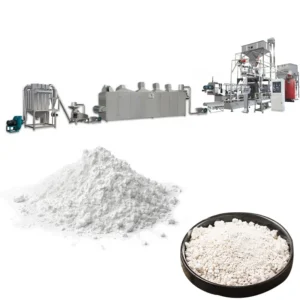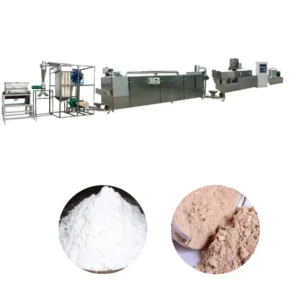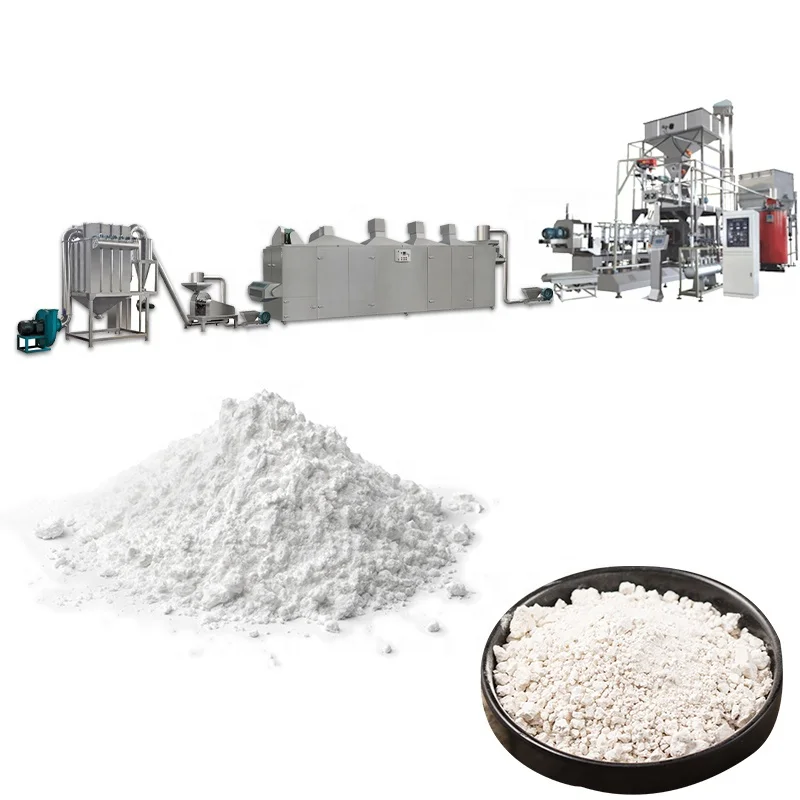
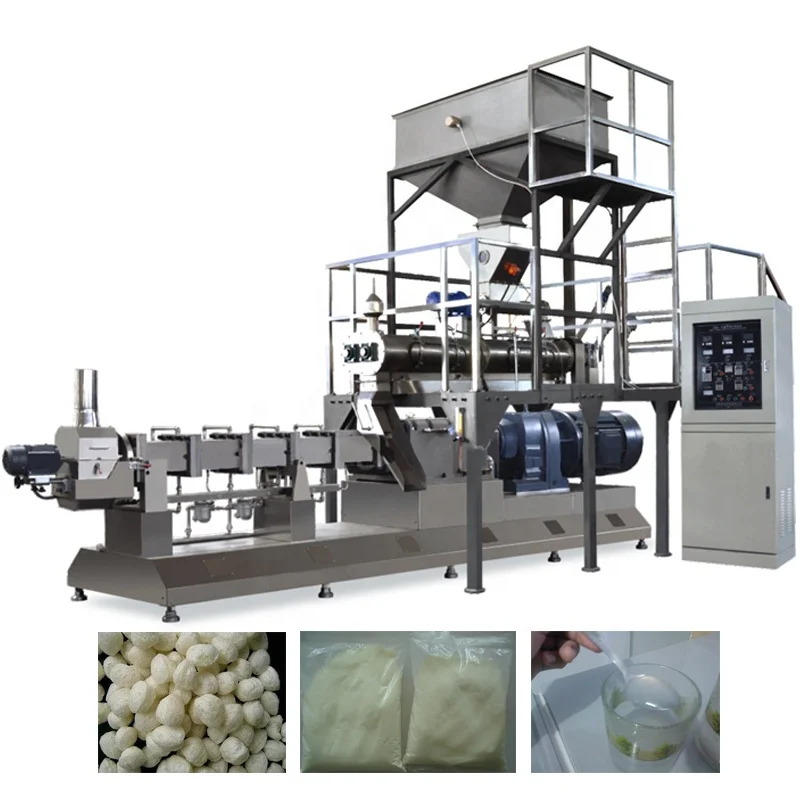


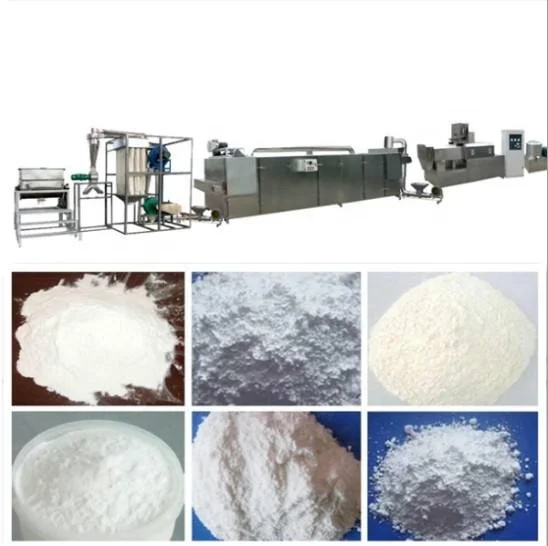
MT75 Modified Starch Processing Line, Twin-Screw, 180 kW Installed Power — configured for corn, cassava, potato and tapioca starch feedstock with frequency conversion speed regulation on feeding, driving and rotary cutting systems.
Screw configuration and die design matched to your raw material and target modification profile, controlling shear and residence time for consistent gelatinisation. Multi-layer dryer with double pitch roller chain transmission ensures stable drying without jamming across the full line.
Line layout, capacity calculation and in-house trial run on your actual feedstock provided before shipment, with throughput matched from batching through packing under one supplier.
Description
Throughput Matching Across Every Station — A complete modified starch line where mixing, extrusion, drying, grinding, and packing capacities are calculated together, so no single station throttles the output you were quoted.
Technical Specifications
| Parameter | Value |
|---|---|
| Model | MT75 |
| Product Type | Modified Starch Processing Line |
| Screw Type | Twin-screw |
| Installed Power | 180 kW (MT75) / 120 kW (MT70) / 150 kW (MT70C) |
| Power Consumption | 135 kW (MT75) / 120 kW (MT70) / 125 kW (MT70C) |
| Output Capacity | 200–250 kg/h (MT75, basis to be confirmed) / 100–150 kg/h (MT70, basis to be confirmed) / 250–300 kg/h (MT70C, basis to be confirmed) |
| Overall Dimensions (L×W×H) | 32,000 × 3,500 × 4,300 mm (MT75) |
| Control System | Frequency conversion speed regulation on feeding, driving, and rotary cutting |
| Mixer Power Options | 4 kW / 7.5 kW / 15 kW |
| Mixer Batch Capacity Options | 20–30 kg / 70–80 kg / 170–180 kg per batch |
| Mixer Material | 201 stainless steel (304 stainless steel optional) |
| Mixer Voltage | 380 V, 50 Hz, Three Phase |
| Dryer Type | Multi-layer, multi-pass, double pitch roller chain transmission |
| Pulse Grinder Drive Motor | 15 kW |
| Pulse Grinder Mesh | 100–120 mesh |
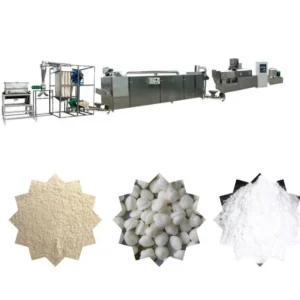
| Line Configuration | Mixer → Twin-screw extruder → Dryer → Pulse grinder → Packaging machine |
| Standards | CE |
Application Suitability
| Application | Material or Output |
|---|---|
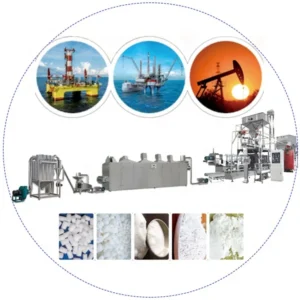
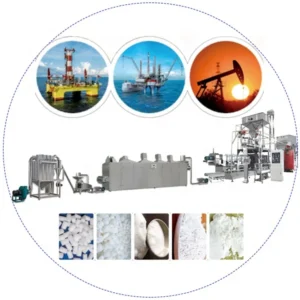
| Oil drilling fluid loss agent production | Pregelatinised starch from corn or cassava for water-based drilling fluids |
| Industrial denatured starch processing | Modified starch derivatives from tapioca and maize feedstock |
| Food-grade modified starch production | Pregelatinised and chemically modified starch powder from potato, corn, and cassava |
| Turnkey starch plant projects | Complete batching-to-packing line layout for contractors and factory builders |
Why Your Quoted Line Capacity May Never Hold on Real Feedstock
A nominal output figure means nothing until the screw configuration, barrel profile, and dryer pass length are matched to your specific starch blend and target gelatinisation degree.
I have watched lines perform well on a supplier’s standard cassava flour and then lose a significant portion of that throughput the moment the buyer switches to a corn-cassava blend with different gelatinisation temperatures. The extruder barrel zones overheat, the moisture window narrows, and the dryer cannot keep pace because its pass length was sized for a different material. Buyers end up paying for a modified starch processing line turnkey that only reaches its rated numbers on someone else’s recipe [NEED_CITE: starch gelatinisation temperature ranges by feedstock type].
Screw Configuration Dictates Gelatinisation Behaviour
The twin-screw extruder at the heart of this line relies on frequency conversion speed regulation across feeding, driving, and rotary cutting systems. This gives operators direct command over shear intensity and residence time, both of which govern how completely starch granules gelatinise inside the barrel. A modified starch processing line turnkey configured for cassava will run a very different screw pitch and kneading block arrangement than one set up for high-amylose corn starch.
Dryer Throughput Must Track Extruder Output
The multi-layer, multi-pass dryer uses a double pitch roller chain transmission to move product through successive temperature zones. If the dryer pass length is calculated on a lighter feedstock but the extruder is pushing denser, higher-moisture pregelatinised starch, material backs up at the dryer infeed. Every station on the line must be sized as a single system rather than selected from independent catalogues [NEED_CITE: thermal drying load calculations for starch products].
Reading the Core Parameters
The 180 kW installed power on the MT75 gives the main drive enough headroom to maintain screw speed under the viscous load of partially gelatinised starch. The mixer options — ranging from 20–30 kg to 170–180 kg per batch — let you match preconditioning residence time to the hydration rate of your specific starch. The pulse grinder operating at 100–120 mesh determines the final powder fineness, which directly affects how the modified starch performs as a fluid loss agent in drilling applications. Frequency conversion on the feeding system means the operator can adjust infeed rate independently of screw speed, a critical lever when switching between corn and tapioca batches that demand different moisture-to-shear ratios.
The Hidden Cost of Mismatched Line Stations
When the grinder is specified without regard to extruder output, you end up with a bottleneck that forces the upstream stations to idle. When the dryer is undersized for the actual moisture load of pregelatinised cassava starch, product exits with residual moisture that causes caking in storage. These failures rarely appear during a short factory test on standard material — they surface weeks after commissioning, once production settles into sustained shifts [NEED_CITE: post-commissioning throughput losses from unmatched line stations].
Why Procurement Through a Single Supplier Matters Here
Every station from the mixer to the packaging machine is configured under one engineering scope, so throughput calculations are cross-checked rather than assumed. Screw and die geometry are specified to your raw material and target modification profile, not copied from a generic build. The in-house testing workshop runs your actual starch blend before the line ships, generating a trial report that documents real output and product quality. Voltage, frequency, and control language are confirmed against your facility standard during the specification phase, not discovered as a mismatch during installation. Electrical schematics and mechanical documentation travel with the shipment so your maintenance team has reference material from day one.
Documentation & Verification
- Line layout drawing showing matched capacity across mixer, extruder, dryer, grinder, and packing station
- Trial run report on your specific starch blend conducted before dispatch
- Screw and die configuration record tied to your feedstock and target mesh size
- Electrical schematic with confirmed voltage and frequency for your facility
- Operation and maintenance manual covering all line stations
Installation, Commissioning & Support
- Foundation and floor space planning based on the 32-metre line footprint and dryer height clearance
- Dedicated power circuit sizing for 180 kW installed load with frequency converter inrush allowance
- On-site assembly supervision covering extruder barrel alignment and dryer chain tensioning
- First-run parameter setting for barrel temperature zones, screw speed, and dryer pass timing
- Operator training on frequency converter adjustment for feedstock changeovers
- Wear parts list covering screws, dies, grinder mesh screens, and dryer chain links
What to Prepare Before Requesting a Quote
To build an accurate line configuration, share your primary starch type and any blend ratios, the target modification or pregelatinisation specification, and your expected daily output. Include your facility voltage and frequency standard, available floor space with ceiling height, and whether you need control panels in a specific language. If you have upstream storage or downstream bagging equipment already in place, note the interface points so the line layout accounts for them.
Frequently Asked Questions
Q: How is line capacity verified on my specific starch raw material before shipment?
A: Your actual feedstock is shipped to the testing workshop where the configured extruder, dryer, and grinder run a sustained trial. The resulting report documents throughput, product moisture, and mesh fineness on your material, so the quoted capacity reflects your recipe rather than a generic benchmark.
Q: What screw and die configuration suits pregelatinised versus chemically modified starch?
A: Pregelatinised starch typically requires a longer kneading zone and wider die openings to manage expansion without tearing the granule structure. Chemically modified starch may need tighter temperature control and shorter residence time. Both configurations are documented in your screw record before production.
Q: How are voltage and frequency aligned to my factory electrical standard?
A: During the specification phase, your facility voltage and frequency are confirmed and written into the electrical schematic. Motors, frequency converters, and control components are sourced to match, preventing commissioning delays caused by incompatible power supplies.
Q: How is throughput matched between the extruder, dryer, grinder, and packing station?
A: Each station is sized using the same capacity calculation that accounts for your feedstock moisture, gelatinisation load, and target mesh fineness. The dryer pass length, grinder motor rating, and packing cycle rate are all derived from the extruder output figure rather than selected independently.
Related products
-
New Automatic Modified Starch Puffing Production Line – Long Service Life Pregelatinized Starch Equipment
¥65.00 Select options This product has multiple variants. The options may be chosen on the product page -
Automatic Deep Processing Machine – Food Grade Modified & Pregelatinized Starch Manufacturing Line
¥65.00 Select options This product has multiple variants. The options may be chosen on the product page -
Pregelatinized Low-Cost Modified Starch Line – High-Efficiency Automated Starch Processing Machine
¥65.00 Select options This product has multiple variants. The options may be chosen on the product page -
Pre-gelatinized Starch Production Line – Modified Starch Integrated Puffing Equipment
¥65.00 Select options This product has multiple variants. The options may be chosen on the product page