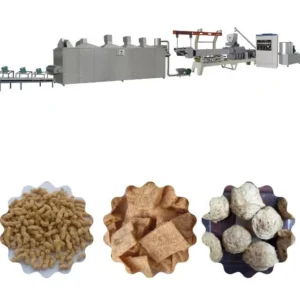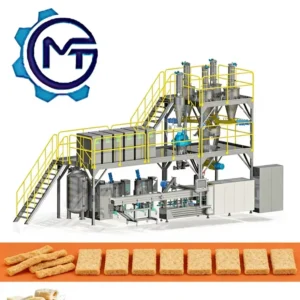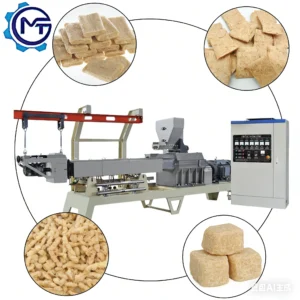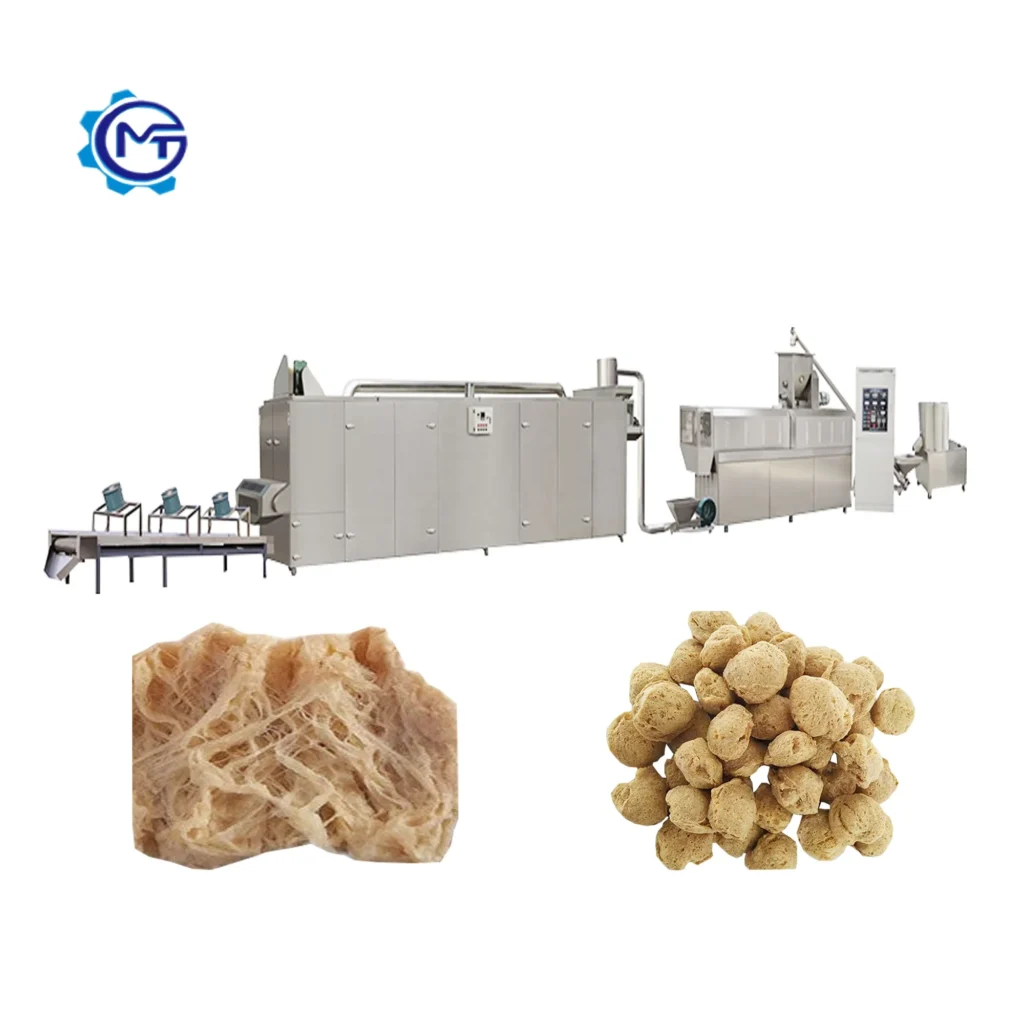
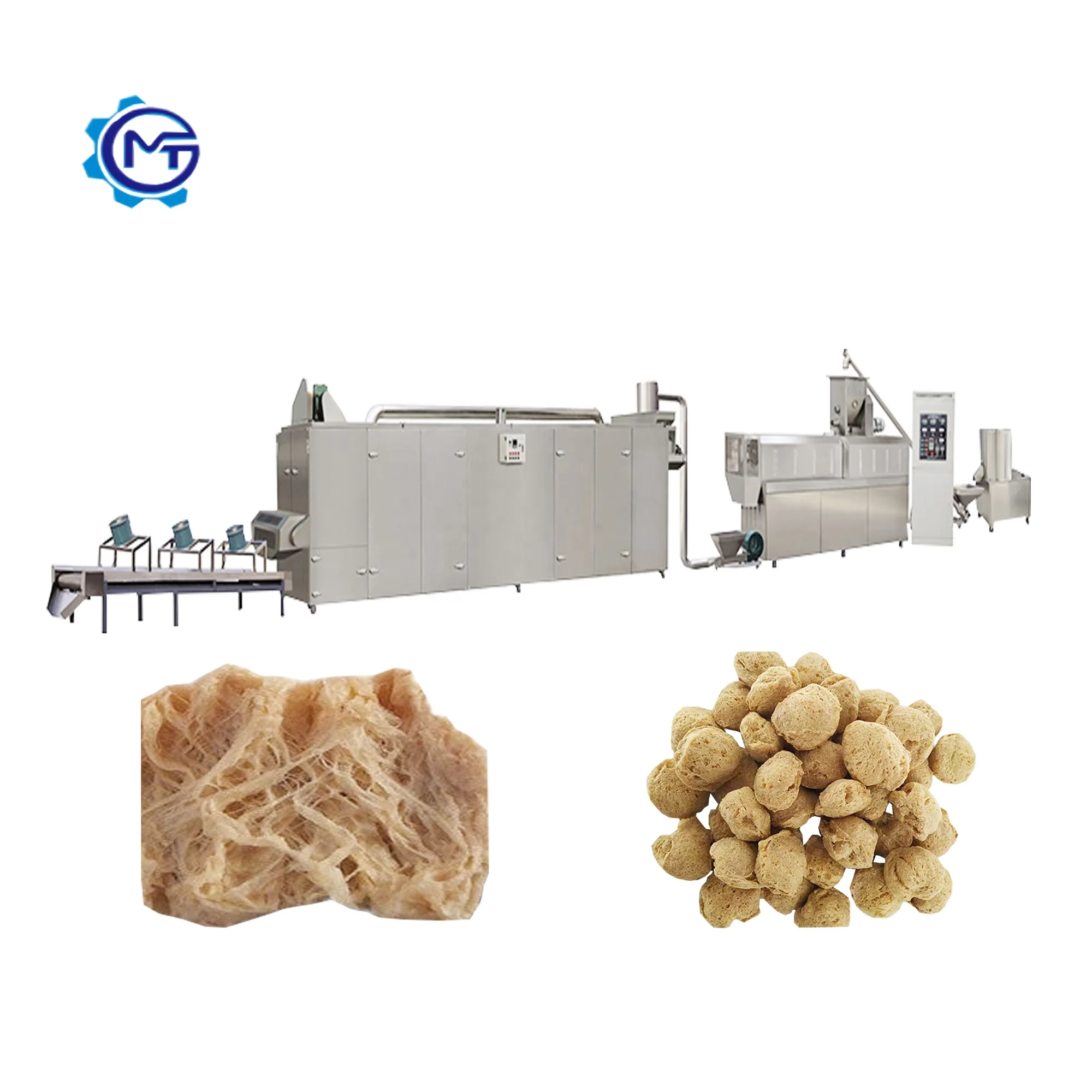

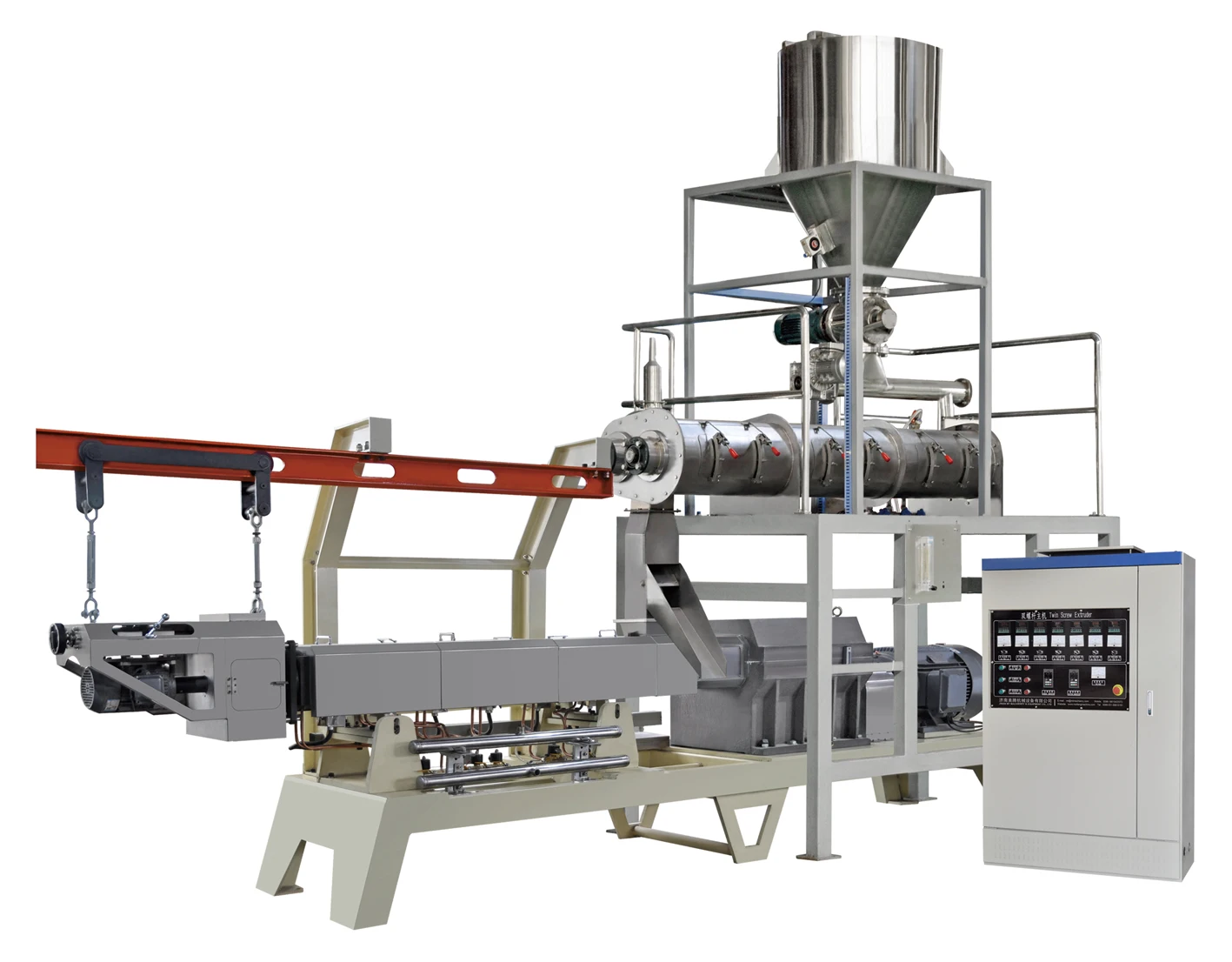


MT65 / MT70 / MT85 Twin-Screw TVP Extrusion Line, Stainless Steel, PLC & MCC Control — engineered for textured vegetable protein and soy meat substitute production. Screw configuration and die design are matched to your specific soybean meal or peanut meal formulation, controlling fiber structure, moisture, and expansion through the barrel profile. Throughput is balanced across every station from mixing to packing so no single unit bottlenecks the line.
- In-house trial runs on customer raw material before shipment validate output and texture
- Complete line layout with capacity calculation confirms station-by-station throughput match
- On-site installation, commissioning, and operator training included with lifetime maintenance support
Description
Screw & Die Matching — Every TVP line we ship starts with your actual soybean meal sample running through our in-house testing workshop, so the screw configuration and die geometry are locked to your specific protein and fat ratios before the machine ever leaves Jinan.
Technical Specifications
| Parameter | Value |
|---|---|
| Product Type | Textured Vegetable Protein (TVP) Extrusion Production Line |
| Models Available | MT65, MT70, MT85 |
| Extruder Type | Twin-screw (Double Screw) |
| Contact Material | Food-grade stainless steel |
| MT65 Installed / Real Power | 85 kW / 65 kW |
| MT65 Output | 150–200 kg/h (basis not stated in source) |
| MT65 Dimension (L×W×H) | 18000 × 1300 × 2300 mm |
| MT70 Installed / Real Power | 120 kW / 90 kW |
| MT70 Output | 200–300 kg/h (basis not stated in source) |
| MT70 Dimension (L×W×H) | 20000 × 1500 × 2400 mm |
| MT85 Installed / Real Power | 195 kW / 165 kW |
| MT85 Output | 600–800 kg/h (basis not stated in source) |
| MT85 Dimension (L×W×H) | 24000 × 3500 × 4300 mm |
| Powder Mixer Capacity | 300–600 kg/h, tank volume 150 kg, 385 rpm |
| High-temp Roaster Effective Belt | 3.5 m, far infrared heater 3.9 kW × 24, gas 6.8 m³/h |
| Cooling Machine Capacity | 200–300 kg/h |
| Line Stations | Mixing → Conveying → Extrusion → Drying → Cooling → Packing |
| Control | PLC and MCC |
| Standards | CE (certified since 2014), ISO |
| Warranty | 1 year, lifetime maintenance |
Application Suitability
| Application Scenario | Raw Material / Output |
|---|---|
| Retail & food-service soy meat chunks | Low-temperature defatted soybean meal |
| Textured soy protein for sausage and ham blending | Peanut meal or soy-protein concentrate |
| Quick-frozen plant-based patty premix | Blended soy and wheat gluten |
| Canned vegetarian ingredient supply | Soy grits with controlled moisture |
What "Nominal Capacity" Hides from TVP Buyers
A rating plate number means nothing until your exact flour runs through the barrel.
I once watched a Middle-East client watch his brand-new line produce a collapsed, gummy mess instead of the fibrous strands he had approved in the brochure. The extruder was sized to a generic soy isolate recipe, but his local meal carried higher residual oil and lower protein; shear and residence time were both wrong. Two weeks of re-tuning on site cost him three container shipments of ruined product. That turnkey textured vegetable protein production line should have been validated against his flour before the motor was even wired [NEED_CITE: typical raw-material variability in regional soybean meal].
Matching the Screw Profile to Your Protein Matrix
TVP fiber structure is born inside the barrel, not at the die. The MT65, MT70, and MT85 all share a modular screw shaft, but the element sequence — kneading blocks, reverse pitches, conveying flights — must be dialed to the gelatinisation window of your specific meal. Run a high-fat peanut blend through a screw stack tuned for defatted soy and you lose the laminar shear that creates the meat-like tear. Our engineers map barrel temperature zones to your DSC curve before the first element is slid onto the shaft, which is why every textured vegetable protein production line we release ships with a screw configuration record, not a catalog default.
Why the Dryer Matters as Much as the Extruder
Moisture leaving the die typically sits between 25 % and 35 %, and if the roaster cannot pull that down evenly, the fibers collapse during cooling. The high-temperature roaster in this line uses 24 far-infrared heaters across a 3.5 m belt, paired with gas burners that can be trimmed for local BTU value. We size belt speed to the extruder’s real, not nameplate, throughput so no wet product piles up at the infeed [NEED_CITE: infrared versus convection drying in high-protein extrudates]. A bottleneck here shows up as clumped, dark-edged chunks that your packing station will reject.
Reading the Power Numbers the Right Way
Installed power on the MT85 is 195 kW, but real running load averages 165 kW because the main drive, feeder, and cutter motors never peak together. Knowing the difference shapes your transformer sizing and your monthly utility bill. The same rule applies downstream: the powder mixer draws 4 kW, the cooling machine runs well below its plate rating, and the roaster’s gas consumption sits at 6.8 m³ per hour at full belt load. Quote these figures to your electrical contractor before you sign the PO, not after the panel is bolted to the floor.
The Hidden Cost of a Mismatched Die Plate
Die geometry decides whether your chunks tear like chicken breast or crumble like shortbread. A generic 4-hole die may give attractive output numbers, but if the land length is wrong for your dough viscosity, expansion will be uneven and the dryer will over-cure the thin pieces while the thick ones stay chewy. On site, operators compensate by slowing the belt, which drops overall line yield and creates a backlog at the cooling conveyor. We cut and hone the die after your trial run, so hole count, land length, and face relief all match the real rheology of your mix [NEED_CITE: die land length and expansion control in twin-screw extrusion].
Why Buyers Source This Line from One Supplier
A textured vegetable protein production line assembled from separate vendors often discovers throughput gaps only when the first shift runs. Our mixer, extruder, roaster, cooler, and packing station are calculated as one mass-balance sheet, so a 300 kg/h MT70 never waits on an undersized dryer. Every food-grade contact surface is stainless, and the PLC language is loaded in your operator’s tongue before the control cabinet leaves the workshop. Trial runs on your flour happen in Jinan, so commissioning at your site is a matter of utilities and calibration, not recipe invention. Spare screw elements and die plates travel with the first shipment, eliminating the most common cause of second-month downtime.
Documentation & Verification
- Line layout and capacity calculation matched to your target hourly output
- Screw and die configuration record specific to your soybean meal sample
- Trial run report filmed and weighed on your raw material before dispatch
- Electrical schematic confirming voltage, frequency, and PLC language
- CE declaration of conformity and ISO certificate package
- Operation, maintenance, and wear-parts manual in your chosen language
Installation, Commissioning & Support
- Foundation drawing provided for the MT85’s 24 m footprint and 165 kW load
- Dedicated 400 V / 50 Hz circuit diagram for extruder and roaster heaters
- Modular barrel sections arrive labeled for rapid on-site reassembly
- First-run parameter sheet handed over after on-site calibration
- Operator training covers screw element swap and die cleaning routines
- Wear-parts list with part numbers screws, barrels, and die inserts
- Preventive maintenance calendar tied to running hours on the main drive
What We Need Before We Quote
Send us the protein and fat certificate of your soybean or peanut meal, your target chunk size, and the daily tonnage you plan to run. Confirm local voltage, frequency, and the language your operators speak at the HMI. If you already have a mixer upstream or a packing scale downstream, share their capacities so we can match the new textured vegetable protein production line to your existing flow.
Frequently Asked Questions
Q: How do you confirm the line capacity against my specific soybean meal?
A: We ask for a 50 kg sample of your actual meal, run it through the testing workshop on the chosen MT model, and record throughput, moisture loss, and fiber tear. The resulting trial report becomes the contractual capacity reference, so the number on the invoice matches the kilos you will see on your scale.
Q: What is the typical installation sequence for a complete TVP line?
A: Mixer and conveyor go in first, followed by extruder barrel alignment, then roaster and cooler ducting. Utilities are terminated during week one; week two covers no-load rotation checks; week three runs product. Operator training overlaps the final week so your team is signing off parameters before our engineer leaves.
Q: How are extruder, dryer, and cooler throughput matched?
A: We calculate mass balance at your target moisture window. The roaster belt speed is set so residence time removes the exact water load the extruder delivers, and the cooling machine is sized one step above that figure to handle surge without product stacking.
Q: How is screw configuration chosen for my target fiber texture?
A: We plot your meal’s gelatinisation temperature and shear sensitivity, then arrange kneading blocks, reverse pitches, and conveying elements to hold the dough inside that window. The die land length is then cut to control expansion, giving you the tear and bite your market expects.
Related products
-
Soybean Protein Making Machine Automatic Soy Chunk Production Line
¥30.00 Select options This product has multiple variants. The options may be chosen on the product page -
Soy Bean Meat Protein Production Line Machine Multi-functional Extruder for Soy Protein Food
¥8,650.00 Select options This product has multiple variants. The options may be chosen on the product page -
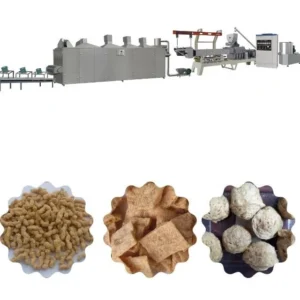
Dry Protein Drawing Equipment – Intelligent Puffing Machine for Cake Protein & Vegetarian Meat
¥65.00 Select options This product has multiple variants. The options may be chosen on the product page -
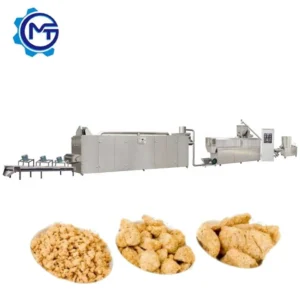
New Pea and Soybean Protein Production Line Equipment with Mechanical Extruder Food Grade Stainless Steel High Productivity
¥65.00 Select options This product has multiple variants. The options may be chosen on the product page