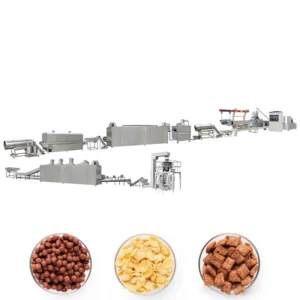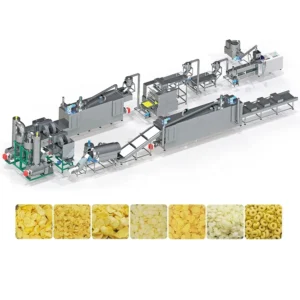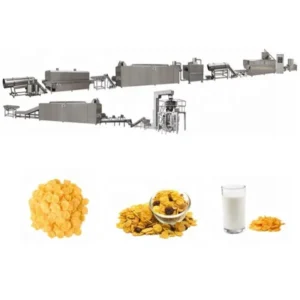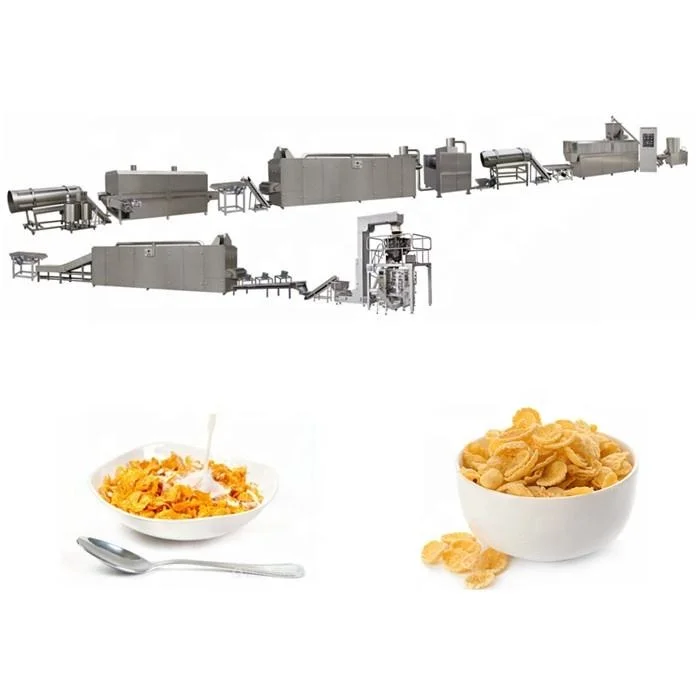
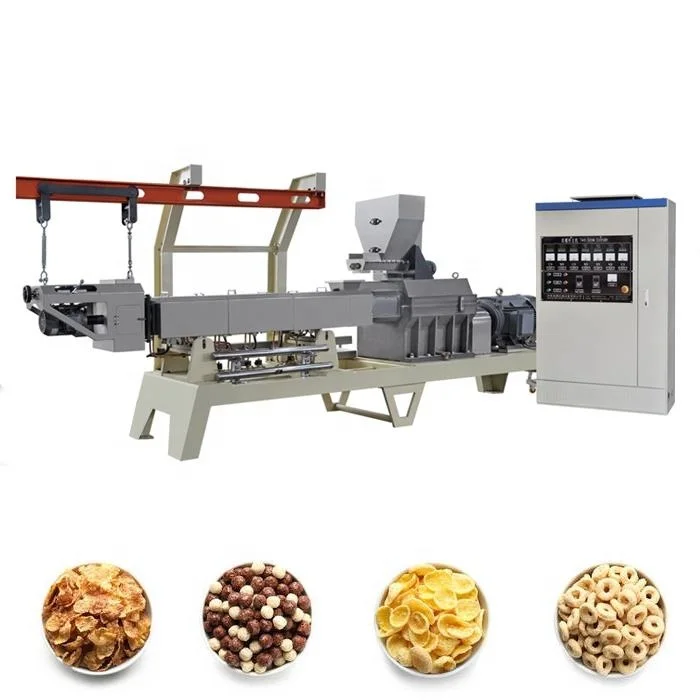
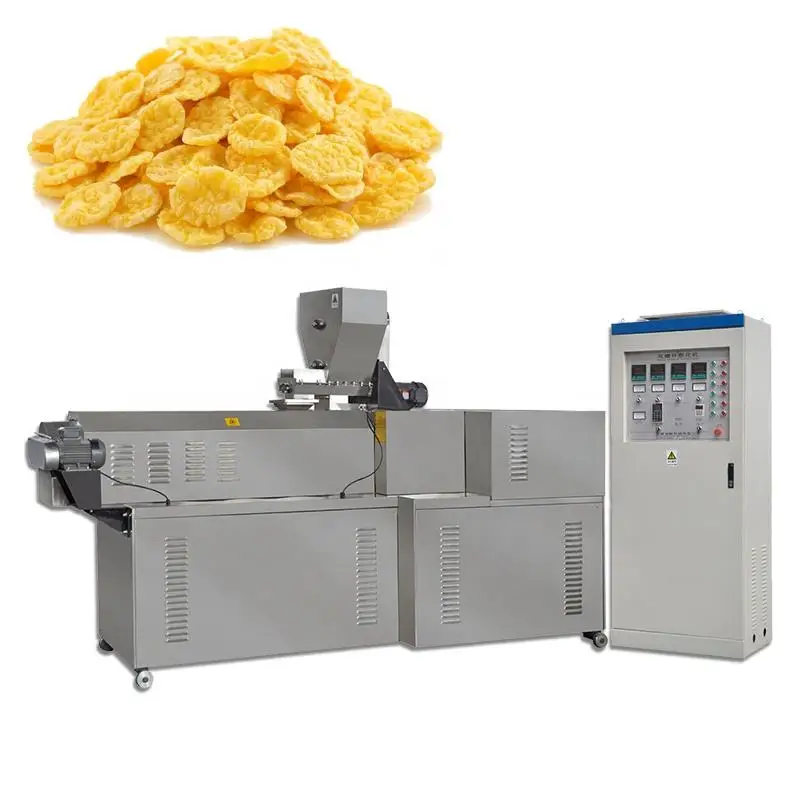
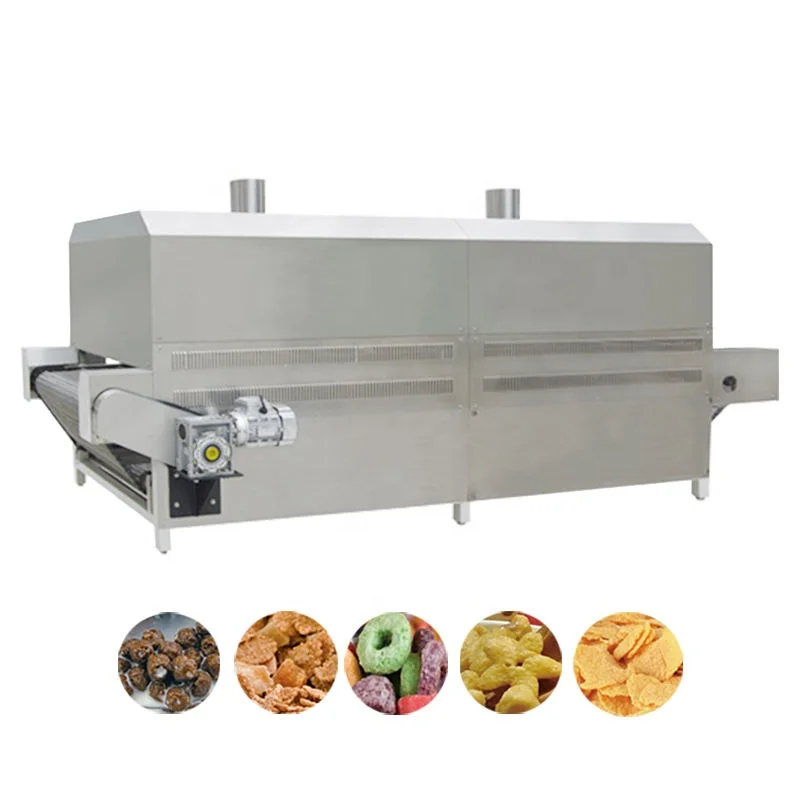
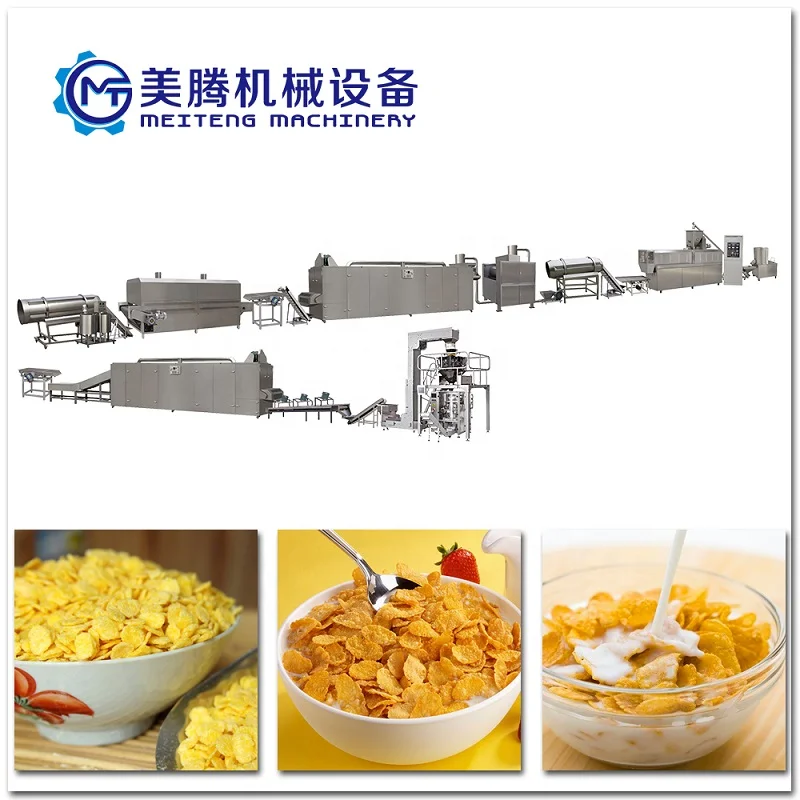
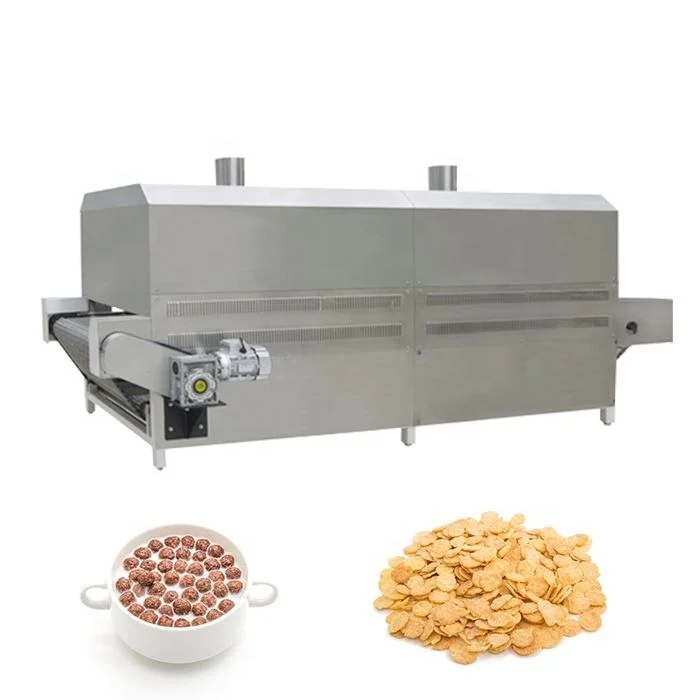
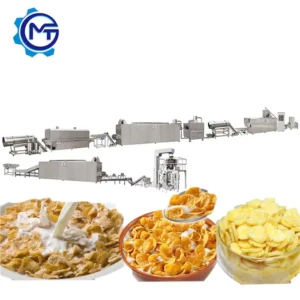
MT75 Twin Screw Corn Flakes Production Line, 210 kW, PLC Control — integrated from mixing to packing with hydraulic flaking, hot air roasting and optional sugar coating.
- Twin screw extrusion with automatic lubricating and cooling maintains stable gelatinisation across corn, rice, wheat and oat formulations
- Flaking station uses dual independent motors and infrared temperature control for uniform thickness, while the roasting oven delivers consistent surface blistering with dual circulating fans and cyclone dust removal
Turnkey layout, throughput matching and on-site commissioning are engineered under one supplier so no station bottlenecks your line.
Description
Integrated throughput matching — Every station from mixing through packing is engineered to the buyer’s raw material and target flake density, preventing the bottlenecks that occur when equipment is assembled from separate vendors.
Technical Specifications
| Parameter | Value |
|---|---|
| Model | MT75 (also available: MT70, MT85) |
| Product Type | Twin Screw Corn Flakes Production Line |
| Screw Type | Twin Screw |
| Installed Power | 210 kW (MT75); 160 kW (MT70); 190 kW (MT85) |
| Power Consumption | 150 kW (MT75); 120 kW (MT70); 140 kW (MT85) |
| Output Capacity | 300-500 kg/h (MT75) (basis not stated in source — confirm raw material type, moisture content and product format); 150-200 kg/h (MT70); 300-400 kg/h (MT85) |
| Overall Dimensions | 45 × 1.5 × 3.5 m (MT75); 41 × 1.5 × 2.2 m (MT70); 43 × 1.5 × 3.2 m (MT85) |
| Control System | PLC control system (flaking station); MCC line control |
| Extruder Screw Feature | Automatic lubricating and cooling function; wear-resistant screw technology |
| Flaking Machine | Hydraulic system for double rollers; double motors for separate roller driving; infrared sensor temperature control |
| Dryer Heating Source | Gas or Electric |
| Roasting Oven | Hot air roasting with vibrating pan, high temperature spraying tubes, conciliation burner, two separate circulating fans, cyclone dust removal device |
| Coating System | Double tumble for sugar melting, elevator, coating drum, spraying nozzle |
| Line Stations | Mixing → Extruding → Flaking → Drying → Hot Air Roasting → Sugar Spraying & Coating (optional) → Drying → Cooling → Packing |
| Raw Materials | Corn, rice, wheat, oat, barley powder |
| Voltage & Frequency | Customized to local voltage (source value — verify against manufacturer catalog) |
| Certification | CE, ISO |
Application Suitability
| Application | Material or Output |
|---|---|
| Breakfast cereal manufacturing | Natural corn flakes from corn, wheat, or oat powder |
| Sugar-coated cereal production | Sugar-coated corn flakes using the double tumble coating system |
| Multi-shape puffed snacks | Ball, tube, stick, ring, fruit loop, star, wheel, flower, heart shapes by adjusting extruder mould |
| Fortified breakfast cereals | Vitamin-enriched or nutrition programme breakfast cereals |
Why the Capacity Figure on Your Corn Flakes Line Proposal Might Be Misleading
A nominal throughput figure is meaningless unless it specifies the exact raw material formulation, moisture content, and target flake density.
Many producers receive proposals for a corn flakes production line turnkey system that quotes a maximum capacity based on ideal laboratory conditions. When the equipment arrives and runs on the buyer’s actual corn grits or oat blends, the extruder might reach that output but the downstream flaking station or dryer cannot keep pace. The result is material backing up, flakes cooling prematurely, and the coating drum unable to maintain a consistent sugar layer. This mismatch happens when vendors supply individual machines rather than engineering the complete line as a single integrated system. I have seen situations where a producer had to halt production every few hours to clear accumulated material between stations, effectively reducing actual output to a fraction of the quoted figure [NEED_CITE: importance of matched throughput in cereal processing lines].
Twin Screw Extrusion for Consistent Gelatinisation Across Varying Formulations
The twin screw configuration in this corn flakes production line turnkey system handles raw materials with varying starch and moisture profiles more effectively than single screw alternatives. The intermeshing screws create a self-wiping action that prevents material buildup inside the barrel, which is critical when switching between corn, rice, wheat, or oat-based recipes. The automatic lubricating and cooling function on the screw shaft maintains stable barrel temperatures during continuous runs, supporting uniform starch gelatinisation. Uniform gelatinisation directly affects the flake’s final texture, blistering behaviour in the roasting oven, and shelf stability.
Flaking and Roasting: Where Density and Crispness Are Decided
The flaking station uses a hydraulic double-roller system with dual independent motors and infrared sensor temperature control. This setup maintains a precise gap between the rollers, producing a consistent flake thickness across the entire batch. After the initial drying stage, the hot air roasting oven employs a conciliation burner, two separate circulating fans, and a cyclone dust removal device. The dual fans ensure even air distribution across the vibrating pan, creating the characteristic surface blistering and crispness expected in commercial breakfast cereals [NEED_CITE: hot air roasting parameters for breakfast cereal flakes]. Inconsistent roasting leads to some flakes remaining doughy while others over-brown, which buyers immediately notice.
Reading the Spec Sheet: What the Power and Dimensions Tell You
The MT75 variant draws 150 kW during operation and requires a 45-meter line footprint, which defines the electrical supply and floor space commitments before installation begins. The hydraulic flaking station with its independent roller motors requires a dedicated power circuit to prevent voltage fluctuation from affecting the extruder’s PLC control. The overall height of 3.5 meters for the MT75 also dictates ceiling clearance, particularly where the elevator feeds the coating drum. The dryer’s option for gas or electric heating must be confirmed early, as gas-fired units require different exhaust ducting and safety compliance than electric elements. Verifying these utility requirements before production prevents costly site modifications after the equipment arrives.
The Cost of Mismatched Stations Downstream from the Extruder
When the extruder runs at full capacity but the dryer or roasting oven is undersized, wet flakes accumulate and begin to clump together before entering the oven. This forces operators to throttle back the extruder, defeating the purpose of a high-capacity machine. If the coating drum’s rotation speed and spray nozzle pressure are not matched to the throughput, sugar-coated flakes receive an uneven layer, with some pieces receiving excess syrup that causes them to stick together in the packaging [NEED_CITE: sugar coating uniformity issues in cereal production]. These problems are not visible during a factory test that only runs the extruder in isolation.
Why Engineering the Whole Line Matters Here
The complete line from batching to packing is supplied by a single source, so throughput at the mixer, extruder, flaking station, dryer, roasting oven, and coating drum is calculated against one target output rather than negotiated across separate vendors. Screw configuration and die design are specified to the buyer’s particular corn, rice, or oat formulation and the desired flake thickness, not copied from a generic build. The in-house testing workshop conducts trial runs on the buyer’s actual raw material before shipment, confirming that the extruded pellets flake correctly and achieve the target density in the roasting oven. PLC control at the flaking station is integrated with the MCC line control, allowing synchronized start-up, shut-down, and speed adjustment across all stations. Pre-sales consultation covers line layout and utility planning, followed by on-site installation, commissioning, and operator training to ensure the crew can run the line independently from day one.
Documentation & Verification
- Line layout and capacity calculation matched to your raw material formulation and target flake density
- Screw and die configuration record specific to your product, not a generic template
- Electrical schematic with confirmed voltage, frequency, and control language for your facility
- Trial run report on your actual corn, rice, or oat raw material conducted in the testing workshop
- Factory test record documenting throughput and flake quality before dispatch
- CE declaration of conformity and ISO certificate for the complete line
Installation, Commissioning & Support
- Site preparation covering the 45-meter footprint and 3.5-meter height clearance required by the MT75 layout
- Dedicated power circuits for the 210 kW installed capacity and hydraulic flaking station motors
- Assembly of the extruder barrel, screw elements, and flaking rollers from their packed transport state
- First-run parameter setting for barrel temperature profile, roller gap, and roasting oven air circulation
- Operator training on PLC control interface, MCC line synchronization, and screw cleaning procedures
- Wear parts list covering screws, dies, and roasting oven components with recommended replacement intervals
- Daily maintenance schedule for the automatic lubricating system and infrared sensor calibration
Specifying Your Line Requirements
To receive an accurate line configuration, specify the primary raw material (corn, rice, wheat, oat, or a blend) and its moisture content upon delivery. State the target output in kilograms per hour and whether the final product is natural flakes, sugar-coated, or a multi-shape format. Provide your facility’s voltage, frequency, and preferred control language, along with available floor space and ceiling height, so the layout can be designed before production begins.
Frequently Asked Questions
Q: How is line capacity verified against my specific raw material and moisture content?
A: Capacity is verified through a trial run conducted in the in-house testing workshop using your actual raw material. The test confirms extruder throughput, flaking behaviour, and roasting results at the proposed output rate. A trial run report is provided before shipment, documenting the achieved capacity on your specific formulation.
Q: How do you match throughput between extruder, flaking, drying and coating stations?
A: Throughput is calculated for the entire line before configuration, ensuring each station can handle the output from the preceding one. The extruder’s screw speed, flaking roller gap, dryer residence time, and coating drum rotation are all set to a common target, preventing material accumulation or starvation at any point.
Q: What voltage, frequency and control language options are confirmed before production?
A: Voltage and frequency are customized to your facility’s utility supply and confirmed during the specification stage. The control language on the PLC and MCC interface is set to your operator’s preference. An electrical schematic reflecting these choices is reviewed before production begins.
Q: Can I run a trial on my raw material in your testing workshop before shipment?
A: Yes, the in-house testing workshop runs your specific raw material through the extruder and flaking station before the line ships. This confirms that the screw configuration and die design produce the correct pellet structure for your target flake density and texture.
Q: What installation, commissioning and operator training is included with the turnkey line?
A: Engineers conduct on-site installation, utility connection verification, and first-run commissioning. Operator training covers the PLC control interface, MCC line synchronization, screw and die cleaning, and daily maintenance routines for the automatic lubricating system and hydraulic flaking station.
Related products
-
Stainless Steel Honey Small Corn Flake Breakfast Cereal Flakes Maker Making Machine Production Plant
¥30,000.00 Add to cart -
Automatic Cornflakes Making Machine Corn Flakes Breakfast Cereals Processing Production Line
¥500.00 Select options This product has multiple variants. The options may be chosen on the product page -
Automatic Commercial Breakfast Wheat Circle Corn Flake Production Line
¥65,000.00 Add to cart -
Automatic 500kg/h Corn Flakes Making Machine New Condition High Productivity Sweet Breakfast Cereal Processing Line From Factory
¥8,500.00 Select options This product has multiple variants. The options may be chosen on the product page