

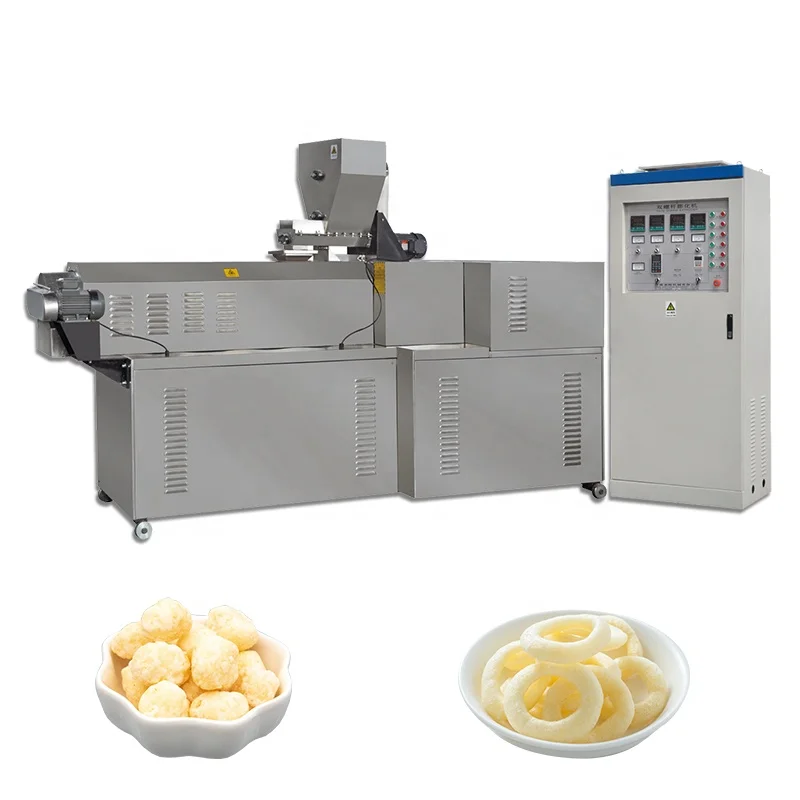
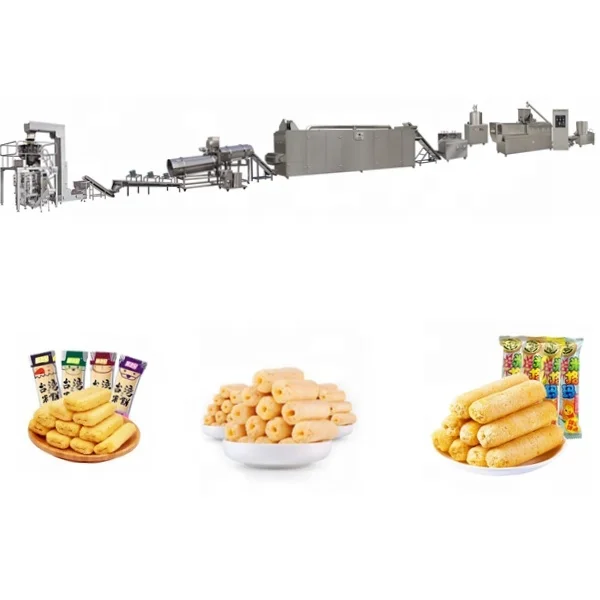
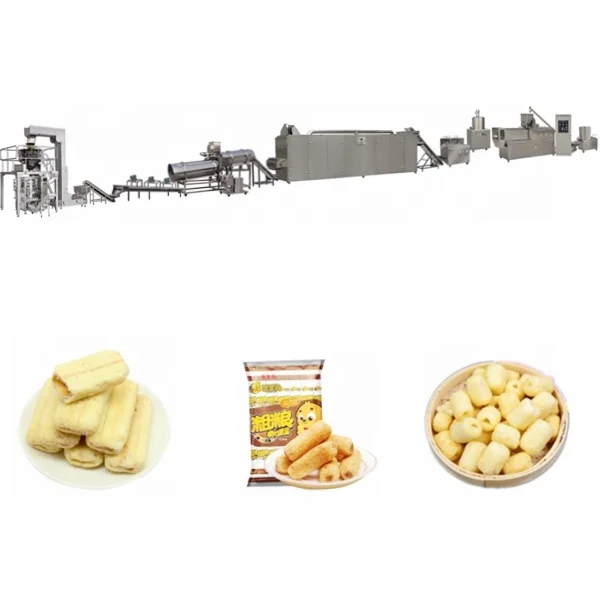
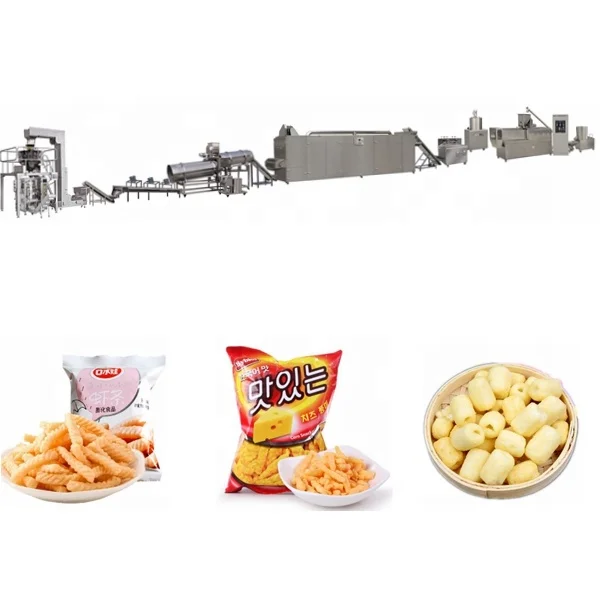
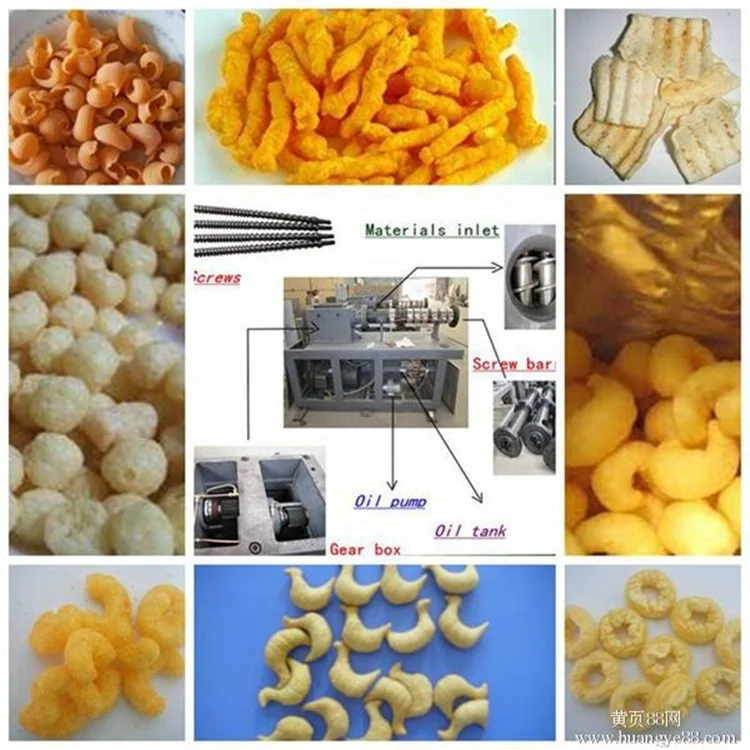
MT70 / MT85 / MT75 Twin Screw Extrusion Corn Puffs Snack Production Line, 130–220 kW Installed Power, Interchangeable Die Shapes — engineered as a complete turnkey food extrusion processing line with throughput-matched stations from batching through extrusion, drying, coating, cooling and packing.
- Screw configuration and die design specified to your raw material and target puff density, with trial runs on customer flour blends before shipment
- Layout customized to factory footprint, covering utility planning, phased installation and operator training under one supplier
Description
Integrated throughput matching — Every station from mixing through packing is engineered as one coherent food extrusion processing line turnkey project, so the dryer and coater never bottleneck the extruder on your actual grain formulation.
Technical Specifications
| Parameter | Value |
|---|---|
| Model | MT70 / MT85 / MT75 |
| Product Type | Twin Screw Extrusion Corn Puffs Snack Production Line |
| Screw Type | Twin Screw |
| Installed Power | MT70 — 130 kW; MT85 — 180 kW; MT75 — 220 kW |
| Power Consumption | MT70 — 95 kW; MT85 — 120 kW; MT75 — 130 kW |
| Output Capacity | MT70 — 100–120 kg/h; MT85 — 200–300 kg/h; MT75 — 300–500 kg/h (basis not stated in source — confirm raw material, moisture content and product shape) |
| Overall Dimensions (L×W×H) | MT70 — 21 × 1.5 × 2.2 m; MT85 — 25 × 1.5 × 2.2 m; MT75 — 28 × 1.5 × 2.2 m |
| Die Configuration | Interchangeable moulds for ball, tube, stick, ring, fruit loop, star, wheel, flower, heart shapes |
| Raw Materials | Corn, rice, wheat, oat, barley flour |
| Heating Source (Dryer) | Gas or Electric |
| Coating System | Double tumble for sugar melting, elevator, coating drum, spraying nozzle |
| Voltage & Frequency | Configurable to local supply standard |
| Control System | PLC and MCC control |
Application Suitability
| Application | Material or Output |
|---|---|
| Puffed corn snacks and cheese balls | Corn flour and rice flour blends at controlled moisture |
| Extruded rings, stars and fruit loops | Wheat, oat and barley flour formulations |
| Coated and sugar-glazed cereal pieces | Grain-based extrudates with sugar or flavour slurry |
| Stick and tube format savoury snacks | Corn grits and mixed grain flours |
What "Nominal Capacity" Really Means on a Snack Line
A quoted kg/h figure only holds when the raw material, moisture content and die geometry match the test basis.
I have watched buyers sign off on an extruder rated for corn flour, then switch to a cassava-dominant blend at their own factory and see the expansion rate collapse. The extruder runs, but the product density drifts outside what the market expects, and the dryer suddenly cannot keep pace because the moisture profile changed. When we plan a food extrusion processing line turnkey project, the capacity conversation starts with your actual flour blend and the exact shape you intend to run [NEED_CITE: starch gelatinisation behaviour across grain types]. That is the only way the number on the quotation survives contact with your production floor.
Line-Wide Throughput as the Design Starting Point
A snack line is only as fast as its slowest station. The extruder may push product at a steady rate, but if the dryer belt is too short or the coating drum cannot complete its tumble cycle before the next batch arrives, the whole food extrusion processing line turnkey project stalls. We size every conveyor, dryer zone and flavouring drum against the extruder output so that no single station forces operators to throttle back.
Matching the Dryer to the Extrusion Moisture Profile
Freshly extruded puffs carry significant surface and internal moisture that must be reduced before coating and packing. The dryer on this line is available with gas or electric heating, and the choice affects both utility planning and temperature ramp behaviour. Gas heating tends to recover temperature faster after a door-open event, while electric elements offer finer zone control. Either way, belt length and air flow are specified against the extruder model so residence time stays adequate at full throughput [NEED_CITE: moisture reduction requirements for puffed snack shelf stability].
Reading the Power and Capacity Spread Across Models
The three extruder models span a wide installed power range — from 130 kW on the MT70 to 220 kW on the MT75 — and the power consumption figures follow proportionally. In twin-screw extrusion, installed motor power determines the shear energy available to gelatinise starch inside the barrel. A higher-power model handles denser flour blends and larger die orifices while maintaining screw speed. The dimension spread from 21 m to 28 m in line length also signals how much floor space each configuration occupies, which matters when you are fitting a food extrusion processing line turnkey project into an existing building. Die interchangeability across ball, tube, ring, fruit loop and other shapes means one extruder platform covers multiple SKUs without a second capital purchase.
The Cost of Skipping a Raw-Material Trial Run
When a line ships without a trial on the buyer’s own flour, the first week of production becomes an expensive experiment. Operators adjust feed rate, barrel temperature and screw speed blindly, generating off-spec product that either gets reworked or scrapped. Screw and die settings that work on one starch profile often fail on another, and the resulting density variation makes the coating drum apply uneven layers. These problems surface late, when the line is already installed and the buyer has committed to packaging materials and delivery schedules [NEED_CITE: extrusion trial run importance for grain-based snack production].
Why Source the Entire Line From One Supplier
Every station on this food extrusion processing line turnkey project is throughput-matched at the design stage, removing the finger-pointing that happens when an extruder vendor blames the dryer supplier and vice versa. The screw configuration and die design are specified to your raw material and target shape rather than copied from a generic build. An in-house testing workshop allows trial runs on your flour before the line ships, so product development happens in Shandong, not on your factory floor during commissioning. Electrical schematics and voltage are confirmed for your market before production begins. Pre-sales consultation carries through to on-site installation, operator training and ongoing wear-part support.
Documentation & Verification
- Line layout and capacity calculation confirming throughput at each station
- Screw and die configuration record matched to your flour blend and shape
- Trial run report on your raw material before dispatch
- Electrical schematic with voltage and frequency locked to your local grid
- Operation and maintenance manual covering all stations
- Packing photographs and customs documentation support
Installation, Commissioning & Support
- Foundation and floor space planned against the 21–28 m line length envelope
- Dedicated power circuits sized to the MT70/MT85/MT75 installed power draw
- Dryer heating source — gas or electric — confirmed before utility rough-in
- First-run parameter setting on your flour blend during on-site commissioning
- Operator training covering screw changes, die swaps and coating drum adjustment
- Wear parts list for screws, dies and spray nozzles with reorder references
What We Need to Prepare Your Line Proposal
Share the grain flours you plan to run, the moisture range of your blend, and the specific snack shapes you want from the die set. Let us know your target hourly output, available floor length and ceiling height, and the local voltage and frequency standard. If you have existing upstream mixers or downstream packing equipment, tell us the model and throughput so we can match interfaces.
Frequently Asked Questions
Q: How is line throughput verified across all stations before shipment?
A: Each station — mixer, extruder, dryer, coater, cooler — is sized against the extruder output during layout design. Before dispatch, we run your raw material through the extruder in our testing workshop and document actual output, expansion and moisture at the die exit. That data drives final dryer belt speed and coating drum cycle confirmation.
Q: What factory utility planning is required for a complete installation?
A: You will need a power supply matching the selected model’s installed power, a dedicated circuit for the dryer heating source whether gas or electric, compressed air for pneumatic gates and spray nozzles, and floor space accommodating the full line length. We provide a utility diagram with connection points once the model and layout are confirmed.
Q: How does the installation and commissioning schedule work?
A: The line ships as matched stations that are positioned according to the approved layout drawing. Our engineers oversee mechanical assembly, electrical connection and first-run parameter tuning on your flour. Operator training covers die changes, screw maintenance and coating system adjustment, typically completed within the commissioning window before handover.
Q: Can the line layout be adapted to a specific factory footprint?
A: Yes. The production line drawing is customised to your building dimensions, ceiling height and column positions. Conveyor lengths and station spacing are adjusted so the food extrusion processing line turnkey project fits without compromising throughput matching between the extruder, dryer and coating sections.
Q: What documentation supports customs clearance and local certification?
A: We supply a CE declaration of conformity, ISO certificate, electrical schematic, packing list with photographs and a factory test record. These documents support import clearance and local machinery registration. The trial run report and screw configuration record also help your technical team validate the line against your internal quality standards.
Related products
-

Twin Screw Corn Puffs Extruder Machine Small Corn Snack Food Extruder Machine
¥100.00 Select options This product has multiple variants. The options may be chosen on the product page -

Stainless Steel Corn Puff Cake Making Machine Corn Snack Food Machines Top Selling Snacks Machine
¥8,560.00 Select options This product has multiple variants. The options may be chosen on the product page -

Puff Corn Snacks Food Line Puffed Rice Ball Production Making Equipment Machines
¥10,565.00 Select options This product has multiple variants. The options may be chosen on the product page -

Hot Sale Corn Snack Extruder Puffed Snacks Production Machine Corn Puffs Making Machine
¥20,000.00 Select options This product has multiple variants. The options may be chosen on the product page


