

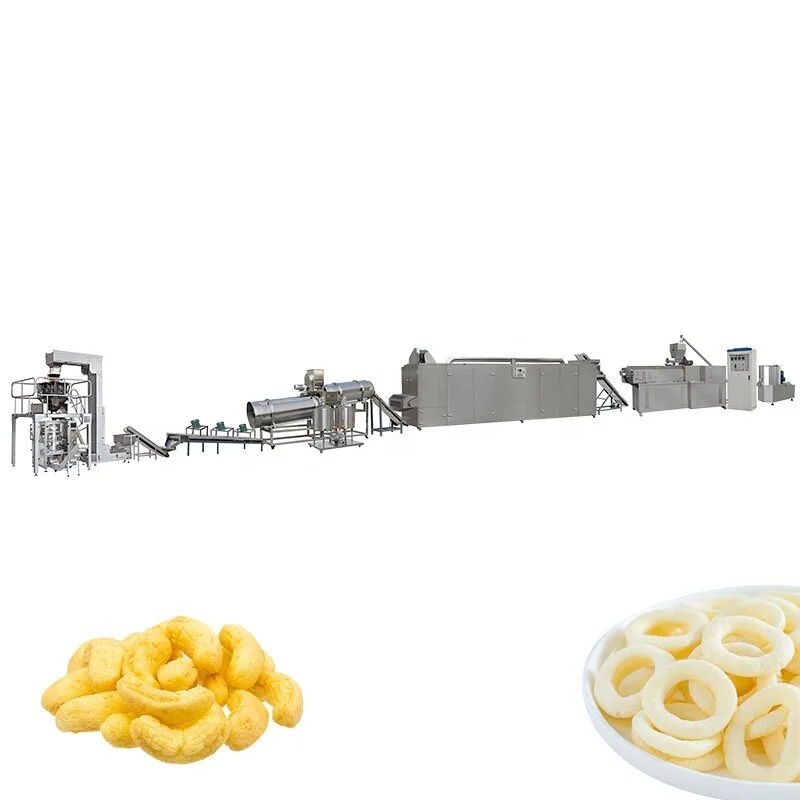
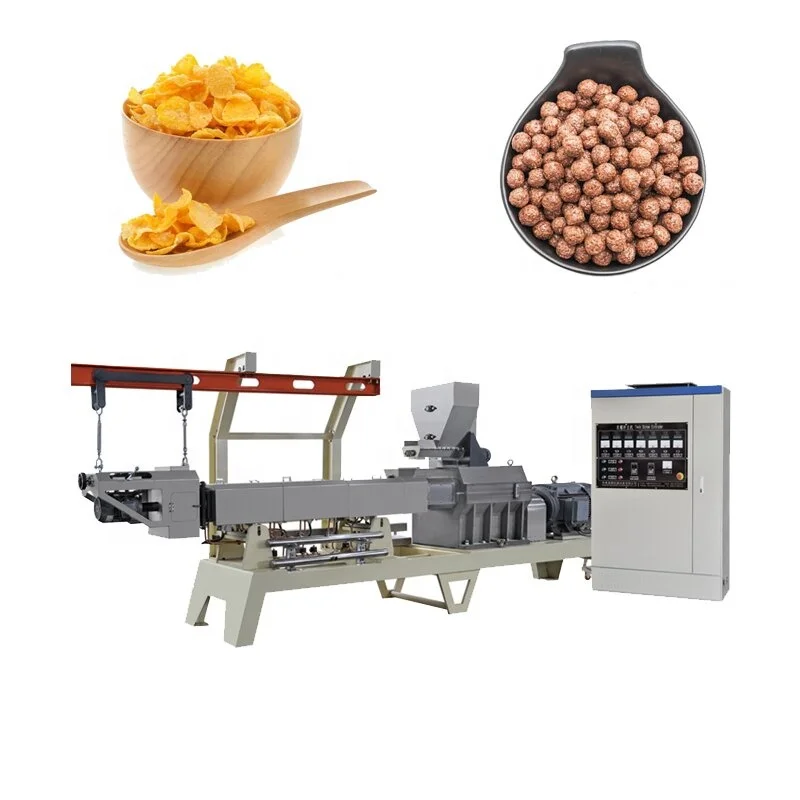
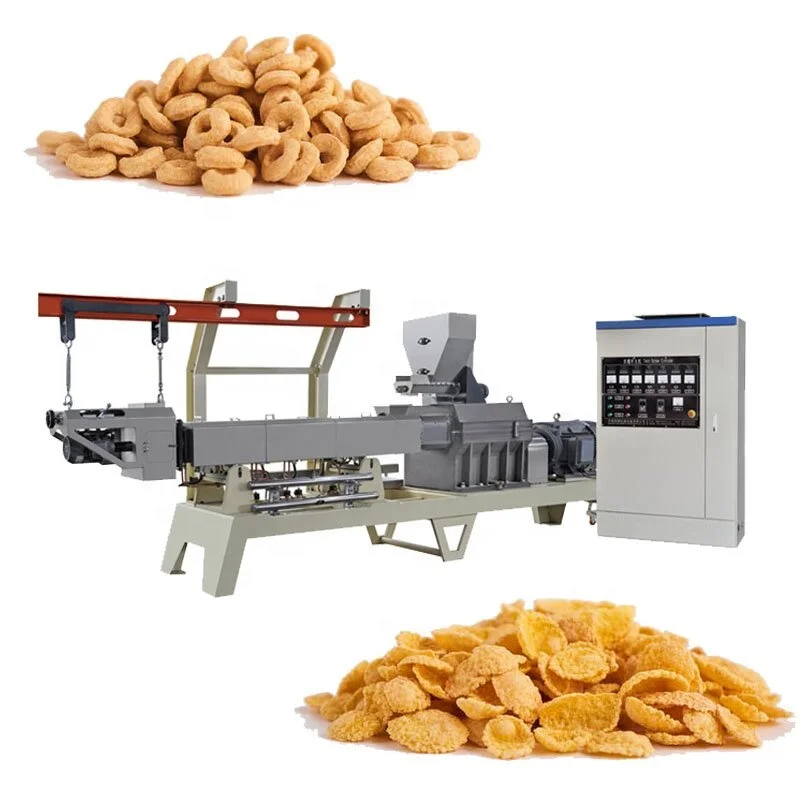
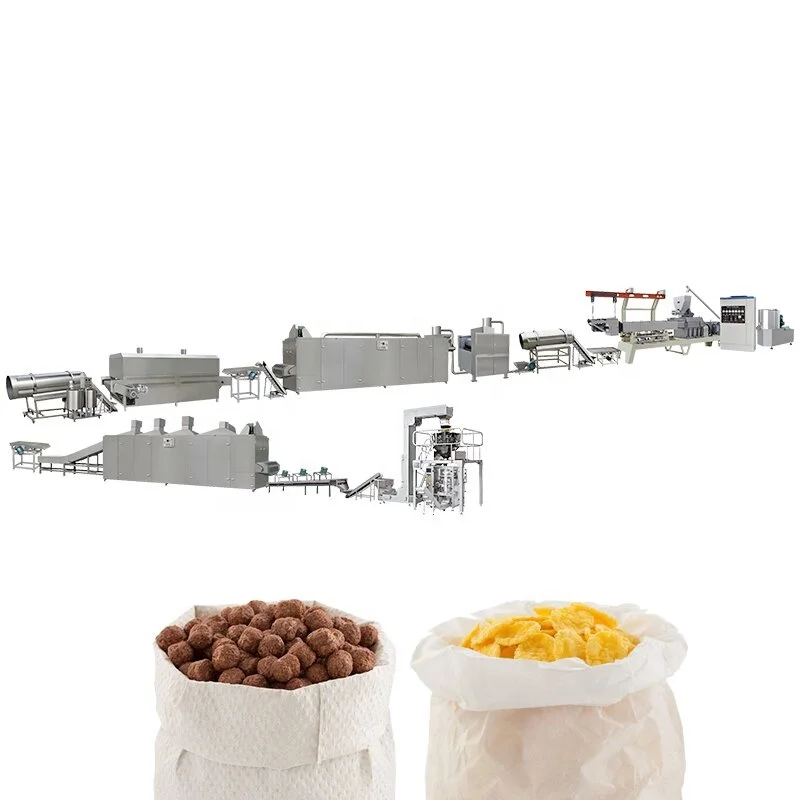
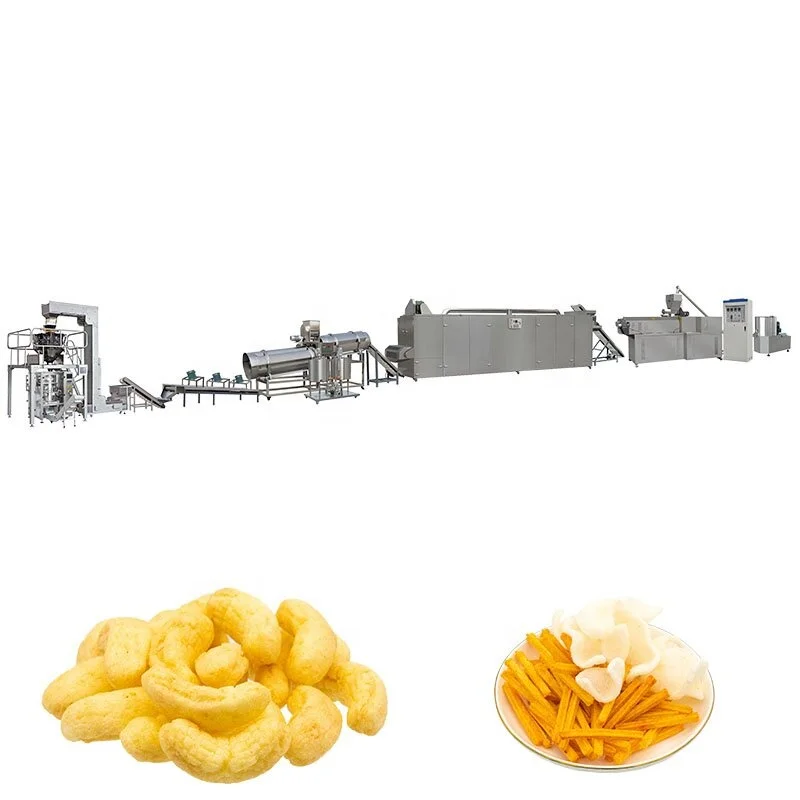
MT65 Twin Screw Corn Puffs Extruder Machine, 70 kW Installed Power, Five-Layer Mesh Dryer — delivered as a complete turnkey project from batching through packing. Screw configuration and die design are specified to your raw material formula and target puff density, with throughput balanced across mixer, extruder, dryer and seasoning stations to prevent line bottlenecks. In-house trial runs on your actual raw material are completed before shipment, with a full test report provided.
- Models available: MT65 / MT70 / MT85 with matched downstream equipment
- Delta inverter-driven feeding, extrusion and cutting for stable output
- CE and ISO certified production lines for 60+ countries
Description
Integrated project delivery — Every station from mixer to packing is throughput-balanced on paper before the twin screw corn puffs extruder production line turnkey ships, so the contracted output holds on your actual formula.
Technical Specifications
| Parameter | Value |
|---|---|
| Product Type | Twin Screw Corn Puffs Extruder Machine |
| Model | MT65 / MT70 / MT85 |
| Installed Power | 70 kW (MT65) / 100 kW (MT70) / 200 kW (MT85) |
| Real Power Consumption | 40 kW (MT65) / 70 kW (MT70) / 150 kW (MT85) |
| Output Capacity | 100–150 kg/h (MT65) / 200–240 kg/h (MT70) / 300–400 kg/h (MT85) (basis not stated in source — confirm raw material, moisture, product shape) |
| Overall Dimensions (L×W×H) | 20000×1200×2200 mm (MT65) / 25000×1500×2200 mm (MT70) / 30000×3500×4300 mm (MT85) |
| Screw Type | Twin screw, co-rotating, sectional modules |
| Screw Material | Alloy 38CrMoAL, nitriding process |
| Feeding System | Food-grade stainless steel twin screw feeder with Delta inverter |
| Main Motor | SIEMENS (China) |
| Control System | Auto-temperature controlling, inverter-driven feeding / extrusion / cutting |
| Gearbox | Automatic lubrication function |
| Cutting Mechanism | Rotary knife on die head seat, V-belt drive |
| Mixer Capacity | 80–100 kg/batch, mixing time 30 s–3 min, motor 7.5 kW |
| Dryer Structure | Five-layer SUS mesh belt, sealed body, auto temperature control, max 160°C |
| Dryer Heating Options | Electric / gas / oil |
| Shapes Available | Round, triangle, square, stars, flower, rings, strips, hearts, wheels (die-dependent) |
| Assembly State | Complete line (batching to packing) |
| Warranty | At least 1 year from completion of commissioning |
| Standards | CE, ISO |
Application Suitability
| Application | Material or Output |
|---|---|
| Puffed corn snack production | Corn grits, corn flour, corn meal |
| Rice puff and multigrain snack formats | Rice flour, rice grits, blended cereal bases |
| Wheat and oat extruded snacks | Wheat flour, oat flour, rye flour |
| Fortified breakfast cereal pieces | Cereal blends with vitamin and mineral premixes |
| Coated and seasoned snack products | Oil-sprayed and powder-dusted puffed pieces |
What "300 kg/h" Actually Means on Your Corn Formula
Capacity is only real when verified against your raw material, moisture content, and target puff density — not a catalog number.
I have watched a puffed snack line get rejected at site acceptance because the corn flour the buyer sourced locally had different starch behaviour than the grits used during the factory test. Output dropped, texture went dense, and the seasoning drum sat half-empty waiting for product that never arrived at the promised rate. [NEED_CITE: raw material variability in extrusion processing] When you evaluate a twin screw corn puffs extruder production line turnkey, the first question should never be about price — it should be about what happens when your specific formula meets those screws.
Throughput Matching Across Every Station
A twin screw corn puffs extruder production line turnkey is only as fast as its slowest station. The extruder may push product at its rated output, but if the five-layer mesh dryer cannot remove moisture quickly enough at that throughput, puffs pile up, soften, and lose the crispness your market expects. Each station — mixer, screw conveyor, extruder, dryer, seasoning drum, cooling conveyor — is sized so that none becomes a hidden bottleneck during continuous shifts.
Screw Configuration Dictates the Real Output
The co-rotating twin screw design with sectional modules allows the screw profile to be rebuilt for different cereal bases. Corn grits at a certain moisture level need a different compression ratio and kneading block arrangement than a rice-wheat blend. The die design then controls expansion and final piece density. Getting this combination wrong means the extruder runs, but the product does not meet the texture specification your packaging promises. [NEED_CITE: screw configuration impact on extrudate density]
Reading the Power and Dimension Data
The gap between installed power and real power consumption matters for your utility planning. The MT85 draws 200 kW on paper but runs around 150 kW under typical load, which affects transformer sizing and cable runs to the extruder panel. The 30-metre line length for the MT85 variant means you need clear floor space plus access room on both sides for maintenance. The Delta inverter-driven feeding and extrusion control holds throughput steady across product changeovers, which keeps the downstream dryer and seasoning drum loaded at a consistent rate rather than cycling between surges and starvation.
The Hidden Cost of an Undersized Dryer
When the dryer is spec’d to a lower throughput than the extruder, operators slow the extruder down to match — and the line never reaches the output you paid for. Worse, puffs that enter the dryer too quickly spend insufficient time at temperature, leaving residual moisture that causes staling within days. I have seen producers blame the extruder for soft product when the real problem was a dryer that was one size too small for the line speed. [NEED_CITE: moisture content and shelf stability in puffed snacks]
Why Source the Full Line from One Supplier
Throughput matching happens on paper before metal is cut, with a line layout and capacity calculation that shows how each station relates to the next. Screw and die configuration is recorded against your target product, not copied from a generic build. An in-house testing workshop runs your actual raw material before shipment, generating a trial run report that becomes the baseline for site commissioning. Electrical schematics confirm voltage, frequency, and control language against your plant specification so that the first power-on at site is not a debugging session.
Documentation & Verification
- Line layout and capacity calculation showing throughput balance between extruder, dryer, and seasoning drum
- Trial run report executed on your corn or cereal formula in the testing workshop before dispatch
- Screw and die configuration record matched to your target puff shape and density
- Electrical schematic with voltage, frequency, and control language confirmed against your plant
- CE declaration of conformity and ISO certificate for customs and regulatory clearance
- Wear parts list covering screws, dies, and cutting blades with replacement intervals
Installation, Commissioning & Support
- MT85 line requires approximately 30 metres clear floor length plus utility connection space on both sides
- Power supply must match confirmed voltage and frequency; dedicated circuit breaker sized to real power draw
- Phased installation follows the layout plan — mixer and conveyor first, extruder and dryer second, seasoning and packing last
- On-site commissioning includes parameter setting for barrel temperature profile, screw speed, and feeding rate on your raw material
- Operator training covers product changeover procedures, die swaps, and routine screw inspection
- Wear parts kit with initial spare screws, dies, and rotary knives supplied for the first maintenance cycle
What We Need to Quote Accurately
Provide your primary cereal base and any secondary grains or premixes in the formula, along with the moisture range you expect at the feeder. Share your target daily output and the number of shifts you plan to run so that capacity can be calculated on a realistic duty cycle. Confirm your local voltage, frequency, and preferred control panel language so that the electrical design matches your facility from day one.
Frequently Asked Questions
Q: How is line capacity verified on my raw material before shipment, and what does the trial run report include?
A: Your formula is run through the extruder in our testing workshop at production speed. The trial run report documents screw configuration, barrel temperature settings, output rate, and puff density achieved. You receive this report before the line ships, so commissioning at your site starts from a known baseline rather than a cold start.
Q: How are extruder, dryer, and seasoning drum throughput matched so the line holds contracted output?
A: Each station is sized during the layout phase based on the extruder output on your specific raw material. The dryer belt speed and temperature zones are calculated to handle that throughput while reaching target moisture. The seasoning drum volume and oil spray rate are then matched so no station forces the others to slow down.
Q: What utility planning is required before phased installation?
A: You need confirmed electrical supply matching the voltage and frequency on your schematic, with circuit capacity for the real power draw of the largest model you select. Gas or oil supply lines are required if you choose those dryer heating options. Compressed air and water connections follow the layout document provided during the design phase.
Q: How are screw configurations and die formats selected for different puff shapes and densities?
A: The sectional screw modules are arranged based on your cereal base and target texture. Compression ratio and kneading block position control how much shear the material receives. The die opening geometry then determines expansion rate and final piece shape. Both are recorded so you can reorder the same configuration for repeat production runs.
Related products
-

Puff Corn Snacks Food Line Puffed Rice Ball Production Making Equipment Machines
¥10,565.00 Select options This product has multiple variants. The options may be chosen on the product page -

Full Automatic Crispy Maize Chocos Corn Flakes Breakfast Cereals Processing Production Line Industrial Equipment
¥1,000.00 Select options This product has multiple variants. The options may be chosen on the product page -

Automatic Corn Flake Processing Line Corn Coco Pops Breakfast Cereals Snacks Making Machinery
¥7,500.00 Select options This product has multiple variants. The options may be chosen on the product page -

Puffed Snack Food Machine Snack Food Machine Puffed Snack Machine
¥11,050.00 Select options This product has multiple variants. The options may be chosen on the product page


