

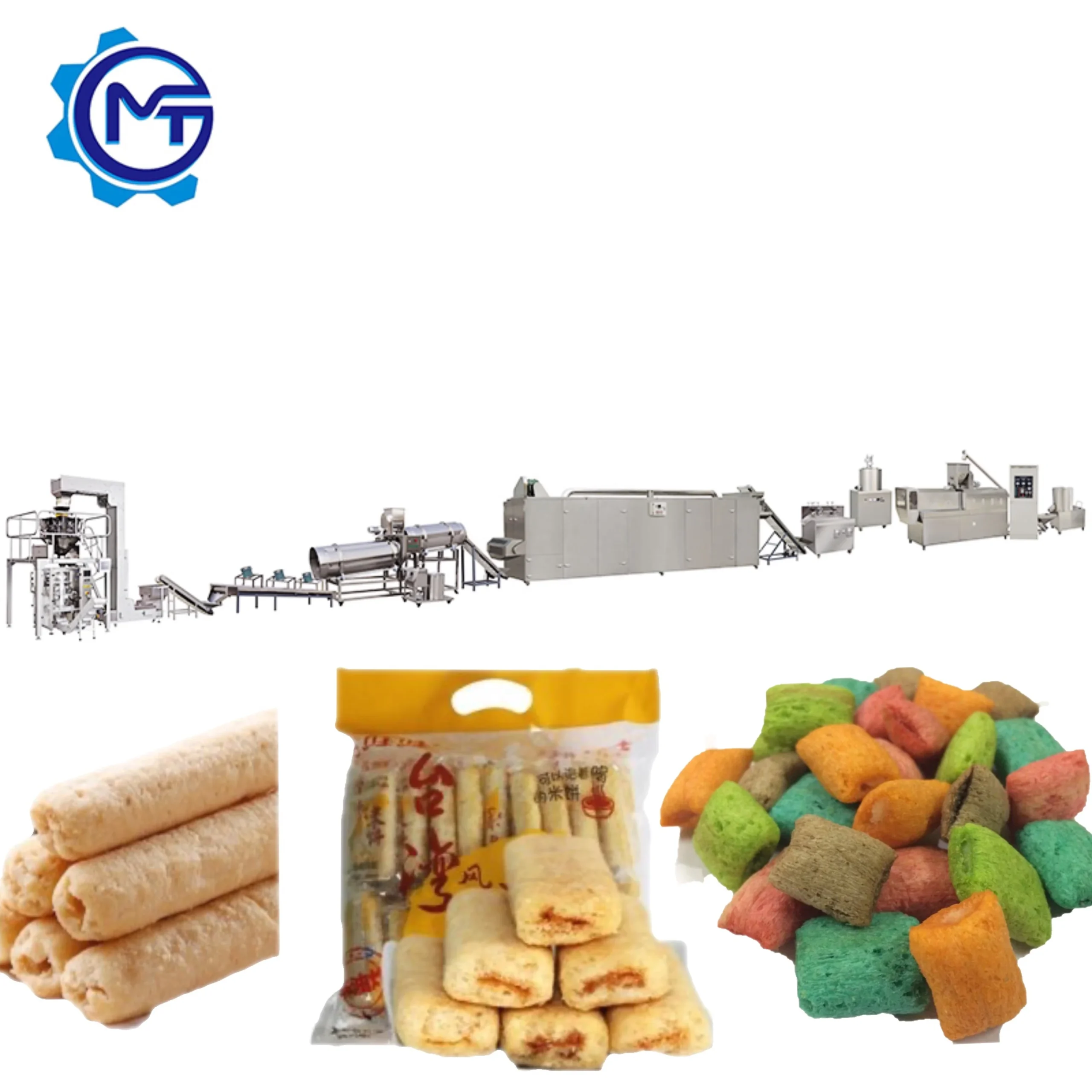
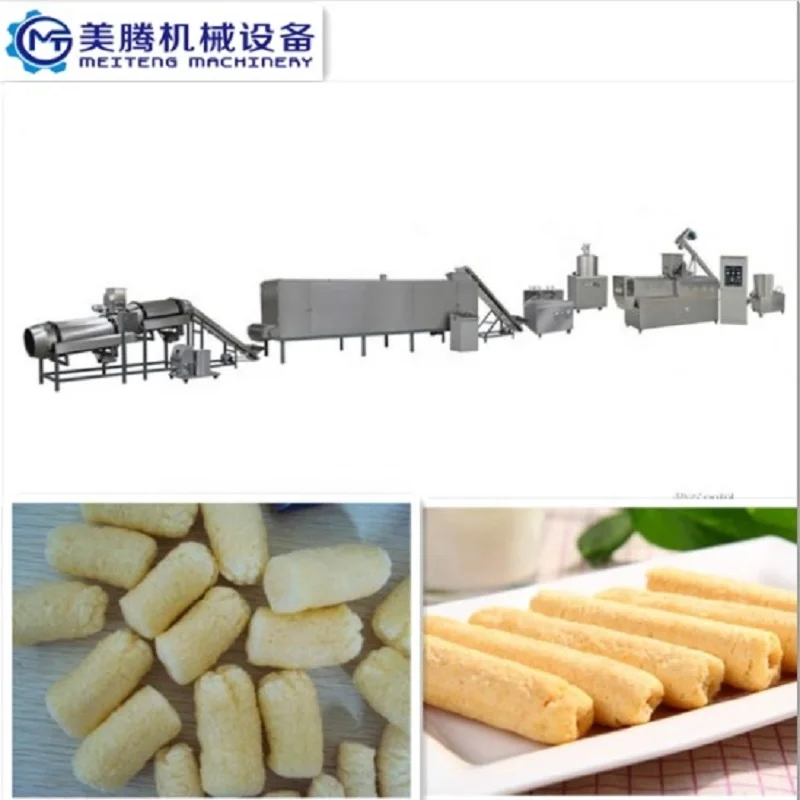

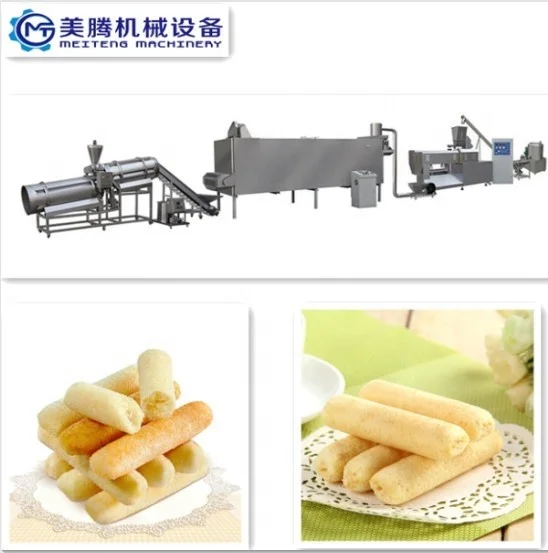
MT70 / MT85 / MT75 Twin Screw Extrusion Puffed Snacks Production Line, PLC & MCC Control, Interchangeable Dies — engineered as one turnkey project from mixing through extrusion, drying, coating and packing with throughput matched across every station.
- Screw configuration and die profile specified to your raw material, moisture level and target shape
- Factory layout customised to your plant footprint with voltage and frequency confirmed before build
Trial runs on your actual recipe in our testing workshop before shipment, backed by complete line documentation from layout calculation to CE declaration.
Description
Throughput-Matched Engineering — Every station from batching through extrusion, drying, coating and packing is sized to the actual output of the preceding unit, eliminating the mid-line bottlenecks that plague pieced-together snack lines.
Technical Specifications
| Parameter | Value |
|---|---|
| Model | MT70 / MT85 / MT75 |
| Product Type | Twin Screw Extrusion Puffed Snacks Production Line |
| Screw Type | Twin Screw |
| Installed Power | MT70: 130 kW; MT85: 180 kW; MT75: 220 kW |
| Power Consumption | MT70: 95 kW; MT85: 120 kW; MT75: 130 kW |
| Output Capacity | MT70: 100–120 kg/h (basis not stated in source — confirm raw material / moisture / product shape); MT85: 200–300 kg/h (basis not stated in source); MT75: 300–500 kg/h (basis not stated in source) |
| Overall Dimensions (L×W×H) | MT70: 21 × 1.5 × 2.2 m; MT85: 25 × 1.5 × 2.2 m; MT75: 28 × 1.5 × 2.2 m |
| Control System | PLC and MCC |
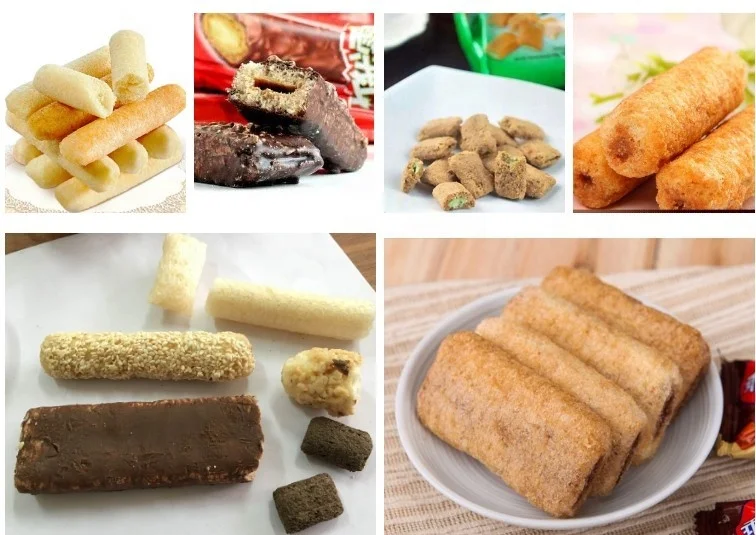
| Die Configuration | Interchangeable dies (ball, tube, stick, ring, fruit loop, star, wheel, flower, heart) |
| Line Stations | Mixing → Extruding → Drying → Coating / Flavouring → Cooling → Packing |
| Dryer Heating Source | Gas or Electric |
| Coating System | Double tumble sugar melting, elevator, coating drum, spraying nozzle |
| Screw Construction | Wear-resistant alloy, self-cleaning profile, automatic lubrication and cooling |
| Voltage & Frequency | Customised to buyer’s local supply |
| Standards | CE, ISO |
Application Suitability
| Application | Material or Output |
|---|---|
| Corn stick and cheese ball production | Corn flour, corn grits, rice flour blends |
| Ring and fruit loop cereal snacks | Wheat flour, oat flour, compound grain formulations |
| Star, wheel and flower shaped puffed snacks | Multi-grain blends with starch modifiers |
| Pilot to full-scale snack line commissioning | Manufacturer recipes requiring in-house trial runs before shipment |
What "Nominal Capacity" Really Means on a Twin Screw Extruder Puffed Snacks Production Line Turnkey Project
A rated throughput figure only holds if it was measured on your exact recipe at your target moisture level.
Too many snack producers discover after installation that the extruder hits its brochure number on a test flour, then drops noticeably when running the actual corn-to-rice ratio they bought the machine for. The dryer ends up half-empty while the extruder is choked, or the coating drum overflows because its cycle time was never matched to the upstream output. [NEED_CITE: extrusion throughput variance by raw material composition] These mismatches do not show up in a catalogue; they only appear when the full line runs under real conditions.
Screw Configuration Dictates Product Texture, Not Just Output
The twin-screw geometry — flight depth, pitch, and kneading block arrangement — controls shear intensity and residence time inside the barrel. A screw profile designed for high-moisture corn dough produces a completely different expansion ratio than one set up for dry wheat grits. On this Twin Screw Extruder Puffed Snacks Production Line Turnkey build, the screw configuration is specified against the buyer’s raw material data sheet and target product density before the barrels are assembled. Generic off-the-shelf screw sets are the most common root cause of snacks that emerge too dense, too fragile, or unevenly puffed straight off the die.
Balancing the Dryer and Coating Drum to the Extruder
An extruder running at full output is worthless if the downstream dryer cannot handle the volume. The dryer belt length, airflow rate, and heating source — gas or electric — are calculated from the extruder’s actual discharge rate at the buyer’s target moisture drop. Similarly, the coating drum diameter and tumble speed are matched so that each batch spends enough time in the seasoning zone to achieve full coverage without crushing the product. This throughput balance across every station is what separates a working line from a collection of individual machines that fight each other. [NEED_CITE: industrial dryer sizing methodology for extruded snack lines]
Reading the Specs That Actually Matter
The installed power figures — ranging across the three models — indicate the thermal and mechanical headroom available for demanding formulations that require high barrel temperatures and aggressive shear. Power consumption values, which are noticeably lower than installed power, reflect the typical running load during steady-state production. The line dimensions span from 21 to 28 metres in length, which directly informs the factory floor plan and utility routing. The interchangeable die system allows a single extruder platform to produce multiple shapes — from sticks and tubes to fruit loops and stars — simply by swapping the die plate, without changing the screw configuration.
The Hidden Cost of Mismatched Line Components
When the dryer is undersized relative to the extruder, product piles up on the conveyor, cools unevenly, and enters the coating drum at the wrong moisture content. Seasoning then clumps on the surface instead of bonding, leading to customer complaints about flavour inconsistency. When the coating system is oversized, product tumbles too long and fractures, generating waste that never reaches the packing station. [NEED_CITE: downstream bottleneck effects on extruded snack quality] These problems are expensive to fix after installation because they require replacing entire stations rather than adjusting a parameter.
Why Procure This Line as a Single Project
Every station on this line — mixing, extruding, drying, coating, cooling and packing — is engineered under one supplier’s responsibility, meaning throughput is calculated end-to-end rather than left to chance between separate vendors. Screw and die configurations are specified against the buyer’s actual raw material and target shape, not copied from a generic catalogue build. The in-house testing workshop allows trial runs on customer-supplied raw material before the line ships, catching formulation issues at the factory rather than on the buyer’s floor. Electrical schematics confirm voltage, frequency and control language before production begins, avoiding commissioning delays. Pre-sales layout design accounts for the buyer’s factory footprint, utility connection points and future expansion space.
Documentation & Verification
- Line layout drawing showing throughput calculations for each station matched to your target output
- Screw and die configuration record specific to your raw material and product shape
- Trial run report generated on your supplied raw material in the testing workshop before dispatch
- Electrical schematic with confirmed voltage, frequency and control language for your facility
- CE declaration of conformity and ISO certificate for the complete line
- Wear parts list with part numbers for screws, dies, and dryer components
Installation, Commissioning & Support
- Foundation and floor plan requirements based on the line’s 21–28 m footprint and station weight distribution
- Dedicated power circuit sizing for the MT70 through MT75 installed power range up to 220 kW
- Phased assembly schedule covering extruder barrel alignment, dryer ductwork and coating drum levelling
- First-run parameter setting including barrel temperature profile, screw speed and die pressure on your recipe
- Operator training covering die changes, screw cleaning procedures and automatic lubrication system checks
- Spare screw elements and die plates supplied with the initial shipment for first replacement cycle
Preparing Your Project Brief
To move from an initial inquiry to a line configuration proposal, we need your target product shape and size, the raw material formulation including flour types and moisture content, your planned daily output, and the available factory floor area with ceiling height. Confirming your local voltage and frequency early prevents redesigns later in the process.
Frequently Asked Questions
Q: How is line capacity verified against my specific raw material and moisture level?
A: Before shipment, your raw material is run through the extruder in our testing workshop under production conditions. We record throughput, expansion ratio and product density at your target moisture content, then issue a trial run report. This confirms the line will hold its rated output on your actual recipe rather than on a generic test flour.
Q: What does the turnkey scope include for layout and commissioning?
A: The scope covers factory layout design matched to your building dimensions, utility connection planning for power and gas, a phased installation schedule, and full commissioning with parameter tuning on your recipe. Operator training is conducted on-site before handover so your team can run the Twin Screw Extruder Puffed Snacks Production Line Turnkey system independently.
Q: How is throughput balanced between the extruder, dryer and coating drum?
A: Each downstream station is sized from the extruder’s verified discharge rate on your material. Dryer belt length and airflow are calculated to achieve the required moisture drop at full extruder output, while the coating drum diameter and tumble speed ensure complete seasoning coverage without product breakage.
Q: Can the line be expanded in phases as production grows?
A: The initial layout is designed with expansion space so additional drying length, a second coating drum or an extra packing station can be added without relocating existing equipment. Utility routing is planned to accommodate future connections, and the PLC architecture supports additional I/O modules.
Q: What documentation arrives with the shipment?
A: You receive the screw and die configuration record for your product, the trial run report on your raw material, electrical schematics, an operation and maintenance manual, a wear parts list with reorder numbers, CE and ISO documentation, packing photographs and customs support paperwork.
Related products
-

Fully automatic puff snack processing line
¥8,500.00 Select options This product has multiple variants. The options may be chosen on the product page -

Automatic Puffed Food Snack Machine Electric Corn Puffs Snacks Making Machinery New Condition Flavorful Puff Snack Production
¥7,550.00 Select options This product has multiple variants. The options may be chosen on the product page -

Twin Screw Extruder for Cheese Puffs Food Stainless Steel Simple Puffed Rice Snack Machine
¥8,500.00 Select options This product has multiple variants. The options may be chosen on the product page -

Full Automatic Crispy Maize Chocos Corn Flakes Breakfast Cereals Processing Production Line Industrial Equipment
¥1,000.00 Select options This product has multiple variants. The options may be chosen on the product page


