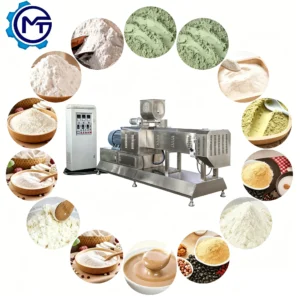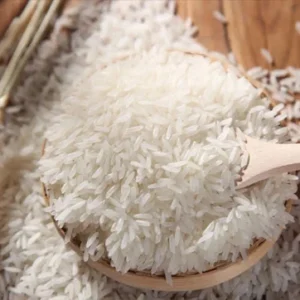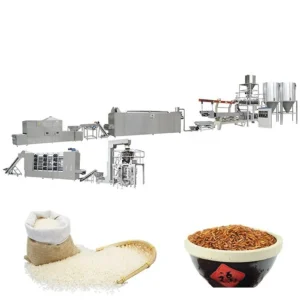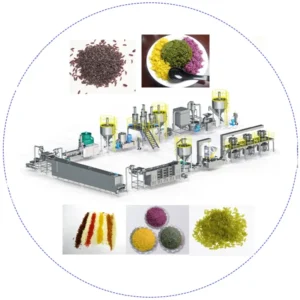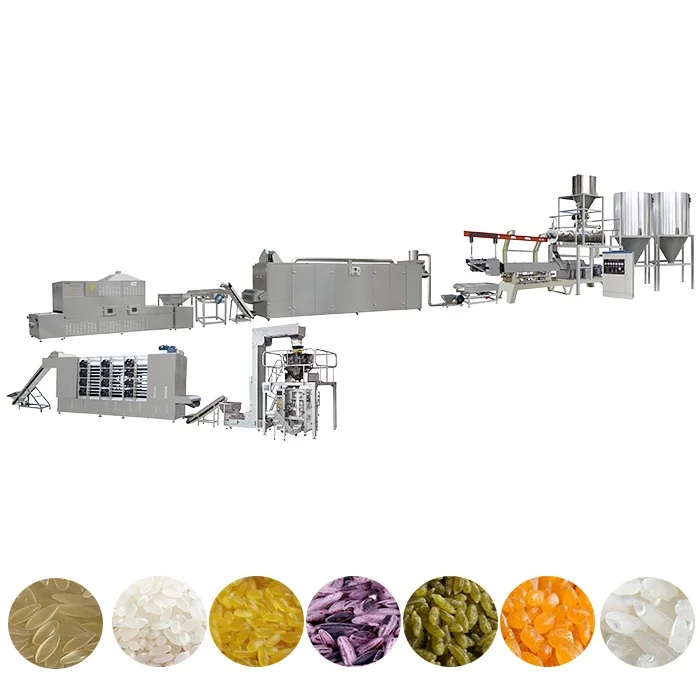


MT65 / MT70 / MT85 Artificial Rice Processing Line, Twin-Screw Extruder, PLC & MCC Control — engineered for fortified and artificial rice production from rice, millet, buckwheat and blended grains.
- Screw configuration and die design matched to your raw material formulation and target rice density
- Complete turnkey line from batching through extrusion, drying, cooling to packing with throughput balanced at every station
- Trial runs on your own grain blend in our testing workshop before shipment
Throughput verification, matched station capacity and on-site commissioning ensure the line performs to specification from day one.
Description
Screw and Die Configured to Your Grain Formulation — every MT65, MT70 or MT85 station is balanced to the same throughput target, and the extruder tooling is cut for your specific blend of rice flour, millet or buckwheat before the line leaves the factory.
Technical Specifications
| Parameter | Value |
|---|---|
| Model | MT65 / MT70 / MT85 |
| Product Type | Artificial Rice Processing Line |
| Screw Configuration | Twin-screw extrusion |
| Installed Power (MT65) | 60 kW |
| Installed Power (MT70) | 85 kW |
| Installed Power (MT85) | 165 kW |
| Output Capacity (MT65) | 70–100 kg/h (basis not stated in source — confirm raw material formulation and moisture content) |
| Output Capacity (MT70) | 100–120 kg/h (basis not stated in source — confirm raw material formulation and moisture content) |
| Output Capacity (MT85) | 200–300 kg/h (basis not stated in source — confirm raw material formulation and moisture content) |
| Line Footprint (MT65) | 28,000 × 1,200 × 2,200 mm |
| Line Footprint (MT70) | 30,000 × 1,500 × 2,200 mm |
| Line Footprint (MT85) | 34,000 × 3,500 × 4,300 mm |
| Mixer Motor / Batch Size | 4.0 kW / 3.0–4.0 kg per batch (basis to be confirmed) |
| Screw Conveyor | 1.1 kW, throughput variable up to 150 kg/h (basis to be confirmed) |
| Control System | Automated PLC and MCC |
| Die Arrangement | Interchangeable moulds for multiple rice kernel shapes |
| Certification | CE |
Application Suitability
| Application | Material or Output |
|---|---|
| Fortified white rice production | Rice flour blended with vitamins and mineral premix |
| Multigrain artificial rice | Millet, buckwheat, black rice and purple potato flour blends |
| Golden rice extrusion | Rice grits enriched with beta-carotene and protein isolates |
| Nutrition programme supply | High-volume runs of iron- and folic-acid-enriched kernels for institutional distribution |
| Instant breakfast rice | Pre-gelatinised kernels designed for rapid rehydration in hot water |
Why the Rated Capacity of an Artificial Rice Processing Line Turnkey Often Fails on Arrival
A capacity number quoted on standard rice flour rarely holds when your formulation includes buckwheat, millet or added protein isolates.
Buyers in Southeast Asia and South America have watched lines stall because the extruder could not maintain barrel pressure on a high-fibre blend, while the downstream dryer was sized for a lighter, pure-starch recipe. The throughput gap between stations compounds across the line, and operators end up throttling the mixer to keep pace with the slowest link. [NEED_CITE: effect of fibre content on twin-screw extrusion throughput]
Barrel Temperature Profile and Starch Gelatinisation
Twin-screw extrusion relies on a precise temperature gradient across the barrel zones to gelatinise starch without scorching the grain matrix. On an artificial rice processing line turnkey installation, the heater bands and cooling jackets must be tuned to the amylose content of the specific flour blend, since buckwheat and millet gelatinise at different points than polished white rice. The PLC logs each zone temperature so operators can replicate the profile across shifts.
Die Pressure, Kernel Density and Rehydration Behaviour
The interchangeable moulds shape the extrudate into rice-like kernels, but the die land length and orifice diameter also control internal density. A shorter die land produces a more open, porous kernel that rehydrates quickly in boiling water, while a longer land yields a denser kernel suited to parboil-style cooking. Matching die geometry to the target market’s preferred cooking method is part of the pre-shipment trial run. [NEED_CITE: die land length and expansion index in food extrusion]
What Mixer Batch Size and Conveyor Speed Mean for Line Continuity
The 4.0 kW mixer handles 3.0–4.0 kg per batch, and the 1.1 kW screw conveyor can feed material at a variable rate. If the batch cycle is too slow for the extruder’s screw speed, the barrel runs partially empty, causing surges in motor load and uneven gelatinisation. Balancing these upstream stations against extruder throughput is calculated during the line layout phase and validated in the testing workshop.
Moisture Content and Expansion Control
Adding water or steam at the mixer changes how the dough behaves inside the barrel. Higher moisture lowers viscosity and reduces shear heating, which can leave the centre of the kernel under-cooked. Lower moisture increases torque and accelerates screw wear. Operators adjust the liquid dosing pump based on trial-run data, and the PLC stores the recipe for repeat orders.
The Hidden Cost of Skipping a Pre-Shipment Trial
When a line ships without running the buyer’s actual flour blend, the first week of production becomes an expensive experiment. Die sets may need re-cutting, barrel zones require re-mapping, and the dryer residence time must be extended or shortened. [NEED_CITE: commissioning delays from unverified raw material trials] These adjustments cost more in lost output and technician travel than a scheduled test run would have added to the lead time.
Why Procure the Whole Line From One Source
Every station — mixer, screw conveyor, extruder, dryer, cooler and packing belt — is specified against the same throughput target, so no single machine bottlenecks the rest. The screw configuration and die geometry are selected for your flour blend and target kernel density rather than copied from a generic build. Trial runs on your raw material take place in the in-house testing workshop before the line is crated. Electrical schematics, voltage and control language are confirmed against your facility’s supply before production begins. Wear parts lists include screw elements, die inserts and barrel liners so the first replacement order can be placed before the originals reach end of life.
Documentation & Verification
- Line layout drawing showing throughput balance across every station
- Screw element and die configuration record matched to your flour blend
- Trial run report produced on your raw material in the testing workshop
- Electrical schematic with voltage, frequency and PLC language confirmed
- CE declaration of conformity and ISO certificate copies
- Operation and maintenance manual with wear parts schedule
Installation, Commissioning & Support
- Floor plan review to confirm the 28–34 m line footprint fits your hall
- Dedicated power circuit sized for the 60–165 kW total installed load
- Mechanical and electrical assembly supervised by an installation engineer
- First-run parameter tuning on your local grain supply and water quality
- Operator training covering PLC recipe storage, screw change and die cleaning
- Wear parts kit shipped with the line for the first scheduled replacement
Preparing Your Inquiry
Share the exact flour blend, target kernel size and daily output requirement so the line can be sized correctly. Provide your facility’s voltage, frequency and preferred PLC language to avoid rewiring or re-programming on site. Confirm available floor length and ceiling height so the layout drawing reflects your building constraints.
Frequently Asked Questions
Q: How is the line capacity verified against my specific grain formulation and moisture level?
A: Before shipment, we run a trial in the testing workshop using your actual flour blend at the moisture content you specify. The test records throughput, barrel temperatures, die pressure and kernel density, and those figures become the baseline for the PLC recipe and the capacity guarantee.
Q: How do you match throughput between extruder, dryer, cooler and packing stations?
A: Each station is selected during the layout phase so its rated handling rate equals or slightly exceeds the extruder’s verified output on your recipe. Conveyor speeds and belt widths are then set to maintain a steady flow without material backlog or starvation.
Q: What is included in the turnkey installation and commissioning schedule?
A: The schedule covers mechanical assembly, electrical termination, utility hook-up checks, first-run trials on your raw material, PLC parameter fine-tuning and operator training. A written handover report documents all confirmed settings and any remaining punch-list items.
Q: Can screw configuration and die design be adjusted to produce different rice shapes and densities?
A: Yes. The twin-screw extruder accepts interchangeable screw elements and die inserts. During the trial run we test alternative configurations, and the successful setup is recorded so you can switch between long-grain, short-grain or multigrain kernel profiles without guessing.
Q: What documentation and operator training are delivered with the complete line?
A: You receive a layout drawing, screw and die record, trial run report, electrical schematic, CE and ISO certificates, and an operation manual. On-site training covers recipe management on the PLC, routine screw inspection, die changeover and the recommended wear-parts replacement interval.
Related products
-

High Precision Automatic 500kg/h Baby Food Nutrition Powder Rice Extrusion Processing Line
¥9,500.00 Add to cart -

Full Automatic Complete Baby Food Nutrition Powder Porridge Processing Production Line for Infant Nutrition Factory
¥9,500.00 Add to cart -

High Quality Automatic PLC Controlled 500kg/h Twin Screw Extruder Machine for Baby Rice Nutrition Powder
¥8,238.27 Add to cart -
Healthy Baby Food Production Line Nutritional Powder Equipment for Baby Food Supplements for Flour Processing Machinery
¥8,500.00 Select options This product has multiple variants. The options may be chosen on the product page