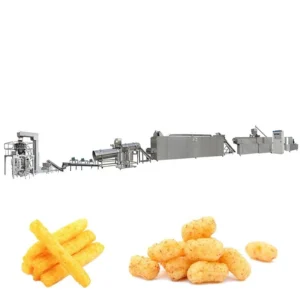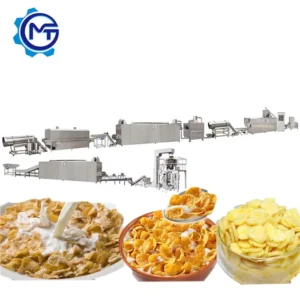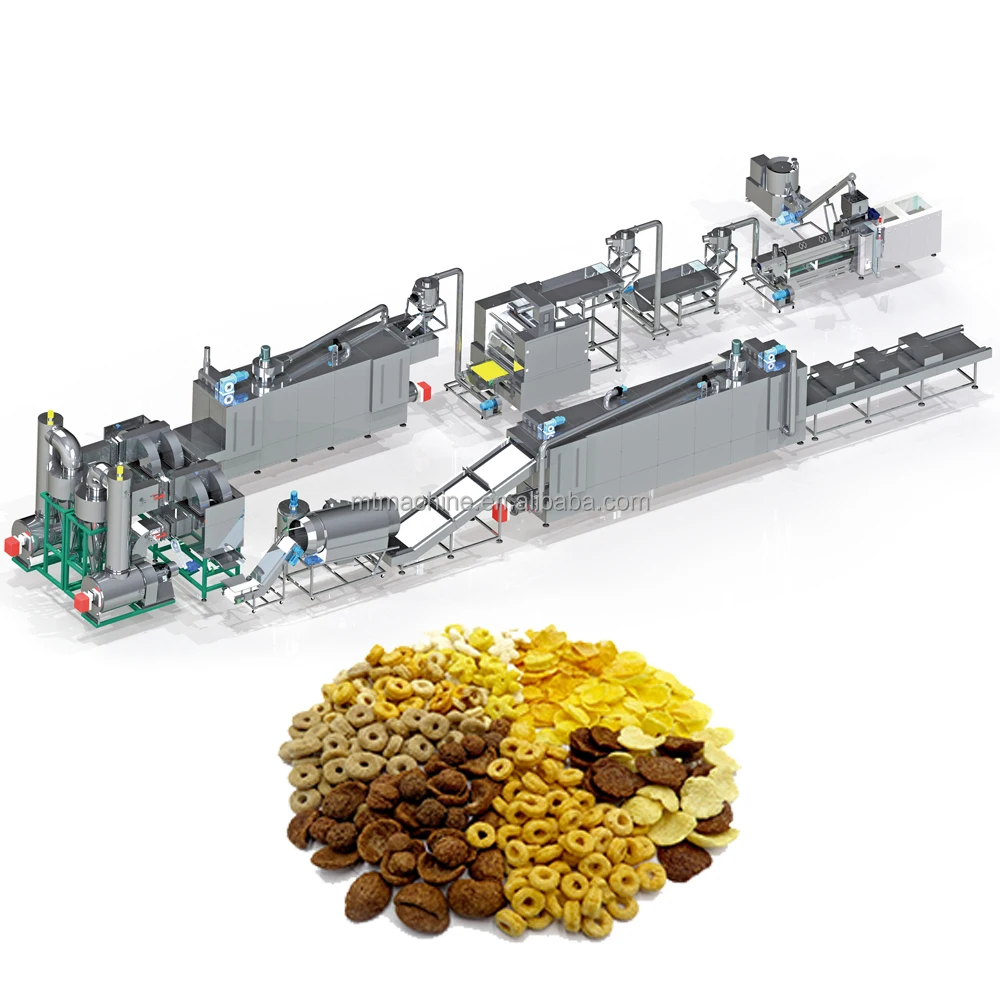
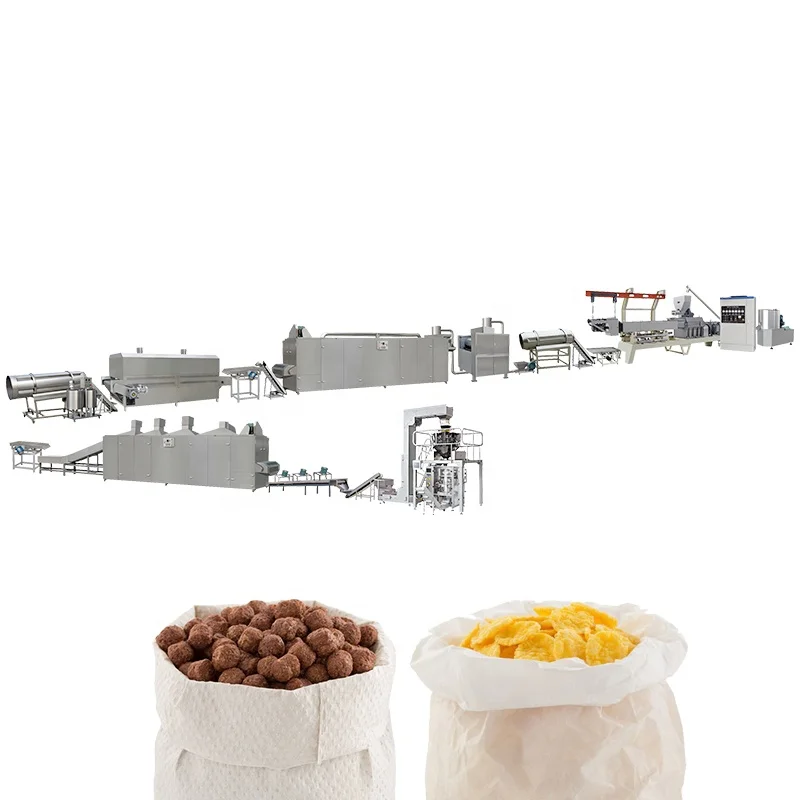

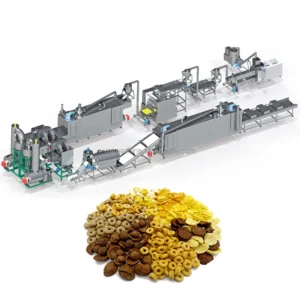
MT75 Corn Flakes Production Line, Twin-Screw Extrusion, PLC Control — turnkey configuration from mixing and flaking through drying, roasting and packing.
- Screw configuration and die design matched to your grain formulation and target flake density
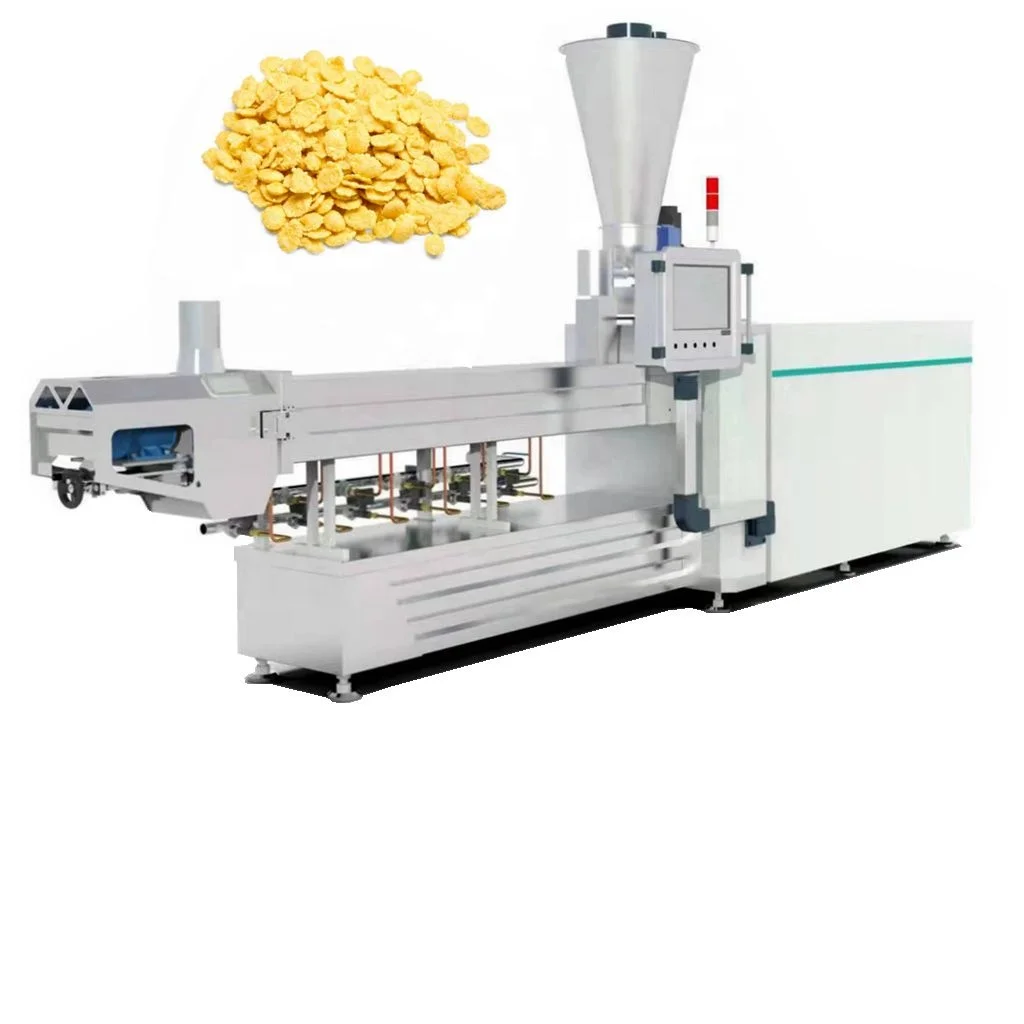
- Hydraulic double-roller flaking with infrared temperature regulation for consistent thickness
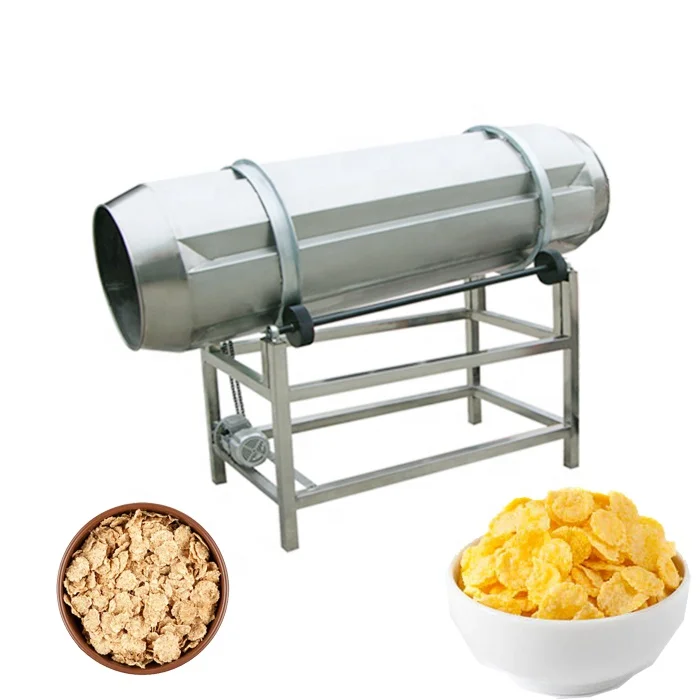
- Hot air roasting oven with dual circulating fans and cyclone dust removal
Capacity ranges across MT70, MT85 and MT75 line variants, with throughput matched at every station. We run trial production on your actual raw material in our testing workshop before shipment.
Description
Complete Turnkey Line Projects — From factory layout planning to phased installation schedules, every breakfast cereal line delivered as a single managed project with matched station throughput.
Technical Specifications
| Parameter | Value |
|---|---|
| Product Type | Corn Flakes Production Line |
| Model | MT75 |
| Line Variants Available | MT70, MT75, MT85 |
| Installed Power (MT75) | 210 kW |
| Power Consumption (MT75) | 150 kW |
| Capacity (MT75) | 300–500 kg/h (basis to be confirmed: raw material, moisture content, product format) |
| Overall Dimensions (MT75) | 45 × 1.5 × 3.5 m |
| Extruder Type | Twin Screw |
| Flaking Machine System | Hydraulic double-roller with separate motor drives and infrared temperature control |
| Dryer Heating Source | Gas or Electric (configurable) |
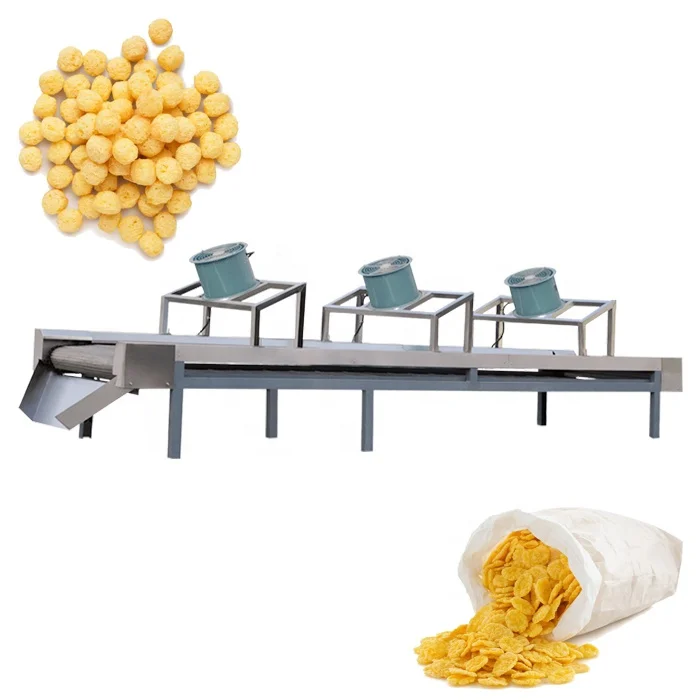
| Roasting Oven Design | Vibrating pan with high-temperature spraying tubes, reconciliation burner, dual circulating fans, cyclone dust removal |
| Coating System | Double tumble sugar melting, elevator, coating drum, spraying nozzle |
| Control System | PLC control with MCC integration available |
| Standards | CE, ISO |
Application Suitability
| Application | Material or Output |
|---|---|
| Natural corn flakes production | Corn grits and corn flour at controlled moisture levels |
| Sugar-coated breakfast cereal | Corn flakes with sugar syrup glazing and secondary drying |
| Multi-grain flake formats | Rice, wheat, oat, and barley powder blends |
| Shaped cereal production | Ball, tube, ring, star, wheel, and heart forms via extruder die adjustment |
Why "500 kg/h" Means Nothing Without Your Raw Material in the Trial Report
Capacity is not a plate on the machine — it is a result of how your specific grain formulation behaves under screw shear and barrel heat.
When a corn flakes production line turnkey is quoted at a nominal figure, the number usually assumes ideal corn grits at a specific moisture content. If your supplier sources coarser meal, or your local grain carries higher ambient humidity, the extruder output drops and the downstream dryer can no longer keep pace. The line stalls at the drying tunnel while the extruder keeps pushing product, and operators start dumping wet flakes to clear the backlog [NEED_CITE: extrusion throughput dependency on raw material moisture and particle size]. I watched a line in Thailand lose an entire shift because the corn flour particle size was coarser than the sample used during the supplier’s bench test — the microwave dryer simply could not evaporate moisture fast enough, and the flakes came out soft. That is why every corn flakes production line turnkey from this workshop runs on the buyer’s actual raw material before it ships.
Screw Geometry and Die Design as Product Variables
The twin-screw extruder at the heart of this corn flakes production line turnkey does more than push dough through a barrel. Screw element sequencing determines residence time, shear intensity, and the degree of starch gelatinisation inside the barrel — all of which govern how the pellet expands when it exits the die. A configuration optimised for pure corn will over-shear a barley-heavy blend, producing fines instead of intact pellets. The die aperture and land length then set pellet density, which directly controls final flake thickness after the hydraulic press. Specifying screw and die to the buyer’s formulation is a project-level decision, not a catalogue pick.
Throughput Matching Across Every Station
A common failure mode in cereal projects is an extruder that outpaces its own dryer. The MT75 line addresses this by sizing the flaking machine, drying tunnel, roasting oven, and coating drum to a single agreed throughput target rather than assembling stations from separate vendor catalogues. The roasting oven uses a vibrating pan with dual circulating fans and a cyclone dust removal device to maintain even heat distribution across the pan surface, preventing the blistering inconsistency that appears when air flow is uneven [NEED_CITE: hot air circulation uniformity in cereal roasting ovens]. The coating drum sits downstream of a dedicated secondary drying stage for sugar-coated variants, so syrup sets before the cooling conveyor.
Reading the Numbers That Actually Matter
Installed power of 210 kW on the MT75 variant tells you the peak draw during start-up and heavy extrusion loads; running consumption at 150 kW reflects steady-state operation once barrel heaters reach setpoint. The line footprint of 45 × 1.5 × 3.5 m means you need clear linear floor space plus service access on both sides — plan your utility trenches and drainage before the foundation pour. The hydraulic flaking press uses infrared sensor temperature control on the rollers, which matters because roller surface temperature affects how the cooked pellet sheets without sticking or tearing. Gas or electric dryer options let you align with local fuel costs and emission regulations rather than accepting a fixed heating source.
The Cost of Skipping the Configuration Record
When screw elements and die specifications are copied from a generic build sheet, the extruder may produce pellets that are too dense for the flaking press to flatten evenly. Downstream, the roasting oven then over-toasts the thick edges while the thin centres burn. Operators compensate by slowing the line, which means the quoted capacity was never real for that product [NEED_CITE: twin-screw extruder screw configuration impact on pellet density]. For sugar-coated lines, a coating drum sized without reference to extruder output will leave flakes tumbling too long or too briefly, giving uneven glaze coverage that the market rejects.
Project Delivery From One Supplier
Layout and throughput calculations are produced before the quotation stage, so every station in the corn flakes production line turnkey is confirmed against your target output. Screw configuration and die design records are written to your specific grain formulation, not pulled from a standard library. An in-house testing workshop runs trial production on your actual raw material, generating a trial report before the line enters fabrication. Voltage, frequency, and control language are confirmed against your facility’s electrical specification during the engineering phase, eliminating commissioning delays. Post-installation support covers operator training, wear parts supply, and ongoing maintenance scheduling.
Documentation & Verification
- Line layout drawing with throughput calculation at each station against your grain specification
- Screw and die configuration record matched to your formulation and target flake density
- Trial run report produced on your raw material in the testing workshop before dispatch
- Electrical schematic with confirmed voltage, frequency, and PLC language for your site
- CE declaration of conformity and ISO certificate for customs and regulatory filing
- Wear parts list identifying screw elements, die inserts, and roller surfaces with replacement intervals
Installation, Commissioning & Support
- Foundation plan accounts for the 45 m line length and 210 kW peak load with dedicated circuit breakers
- Hydraulic flaking press requires levelled mounting pads and hydraulic fluid specification confirmed before fill
- PLC and MCC panels configured to local voltage and frequency, with operator interface in agreed language
- First production run supervised on-site with parameter logging for extruder barrel zones and dryer temperature
- Operator training covers screw element inspection, die cleaning, and roller gap adjustment on the flaking machine
- Spare screw segments, die plates, and spraying nozzles shipped with initial order to cover first maintenance cycle
What to Include With Your Enquiry
Provide your grain formulation — whether pure corn, a multi-grain blend, or a mix with added fibre — along with target moisture content and desired flake density. Confirm your facility voltage, frequency, and preferred control language so the electrical package is specified before production begins. Share your available floor space and ceiling height so the line layout fits without compromising service access around the 3.5 m tall roasting oven section.
Frequently Asked Questions
Q: How is line capacity verified on my specific grain formulation and moisture level?
A: We run your actual raw material through the extruder and downstream stations in our testing workshop before fabrication begins. The trial report documents throughput, flake density, and dryer performance at your specified moisture content, so the capacity figure in your contract reflects your formulation — not a generic benchmark.
Q: What screw and die configuration do you recommend for my target flake density and crispness?
A: Screw element sequencing and die aperture are selected based on your grain blend, target pellet density, and final flake thickness requirement. The configuration record is documented and included in your project file, and adjustments are validated during the in-house trial run before the extruder ships.
Q: How do you ensure the dryer and coater capacity matches the extruder output?
A: Every station — flaking press, drying tunnel, roasting oven, and coating drum — is sized to one agreed throughput target during the layout phase. We do not assemble stations from separate catalogues; the line is calculated as a single system so no downstream unit becomes a bottleneck.
Q: Can you run a trial on my raw material before shipment?
A: Yes. Our testing workshop is equipped for full trial runs using your supplied raw material. You receive a trial run report documenting extruder behaviour, flake quality, and drying performance. This step is standard procedure, not an optional add-on, and it happens before the line enters final assembly.
Q: What voltage, frequency and control language options are confirmed before production?
A: Your local utility specification and preferred PLC interface language are confirmed during the engineering review stage, before fabrication starts. The electrical schematic and MCC panel layout are then built to those confirmed values, avoiding commissioning delays caused by mismatched power supply or untranslated control screens.
Related products
-
Automatic Cornflakes Making Machine Corn Flakes Breakfast Cereals Processing Production Line
¥500.00 Select options This product has multiple variants. The options may be chosen on the product page -

Corn Flakes Production Line Breakfast Cereal Production Machine Line Corn Flake Making Machinery
¥59,800.00 Select options This product has multiple variants. The options may be chosen on the product page -
Stainless Steel Honey Small Corn Flake Breakfast Cereal Flakes Maker Making Machine Production Plant
¥30,000.00 Add to cart -

Small Scale Breakfast Cereal Manufacturing Machine for Corn Flakes Process Line
¥45,000.00 Select options This product has multiple variants. The options may be chosen on the product page