

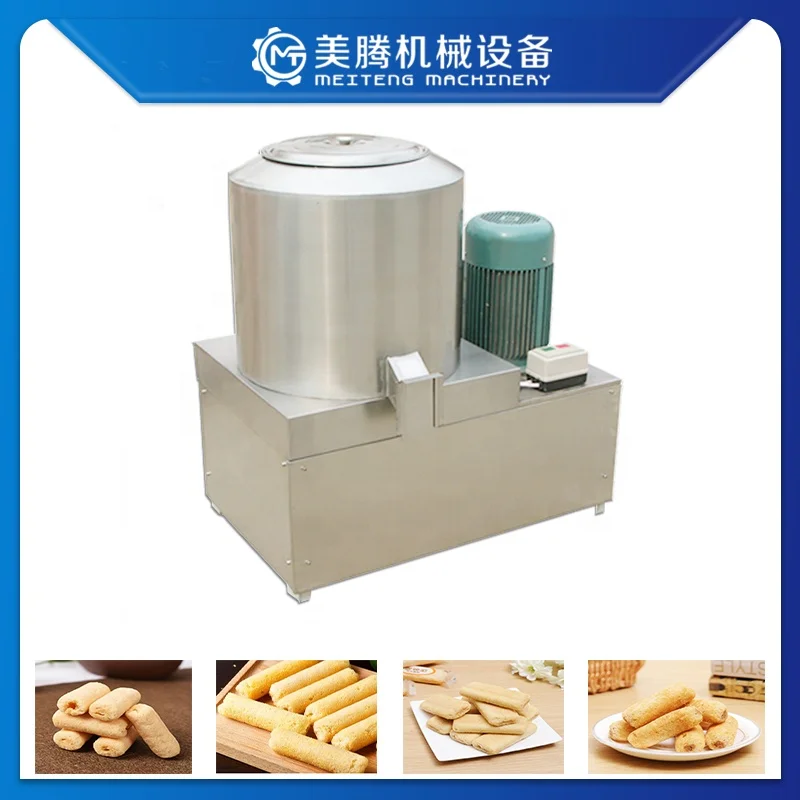
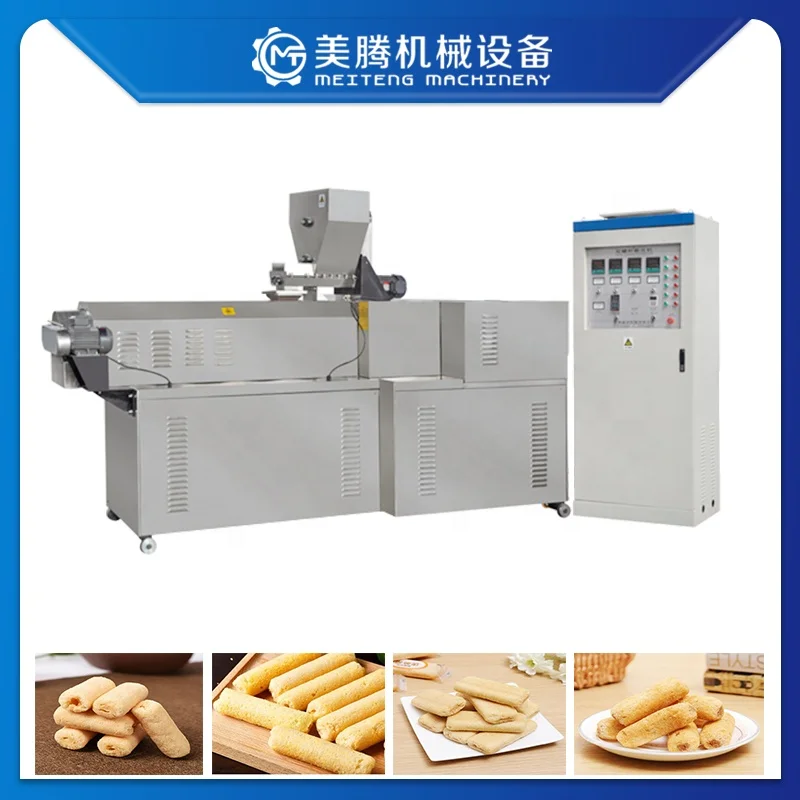
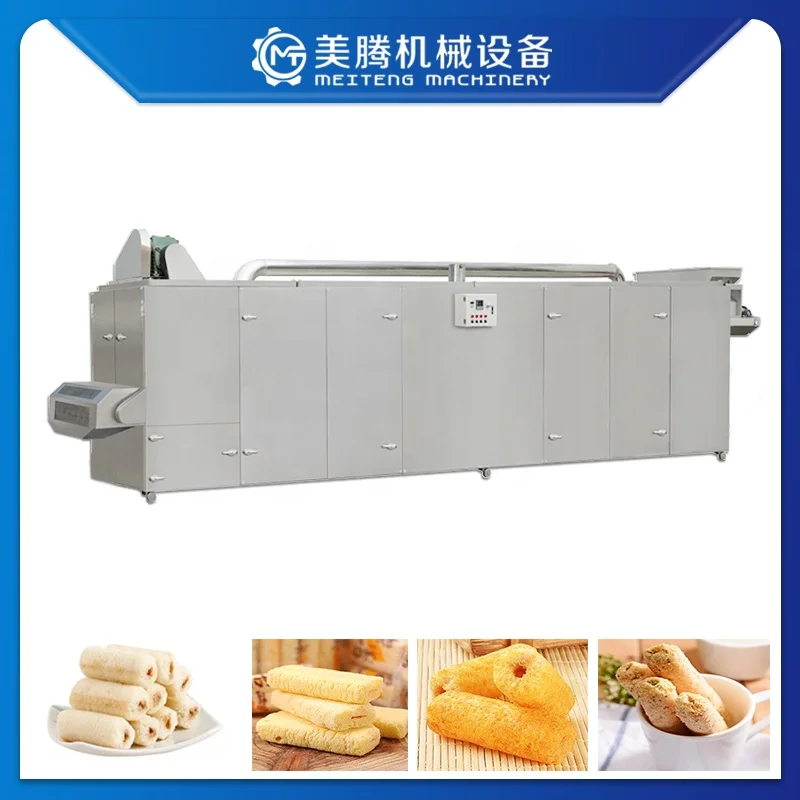
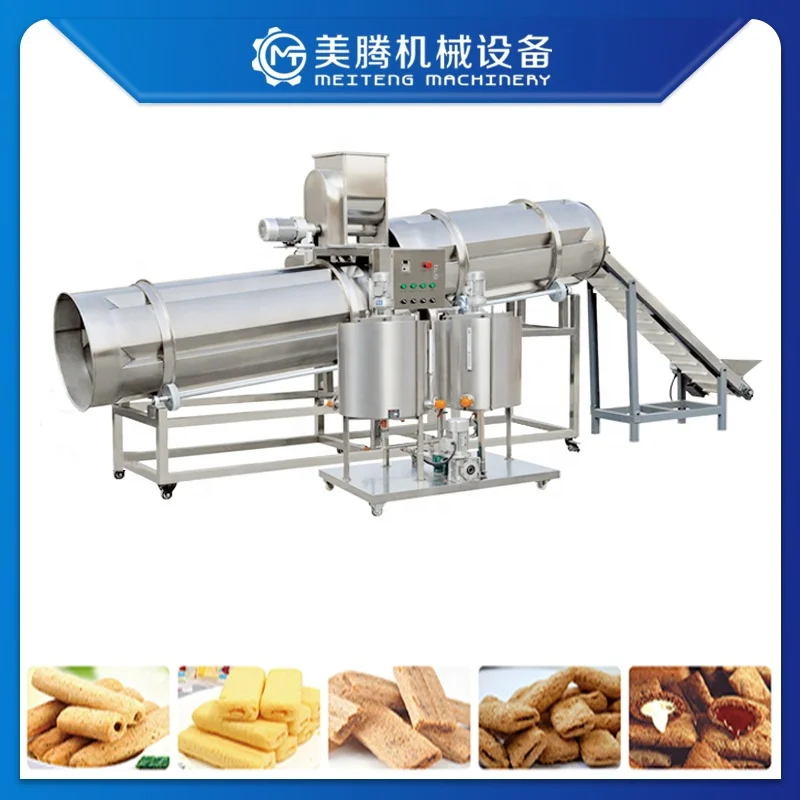
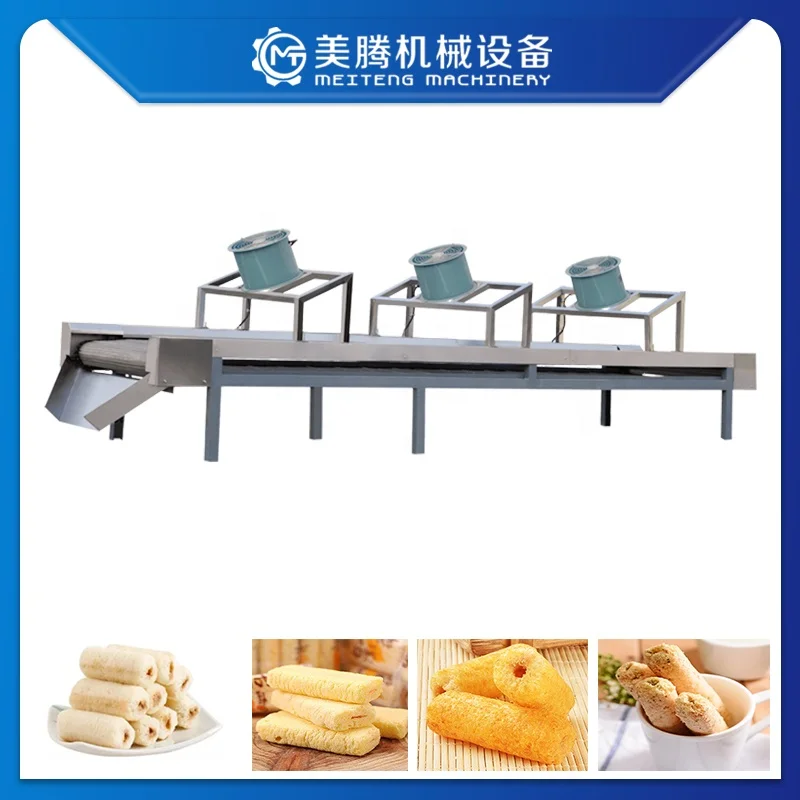
Puffed Snack Extrusion Line, Twin-Screw, Food-Grade SS 201/304 — configured for popcorn-style and cereal puffed snacks across rice, millet, brown rice and buckwheat raw materials. Energy source selectable among electricity, gas, diesel or steam to match plant utilities; screw and die setup matched to your material behaviour and target density. Trial runs completed in our testing workshop before shipment to validate real output on your raw material.
- Complete line from batching through drying, flavoring and packing under one supplier
- Line layout and capacity calculation provided with electrical schematic and voltage confirmation
- CE and ISO certified for international snack food projects
Description
Integrated Line Throughput — Every station from mixer to packing is engineered as a single project, so extruder output never outpaces dryer or flavoring capacity.
Technical Specifications
| Parameter | Value |
|---|---|
| Product Type | Puffed Snack Extrusion Line |
| Extruder Type | Twin-screw (double screw) extruder |
| Contact Material | Food-grade stainless steel 201 / 304 |
| Energy Source Options | Electricity / gas / diesel / steam |
| Rated Power (Electric Heating) | Approximately 100 kW |
| Rated Power (Gas / Diesel Heating) | Approximately 50–60 kW |
| Voltage & Frequency | Three-phase 380V/50Hz, Single-phase 220V/50Hz (customizable) |
| Motor | Siemens (China) or equivalent top-tier domestic brand |
| Inverter | Delixi or Delta |
| Flavoring System | Semi-automatic or automatic; supports sugar, oil, powder seasoning |
| Dryer Configuration | Multi-layer / multi-length, configurable to product type |
| Line Sequence | Mixer → Extruder → Vibrate Cooler → Roasting Machine → Packing Machine |
| Control System | Basis to be confirmed (PLC / MCC / manual options) |
| Output Capacity | Basis to be confirmed (depends on raw material, moisture, product format) |
| Certification | CE, ISO |
Application Suitability
| Application | Material or Output |
|---|---|
| Popcorn-style puffed cereal snacks | Rice, millet, brown rice, buckwheat |
| Fortified extruded snack products | Cereal blends with added vitamins, proteins, minerals |
| Seasoned and coated snack formats | Sugar-glazed, oil-sprayed, powder-dusted finishes |
| Turnkey snack line projects | Complete production from batching through packing |
What "Nominal Capacity" Leaves Out on a Puffed Snack Extrusion Production Line Turnkey
Real throughput is only meaningful when tied to your specific raw material and moisture content.
I remember a snack manufacturer in eastern China who signed for a puffed snack extrusion production line turnkey based on a quoted capacity figure. When their corn flour arrived at the workshop with moisture content higher than the standard test baseline, actual output dropped noticeably. The extruder ran fine mechanically, but the material behavior inside the barrel changed — expansion was inconsistent, and the line could not sustain the expected rhythm. That is why verifying output against your actual grain batch, not a generic benchmark, should always precede any commitment [NEED_CITE: raw material moisture impact on twin-screw extrusion throughput].
Screw and Die Configuration Matched to Your Grain Blend
The twin-screw extruder at the heart of this puffed snack extrusion production line turnkey is configured after reviewing your raw material profile. Rice flour behaves differently from buckwheat or millet under shear and heat — starch gelatinization temperature, viscosity curve, and expansion ratio all shift. Screw element arrangement and die aperture are selected to match those characteristics, not copied from a generic template.
Dryer and Flavoring Throughput Aligned to Extruder Rhythm
A common bottleneck on snack lines appears when the extruder pushes product faster than the dryer can reduce moisture to the target level. On this puffed snack extrusion production line turnkey, dryer length and layer count are calculated against the extruder’s verified output, and the flavoring drum diameter is sized so residence time allows even coating coverage. Every station keeps pace because one supplier engineers the entire sequence [NEED_CITE: throughput matching methodology across extrusion line stations].
Energy Source Flexibility for Different Factory Utilities
Not every snack factory has the same utility infrastructure. This line supports electric, gas, diesel, or steam heating, so the roasting and drying stages can be configured around whatever energy source is available or cost-effective at the installation site. The rated power draw shifts accordingly — roughly 100 kW on full electric heating versus 50–60 kW when gas or diesel furnaces handle the thermal load.
Barrel Zones, Moisture, and Expansion Control
Twin-screw extrusion of puffed cereals depends on precise moisture conditioning and barrel temperature profiling across multiple heating zones. Too little moisture and the starch does not gelatinize fully, producing hard, dense pieces; too much and expansion collapses after the die. The L:D ratio and screw speed work together to control residence time, determining how completely the grain matrix transforms before it exits the die. Getting this balance right is what separates a crisp, uniform puff from an inconsistent batch that breaks apart during coating [NEED_CITE: starch gelatinization and expansion mechanics in twin-screw food extrusion].
The Cost of Skipping a Trial Run Before Shipment
When a line ships without a trial run on the buyer’s actual grain blend, the first production test happens on the factory floor — with installation crews still on site and market launch dates pressing. Density targets may be missed, seasoning adhesion may fail, or the dryer may prove undersized. Resolving these issues after installation costs far more in downtime and re-engineering than a pre-shipment test in a dedicated workshop ever would [NEED_CITE: post-installation line modification costs versus factory trial runs].
Why Source This Puffed Snack Extrusion Production Line Turnkey Here
Every station — mixer, extruder, cooler, roaster, flavoring drum, packing — is designed and supplied by one team, eliminating the finger-pointing that happens when separate vendors blame each other for throughput mismatches. Screw configuration and die geometry are specified after testing your raw material in an in-house workshop, not pulled from a catalog default. Pre-sales consultation covers line layout and utility planning, and on-site commissioning includes operator training so your crew understands parameter adjustments from day one. Documentation travels with the machine: electrical schematics, configuration records, and wear parts lists are all prepared before dispatch.
Documentation & Verification
- Line layout drawing with capacity calculation for your target snack format
- Screw and die configuration record matched to your grain blend
- Electrical schematic with voltage and frequency confirmation for your market
- Factory trial run report on your raw material before shipment
- CE declaration of conformity and ISO certificate
- Wear parts list covering screws, dies, and seals
Installation, Commissioning & Support
- Floor plan and utility connection points mapped to the ~100 kW electric or ~60 kW gas-heated configuration
- Three-phase 380V/50Hz supply verified; alternative voltage documented before production begins
- Extruder barrel and screw assembly inspected on site after transit
- First production run supervised with parameter logging for your grain moisture and target density
- Operator training covering screw speed, barrel temperature zones, and die changeover
- Spare screw elements and die plates stocked against the initial wear parts list
Before You Request a Quote
To prepare a line configuration that reflects your actual production conditions, share your primary grain types and their typical moisture range, the snack format you want to produce, and the daily output target. Confirm your factory’s available voltage and frequency, and whether gas, steam, or electric heating suits your utility setup. If you have existing upstream or downstream equipment that must integrate, include those details as well.
Frequently Asked Questions
Q: How is actual line capacity verified before I commit?
A: We run your raw material through the twin-screw extruder in our in-house testing workshop. The trial uses your grain blend at its typical moisture content, and the resulting output rate, expansion ratio, and product density are recorded in a trial run report shared before you sign.
Q: How do you confirm voltage and control language for my market?
A: During the specification phase, we collect your local voltage, frequency, and preferred control panel language. An electrical schematic and voltage confirmation record are prepared and reviewed with your team before production starts, avoiding commissioning delays on site.
Q: Can the screw and die be adjusted if I change my grain recipe later?
A: Yes. The twin-screw configuration uses modular screw elements and interchangeable dies. If you introduce a new grain blend or target a different snack texture, we can re-specify the screw arrangement and die geometry, then validate it with another trial run.
Q: How do you prevent the dryer or flavoring drum from bottlenecking the extruder?
A: Dryer length, layer count, and flavoring drum diameter are all calculated against the extruder’s verified output on your material. Because one supplier engineers every station, throughput is matched across the entire sequence rather than assembled from independent quotes.
Related products
-

Puffed Snack Food Machine Snack Food Machine Puffed Snack Machine
¥11,050.00 Select options This product has multiple variants. The options may be chosen on the product page -

Crunchy Puffed Snack Breakfast Cereal Corn Flakes Making Machine
¥1,000.00 Select options This product has multiple variants. The options may be chosen on the product page -

New Puffed Snack Food Machine Production Line Corn Flake Puff Corn Making Machine Twin Screw Extruder 100-500kg/h Capacity Food
¥8,500.00 Select options This product has multiple variants. The options may be chosen on the product page -

Twin Screw Corn Puffs Extruder Machine Small Corn Snack Food Extruder Machine
¥100.00 Select options This product has multiple variants. The options may be chosen on the product page


